Whole Life Insurance vs Term: Which One Fits Your Family?


The Short Version
Whether you frame it as whole life insurance vs term or term vs whole life, the question really comes down to two things: how long you need coverage and what you want it to do. Term gives you the most protection for the least money during your working years. Whole life costs much more but lasts forever and builds cash value. Both can be right. It depends on your family, your budget, and your goals.
If you have spent ten minutes researching life insurance, you have run into the term vs whole life insurance debate. One camp swears term is the only smart buy. The other side swears whole life is the secret rich people use. Both camps are usually selling you something.
Let me give you the plain-English version instead. No hype, no scare tactics. Just what each one is, what it really costs, how the cash value piece actually works, and how to tell which fits the people who count on you. By the end you should be able to answer the question for your own family without needing anyone to talk you into a product.
What this guide covers
- What term life insurance is
- What whole life insurance is
- Term vs whole life at a glance
- The cost difference, explained
- How cash value actually works
- Pros and cons, side by side
- Who term life fits
- Who whole life fits
- The buy term and invest the difference debate
- What about universal and indexed policies?
- Can you convert term to whole life later?
- How much coverage do you need?
- How to decide: three plain questions
- Common mistakes to avoid
- Frequently asked questions
What term life insurance is
Term life is the simple one. You pick a length of coverage, usually 10, 20, or 30 years, and you pay a level monthly premium for that whole stretch. If you pass away during the term, your family gets the full death benefit, tax free in most cases. If you outlive the term, the coverage ends and you walk away. No cash value, no payout. That is why term is sometimes called pure life insurance: every dollar is buying protection and nothing else.
That sounds like a downside until you see the price. Term is cheap precisely because the insurer expects most people to outlive it. You are renting a big safety net for the exact years your family needs it most: while the kids are home, while the mortgage is fat, while your income is the engine that keeps the house running. If covering the house is your main reason for buying, it is worth seeing how a term policy stacks up against a dedicated product in our look at mortgage protection vs term life and which protects the house better.
A few features worth knowing before we go further, because they come up in almost every conversation I have:
- Level premium. The price is locked for the whole term. A 30-year term bought today costs the same in year 29 as it does in year one, even though you are older and statistically riskier by then.
- Renewable, but expensively. Most term policies let you keep the coverage past the term on a year-to-year basis, but the price jumps sharply each year. That is a backstop, not a plan.
- Convertible. Many term policies include the right to convert to a permanent policy later without a new medical exam. We will come back to this, because it quietly solves a lot of the term-versus-whole tension.
Level coverage locked for 10 to 30 years. About 2 minutes.
What whole life insurance is
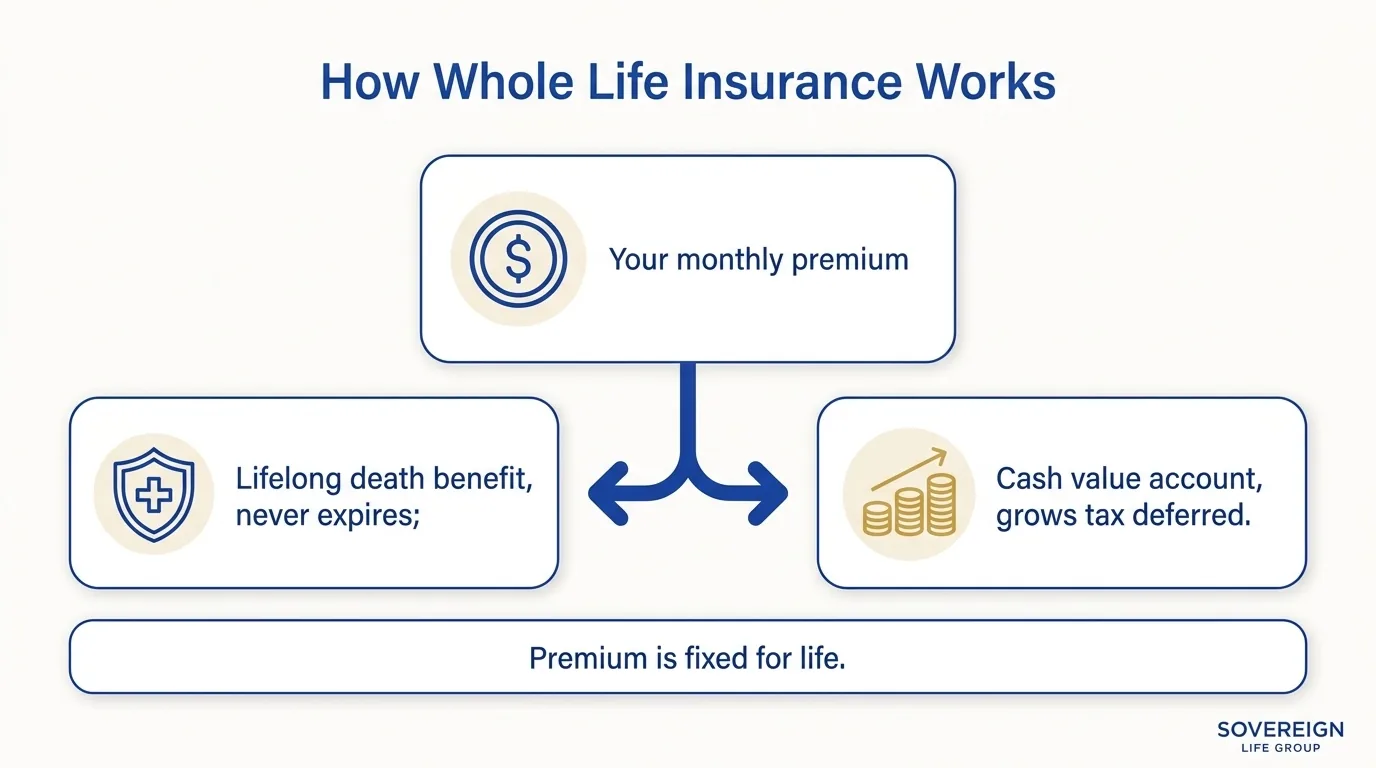
Whole life is permanent. As long as you pay the premium, the policy never expires and the death benefit is guaranteed to pay out eventually. On top of that, part of every premium goes into a cash value account that grows over time at a rate the insurer sets. You can borrow against that cash value later or use it while you are alive.
So whole life is doing two jobs at once: protecting your family and slowly building a pot of money inside the policy. That is why it costs more. You are not just renting protection, you are buying a lifelong guarantee plus a savings engine bolted to it. With some mutual insurers, a whole life policy can also earn dividends, though dividends are never guaranteed and depend on the company's performance in a given year.
The defining traits of whole life are the mirror image of term:
- It never expires. There is no term to outlive. The coverage is designed to be there whenever you pass, whether that is at 60 or 100.
- The premium is fixed for life. It is higher than term from day one, but it does not climb as you age.
- It builds guaranteed cash value. The guaranteed portion grows on a set schedule. Any growth above that, including dividends, is a projection rather than a promise.
Whole life insurance vs term, at a glance
Before we go deep on any one piece, here is the whole comparison on a single screen. Skim it, then read the sections below for the parts that matter to your situation.
| Feature | Term life | Whole life |
|---|---|---|
| How long it lasts | A set term, usually 10 to 30 years | Your entire life, as long as premiums are paid |
| Relative cost | Lowest cost per dollar of death benefit | Often many times more for the same benefit |
| Builds cash value? | No | Yes, on a guaranteed schedule, slowly at first |
| Premium over time | Level for the term, then rises sharply if renewed | Fixed for life |
| Death benefit | Pays only if you pass during the term | Designed to pay whenever you pass |
| Best at | Income replacement, mortgage, raising kids | Lifelong needs, final expenses, legacy, estate goals |
| Main trade-off | Coverage ends when the term does | Higher cost and slow early cash value growth |
| Who it often fits | Young families on a budget | People wanting permanence plus a savings piece |
The cost difference is bigger than most people think
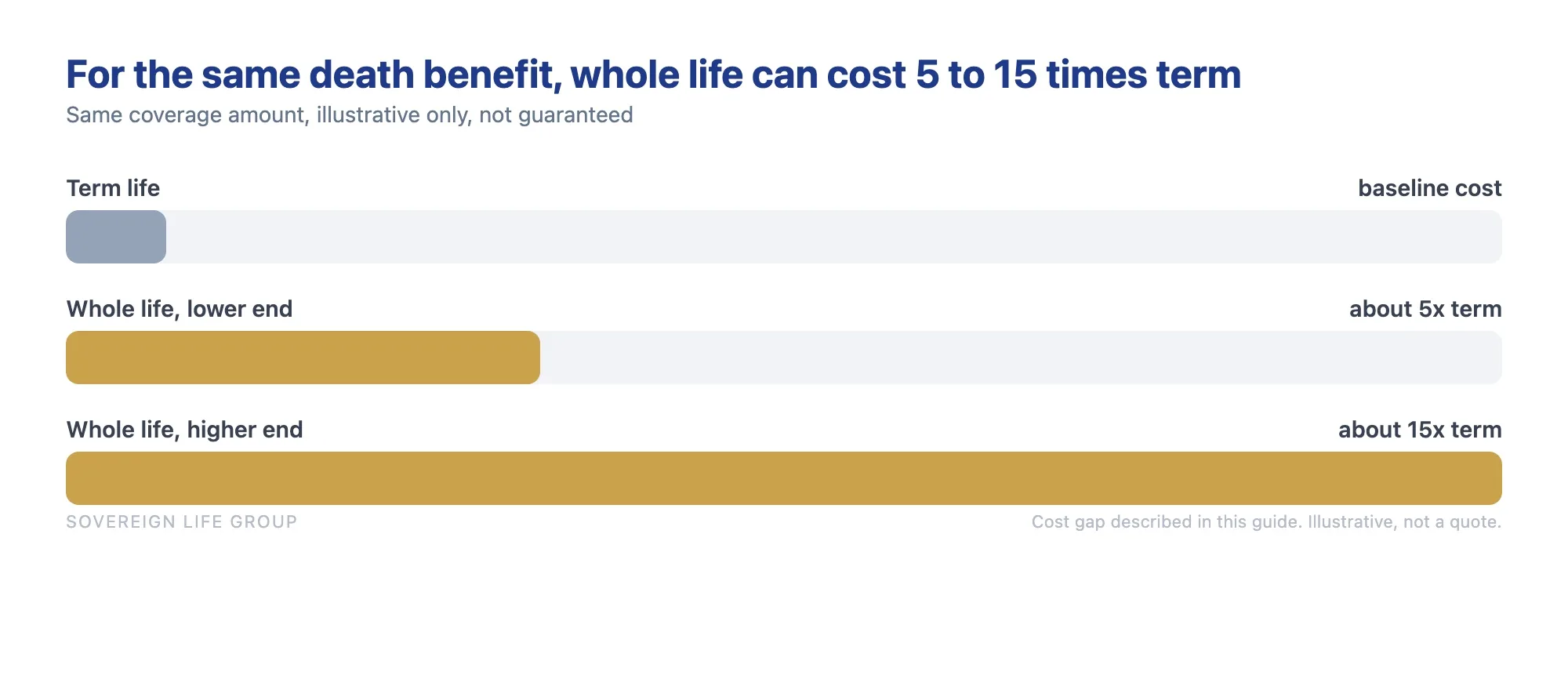
This is where the term vs whole life insurance conversation gets real. For the same death benefit, whole life typically runs many times the price of term. As the Insurance Information Institute notes, permanent coverage carries higher premiums because part of each payment funds cash value, and for younger, healthy buyers the gap can be especially wide.
To put rough shape on it: a healthy 40 year old buying a large term policy might pay somewhere in the range of a streaming bill or two each month. The same death benefit in whole life can run several hundred dollars a month. I am not quoting you a rate here, because yours depends on your age, health, coverage amount, and carrier, but the shape of the gap holds true almost every time. Either type gets pricier the longer you wait, so it helps to understand the best age to buy life insurance before you start shopping.
That difference is the whole ballgame, and seeing the average cost of life insurance by policy type in plain monthly numbers makes it concrete. The money you save with term is money you could put toward retirement, debt, or a bigger death benefit. The money you spend on whole life buys you permanence and a cash value account. Neither is wasted. They just do different things, and the right call depends on which job you actually need done.
Why the gap is so wide
It helps to see exactly where the extra money goes. With term, the insurer is pricing a bet that you will probably outlive the policy, so the premium only has to cover the slim chance of a claim during a limited window, plus a little overhead. With whole life, three things drive the price up at once. The policy is guaranteed to pay eventually, so a claim is a near certainty rather than a possibility. It funds a cash value account, so part of every premium is being set aside rather than spent on pure insurance. And it locks a level premium across a much longer life span, which the insurer has to price conservatively. Stack those together and you get a premium that can be five to fifteen times the cost of comparable term coverage, depending on age and design.
How cash value actually works
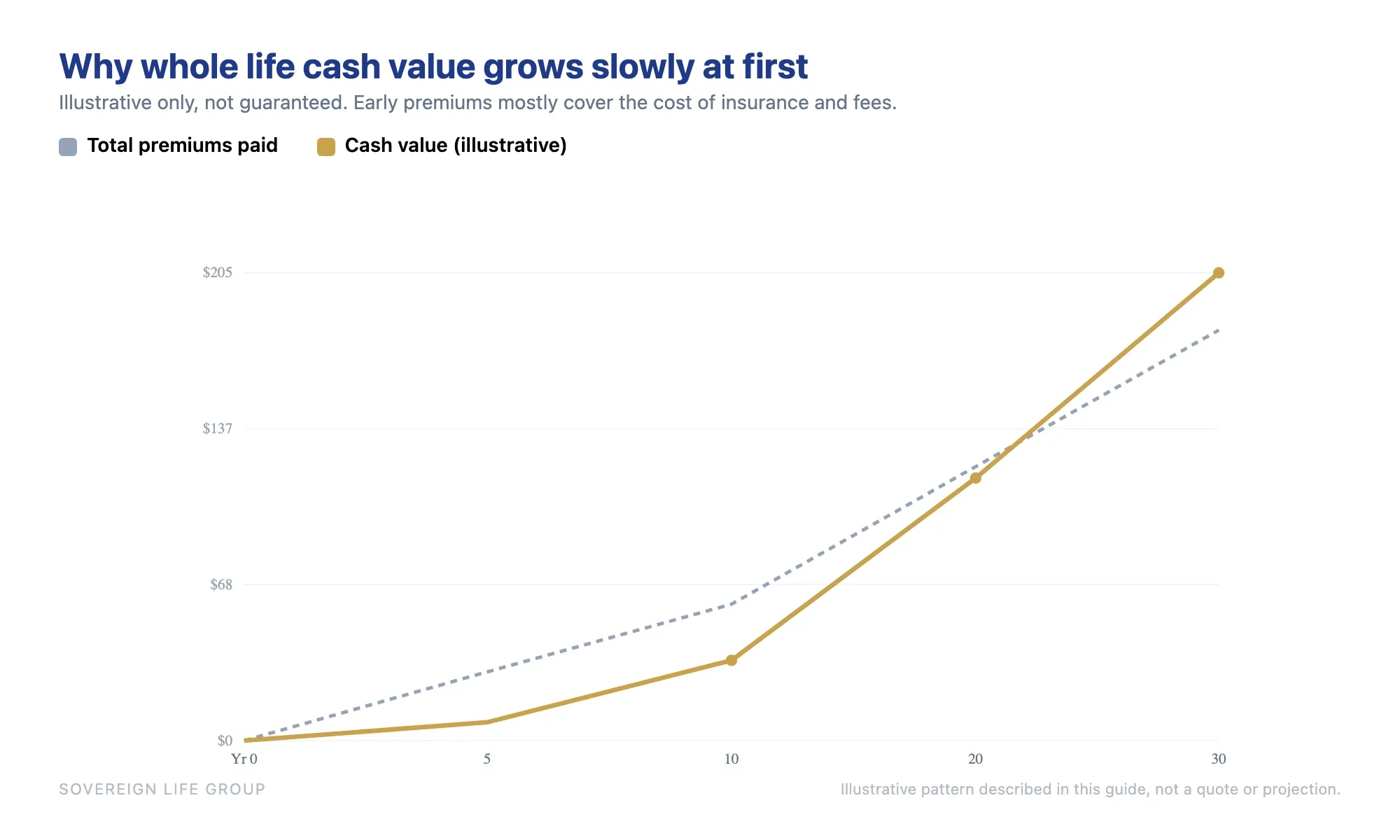
Cash value is the piece that confuses people, so let me keep it plain, and if you want the deeper version, my guide to how cash value life insurance works walks through every policy type that builds it. A slice of each whole life premium goes into an account inside your policy. It grows tax deferred at a rate the insurer guarantees, and with some mutual companies it can earn dividends on top, though dividends are not guaranteed.
Here is the honest part nobody likes to say out loud: cash value grows slowly in the early years. Most of your first few years of premium go toward the cost of insurance and the policy's fees, not the account. It commonly takes several years before the cash value really starts to build, and longer still before it catches up to what you have paid in. That is not a scam, it is just how the math front-loads the insurance cost. But you should know it going in, because some people are surprised to learn their cash value is small in year three.
What you can do with cash value
Once it builds, the cash value gives you some genuine options:
- Borrow against it. You can take a policy loan, often without a credit check, and use the money for whatever you need. The loan accrues interest, and any unpaid balance reduces the death benefit if you pass before repaying it.
- Use it to pay premiums. Later in life, accumulated cash value can sometimes cover the premium, easing the cost when income drops.
- Surrender for cash. You can cancel the policy and take the surrender value, though you give up the coverage and there can be tax consequences on gains.
The guaranteed portion of cash value is solid and contractual. Any figures above that, including projected dividends or non-guaranteed growth, are illustrations, not promises. When someone shows you a glossy chart of future cash value, ask which column is guaranteed and which is projected. The difference matters.
Pros and cons, side by side
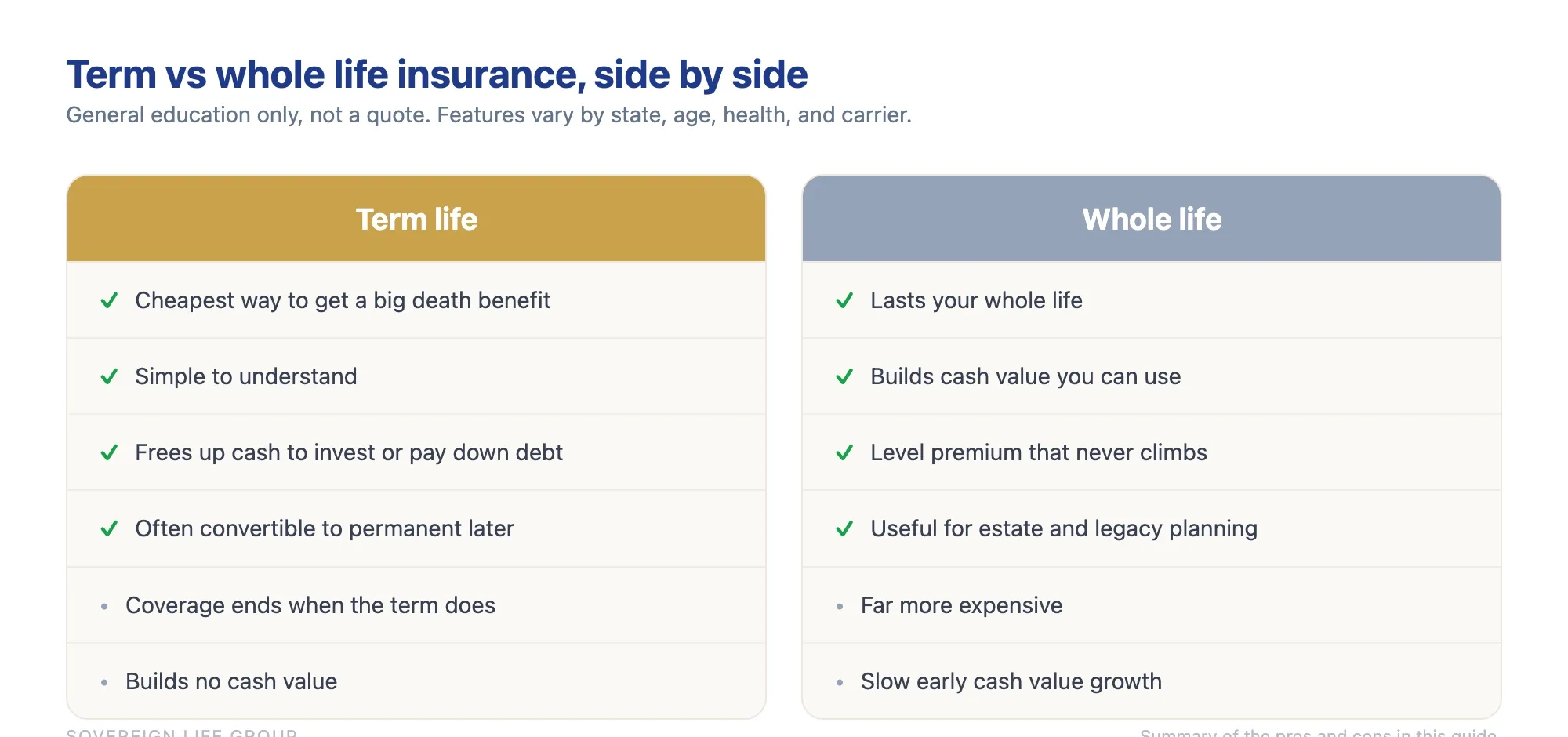
Term life
- Pros: cheapest way to get a big death benefit, simple to understand, frees up cash to invest or pay down debt, and often convertible to permanent coverage later.
- Cons: coverage ends when the term does, no cash value, and buying new coverage later costs more as you age.
Whole life
- Pros: lasts your whole life, builds cash value you can use, level premium that never climbs, and useful for estate and legacy planning.
- Cons: far more expensive, slow early cash value growth, less flexibility, and more complexity than most young families need.
If you read those two lists and feel pulled toward both, you are not confused, you are paying attention. Most families have one need that is temporary and one that is permanent. That is exactly why so many people end up with a blend rather than a pure choice, which we will get to.
Who term life insurance fits
- Young families raising kids on a budget who need a lot of coverage right now, the very situation our guide to life insurance for parents walks through.
- Anyone covering a temporary need: a mortgage, the years until the kids are grown, or a business loan, which a company often insures with key man insurance on the person who carries the business. Speaking of which, here is how mortgage protection fits in. And if you own that company, it is worth deciding whether your business actually needs key man insurance in the first place.
- People who plan to invest the money they save and have the discipline to actually do it month after month.
- Anyone who wants the largest possible death benefit for the smallest possible premium during a specific window of high responsibility.
The common thread is a need with a finish line. If you can point to the year your family stops depending on your income, term is usually the most honest, affordable way to cover the years in between.
The younger and healthier you are, the lower it locks in.
Who whole life insurance fits
- Folks who want coverage that never expires, no matter how long they live.
- People who have already maxed out other tax-advantaged accounts and want another place for money to grow on a tax-deferred basis.
- Families focused on leaving a guaranteed legacy or covering final expenses for certain, so no one inherits a funeral bill.
- Parents or grandparents who want a small policy on a child to lock in insurability early at a low rate.
- People with estate-planning needs, such as creating liquidity to cover taxes or to equalize an inheritance among heirs.
The common thread here is a need with no finish line. Some obligations and goals do not end when the kids move out or the mortgage is paid. Final expenses, a lifelong dependent, or an estate goal can call for coverage that is designed to still be there decades from now.
The buy term and invest the difference debate, handled fairly
You have probably heard the line: buy cheap term, then invest the money you save instead of overpaying for whole life. On paper it is strong. If you take the monthly difference and put it in a diversified portfolio for thirty years, the math can leave you with far more than a whole life policy's cash value would have built over the same period.
But the math only works if you actually do it. The honest catch is that most people do not invest the difference. They spend it. And term coverage tends to end right around the age when buying new insurance gets expensive or impossible because your health has changed. So the plan that looks bulletproof on a spreadsheet can quietly fall apart in real life.
There are also a few things the simple version of the argument glosses over. Whole life cash value grows without market risk, which a stock portfolio cannot promise. The guaranteed portion does not have a down year. And the death benefit of permanent insurance is there at age 90, when a term policy bought at 35 is long gone. None of that makes whole life the winner. It just means the comparison is not as lopsided as the bumper-sticker version suggests.
My take: buy term and invest the difference is a great plan for a disciplined saver who will not blink during a market dip and who genuinely automates the investing. For someone who wants a guarantee they do not have to manage, whole life or another permanent policy may fit better. There is no villain here. There is only the question of which one matches how you actually live.
What about universal and indexed life insurance?
Term and whole life are the two ends of the spectrum, but they are not the only options, and leaving the rest out would make this guide less than honest. Permanent insurance comes in a few flavors, and the differences matter.
- Universal life (UL) is permanent coverage with more flexibility than whole life. You can often adjust the premium and death benefit within limits, and the cash value grows at a declared interest rate. The flexibility is useful, but it also means a poorly funded policy can run into trouble later if the cash value cannot keep up with the cost of insurance.
- Indexed universal life (IUL) ties cash value growth to the performance of a market index, with a floor that limits losses and a cap or participation rate that limits gains. The floor protects you in down years, but the caps, fees, and crediting methods are complex, and the returns are not guaranteed. It can be a fit for the right person, but only if you understand the moving parts. I would not buy one off a single illustration.
- Guaranteed universal life is sometimes used as a middle path: lifelong coverage priced closer to term, with little or no cash value emphasis. It is essentially permanent protection without the savings engine.
The point is that the choice is rarely just term or whole life. If you are weighing the two permanent options against each other, our guide to the honest difference between whole life and universal life breaks it down. If cash value growth is your real interest, an indexed universal life policy may deserve a look, but with eyes open about the fees and the fact that projected growth is not promised. The right tool depends on the job, not on which product has the most exciting brochure.
Can you convert term to whole life later?
This is one of the most useful and least discussed features in life insurance, and it takes a lot of the pressure off the term-versus-whole decision. Many term policies are convertible, meaning you can switch some or all of the coverage to a permanent policy later without taking a new medical exam.
Why does that matter? Because it lets you buy affordable term now, while money is tight and the kids are young, and keep the door open to permanent coverage later, even if your health changes in the meantime. The premium goes up to the permanent rate when you convert, but your insurability is locked in. If you developed a serious health condition during the term, you could still convert without being re-underwritten.
The catch is that conversion rules vary. Some policies allow conversion only before a certain age or within a set number of years, and the menu of permanent products you can convert into is limited to what that carrier offers. So if conversion is part of your plan, read the rider before you assume it will be there in fifteen years. Used well, it is one of the smartest ways to get the best of both worlds without overpaying today.
How much term or whole life insurance do you need?
The amount of coverage matters more than the type, and people get this backwards all the time. A large term policy that actually covers the need beats a small whole life policy that does not, almost every time, during the years a family is most exposed.
A common starting point for sizing the death benefit looks like this:
- Several years of your income, to give your family time to adjust without a financial cliff.
- Plus your outstanding debts, especially the mortgage, so the house is not at risk.
- Plus future costs you want to fund, such as raising children to adulthood or college.
- Minus what you already have saved or covered, including any group coverage through work.
Once you know the number, then you decide how to carry it. Sometimes term is the most affordable way to cover the whole amount. Sometimes a smaller permanent policy handles a lasting need while term covers the temporary one. The figure comes first, the product second. If you want help running your own numbers, the team at our families coverage page walks through exactly this.
How to decide: three plain questions
Skip the camps and ask yourself three plain questions. Your answers point you straight at term, whole life, or a mix of the two.
1. How long do I need this coverage to last?
If you can name the year the need ends, such as when the mortgage is paid or the kids are independent, term matches that window cheaply. If the need has no end date, like final expenses or a lifelong dependent, permanent coverage is built for it.
2. How much can I comfortably pay every month?
Be honest about the number you will not resent a year from now. The right amount of term you keep beats an expensive whole life policy you cancel in two years. A lapsed policy protects no one, and you may have paid mostly fees in those early years.
3. Do I want a savings piece inside the policy, or would I rather invest on my own?
If you are a disciplined investor who will actually invest the difference, term plus your own investing may build more wealth. If you want a guarantee you do not have to manage and a forced-savings element, the cash value in a permanent policy may suit you better.
There is no trophy for picking the fancier product. There is only what keeps your family standing if you are not there. If you would rather talk it through than guess, you can find a real human and not a robot at Sovereign Life Group, your life insurance strategist.
Common mistakes to avoid
After years of these conversations, the same handful of missteps come up again and again. None of them are about being foolish. They are about not having seen the trade-offs laid out plainly, which is the whole point of this guide.
- Buying too little coverage because permanent was the only option shown. If a small whole life policy is all you can afford, but your family needs five times that benefit, you have protected a fraction of the actual need. Size the benefit first.
- Treating whole life as an investment. It is insurance with a savings component, not a substitute for a retirement account. Compare it to other guaranteed options, not to the stock market, and be skeptical of pitches that lead with returns.
- Letting term lapse with no plan for what comes next. If your only coverage is a 20-year term and the need outlives it, you can be left uninsured at an older age. Build conversion or a permanent layer into the plan early.
- Waiting for the perfect rate. The most expensive policy is the one you keep meaning to buy. Every year you wait, you are a year older and your health is a year less certain.
- Buying on price alone. The cheapest policy from a carrier that is hard to work with at claim time is not a bargain. Look at the company's reputation and the policy's features, not just the premium.
Not sure which one fits your family?
Give me fifteen minutes. We will look at your budget, your goals, and the simplest mix that protects the people you love. No pressure, no jargon, just a straight answer for your situation.
Get a Quote Book a 15-Min Call Prefer to start small? Save my card or get a quick term life quote.Frequently asked questions
Is term or whole life insurance better?
Neither is better for everyone. Term gives you the most coverage for the least money during the years your family depends on your income. Whole life costs much more but lasts your whole life and builds cash value. The right answer depends on your budget, your goals, and how long you need the coverage to last.
What is the difference between term and whole life insurance?
Term life covers you for a set number of years, like 20 or 30, and pays only if you pass away during that term. It is affordable and builds no cash value. Whole life covers you for your entire life, never expires as long as you keep paying, and builds cash value you can borrow against. In short, term is temporary and cheaper, whole life is permanent and costs more.
Why is whole life insurance so much more expensive than term?
Term is cheaper because the insurer expects most people to outlive the term, so it often pays nothing. Whole life is built to pay a benefit no matter when you pass, lasts your entire life, and sets aside money to build cash value. That guarantee and the savings piece are why it can cost many times more for the same death benefit.
How does cash value in whole life work?
Part of each whole life premium goes toward a cash value account that grows tax deferred at a rate the insurer sets. It grows slowly in the early years because early premiums mostly cover insurance costs and fees. Over time you can borrow against it or use it, though loans reduce the death benefit if not repaid. Cash value figures beyond the guaranteed portion are not guaranteed.
Should I buy term and invest the difference?
It can work well if you actually invest the savings every month and leave them alone. The catch is that most people spend the difference instead of investing it, and term coverage ends right when buying new insurance gets expensive. It is a sound plan for disciplined investors, but it depends entirely on follow through.
Can you convert term life to whole life later?
Often yes. Many term policies include a conversion option that lets you switch some or all of the coverage to a permanent policy without a new medical exam, usually before a certain age or deadline. The premium changes to the permanent rate, but you keep your insurability. Conversion rules vary by policy and carrier, so check the terms before you rely on it.
How much term or whole life insurance do I need?
A common starting point is several years of income plus any debts like a mortgage, plus future costs such as raising children to adulthood, minus what you have already saved or covered. The death benefit amount matters more than the policy type. Size the coverage to the job first, then decide whether term, whole life, or a blend is the most affordable way to carry it.
Still weighing your options? You can reach out with a question any time, or browse more plain-English breakdowns over in the news library.
Joseph McDermott is a licensed life insurance agent (NPN 22121673), licensed in 27 states. Brokered through Family First Life, in partnership with Catalyst Life. This article is educational and is not financial, tax, or legal advice. Please talk with a licensed professional about your specific situation. Product availability, features, and rates vary by state, age, health, and carrier, and any coverage is subject to underwriting approval. Guarantees are subject to the claims-paying ability of the issuing insurance company, and cash value figures above the guaranteed portion are not guaranteed.