Mortgage Protection vs Term Life: Which Wins?


The Short Version
Both mortgage protection and term life can pay off your house if you pass away. The difference is cost, control, and flexibility. For most healthy buyers, level term life covers the mortgage and your income for a similar or lower price and pays your family directly. Mortgage protection earns its place when a health history makes term hard to qualify for, or when you want speed and simplicity over the lowest possible price.
You bought the house. The mortgage is the biggest promise you have ever signed, and it does not pause if your income stops. So you start reading about mortgage protection vs term life, and within ten minutes you are buried in two products that sound identical, cost different amounts, and are sold by people who each say theirs is the right one. This guide cuts through that. It lays out exactly how the two compare on cost, on who gets the money, on how the benefit behaves over time, on who can qualify, and on the real-life events that change the answer, like selling, refinancing, or a diagnosis you did not see coming.
I write this as a licensed agent who sells both. That matters, because a lot of what follows will steer some readers away from the product that pays me more. Good coverage is the goal, not a big commission, and the only way you can trust a comparison is if it is willing to argue against itself.
What this guide covers
- What each one actually is
- Mortgage protection vs term life: the core differences
- Who controls the money
- Cost: which one is cheaper
- Decreasing vs level: how the benefit behaves
- Underwriting and who can qualify
- A real worked example with numbers
- Selling, refinancing, and moving
- Can you use both together
- Which protects the house better
- How to shop without overpaying
- Frequently asked questions
What each one actually is
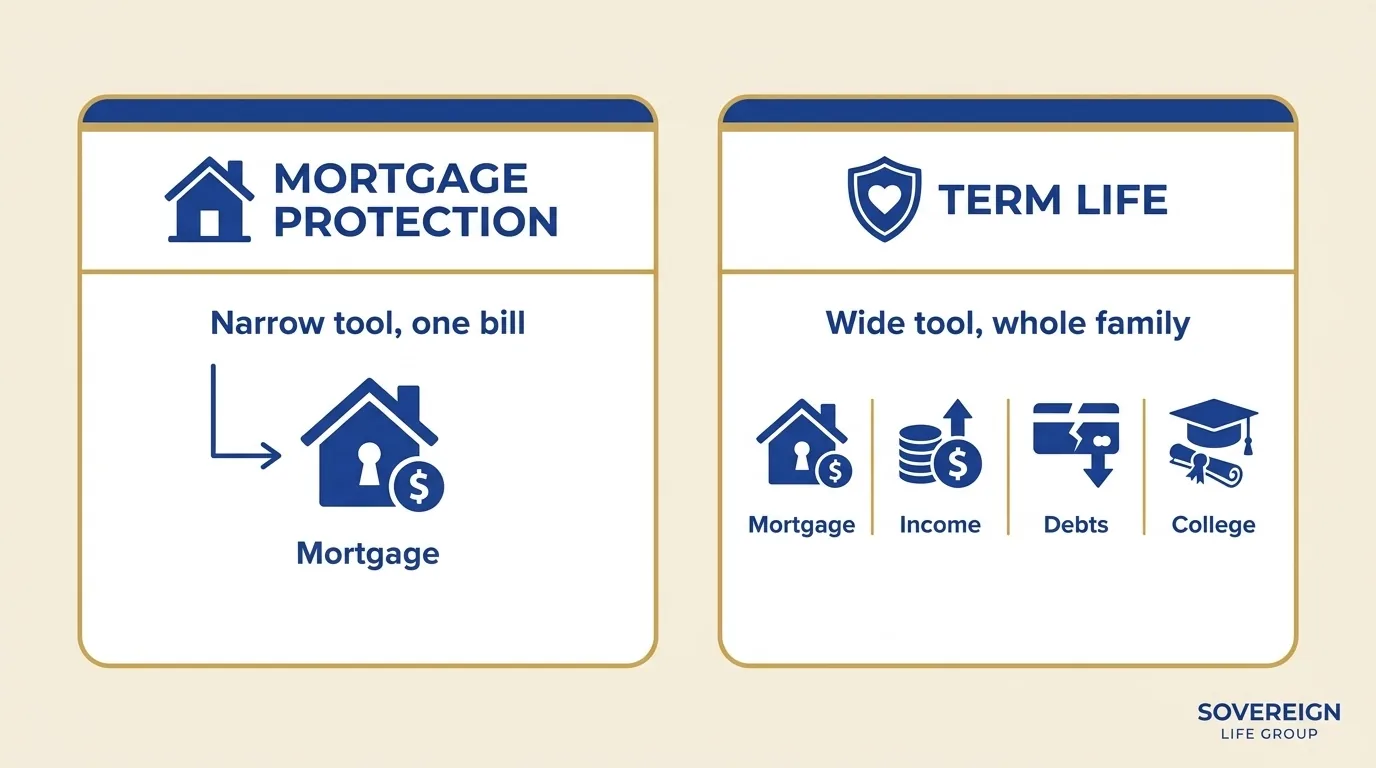
Mortgage protection is life insurance built around your home loan, sized to pay it off if you die during the term. Term life is plain life insurance: a chosen benefit paid to whoever you name, for a set number of years, usable for anything. Both can clear the mortgage. They differ in who controls the money and what else the payout can do.
Start with the names, because the words do a lot of damage. Mortgage protection insurance, sometimes called mortgage life insurance or MPI, is a life insurance policy whose entire design points at one bill: the mortgage. If you pass away while it is in force, it pays a benefit aimed at wiping out or paying down the home loan so your family is not forced to sell. It is sold heavily to new homeowners, often by mail, and it frequently comes with simplified underwriting that trades a higher price for an easier approval.
Term life insurance is the broader, older, simpler product. You pick a benefit amount and a term length, you name a beneficiary, and if you die during those years the insurer pays that flat amount to your beneficiary in cash. They can use it for the mortgage, for groceries, for childcare, for college, for anything. Nothing about term life is tied to the house. It just happens to be large enough to cover the house if you want it to be.
Here is the part most pitches blur: a mortgage is not a special kind of risk that needs a special kind of insurance. It is a debt. Life insurance covers debts and lost income all at once. So the honest framing of mortgage protection vs term life is not "two different needs," it is "two different tools for the same need, with different price tags and different strings attached." Our deeper mortgage protection guide walks through the dedicated product on its own; this article is about choosing between it and term.
Cover the loan so your family keeps the house. About 2 minutes.
Mortgage protection vs term life: the core differences
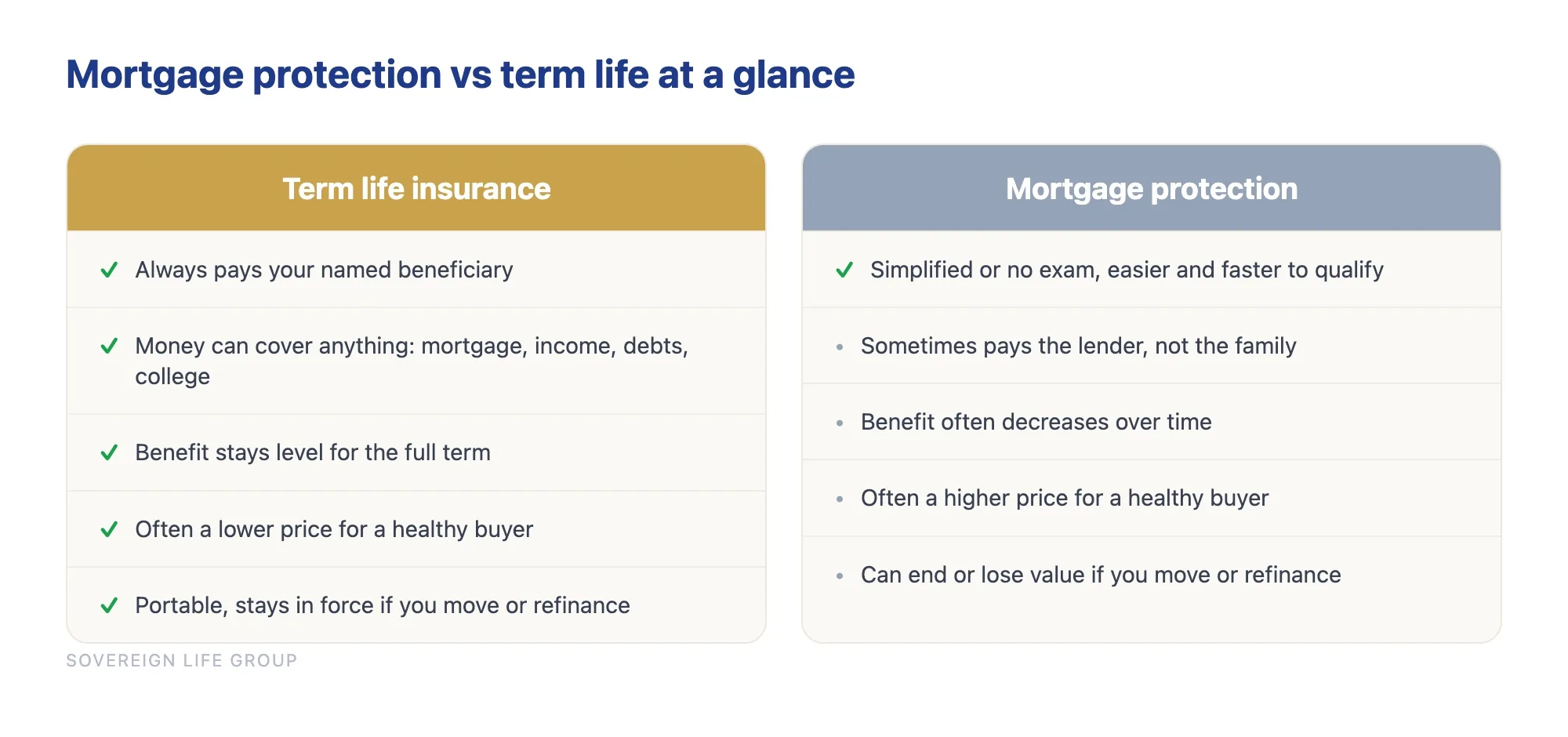
The core differences come down to four things: who receives the money, whether the benefit stays level or shrinks, what the coverage costs for the same protection, and how easy it is to qualify. Term life usually wins on control, flexibility, and price. Mortgage protection usually wins on ease and speed of approval.
It helps to see all of it on one page before we go deep on each row. The table below is the whole debate in miniature. Everything after it is just explaining why each row lands the way it does, and where the exceptions live.
| Factor | Mortgage protection | Term life insurance |
|---|---|---|
| Who gets paid | Sometimes the lender, sometimes your family | Always your named beneficiary |
| What the money can do | Aimed at the mortgage | Anything: mortgage, income, debts, college |
| Benefit over time | Often decreasing, can be level | Stays level for the full term |
| Typical price for same coverage | Often higher for a healthy buyer | Often lower for a healthy buyer |
| Ease of approval | Often simplified or no-exam | Best price usually needs an exam |
| If you move or refinance | Can end or lose value | Portable, stays in force |
| Best fit | Health history, wants speed and simplicity | Healthy buyer who wants the most per dollar |
Notice that term life takes most of the rows. That is not me putting a thumb on the scale, it is the structural reality the industry data keeps confirming. Still, look at the two rows mortgage protection wins, ease of approval and speed, because for a real slice of families those two rows outweigh all the others combined. A policy you can actually get is worth more than a better policy you cannot qualify for. Hold that thought; it is the hinge the whole decision turns on.
Who controls the money
Control of the payout is the difference people feel most. With term life, the death benefit always goes to your named beneficiary in cash, and they decide how to use it. With mortgage protection, it depends: a policy you own pays your family, but some lender-arranged products pay the lender directly to retire the loan, which removes your family's choices.
Why does control matter so much when, either way, the house gets paid off? Because the house is rarely the only thing on fire. Picture a family that loses its main earner. Yes, the mortgage is a crushing worry. But so is the lost paycheck that bought food, covered the car, paid for daycare, and funded the retirement account. If the insurance money can only legally touch the mortgage, the family might end up with a paid-off house and an empty refrigerator.
With term life, your spouse might look at a 3 percent mortgage and decide to keep paying it slowly while using the benefit to replace your income for five years, cover childcare, and stay in their home and their job. That is a smart choice, and only flexible money allows it. With a lender-paid mortgage protection product, that choice is gone: the loan is retired automatically whether or not that was the family's best move.
The ownership question to ask out loud
Not all mortgage protection is lender-controlled. Plenty of it is a normal life policy you own, with your spouse as beneficiary, that simply happens to be sized to your loan. That version keeps the money in your family's hands. So the single most useful question you can ask a mortgage protection salesperson is plain: "Who is the beneficiary, my family or the lender, and who owns the policy?" If the honest answer is that the lender gets paid directly, you are looking at the most rigid version of the product, and term life almost certainly beats it on flexibility for a similar or lower price.
Cost: which one is cheaper
For the same amount of coverage, a healthy applicant usually pays less for level term life than for a dedicated mortgage protection policy. Mortgage protection often uses simplified or no-exam underwriting, and skipping the medical exam shifts risk to the insurer, who prices for it. The exception is someone with a health history, where simplified coverage can be cheaper or the only option available.
This is the row where the marketing and the math part ways. Mortgage protection is advertised as the easy, friendly, homeowner-focused choice, and ease has a cost. When an insurer agrees to cover you off a short health questionnaire instead of a full exam, they are accepting more uncertainty about your health, and they build that uncertainty into the premium. For a person who would have sailed through underwriting anyway, that means paying extra for a convenience they did not need.
The cost gap matters more when you realize how badly most people misjudge these prices to begin with. According to the 2024 Insurance Barometer Study from LIMRA and Life Happens, a majority of consumers overestimate the cost of term life insurance, and younger adults often guess it costs several times the real figure. People walk in expecting term life to be expensive, get quoted a mortgage protection premium that feels reasonable by comparison, and never learn that a fully underwritten term policy might have covered more for less.
None of this makes mortgage protection a bad deal across the board. It makes it a product whose price is fair for the convenience it offers, and a poor value for a healthy person who did not need the convenience. The way to know which one you are is to get both quoted side by side, which costs nothing and takes one conversation.
Why "cheaper" still has limits
Cheaper term is only cheaper if you can hold it. A common mistake is buying the absolute lowest premium with a term so short it expires while the mortgage and the kids are still around, or stripping a policy so bare it gets cancelled the first tight month. The cheapest policy is the one you keep in force on the day your family needs it, not the lowest number on a quote sheet. Price the coverage you will actually maintain for the full length of the obligation.
Decreasing vs level: how the benefit behaves
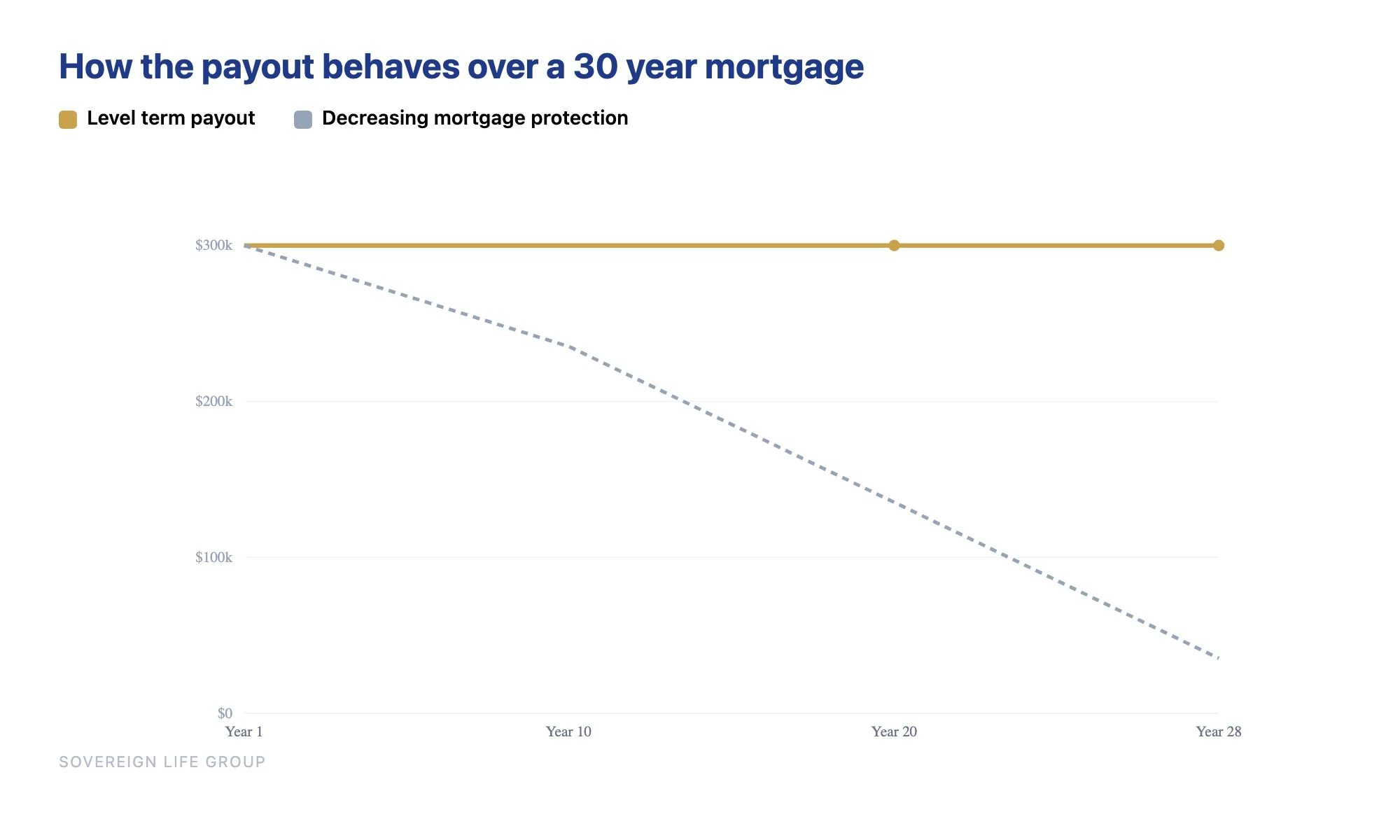
Term life keeps a level benefit for the entire term, so a $300,000 policy still pays $300,000 in year twenty-five. Traditional mortgage protection is often decreasing, meaning the payout shrinks each year to roughly track your falling loan balance. You usually keep paying the same premium either way, so a decreasing benefit slowly buys you less protection over time.
This row trips up more buyers than any other, because it hides inside a reasonable-sounding pitch: "Your mortgage gets smaller every year, so your coverage should too. Why pay for protection you no longer need?" It sounds efficient. The problem is what it ignores.
First, your need does not shrink as neatly as your loan balance. In the early years of a mortgage, almost every payment goes to interest, so the balance barely moves while you keep paying. A decreasing policy can fall faster than your actual equity builds. Second, and more important, the mortgage is not the only reason your family needs money. Your income did not decrease. Your children did not get cheaper. A level benefit keeps the full amount available for whatever the family faces, while a decreasing benefit quietly assumes the house is the only thing worth protecting.
Here is the kicker that the pitch leaves out: a decreasing benefit does not usually come with a decreasing premium. You often pay the same amount every month while the protection you would receive falls year after year. With level term, the dollar you pay buys the same protection in year twenty as it did in year one. For most families, paying a steady price for steadily less coverage is a worse trade than paying a steady price for steady coverage.
| Year of the loan | Decreasing mortgage protection payout | Level term life payout |
|---|---|---|
| Year 1 | About $300,000 | $300,000 |
| Year 10 | About $235,000 | $300,000 |
| Year 20 | About $135,000 | $300,000 |
| Year 28 | About $35,000 | $300,000 |
Read that table slowly. By year twenty, the decreasing policy in this example would pay your family less than half of what the level policy pays, often for a similar premium. If you pass away later in the loan, when your kids are in college and your savings took a hit, the level benefit is the one that actually catches the family. That is the quiet case for term that the brochures rarely make.
Underwriting and who can qualify
Underwriting is where mortgage protection earns its keep. Term life usually offers its best price after a brief medical exam, and certain conditions can mean a higher rate or a decline. Mortgage protection often uses simplified or no-exam underwriting with a short health questionnaire, so it can approve people who would struggle with fully underwritten term, just at a higher price per dollar.
This is the row that flips the entire comparison for a real group of people. Everything above assumes you can qualify for well-priced term life. If you can, term usually wins. But if you have a health history that makes traditional underwriting hard, a heart condition, diabetes that is not well controlled, a recent cancer history, or a build that pushes outside standard tables, then the cheapest term policy on paper is irrelevant because you may not be approved for it at that price.
For those families, simplified mortgage protection is not the consolation prize, it is the realistic path to protecting the home at all. Getting covered today through a simplified policy beats chasing a perfect term rate you cannot get. If your health is the thing that has stalled you for years, the right move is the coverage you can actually put in force now, then revisiting later if your health improves. To understand how carriers tend to view specific diagnoses before you apply, our overview of life insurance with health conditions is a useful next read.
A caution on no-exam coverage
Simplified does not mean no questions. Some no-exam mortgage protection policies still ask health questions, and answering them inaccurately can cause a claim to be reviewed or denied during the contestability period, usually the first two years. A few guaranteed-acceptance products do underwriting essentially after a claim, which can leave a family surprised at the worst possible moment. Read the policy for waiting periods and exclusions, and prefer coverage that does its underwriting up front so an approval is a real approval. The speed of simplified coverage is a genuine benefit; just make sure you know what you are trading for it.
See what it costs to keep your family in the home. No pressure.
A real worked example with numbers
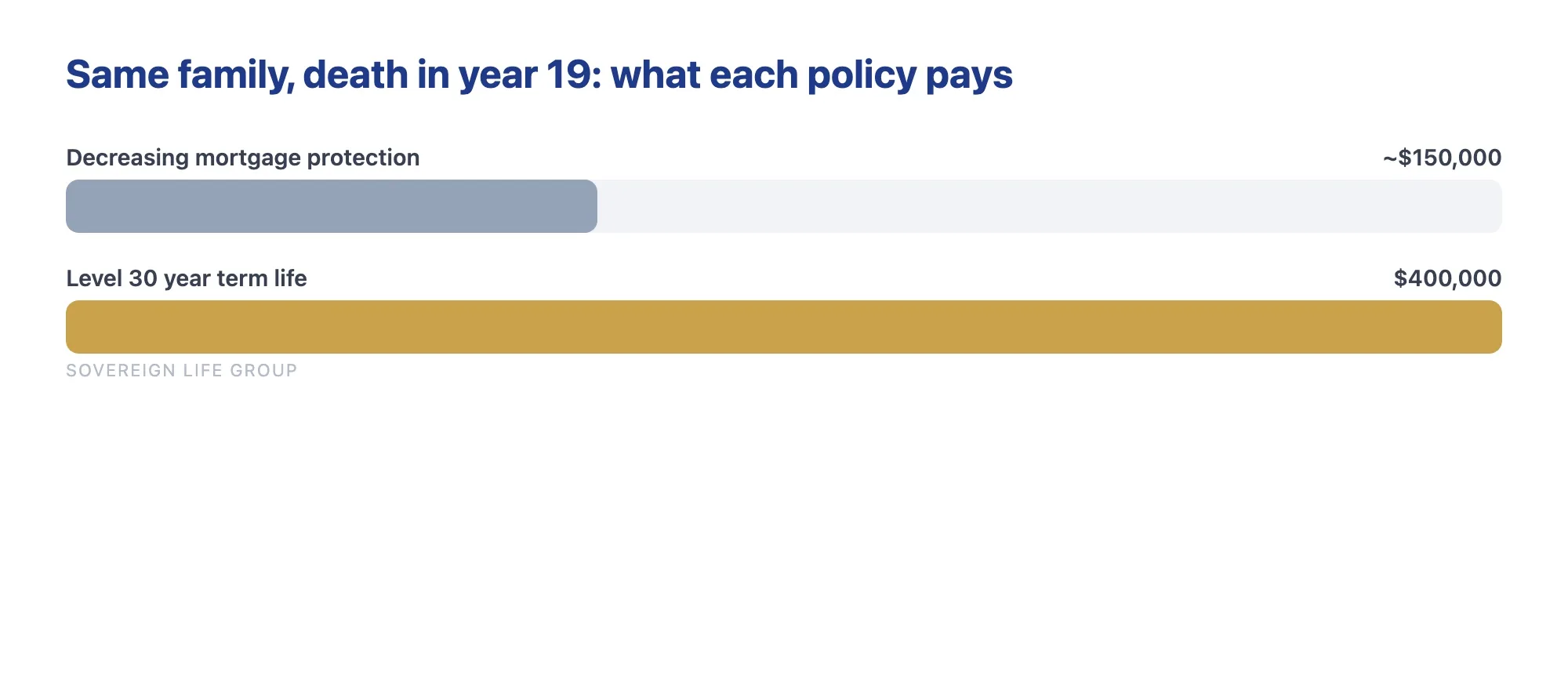
Walking through one family makes the trade-offs concrete. Take a healthy 35-year-old with a $300,000 balance on a 30-year mortgage and two young kids. Both a decreasing mortgage protection policy and a level 30-year term policy can cover the loan. The level term policy keeps the full benefit for all 30 years and pays the family in cash, which changes what happens if the worst comes late in the loan.
Let us call him David. He earns most of the household income, his wife works part time, and they have a 4 and a 6 year old. David is in good health, a nonsmoker, no major conditions. Two options land on his desk.
Option A, decreasing mortgage protection. The benefit starts near his $300,000 balance and shrinks each year toward the falling loan. It is sold as the homeowner's product, approval is quick, and the monthly premium feels modest. If David dies in year two, it roughly pays off the house. If he dies in year twenty, it pays out the much smaller remaining balance, and there is little or nothing left for income, childcare, or college.
Option B, level 30-year term life. David buys a $400,000 level term policy, sized to clear the mortgage and leave a cushion for income and his kids. The benefit never shrinks. His wife is the beneficiary and controls the cash. As a healthy nonsmoker, his fully underwritten term premium may land at or below the mortgage protection premium for a comparable starting benefit, because he is not paying extra to skip the exam.
Now run the years. If David passes away in year three, both options pay off the house, and the difference is modest, though the term policy still leaves roughly $100,000 extra for the family. If David passes away in year nineteen, the gap is brutal. The decreasing policy might pay maybe $150,000, just enough to retire the shrunken loan. The level term policy still pays the full $400,000: the family clears the remaining balance, replaces years of David's income, and keeps the kids' lives stable through high school. Same family, same decade, wildly different outcome, driven almost entirely by which structure they chose at the table.
Change one fact and the answer flips. Suppose David has type 2 diabetes that is not yet well controlled and a recent health scare. Now the well-priced term policy may not be available to him at the rate above, or at all. A simplified mortgage protection policy that approves him in days becomes the responsible choice, because the alternative is leaving his family with nothing while he waits and hopes for a better term rate. That is the whole comparison in one household: the math favors term for the healthy David, and favors mortgage protection for the David whose health closed the term door.
Selling, refinancing, and moving
Term life is portable and mortgage protection often is not. A term policy stays in force at the same benefit no matter what you do with the house: sell it, refinance it, move, or change lenders, the coverage follows you. A dedicated mortgage protection policy tied to a specific loan can end or lose its value when that loan goes away, leaving you to start over, older and possibly less healthy.
Americans move and refinance far more than the comparison articles assume, and this row quietly matters more than its size suggests. Most people do not keep the same mortgage for thirty years. They sell and trade up, they refinance when rates drop, they relocate for work. Each of those events can untie a mortgage-specific policy from the thing it was built around.
Consider what happens at a refinance. You replace the old loan with a new one. A mortgage protection policy bolted to the original loan may not simply carry over, and if you need new coverage you reapply at your current age and health, which are both worse than they were when you first bought. A level term policy does not care that you refinanced. The benefit, the premium, and the term all stay exactly where they were, because the policy was never tied to a particular loan in the first place.
The same logic applies if you sell and buy a bigger home, or pay the house off early. Term life keeps protecting your family and can be repurposed toward income, the new mortgage, or final expenses. Mortgage-specific coverage often just ends, and you are left buying fresh protection at an older age. Portability is not a flashy feature, but over a real life with real moves, it is one of the strongest arguments in the mortgage protection vs term life debate.
Can you use both together
Yes, you can own both, and a few situations make it sensible. There is no rule against holding mortgage protection and term life at the same time. Some families put a small simplified policy in place fast for immediate peace of mind, then underwrite a larger level term policy that becomes the backbone once it is approved. For most people, though, one right-sized term policy is simpler and cheaper than stacking two.
When does stacking actually make sense? A handful of cases. If your health is uncertain and you want something in force this week while a fully underwritten term application is pending, a quick simplified policy can bridge the gap, and you keep or drop it once the term policy issues. If you have already maxed the term coverage a carrier will offer and still want more protection on a large mortgage, a second policy can fill the gap. And if a specific employer or lender benefit is essentially free, there is no harm in keeping it as a supplement rather than a foundation.
What rarely makes sense is buying a dedicated mortgage protection policy on top of term life you already own that is large enough to cover the house. That is paying twice to protect the same bill. Before adding a mortgage-specific policy, add up the coverage you already have, including any group life through work, and ask whether it already clears the mortgage with room to spare. If it does, the smarter move is usually to right-size what you have rather than layer on another premium. The deeper structural question of which kind of life insurance to build around is something we cover in our comparison of term versus whole life insurance.
Which protects the house better
For most healthy buyers, level term life protects the house better, because it covers the mortgage and your income for a similar or lower price, keeps a flat benefit as the loan shrinks, pays your family directly, and travels with you through moves and refinances. Mortgage protection protects the house better only when a health history makes term hard to qualify for, or when speed and simplicity outweigh price.
That is the honest verdict, and it is two-sided on purpose. Anyone who tells you one product always wins is selling, not advising. Here is the decision in plain terms, the way I would lay it out for a friend across the table.
- Choose level term life if you are reasonably healthy, you want the most coverage per dollar, you want your family to control the money, or you expect to move or refinance at some point. This covers the large majority of buyers.
- Choose mortgage protection if a health condition makes well-priced term hard or impossible to get, you want coverage in force in days rather than weeks, or simplicity matters more to you than squeezing out the lowest premium.
- Consider both, briefly, if you want fast simplified coverage in place now while a larger term application is underwritten, then keep whichever serves you best once the term policy issues.
The deeper point underneath all of it: protecting the home is not really about the house, it is about the people in it. The reason this decision is worth an hour of your attention is the same reason most people put it off, because it forces you to picture a day you would rather not. Yet the families who plan for that day are the ones who stay in their home through it. According to the Insurance Information Institute, term life is the most straightforward way to match a set amount of coverage to a set obligation like a mortgage, which is exactly the job most homeowners are trying to do. Whichever tool fits your health and budget, the mistake is owning neither. If you want a clear-eyed look at your own numbers, that is the entire purpose of Sovereign Life Group, your life insurance strategist.
How to shop without overpaying
The way to avoid overpaying is to compare both products on the same numbers before you buy either. Get a level term quote and a mortgage protection quote for the same benefit and term, confirm who controls the payout, check whether the benefit is level or decreasing, and apply while your health is at its best. A licensed agent who shows you both options, not just one, is doing the job right.
Here is the practical order I would walk a friend through.
- Decide what the money is really for. Just the mortgage, or the mortgage plus replacing your income and covering final expenses? The honest answer usually points toward a flat term benefit large enough to do more than one job.
- Get both quoted side by side. Same benefit, same term, level term against mortgage protection. Seeing the two numbers next to each other ends most of the confusion in about five minutes.
- Ask who gets paid and whether the benefit is level. A policy your family owns with a level benefit gives you the most control and the most lasting protection. A lender-paid, decreasing policy gives you the least.
- Apply while your health is on your side. The application captures today's health, and on average today is the best it will be. Waiting rarely lowers your price.
- Match the term to the obligation. A 30-year mortgage often pairs with a 30-year term. Do not buy a term so short it expires while the loan and the kids are still here.
- Use an independent agent who shows options. If someone only ever presents one product, that is a flag. You want trade-offs laid out, then your choice, not a single pitch dressed up as advice.
One more piece of context worth carrying into that conversation: the gap is real and it is large. According to industry research from LIMRA, a large share of American adults say they need more life insurance than they currently own, and cost confusion is one of the top reasons they have not closed the gap. You do not need to become an insurance expert to fix that. You need one honest comparison of the two tools and a policy you will actually keep. When you are ready, you can book a calm, no-pressure look at your numbers, or read more about how mortgage protection coverage fits alongside term in a full plan, then book a 15-minute review to put it together.
Want a straight answer for your house?
Fifteen minutes. We will quote level term and mortgage protection side by side for your loan, your budget, and your health, then you choose. No pressure, no jargon, just the two numbers next to each other.
Get a Quote Book a 15-Min Call Prefer to move quickly? Save my card or get a quick mortgage protection quote.Frequently asked questions
Is term life or mortgage protection better for covering a mortgage?
For most healthy buyers, level term life is the stronger tool. It usually costs less per dollar of benefit, pays your family directly instead of the lender, keeps a flat benefit even as the loan shrinks, and can also replace income. Mortgage protection wins when health history makes term hard to qualify for or you want speed and simplicity.
Is mortgage protection insurance more expensive than term life?
Often, yes. For the same coverage, a healthy applicant frequently pays less for level term life than for a dedicated mortgage protection policy, because mortgage protection commonly uses simplified or no-exam underwriting that prices in extra risk. The exception is someone with a health history, where simplified mortgage protection can be the cheaper realistic option or the only one available.
Does the mortgage protection payout go to the bank or my family?
It depends on the policy. With a true mortgage protection life policy you own, your named beneficiary receives the money and chooses how to use it. With some lender-arranged products, the benefit pays the lender directly to retire the loan. Term life always pays your named beneficiary, who decides what to do with it.
What happens to mortgage protection if I sell my house or refinance?
A dedicated mortgage protection policy tied to a specific loan can end or lose value when you sell, pay off, or refinance, because it is built around that loan. Term life is portable: it stays in force at the same benefit regardless of moving, refinancing, or changing lenders, which is one of its underrated advantages.
Can I have both mortgage protection and term life insurance?
Yes. There is no rule against owning both, and some families layer a small simplified policy now while underwriting a larger term policy. For most people, though, one right-sized level term policy covers the mortgage and income at once, which is simpler and usually cheaper than stacking two policies.
Does mortgage protection require a medical exam?
Often not. Many mortgage protection policies use simplified or no-exam underwriting with a short health questionnaire, which is faster and helps people with a health history. Term life usually offers its best price with a brief exam, though no-exam term exists too. Skipping the exam tends to raise the price for an otherwise healthy applicant.
Joseph McDermott is a licensed life insurance agent (NPN 22121673), licensed in 27 states. Brokered through Family First Life, in partnership with Catalyst Life. This article is for educational purposes only and is not financial, tax, or legal advice. Consult a licensed professional about your specific situation. Product availability, features, riders, and rates vary by state, age, health, and carrier, and any coverage is subject to underwriting approval. Guarantees are subject to the claims-paying ability of the issuing insurance company.