Whole Life vs Universal Life: The Honest Difference


The Short Version
Whole life and universal life are both permanent policies that last your whole life and build cash value. The honest difference is guarantees versus flexibility. Whole life locks in your premium, death benefit, and a minimum growth rate for life. Universal life lets you adjust those things and reach for more growth, but it hands you the responsibility of keeping the policy funded so it does not quietly lapse. Neither is "better." One fits a person who wants set-and-forget certainty, the other fits a person who wants control and is willing to manage it.
If you have started shopping for permanent coverage, you have almost certainly hit the same wall everyone does: the whole life vs universal life decision, explained by two different agents who each happen to recommend the exact product they sell. That is not advice. That is a sales pitch wearing a comparison chart. This article is the version I wish more buyers got, the one that lays out where each policy genuinely wins, where each one can quietly fail you, and how to tell which side of the line you are actually on. Both are forms of permanent life insurance, both build cash value, and both can be the right call or the wrong one depending entirely on who you are. Business owners weighing the same choice often use permanent coverage for key person and buy-sell protection.
I write this as a licensed agent who shops more than a dozen carriers, not as someone trying to move one product. By the end you will understand the mechanics, see a real worked example with numbers, know the risk that ruins more universal life policies than any other, and have a simple framework for deciding. Some of this will talk you out of the more expensive option, and some of it may talk you out of permanent insurance altogether. That is the point.
What this guide covers
- First, what permanent life insurance is
- Whole life vs universal life: the honest difference
- How whole life insurance works
- How universal life works, and its three types
- Cash value comparison: how each builds money
- Premiums, guarantees, and flexibility side by side
- A real worked example with numbers
- The risks nobody puts in the brochure
- How the tax treatment actually works
- What each one tends to cost
- Which one fits you
- How to shop without getting sold
- Frequently asked questions
First, what permanent life insurance is
Permanent life insurance is coverage built to last your entire life rather than a set number of years, and it includes a cash value account that grows over time. Whole life and universal life are the two main families inside it. Both stay in force for life if managed correctly, and both let money accumulate inside the policy.
That last part is what separates permanent coverage from term life. Term is pure insurance: you pay for a death benefit over a fixed window, usually 10 to 30 years, and if you outlive it the coverage simply ends with no cash to show for it. Permanent insurance costs more because part of every premium goes toward a death benefit that never expires, and part goes into a savings component the insurer invests on your behalf. If you are still deciding between the two broad camps, our breakdown of term versus whole life insurance and which fits your family is the right place to start, because the term-versus-permanent question should come before the whole-life-versus-universal-life one.
According to the Insurance Information Institute, term and permanent policies make up the bulk of individual coverage in force, and the permanent share exists precisely because some needs do not expire at 65. Final expenses, a lifelong dependent, estate liquidity, and intentional tax-advantaged savings are all reasons families choose coverage that never sunsets. Once you decide a need is genuinely lifelong, the whole life vs universal life choice is the next fork in the road.
Tax-advantaged growth with a floor against losses. Quick and free.
Whole life vs universal life: the honest difference
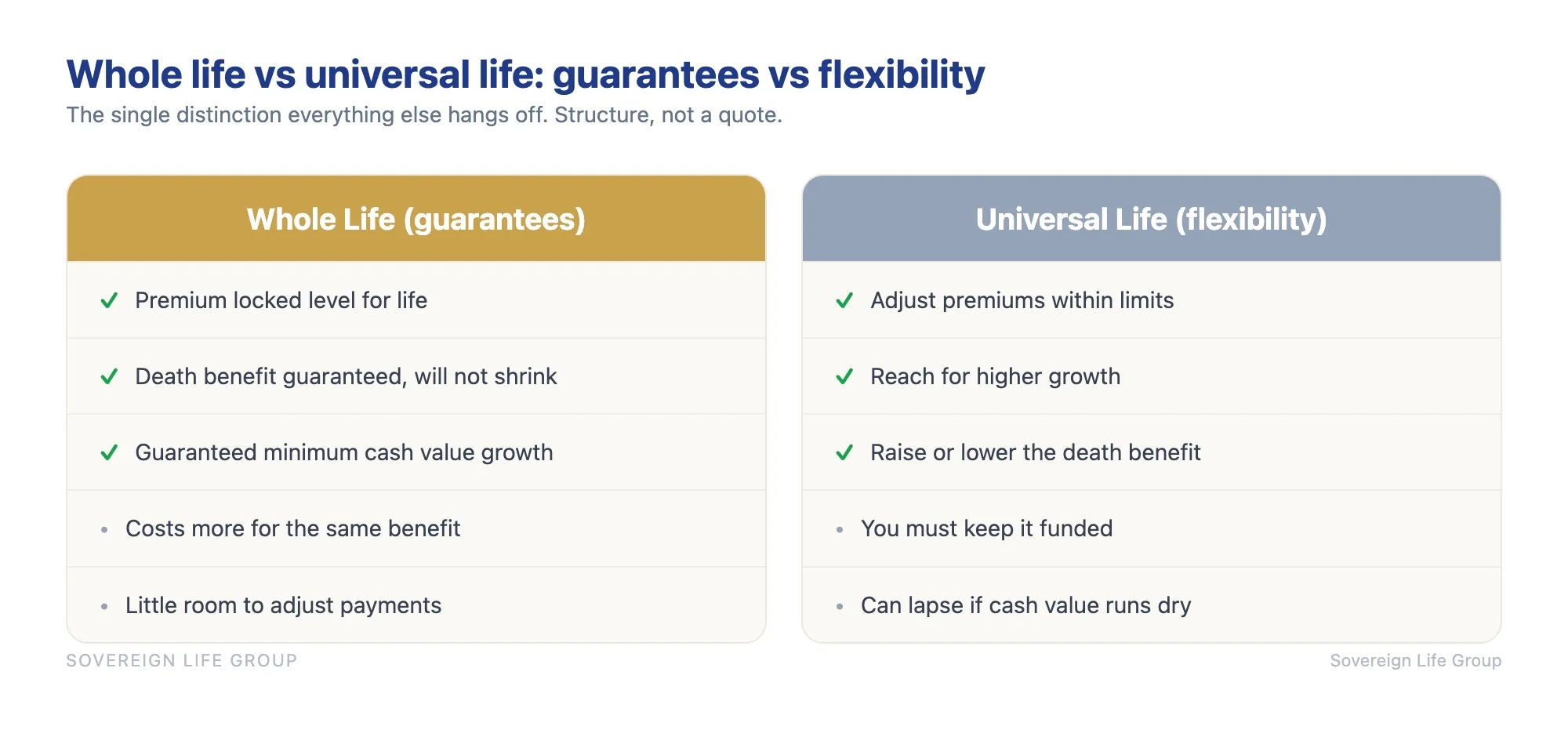
The honest difference between whole life vs universal life comes down to guarantees versus flexibility. Whole life locks in your premium, your death benefit, and a guaranteed minimum cash value growth rate for the life of the policy. Universal life loosens all three of those, giving you the freedom to adjust your payments and coverage while reaching for higher growth, in exchange for taking on the job of keeping it funded.
Picture two cars that both get you across the country. Whole life is the one with cruise control set, a fixed route, and a fuel gauge that cannot lie to you. You pay the same, you arrive, you do not have to think about it. Universal life is the one where you can change lanes, speed up, slow down, and refuel on your own schedule, which is powerful if you are paying attention and dangerous if you stop watching the gauge. Same destination, completely different driving experience and completely different demands on you.
Everything else in this article is a detail hanging off that single distinction. The cash value behaves differently because of it. The pricing differs because of it. The risks differ because of it. So before we get into the mechanics, hold onto the core idea: you are choosing between a policy that protects you from yourself and a policy that gives you the controls and trusts you to use them.
How whole life insurance works
Whole life insurance works on a fixed, guaranteed structure. You pay a level premium that never rises, the death benefit is locked in, and the cash value grows at a guaranteed minimum rate set in the contract. As long as you pay the agreed premium, the policy cannot lapse and the coverage lasts your entire life. Predictability is the entire product.
When you pay a whole life premium, the insurer guarantees three things in writing. First, your premium stays level for life. The payment you sign up for at 40 is the same payment at 70. Second, the death benefit is fixed and will not shrink. Third, the cash value grows by a guaranteed minimum amount every year, building slowly at first and faster as the policy matures.
Dividends, if the carrier pays them
Many whole life policies are sold by mutual insurers that may pay dividends, which are a share of the company's surplus returned to policyholders. Dividends are not guaranteed, but participating policies from financially strong carriers have a long history of paying them. You can take dividends as cash, use them to reduce premiums, or, most powerfully, buy "paid-up additions," small chunks of extra coverage that compound your cash value and death benefit over time. This is the engine behind a lot of what people call "infinite banking," the same approach R. Nelson Nash laid out in Becoming Your Own Banker.
What you give up
The price of all that certainty is cost and rigidity. Whole life premiums are meaningfully higher than universal life for the same death benefit, because you are paying for guarantees the insurer has to stand behind for decades. You also cannot easily dial the premium up or down. If money gets tight, you do not have the built-in flexibility to pay less for a while without restructuring the policy. You are buying a commitment, and the commitment is the feature.
How universal life works, and its three types
Universal life works on a flexible structure. Inside the policy, the cost of insurance and fees are charged against your cash value, and you fund it with premiums you can adjust within limits. The cash value earns a return based on the policy type, and as long as the cash value plus your premiums cover the internal costs, the policy stays in force. Flexibility is the entire product, and so is the responsibility that comes with it.
Here is the part many buyers never have explained clearly. A universal life policy is not one fixed payment for one fixed benefit. It is a flexible container. Each month the insurer deducts the cost of insurance, which rises as you age, plus administrative charges. Whatever you pay above those costs goes into cash value and earns a return. Pay more in good years, less in lean years, even skip a payment if the cash value can cover the internal cost. That freedom is the appeal, and the eroding cash value is the trap if you stop funding it.
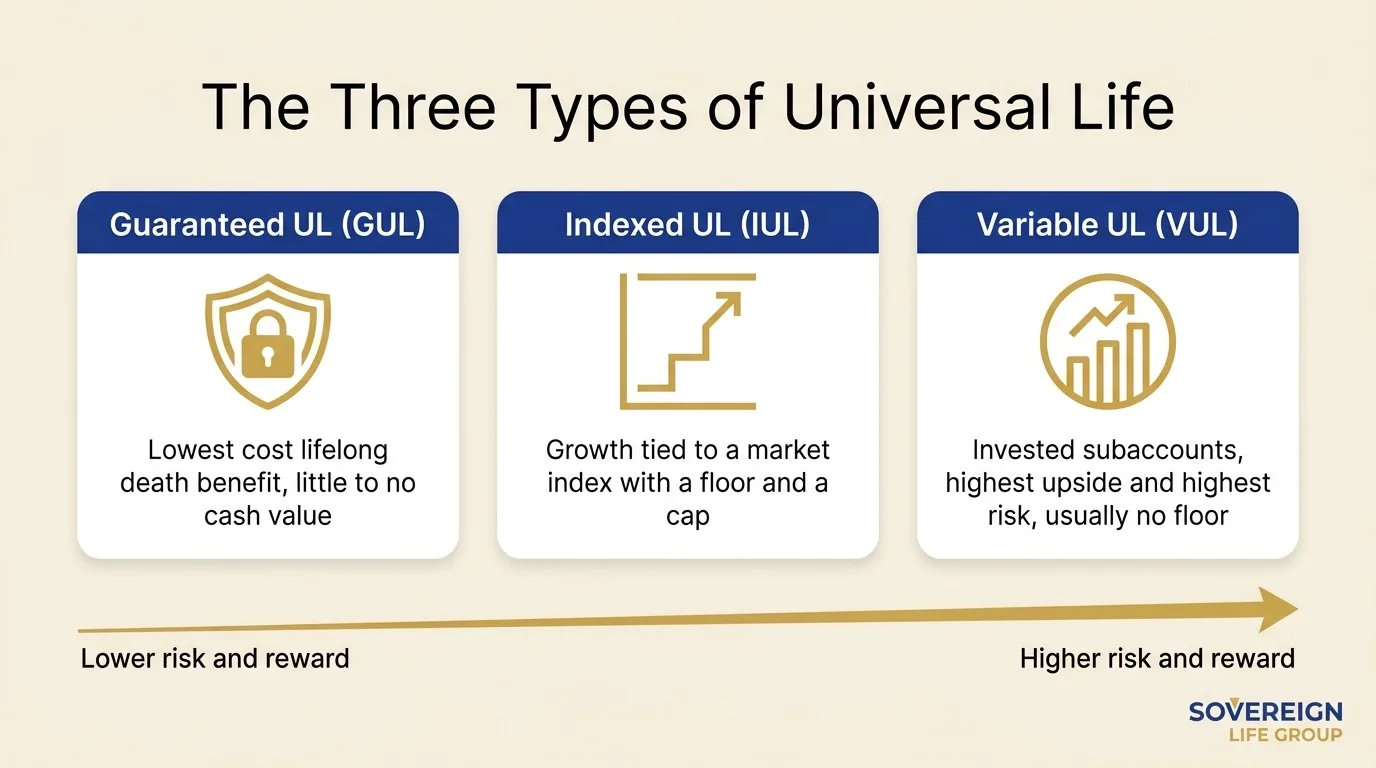
Universal life comes in three main flavors, and lumping them together is how people get confused.
- Guaranteed universal life (GUL). The closest cousin to term. It strips the cash value down to almost nothing and focuses on a guaranteed death benefit to a chosen age, often 90, 95, or 121. It is usually the cheapest way to get a permanent death benefit, but it builds little to no money you can use while alive.
- Indexed universal life (IUL). The cash value earns interest tied to a market index such as the S and P 500, with a floor that protects you from market losses and a cap or participation rate that limits your upside. You get more growth potential than whole life without direct market risk, in exchange for caps and more moving parts. Our overview of how indexed universal life insurance is built walks through the floors, caps, and trade-offs in detail.
- Variable universal life (VUL). The cash value is invested in subaccounts that work like mutual funds. The upside is the highest of the three, and so is the risk, because there is typically no floor. A bad market can directly reduce your cash value and put the policy under pressure. VUL is a securities product and requires a deeper risk tolerance.
When someone says "universal life," ask which of these three they mean, because GUL and VUL are about as different as two products in the same family can be. To go deeper on how the money piece works across all of these, see our explainer on how cash value life insurance actually accumulates.
Cash value comparison: how each builds money
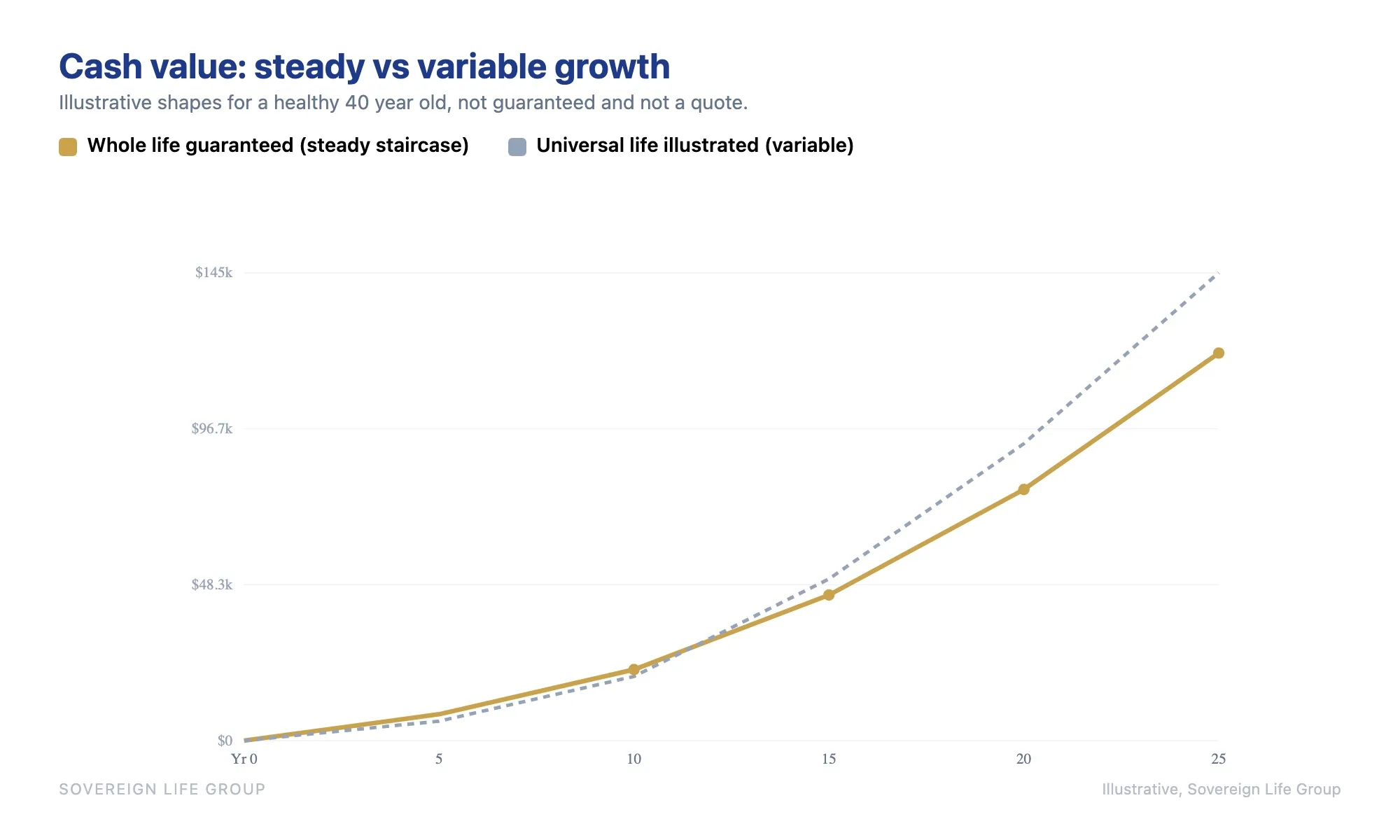
The cash value comparison comes down to predictability versus potential. Whole life builds cash value on a guaranteed schedule with a fixed floor and possible dividends on top, so you always know the minimum. Universal life builds cash value based on interest rates or index performance, which can outpace whole life in strong years and underperform in weak ones, with the funding level partly in your hands.
Think of whole life cash value as a staircase. Each year you take a guaranteed step up, the steps get a little taller as the policy matures, and dividends, when paid, add an extra riser. You can see the staircase before you ever climb it, because the guaranteed values are printed in the contract.
Universal life cash value is more like an escalator whose speed changes. In a year of strong interest rates or a strong index, it moves quickly. In a flat or weak year it slows, and with indexed policies a zero-return year still costs you the internal insurance charges, so the cash value can dip even though the index "did not lose." This is why two identical-looking universal life illustrations can end up worlds apart: the assumed rate of return changes everything, and assumptions are not promises.
The illustration trap
Universal life is almost always sold with an illustration projecting decades of growth. Those projections lean on an assumed rate that is not guaranteed. A policy illustrated at a rosy rate can look like it crushes whole life, then deliver far less if real returns come in lower. Always ask to see the guaranteed column, the worst-case scenario the carrier is contractually bound to, not just the hopeful one. If the guaranteed column shows the policy lapsing in your 70s, that is the number that matters.
| Feature | Whole life | Universal life |
|---|---|---|
| Growth basis | Guaranteed fixed rate, plus possible dividends | Interest rates, an index, or invested subaccounts |
| Guaranteed floor | Yes, set in the contract | Varies: GUL and IUL have a floor, VUL usually does not |
| Upside potential | Steady and modest | Higher in strong years, lower in weak years |
| Predictability | High, you can see it in advance | Lower, depends on returns and funding |
| Your involvement | Low, mostly automatic | Higher, you help manage the funding |
Premiums, guarantees, and flexibility side by side
On premiums and guarantees, whole life is fixed and universal life is adjustable. Whole life requires a set premium that never changes and guarantees the death benefit and minimum cash value. Universal life lets you raise, lower, or occasionally skip premiums and even adjust the death benefit, but most of those guarantees become flexible targets you are responsible for maintaining.
This is where the two products feel most different in daily life. With whole life, the bill is the bill. You either pay it or you do not, and as long as you do, every promise holds. There is a clean simplicity to that. With universal life, you have a dashboard of controls: pay extra to build cash value faster, pay less during a hard stretch, increase the death benefit after a new baby, or decrease it once the kids are grown. Used wisely, that flexibility is genuinely valuable. Used carelessly, or simply ignored, it is how policies erode.
| Factor | Whole life | Universal life |
|---|---|---|
| Premiums | Fixed and level for life | Flexible within limits |
| Death benefit | Guaranteed, will not shrink | Adjustable, not always guaranteed |
| Cash value growth | Guaranteed minimum, steady | Variable, tied to rates or an index |
| Dividends | Possible, with participating policies | Generally none |
| Lapse risk if underfunded | Cannot lapse if the premium is paid | Can lapse if cash value runs dry |
| Ongoing management | Minimal | Active, should be reviewed regularly |
| Typical cost for same benefit | Higher | Often lower upfront |
| Best for | Set-and-forget certainty | Control and growth potential |
Notice the line about lapse risk, because it is the one that surprises families years later. Flexibility cuts both ways. The same feature that lets you skip a payment is the feature that can leave a policy starved if you skip too many. We will come back to that in the risks section, since it is the most important thing to understand before signing a universal life contract.
See the strategy applied to your age and goals. No pressure.
A real worked example with numbers
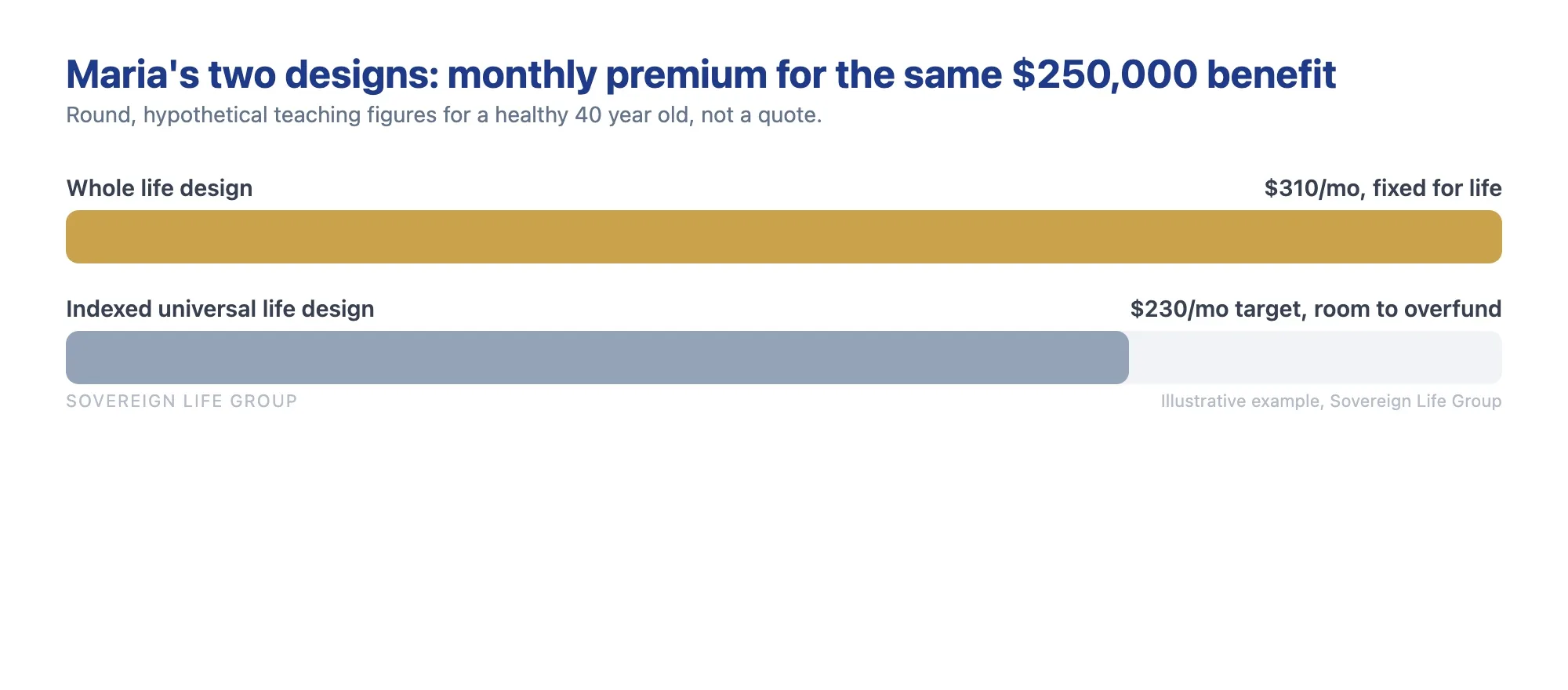
Here is a simplified, illustrative example to make the difference concrete. Imagine a healthy 40-year-old, call her Maria, who wants a permanent policy with a $250,000 death benefit and the ability to build cash value she might tap later. She gets two designs to compare. The numbers below are round, hypothetical figures for teaching, not a quote, and real results depend on health, carrier, and approval.
The whole life design. Maria's premium comes in around $310 a month, fixed for life. The contract shows a guaranteed cash value schedule: modest in the early years while costs and commissions are front-loaded, then compounding steadily. By her mid-60s the guaranteed cash value might sit near $120,000, with the potential for more if dividends are paid as illustrated. The number she can count on is the guaranteed one. The premium never changes, and the policy cannot lapse as long as she pays it.
The indexed universal life design. For the same $250,000 benefit, Maria's target premium might be around $230 a month, and she has room to overfund it to build cash value faster. The illustration assumes, say, a 6 percent indexed return and projects cash value well above the whole life figure by her 60s. But there are two columns. The illustrated column looks great. The guaranteed column, assuming the floor and the maximum internal charges, looks far weaker and shows the cash value under real strain in later decades if she only ever pays the minimum.
What the example actually teaches
Read side by side, the lesson is not "one wins." It is that they answer different questions. If Maria values a number she can take to the bank no matter what happens, whole life gives her that floor at a higher price. If Maria is comfortable funding the policy generously and reviewing it every year or two, the indexed universal life gives her a higher ceiling and lower required premium, with the catch that the rosy projection is a hope, not a guarantee. The most expensive mistake Maria can make is buying the IUL on the strength of the illustrated column and then funding it like the cheap option. That is the exact recipe for a policy that disappoints or lapses.
The risks nobody puts in the brochure
The biggest risk in universal life is lapse from underfunding. Because the cost of insurance rises every year as you age, a policy funded at only the minimum can reach a point where the premium plus cash value no longer covers the internal charges. When that happens the cash value drains, and the policy can lapse, sometimes after decades of payments, exactly when you can least afford to requalify.
This is the part of the whole life vs universal life conversation that almost never makes it into a sales meeting, so read it twice. Universal life's flexibility is real, but it is built on a rising cost of insurance underneath. In the early years the cost is low and easy to cover. In your 70s and 80s it can be enormous. If your cash value has not grown enough to absorb that rising cost, or if you took the flexibility as permission to underpay, the whole structure can hollow out. Older universal life policies sold in high-interest-rate eras are a cautionary tale: when rates fell and stayed low, the projected growth never materialized, and many owners faced sharp premium increases late in life just to keep coverage alive.
Surrender charges
Both whole life and universal life typically carry surrender charges in the early years, often a declining schedule across the first 10 to 15 years. Cancel or pull cash out early and you may get back far less than you paid, sometimes nothing in year one. Permanent insurance is a long-term commitment by design. If there is any real chance you will want out in a few years, permanent coverage is usually the wrong tool, and term plus separate investing may serve you far better.
Loans against your cash value
A major selling point of both products is the ability to borrow against your cash value. Used carefully, policy loans can be a flexible, tax-advantaged source of funds. Used carelessly, they are a quiet way to sink a policy. Unpaid loans accrue interest and reduce the death benefit, and if a loan balance grows large enough to exhaust the cash value, the policy can lapse, which can also trigger a tax bill on gains. Borrowing from your policy is a tool, not free money, and it deserves a plan.
The modified endowment contract trap
If you overfund a policy past the limits the IRS sets under the tax code, it becomes a modified endowment contract, or MEC. A MEC loses some of the favorable tax treatment that makes cash value attractive: withdrawals and loans can be taxed as income first, and a penalty may apply before age 59 and a half. According to the Internal Revenue Service, the tax treatment of life insurance proceeds and distributions depends on how the contract is structured, which is exactly why funding levels should be designed on purpose, not by accident. A good agent designs around these limits so you capture the benefit without tripping the wire.
How the tax treatment actually works
The tax treatment is broadly similar for both. In whole life and universal life alike, cash value generally grows tax-deferred, the death benefit is generally paid to beneficiaries free of federal income tax, and properly structured policy loans are typically not taxed while the policy stays in force. The differences are in the details of how each policy is funded and managed, not in the basic tax rules.
This shared tax treatment is a big reason permanent insurance gets used as a long-term financial tool and not only as a death benefit. Money compounding without an annual tax drag, then accessed through loans rather than taxable withdrawals, is a legitimately powerful structure when it is done right. The phrase you will hear is "tax-advantaged," and it is accurate, with conditions.
The conditions matter. The tax benefits assume the policy stays in force and is not a MEC. Let a loan-heavy policy lapse and the gains can suddenly become taxable in a year you have no cash to pay the bill. Overfund past the IRS limit and you forfeit some of the advantage. This is general education, not tax advice, and your situation has specifics a professional should review. The headline, though, is fair: both whole life and universal life share the same core tax advantages, so taxes are rarely the deciding factor between them. Guarantees, flexibility, cost, and your own discipline are.
What each one tends to cost
For the same death benefit, whole life usually costs more than universal life upfront. You are paying for guarantees the insurer must honor for life. Universal life, especially guaranteed and indexed versions, often has a lower required premium, though "lower required" is not the same as "lower if you want it to perform." Funding a universal life policy generously is often what makes it work.
It helps to separate three different cost questions, because they get blurred together in sales conversations. The first is the minimum premium, the least you can pay to keep the policy alive. The second is the target premium, the amount the policy is designed around. The third is the funded-for-performance premium, what you would actually pay to build the cash value the illustration promises. Whole life basically collapses all three into one fixed number. Universal life spreads them out, and buying on the minimum while expecting target results is the classic error.
Cost also depends on the universal life type. Guaranteed universal life is typically the cheapest path to a lifelong death benefit precisely because it builds almost no cash value. Indexed and variable universal life cost more and aim to build real money. So "universal life is cheaper" is only true in a narrow sense, and only if you are comparing the right things. The honest framing is that whole life costs more for certainty, and universal life can cost less for the same benefit if you accept more responsibility and less guarantee.
One industry-wide pattern is worth knowing as you weigh price. Research from LIMRA has consistently found that many Americans overestimate the cost of life insurance by a wide margin and put off buying as a result, which means the cheapest decision people make is often the one to delay, since premiums for any permanent policy rise with age and health changes. Whatever you choose, the math rarely improves by waiting.
Which one fits you
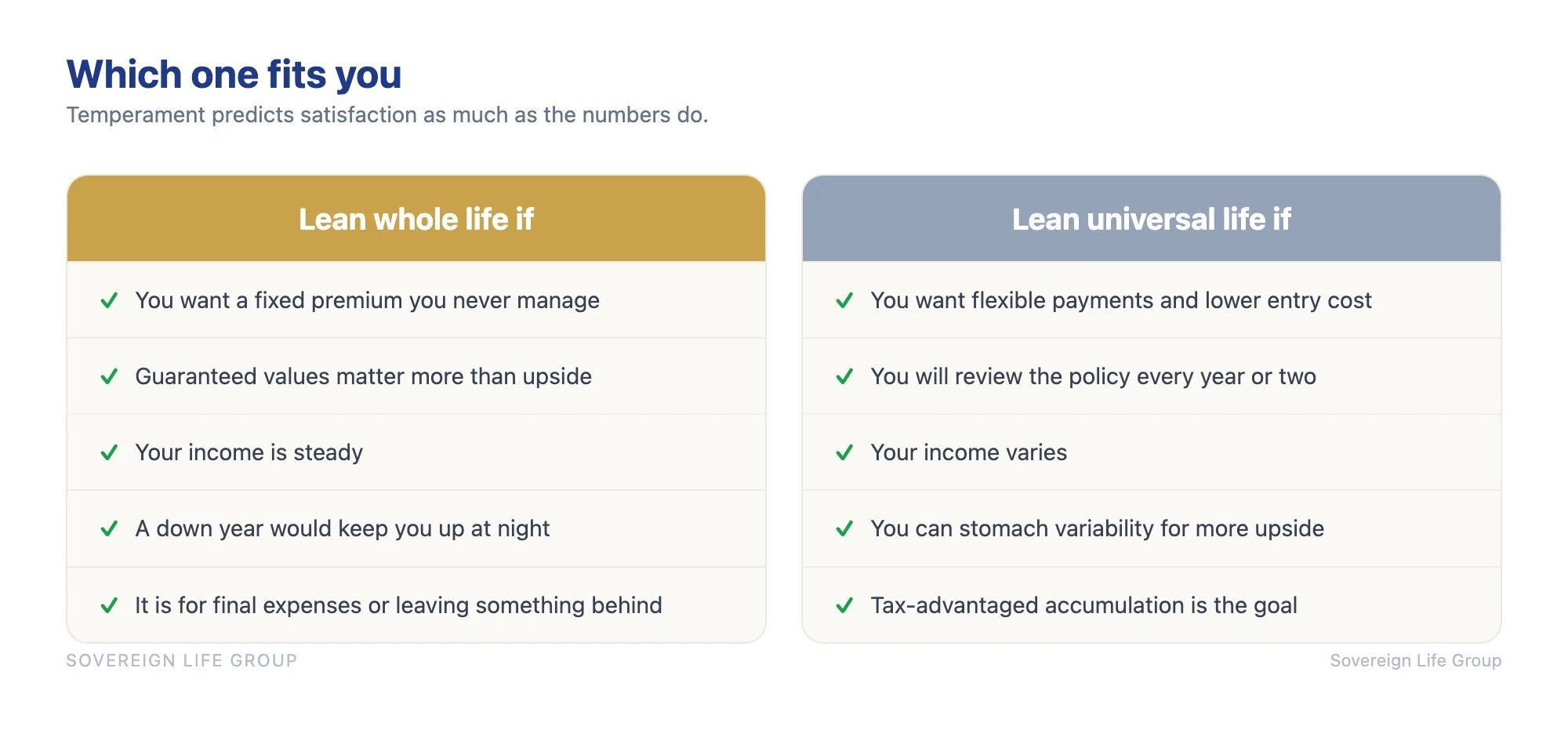
Whole life fits people who want certainty and simplicity, and universal life fits people who want control and growth potential. If you value a fixed premium and guaranteed values you never have to manage, lean whole life. If you value flexible payments, a lower entry cost, and higher upside, and you will actually review the policy, lean universal life. The deciding factor is your temperament as much as your finances.
Be honest with yourself on a few questions, because they predict satisfaction better than any rate of return.
- Will you manage it? Universal life rewards an owner who reviews funding every year or two. If you will file it away and never look again, the guarantees of whole life protect you from your own neglect.
- How steady is your income? Variable income pairs well with universal life's flexible premium. Steady income that can absorb a fixed bill pairs well with whole life.
- What is your risk tolerance? If a year of lower-than-projected growth would keep you up at night, whole life's predictability is worth its higher price. If you can stomach variability for more upside, indexed or variable universal life may fit.
- What is the policy really for? Final expenses and "leave something behind, no surprises" lean whole life or guaranteed universal life. Intentional tax-advantaged accumulation leans indexed universal life. A lifelong death benefit at the lowest cost leans guaranteed universal life.
And here is the answer no product brochure leads with: for a great many families, the right choice is neither one, at least not yet. If your biggest risk is dying during the mortgage-and-young-kids years, a large, affordable term policy often protects your family better per dollar than any permanent policy, and you can invest the difference. Permanent insurance earns its place when the need is genuinely lifelong or when tax-advantaged cash value is a deliberate goal, not a default. Our family coverage overview lays out how these pieces fit a real household budget rather than an ideal one.
How to shop without getting sold
To shop well, get the same case quoted by multiple carriers, always ask for the guaranteed column, and work with an independent agent who can show you more than one product. Decide first whether your need is lifelong, then choose between whole life and universal life on guarantees versus flexibility, and never buy on a non-guaranteed illustration alone. The process protects you more than any single product feature.
Here is the path I would walk a friend through, in order.
- Confirm the need is permanent. If the obligation ends, like a mortgage or the years until the kids are grown, term may be the smarter, cheaper tool. Settle this before comparing permanent policies.
- Match the product to your temperament. Certainty and simplicity point to whole life. Control, lower entry cost, and growth potential point to universal life, with the understanding that you will help manage it.
- Demand the guaranteed column on every illustration. If a policy only shines on the projected numbers, treat it as a warning. A sound policy holds up on its worst contractual assumptions.
- Compare carriers, not just products. An independent agent can run your exact profile across many A-rated carriers. The right product from the wrong carrier, or at the wrong price, is still the wrong outcome.
- Fund it the way you intend to perform. If you want universal life's upside, plan to fund above the minimum. Buying cheap and expecting rich is the most common path to disappointment.
- Read the surrender schedule and the loan provisions. Know what happens if you need out early and how borrowing affects the death benefit before you sign, not after.
If any agent only ever shows you one product, that is a flag, not a recommendation. You want choices and trade-offs laid out plainly so you can decide, which is exactly the kind of conversation you should expect from a strategist rather than a salesman. When you are ready to see your real numbers, you can get a clear, no-pressure comparison from Sovereign Life Group, your independent life insurance partner.
Want both policies compared for your real situation?
Fifteen minutes. We will look at your goals, your budget, and your health, then put whole life and universal life side by side with the guaranteed columns showing. No pressure, no jargon, just the honest math.
Get a Quote Book a 15-Min Call Prefer to start now? You can get a quick quote and we will follow up with options.Frequently asked questions
What is the main difference between whole life and universal life insurance?
Whole life is built on guarantees. The premium, the death benefit, and a minimum cash value growth rate are locked in for life. Universal life trades some of those guarantees for flexibility. You can adjust the premium and death benefit, and the cash value grows based on interest or an index, which means more upside and more responsibility to keep it funded.
Which builds more cash value, whole life or universal life?
It depends on the conditions and how the policy is funded. Whole life builds cash value steadily and predictably with a guaranteed floor, plus possible dividends. Universal life can grow faster in strong interest or index years, but it can also grow slower in weak years, and an underfunded policy can stall or lapse. Predictability favors whole life, ceiling favors universal life.
Can a universal life policy lapse even after years of payments?
Yes. If the cost of insurance rises with age and the premium plus cash value no longer covers it, a universal life policy can erode and eventually lapse, sometimes decades in. Whole life cannot lapse this way as long as the contractual premium is paid. This is the single most important risk to understand before choosing universal life.
Is the cash value in whole life or universal life taxed?
In both, cash value generally grows tax-deferred, and the death benefit is generally income-tax-free to your beneficiaries. Properly structured policy loans are typically not taxed while the policy stays in force. If a policy is overfunded past IRS limits it becomes a modified endowment contract, which changes how withdrawals are taxed. Always confirm specifics with a tax professional.
Is whole life or universal life better for retirement income?
Both can supplement retirement through tax-advantaged policy loans, but they behave differently. Whole life offers steadier, more predictable accumulation. Indexed universal life offers more growth potential with a floor against market loss, though caps and rising costs apply. The better tool depends on your risk tolerance, your time horizon, and how disciplined the funding will be.
Do I even need permanent life insurance, or is term enough?
For many families, affordable term life covers the years with the biggest obligations, a mortgage and growing kids. Permanent life makes sense when the need is lifelong, such as final expenses, a special-needs dependent, estate planning, or building tax-advantaged cash value on purpose. The honest answer is that plenty of people are better served by term, and a good agent will say so.
Joseph McDermott is a licensed life insurance agent (NPN 22121673), licensed in 27 states. Brokered through Family First Life, in partnership with Catalyst Life. This article is educational and is not financial, tax, or legal advice. Please talk with a licensed professional about your specific situation. Product availability, features, riders, and rates vary by state, age, health, and carrier, and any coverage is subject to underwriting approval. Guarantees are subject to the claims-paying ability of the issuing insurance company. IUL and other policy values that are not guaranteed may change, illustrated rates are not promises of future performance, and indexed policies include floors and caps that limit returns.