Becoming Your Own Banker by Nelson Nash: Summary and Key Takeaways


The Short Version
Nelson Nash's book teaches you to run your own financing with a dividend-paying whole life policy instead of paying banks for the privilege. The idea is real and the math can work, but it is a slow, long-haul strategy that only pays off with a well-built policy, years of steady funding, and honest expectations. Read it for the mindset, then check the numbers before you buy anything.
Clients ask me about this book more than almost any other. Someone hears a podcast, gets handed a worn paperback, or falls down a late-night YouTube hole, and the next morning they want to know if they should "become their own banker." So I wrote the becoming your own banker summary I wish they had read first: what Nelson Nash actually says, the key takeaways, an honest review, and the parts the people selling it tend to skip. No hype, no pressure, just a straight look at a strategy that is powerful for the right person and oversold to everyone else.
I am a licensed agent, and yes, I sell some of the policies this book describes. I am telling you that up front so you can weigh what follows. I will also tell you where the concept is weak, who should walk away from it, and when a plain term policy or a different product does the job better. That is the deal I make with every family I sit with on a call.
What this summary covers
- Who Nelson Nash was and why the book matters
- What Becoming Your Own Banker actually teaches
- The problem Nash starts with: you finance everything
- The key takeaways from the Becoming Your Own Banker summary
- A worked example: running your own bank
- Becoming Your Own Banker review: what holds up
- Whole life vs IUL: the piece the book skips
- Who should read this book, and who can skip it
- Frequently asked questions
Who Nelson Nash was and why the book matters
R. Nelson Nash was a forester turned life insurance agent who spent decades watching how compound interest behaves over long stretches of time. He wrote Becoming Your Own Banker in 2000 to explain one idea: that ordinary families give away enormous amounts of money in interest and lost growth, and that a properly built whole life policy can claw a lot of it back. The book launched the Infinite Banking Concept.
Here is the part that gives the book its odd credibility. Nash was not a Wall Street quant. He was a forester by training who spent ten years as a forestry consultant, work that runs on compound interest over forty and fifty year horizons, because that is how trees and timberland actually pay off. Then he sold life insurance for more than thirty years. Somewhere in the middle of a personal debt crisis, when interest rates on his own loans hit brutal levels, he noticed that the cash inside his whole life policies was the one pool of money working for him instead of against him. The concept grew out of his own scramble to survive, which is why the book reads like a man who lived it rather than a professor who theorized it.
The book is short. Under 100 pages. It is repetitive, it wanders, and it leans on analogies more than spreadsheets. I have handed it to clients who loved it and clients who found it maddening. What it does well is shift how you see money. Nash wants you to stop thinking of a bank as a building you visit and start thinking of banking as a function, one you are already performing badly every time you finance a car or pay cash and walk away from the growth that money could have earned.
No medical exam for a ballpark. Free, and no pressure.
What Becoming Your Own Banker actually teaches
Becoming Your Own Banker teaches you to become the source of your own financing. You overfund a dividend-paying whole life policy until it holds real cash value, then you borrow against that value to buy the things you would have financed anyway. The policy keeps growing as if you never touched it, and you pay the loan back on your own terms, recapturing interest you used to hand a bank.
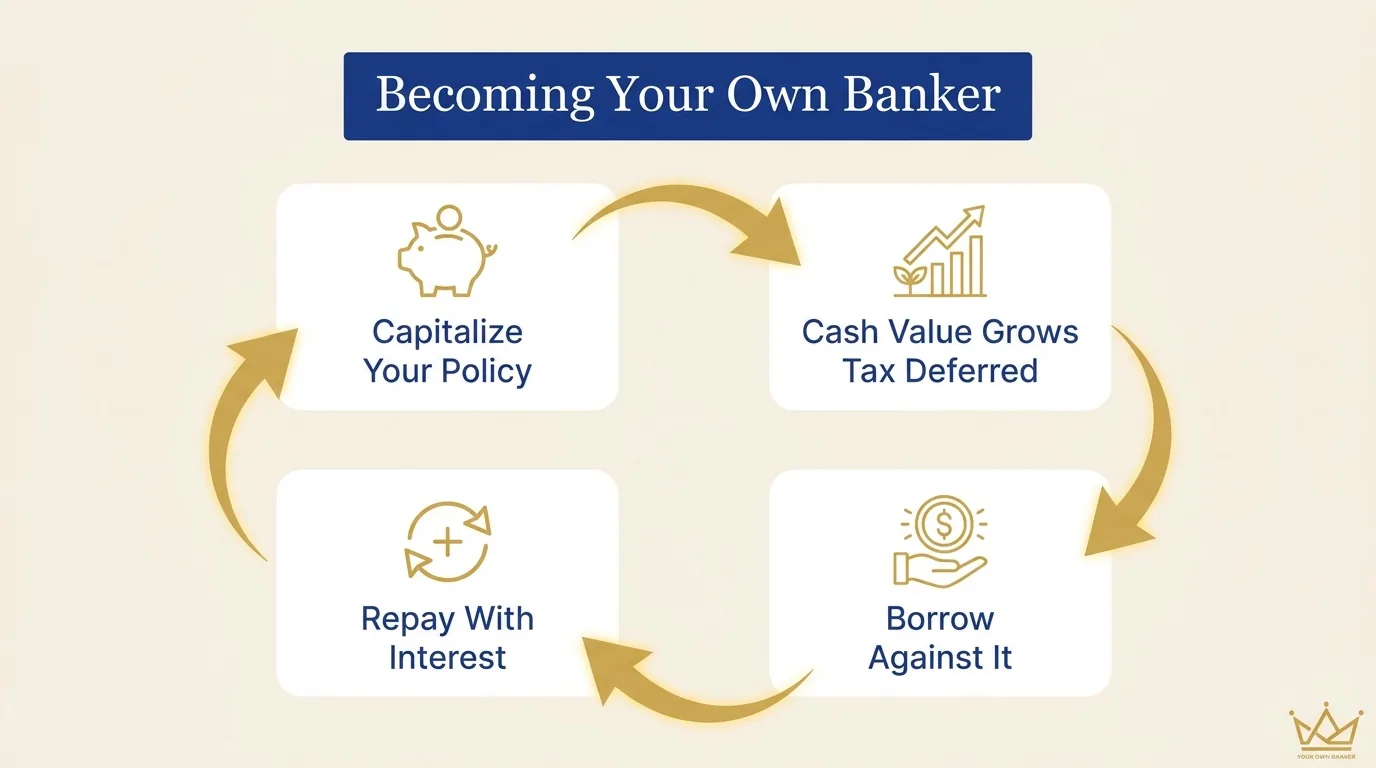
Let me slow that down, because the mechanics are where people get lost. A whole life policy from a mutual insurer does two things at once. It carries a death benefit, and it builds a cash value that grows on a guaranteed schedule plus non-guaranteed dividends the company may pay. When Nash says "become your own banker," he means you use that cash value the way a bank uses deposits. It sits there earning, and you borrow against it when you need capital.
The move that surprises everyone is that you do not withdraw your cash value to spend it. You take a loan from the insurance company and put up your cash value as collateral. Because you never actually removed the money, the full balance keeps compounding while you use the borrowed dollars elsewhere. That is the mechanical heart of the whole concept, and it is the same feature I walk through in plain terms in our guide to how cash value life insurance works.
Nash frames it around four parties in any financial transaction: the depositor, the borrower, the owner of the bank, and the bank itself. Most people play only two of those roles, depositor and borrower, and they lose on both. The whole point of the book is to move you into all four seats at once. You deposit, you borrow, you own the system, and you capture the profit that used to leave your household.
The problem Nash starts with: you finance everything
Nash's opening argument is that you finance every single thing you buy, whether you borrow or not. If you borrow, you pay interest to a lender. If you pay cash, you give up the interest that money could have earned for the rest of your life. There is no third option where financing costs you nothing, so the real question is who captures that cost, a bank or you.
This is the section that changes how people see their own money, and it is worth sitting with. Think about a family that buys a new car every few years for their whole adult life. If they finance, they pour a small fortune into interest over the decades. If they pay cash each time, they feel responsible, but they keep draining a pile of money that could have been growing, then rebuilding it, then draining it again. Nash calls this the difference between the "banking function" working for you or against you.
He uses a running example of financing automobiles four different ways over a working lifetime: leasing, borrowing from a bank, paying cash, and borrowing from a policy. The exact numbers in the book are dated now, but the shape of the argument holds. The person who owns the banking function ends up ahead of the person who rents it. That is the emotional hook of the book, and honestly, it is a fair one. Most families really do bleed money through financing without ever seeing the total.
Where I push back a little, and where the book does not, is that "pay cash and lose the growth" and "finance and pay interest" are not always as far apart as Nash makes them sound once you account for the cost of running the policy itself. Hold that thought. We come back to it in the honest review below, because it is the single most important caveat in this whole becoming your own banker summary.
The key takeaways from the Becoming Your Own Banker summary
The book's key takeaways split into two halves. The first half is mechanical, how a whole life policy can act as a private financing system. The second half is behavioral, the human habits that wreck the plan. Nash is oddly obsessed with the behavioral side, and after years of watching real families, I think he was right to be. The strategy fails on discipline far more often than on math.
The mechanical ideas
- Use a dividend-paying whole life policy from a mutual company. Mutual insurers are owned by policyholders, so dividends, when paid, flow back to owners. Nash wants the policy built for high early cash value, not the biggest death benefit an agent can sell. If you are weighing carriers, our rundown of the best whole life insurance for infinite banking compares the mutual companies most often used for this and what to look for in each.
- Capitalize before you use it. A bank cannot lend on day one. Neither can your policy. You have to fund it for a few years first so there is meaningful cash value to borrow against. Nash compares this to the startup phase of any real business.
- Borrow, do not withdraw. Loans keep your full cash value compounding as collateral. This is the feature that makes the whole thing tick, and it is the piece most people miss on the first read.
- Recapture the interest. When you repay your policy loan, you can choose to pay yourself back at a rate you set, redirecting money that would have gone to a bank back into your own system.
The human problems Nash warns about
This is the part of the book people forget, and it is the most useful part. Nash borrows a handful of laws and syndromes to describe why smart people sabotage a good plan.
- Parkinson's Law. Spending rises to consume whatever money is available. If you do not deliberately capitalize your system, life will find a way to eat the premium.
- The Arrival Syndrome. The belief that you already know enough and have nothing left to learn. Nash saw it as the biggest barrier to the concept, because people dismiss it before they understand it.
- Willie Sutton's Law. Named for the bank robber who robbed banks "because that is where the money is." Nash uses it to point out where the profit in the financial system really sits, and who gets to keep it.
- Use it or lose it. A capitalized system sitting idle does little good. The value comes from actually running your financing through it over and over.
The mistake I see most is people treating this as a product to buy rather than a habit to build. They fund a policy, borrow once for a vacation, never pay it back, and then wonder why the magic did not happen. Nash would have told them the truth: the policy was never the strategy. The discipline was. If you want the broader philosophy in Joseph's own words, I wrote it up in our overview of how the be your own bank strategy actually works.
Get a fast, free estimate tailored to your age and health.
A worked example: running your own bank
A simple worked example makes the concept concrete. You fund a well-designed policy for several years until it holds solid cash value. When you need to buy something, a car, a business tool, a bridge to a real estate deal, you borrow against that value instead of using a bank. The policy keeps growing, you repay yourself over time, and you run the next purchase through the same pool.
Let me put fake but honest numbers on it, clearly labeled as illustration and not a quote. Say a family commits to a policy and, after a capitalization period, they have real cash value built up. In year eight they need a $30,000 vehicle. Instead of financing it at a dealership, they request a policy loan for $30,000. The insurer lends it, using their cash value as collateral. Crucially, their full cash value keeps earning, because they borrowed against it rather than pulling it out.
Now they do the part almost everyone skips. They set up a repayment to their own policy on a schedule, often at a payment similar to what the dealer would have charged. Over the next few years they pay the loan back with interest. The insurer gets its contractual loan interest, and the family directs their repayment discipline back into a system they own instead of one the dealership owns. When the loan is cleared, the cash value is intact and larger, ready for the next purchase.
That is the mechanism working as intended. But look closely at the chart above and you will see the honest catch. In the early years, total cash value sits below total premiums paid. That gap is the cost of the death benefit and the policy's expenses, and it is real. The strategy is designed to make that gap close and then reverse over a long horizon. If you need your money to be worth more than you put in by year three, this is the wrong tool, full stop.
| Question | Borrow from your policy | Borrow from a bank |
|---|---|---|
| Does your money keep growing? | Yes, cash value stays as collateral | No, cash is spent or pledged elsewhere |
| Who sets the repayment pace? | You do, within the contract | The lender does |
| Is there a credit check? | No, it is your collateral | Usually yes |
| Is there a cost? | Yes, loan interest plus policy costs | Yes, loan interest and fees |
| What if you never repay? | Loan reduces the death benefit and can risk a lapse | Default, collections, credit damage |
Notice that last row. Both columns have a real downside. The people who sell this concept love the left column and go quiet on the fact that an ignored policy loan, left to compound, can eat your cash value and, in a worst case, cause the policy to lapse. When a policy lapses with a loan bigger than what you paid in, the difference can become taxable income. That is not a reason to avoid the strategy. It is a reason to run it with your eyes open, which is why it pays to learn how to borrow against your life insurance policy before you take the first loan.
Becoming Your Own Banker review: what holds up
My honest review is that Becoming Your Own Banker is a genuinely valuable book with a real blind spot. What holds up is the mindset: the idea that banking is a function you can own, that most families leak money through financing, and that a cash value policy can recapture some of it. What does not hold up is the way the book, and especially its sellers, glosses over cost, time, and the boring math that decides whether it actually beats the alternatives.
Let me give the book its due first, because it earns it. Nash correctly identifies that Americans are chronically underinsured and under-saved, and that the financing habit is a quiet wealth killer. He is right that whole life is a real asset with legal protections in many states, tax-advantaged growth, and a contractual loan feature that most people never knew they had. And he is right that the biggest enemy of any long-term plan is the person running it. According to 2024 research from LIMRA, about 102 million American adults say they need life insurance or need more of it, so the underlying gap Nash worried about is very real.
Whole life is also not a fringe product. It remains one of the largest slices of the life insurance market. According to LIMRA data for 2024, whole life made up roughly a third of new individual life insurance premium, more than any other single product line. So the vehicle the book relies on is mainstream and heavily regulated, not some exotic loophole.
Where I push back on the book
Now the caveats the sales crowd tends to bury. These are the reasons I talk some people out of this strategy on our calls.
- The early years are slow and costly. A chunk of your first years of premium goes to the cost of insurance and to the agent's commission, not to your cash value. The break-even can take years. If you might need the money soon, this is the wrong home for it.
- Dividends are not guaranteed. The illustrations lean on non-guaranteed dividends. Companies have strong track records, but the word "projected" is doing real work, and any honest agent will show you the guaranteed column too.
- Opportunity cost is real. For a young, healthy person with a long horizon, buying cheaper term insurance and investing the difference has beaten whole life plenty of times. Nash barely engages this argument, and it deserves engaging. Our breakdown of term versus whole life insurance lays out both sides.
- It rewards discipline and punishes everyone else. The concept only works if you actually repay your loans and keep funding the system for decades. Most people are not built that way, and the book underestimates how many will quit.
- Policy loans are not free money. The insurer charges interest on the loan. The pitch that you are "borrowing from yourself" is a useful simplification, but the mechanics involve a real cost you should see in writing.
So is it worth it? For a saver with steady income, a long time horizon, and the discipline to run the system, a properly built policy can be a legitimate and durable part of a plan. For someone chasing a quick win or stretching to afford the premium, it is a mistake dressed up as a strategy. The book is worth reading either way, because the mindset is valuable even if you never buy a policy.
Whole life vs IUL: the piece the book skips
Nash wrote before indexed universal life was common, so the book only ever discusses whole life. That leaves out a question I get on almost every call: can you run a version of this with an IUL instead? The short answer is that you can pursue similar cash value banking with an indexed universal life policy, but the trade-offs are different, and neither one is automatically better.
Whole life is the more predictable of the two. The cash value grows on a contractual, guaranteed schedule, and dividends, while not guaranteed, come from insurers with long histories of paying them. It is the "set it and forget it" version, which is exactly why Nash liked it. The trade-off is a lower growth ceiling and a premium that is fixed and often higher.
Indexed universal life ties part of your growth to the performance of a market index, with a floor that protects you from index losses and a cap that limits your upside. It offers flexible premiums, which some families love and others abuse. The catch is that the caps, participation rates, and internal costs are not fixed forever, so an IUL needs to be reviewed over the years, not ignored. It is a more hands-on vehicle. If you want the deeper mechanics, our indexed universal life and tax-free retirement page walks through how those policies are built and where they fit.
My take, after fitting both to real families: whole life suits the person who wants certainty and will never touch the dial. IUL suits the person who wants more upside potential and will actually pay attention to the policy over time. Nash would push you toward whole life every time, and for his personality, he was probably right. Your personality might be different. This is exactly the sort of thing worth talking through with a human before you commit a dollar, which is the whole reason Sovereign Life Group builds life insurance strategies around the person, not the product.
Who should read this book, and who can skip it
You should read Becoming Your Own Banker if you want to understand how money and financing move through your life, and if you are the kind of person who can commit to a long, patient plan. You can skip it if you are looking for a fast return, cannot comfortably fund a policy for years, or would be tempted to borrow and never repay. The mindset is worth the afternoon it takes to read, even if the strategy is not for you.
Here is how I sort it on a call. This strategy tends to fit people who:
- Have stable income and can commit to a premium for the long haul without straining the budget.
- Already have their basics covered, an emergency fund, some retirement savings, and enough term coverage to protect their family right now.
- Value control and certainty, and would genuinely run their financing through the system rather than let it sit.
- Want a conservative, tax-advantaged place for money they will not need for a decade or more.
- Own a business or buy assets regularly, where the financing volume makes the recaptured interest add up.
And it tends to be a poor fit for people who:
- Are stretching to afford the premium, or might need the cash within a few years.
- Have high-interest debt that should be attacked first, before any long-term policy funding.
- Are young and mainly need the most death benefit per dollar, where term plus investing may serve better.
- Would not have the discipline to repay policy loans, which is what makes the whole thing work.
I have talked more than a few people out of this over the years, and I have never once regretted it. If your foundation is not solid, a fancy banking policy on top of a shaky budget just piles on risk you do not need. Get the basics right first. If you want the family-money philosophy behind all of this in book form, that is exactly why I wrote The Family Bank, and you can read it free.
One more honest note on taxes, because people ask. The reason this strategy is tax-advantaged at all is that life insurance sits in a special corner of the tax code. Policy loans are generally not treated as taxable income while the policy stays in force, and the cash value grows tax deferred. You can read a neutral overview of how life insurance is treated at the Insurance Information Institute, and the rules that define life insurance for tax purposes live in Section 7702 of the Internal Revenue Code. None of that is a loophole. It is simply how the product has always been taxed, and it is a big part of why Nash built the concept on it.
Want a straight answer for your situation?
Fifteen minutes. We will look at your income, your goals, and whether an infinite banking style policy actually fits, or whether something simpler does the job. No pressure, no jargon, just the honest math.
Get a Quote Book a 15-Min Call Prefer to start with the basics? See how coverage fits a household on the families coverage page.Frequently asked questions
What is the main idea of Becoming Your Own Banker?
The main idea is that you can run your own financing instead of handing that job to banks. Nash argues that a properly built dividend-paying whole life policy holds cash you can borrow against, so you keep the growth working while you fund cars, homes, and business needs, then pay yourself back over time.
Is the infinite banking concept a scam?
No, it is not a scam. It uses a real, regulated financial product, dividend-paying whole life insurance, in a legitimate way. The fair criticism is that it is oversold. It works only when the policy is designed well, funded consistently for years, and used with discipline. Sold as a shortcut to fast wealth, it disappoints people.
What kind of life insurance does Nelson Nash recommend?
Nash recommends dividend-paying whole life insurance from a mutual company, structured for high early cash value rather than the largest possible death benefit. He does not recommend term insurance for this strategy, because term builds no cash value to borrow against, which is the whole engine of the concept.
How much money do you need to start infinite banking?
There is no single number, but the strategy rewards consistent premium you can commit to for many years, often a few hundred dollars a month or more. What matters more than the amount is that the premium is sustainable, because the early years build slowly and cutting it short undoes most of the benefit.
Is Becoming Your Own Banker worth reading?
Yes, if you want to understand how money and financing really move through your life. The book is short and repetitive, and it reads more like a philosophy than a manual. Read it for the mindset shift, then get an honest illustration from a licensed agent before you act on it.
What are the downsides of the infinite banking concept?
The main downsides are slow early cash value, real ongoing costs inside the policy, a long time commitment, and dividends that are not guaranteed. Policy loans also charge interest and can cause a lapse if they are ignored. It is a long-horizon strategy that punishes people who quit early or skip the honest math.
Joseph McDermott is a licensed life insurance agent (NPN 22121673), licensed in 27 states. Brokered through Family First Life, in partnership with Catalyst Life. This article is educational and is not financial, tax, or legal advice. Please talk with a licensed professional about your specific situation. Product availability, features, riders, dividends, and policy loan terms vary by state, age, health, and carrier, and any coverage is subject to underwriting approval. Whole life dividends and IUL index returns are not guaranteed. Guarantees are subject to the claims-paying ability of the issuing insurance company.