The History of Life Insurance: Rome to Today


The Short Version
The history of life insurance is really the history of neighbors pooling money so a grieving family would not be left with nothing. Rome had burial clubs. Guilds had funds. Then math showed up, and a simple promise became a real industry. The promise never changed.
The history of life insurance starts with a worry that is older than money itself: what happens to the people I love if I am gone? Long before there were policies or premiums, families asked that question around fires and kitchen tables, and they kept arriving at the same answer we still use today. You spread the risk. You pool a little from a lot of people, and when one family is hit, the group catches them.
It is a good story, and an honest one. It runs from Roman burial clubs to medieval guilds, through the first life table and the first real companies in London, across the ocean to a fund for Presbyterian widows, and into the product zoo of term, whole life, and indexed universal life that families choose from now. This guide walks the whole arc, plainly, and then shows why a 2,000-year-old idea still decides whether your own family ends up okay. Let us start at the beginning.
What this guide covers
- Ancient origins: Egypt, Greece, and Rome
- Medieval guilds and friendly societies
- 1583: the first known life insurance policy
- Lloyd's coffeehouse and the merchant roots
- 1693: Edmond Halley does the math
- 1706 and 1762: the first real companies
- 1759: life insurance crosses to America
- The 1800s: life insurance goes mainstream
- The 20th century: one promise, many shapes
- The digital age: faster, simpler buying
- A timeline of the history of life insurance
- Then versus now: what actually changed
- What the history teaches a modern buyer
- Why it still matters for your family
- Frequently asked questions
Ancient origins: Egypt, Greece, and the first time strangers pooled their money
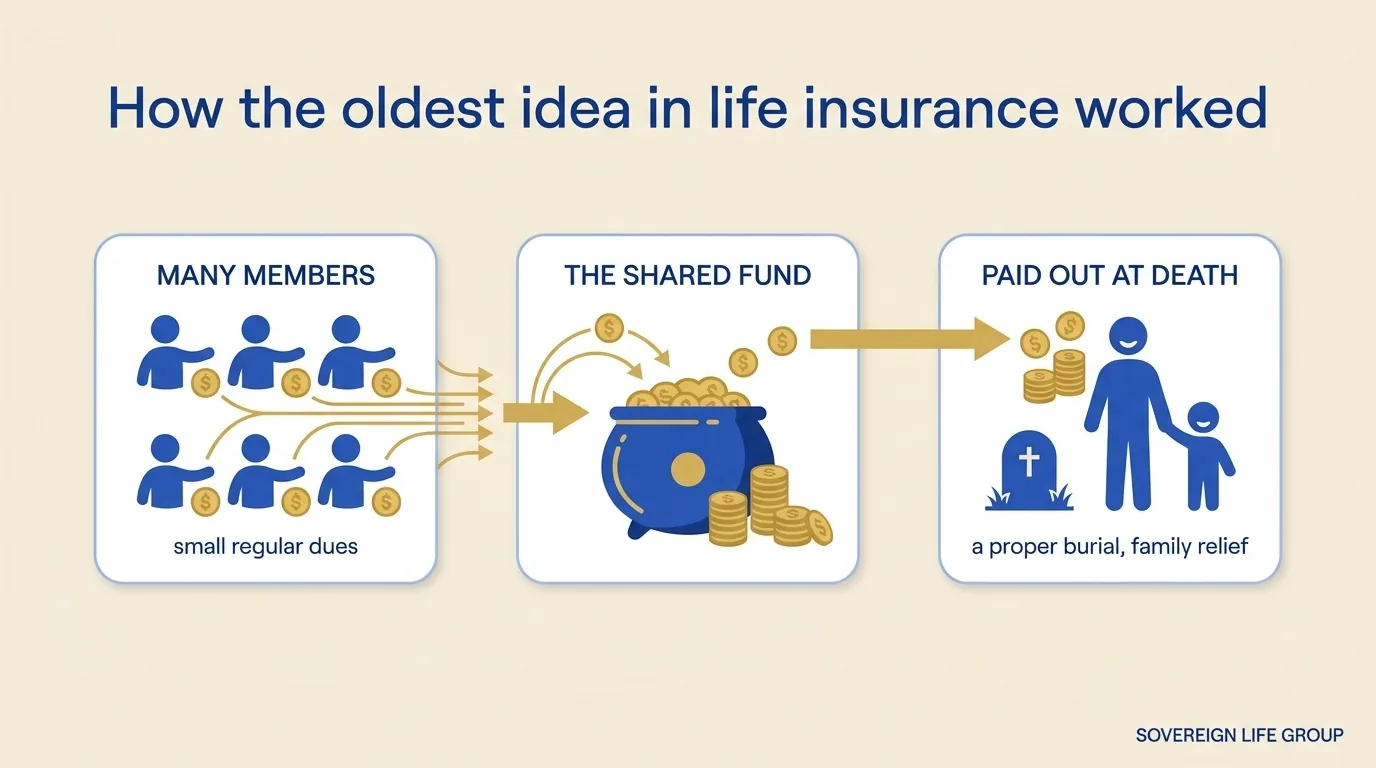
The instinct behind life insurance is far older than any company. Reach back far enough and you find people in the ancient world already solving the same problem: a death should not financially destroy the people left behind.
In ancient Egypt, stonemasons and craftsmen are believed to have set aside part of their pay into shared funds that helped cover the cost of a proper burial for a fellow worker. In the Greek and Roman world, mutual societies known as benefit clubs collected dues and stood ready to help a member's household at death. The details differ by place and century, but the shape is unmistakable. Many people each give a little, regularly, and the pool stands behind any one of them when the worst happens.
Rome and the burial clubs
Roman society took funerals seriously. A proper burial was not a nicety. Many believed that without one, a person could not pass on to the afterlife. The trouble was the cost. Funerals were expensive then, same as now, and a poor family could be wrecked by one.
So Romans formed clubs. These were the collegia, fraternal and trade associations, and among the poor, the collegia tenuiorum, the associations of modest means. Members paid small, regular dues into a shared pot. When one of them died, the club covered the burial and the rites, and made sure the person was not dumped in a pauper's grave. A Roman general named Caius Marius is often credited with formalizing a version of this for soldiers, so a fallen man's burial and honor were paid for by the group rather than left to chance.
Look closely and you will see the whole idea of life insurance sitting right there in the ancient world. Regular contributions. A shared fund. A payout when a member dies. The Romans even got the human part right. These clubs were also where people gathered, held small offices, and felt like they belonged to something. Protection and community, bundled together. That is not a footnote. It is the emotional core of the product, and it has never left.
No medical exam for a ballpark. Free, and no pressure.
Medieval guilds: protection becomes a system
After Rome, the idea did not vanish. It moved into the workshops. Through the Middle Ages, craftsmen and merchants ran guilds, and many of those guilds kept a mutual aid fund. If a member died, the fund helped cover the burial and, often, supported the widow and children left behind. Some guilds went further and helped members who were sick, injured, robbed, or burned out of a shop, which makes them an ancestor of several kinds of insurance at once.
Guild records from roughly the 13th through 16th centuries show these arrangements getting more formal over time. Set dues. Clear rules about who qualified. Decisions about how much help a family could expect, and for how long. That is a quiet but important shift. Charity is generous but unpredictable. A system, with rules everyone agrees to in advance, is something a family can actually count on.
As the guilds faded, their role passed to the friendly societies, member-owned groups that pooled dues to pay out at sickness or death. These societies spread widely in Britain and later in America, and for many working families they were the only safety net there was. The guilds and the friendly societies were the bridge between a Roman burial club and a real insurance company. The missing piece was math.
1583: the first known life insurance policy
Before companies, there were one-off deals. The earliest life insurance policy that historians can point to was written in London in June 1583. A group of merchants agreed to insure the life of a man named William Gibbons for a single year, in exchange for a payment up front. If he died inside the year, the underwriters paid out a far larger sum.
It is a milestone, but be honest about what it was. With no reliable way to measure the odds of death, the price was a guess, and the deal was closer to a structured wager on one man's life than to the steady, fairly priced protection we know today. There is even a famous wrinkle: when Gibbons died, a dispute broke out over whether the "year" meant twelve calendar months or twelve lunar months of 28 days, because the difference decided whether the claim was valid. Early insurance was full of arguments like that, which is exactly why the arrival of real data mattered so much.
Lloyd's coffeehouse and the merchant roots of insurance
The next chapter ran through the smell of coffee. In the late 1600s, a London coffeehouse run by Edward Lloyd became the gathering spot for ship owners, sea captains, and merchants. Over cups of coffee, men who had money to risk would agree to cover part of the danger of a voyage in exchange for a fee. They would write their names under the terms of the risk they were accepting, which is where the word underwriter comes from. That informal market grew into Lloyd's of London, one of the most important names in insurance history.
Most of that early activity was marine insurance, covering ships and cargo rather than lives. But it built the habits, the language, and the trust networks that life insurance would later borrow. People learned that a risk could be shared, priced, and written down as a contract that strangers would honor. Once that idea was normal for a cargo of spices, applying it to a human life was a shorter leap than it sounds.
Where the words come from
A lot of the vocabulary you still see on a policy was minted in exactly these centuries, and knowing the roots makes the modern paperwork less intimidating. Underwriter, as noted, comes from those Lloyd's coffeehouse risk-takers signing their names under the terms they agreed to cover. Premium traces to the Latin for a reward or payment given. Actuary began as the title for a registrar or record-keeper and grew into the name for the mathematicians who price risk. And in Britain you will still hear life cover called assurance rather than insurance, a distinction that once separated covering a certain event, like a death that will happen eventually, from insuring against a mere possibility, like a fire. The words are old. The needs behind them are older.
1693: Edmond Halley does the math
Here is where the story turns. For centuries, people pooled money on instinct. Charge a little, hope it covers the claims, and pray. Nobody could actually calculate the odds of dying at a given age, which made fair pricing impossible.
Then in 1693, the astronomer Edmond Halley, yes, the comet man, built one of the first real life tables. Using birth and death records from the city of Breslau, now Wroclaw in Poland, he laid out how many people out of a group could be expected to die at each age. For the first time, you could look at a number and say, with reason, how likely a 30-year-old was to reach 40.
That table did not sell a single policy. What it did was bigger. It proved that human lifespan, across a large group, follows patterns you can measure. Risk stopped being a mystery and started being math. Everything fair about modern insurance, the idea that a young healthy person and an older person should not pay the same price, traces back to the kind of thinking Halley put on paper.
1706 and 1762: the first real companies in London
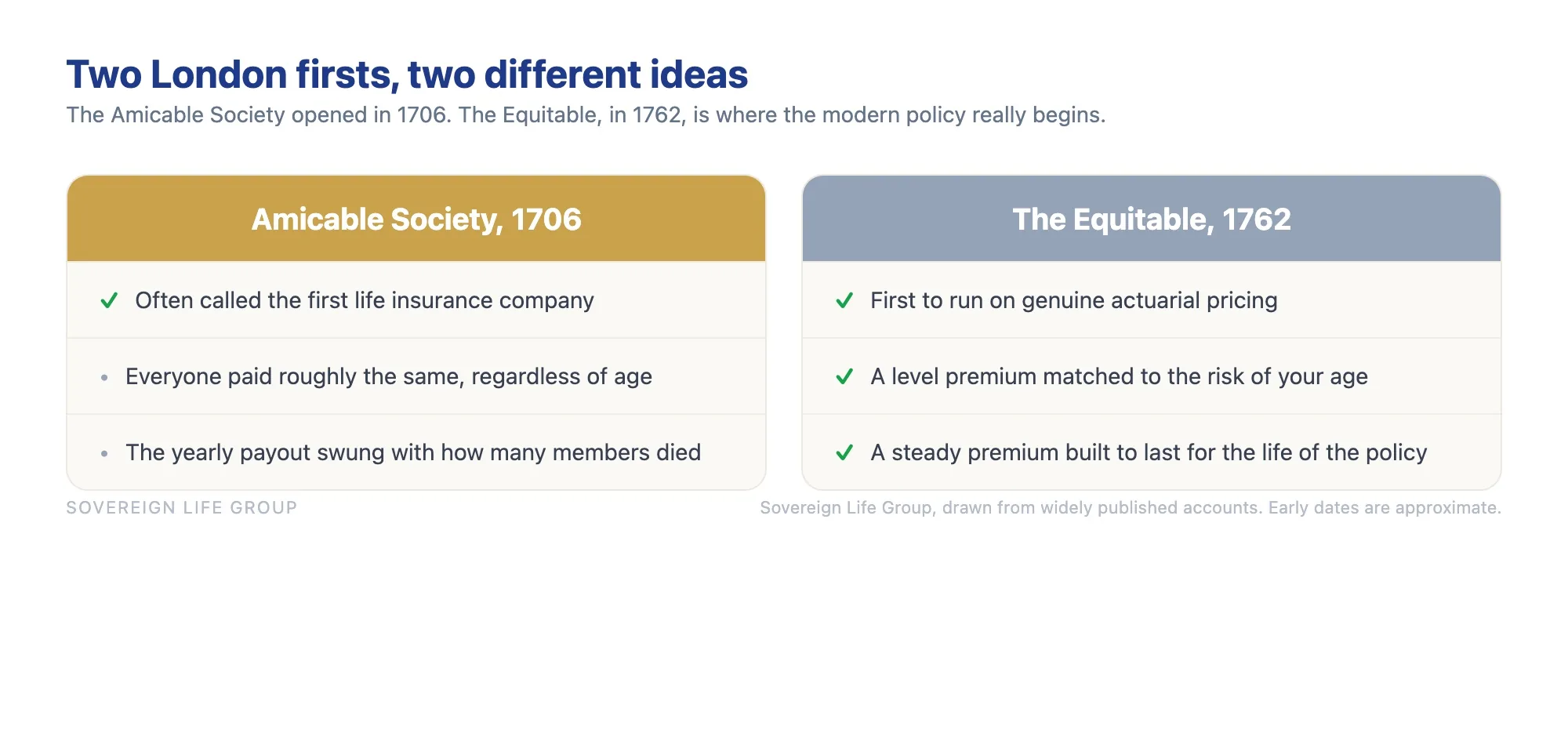
The math and the money finally met in London.
In 1706, the Amicable Society for a Perpetual Assurance Office opened its doors, founded with the backing of William Talbot and Sir Thomas Allen. It is widely called the first life insurance company. Members paid annual premiums into a shared fund, and the families of members who died that year split a payout. It worked, but it was rough. Everyone paid roughly the same regardless of age, which is not quite fair to the young and healthy, and the yearly payout could swing depending on how many members died.
The real breakthrough came in 1762, with the Society for Equitable Assurances on Lives and Survivorships, usually just called the Equitable. It was the first company to run on genuine actuarial principles. The pricing method came from the mathematician James Dodson, who designed a level premium system using mortality figures so that a customer paid a steady premium matched to the risk of their age. Dodson did not live to see it. He died in 1757, years before the company opened, and others carried his work across the finish line.
Later, the minister and mathematician Richard Price refined the company's approach, and in 1771 he published Observations on Reversionary Payments, which became a foundational actuarial text. With the Equitable, the rough idea of pooling money grew up into a profession. The modern life insurance policy, priced by age and built to last decades, starts here.
What the level premium actually solved
It is worth slowing down on Dodson's idea, because it is the hinge of the whole story. Earlier schemes charged everyone a similar amount, which meant the young effectively subsidized the old, and as members aged the cost of staying in climbed. A level premium fixed the price for the life of the policy by charging a little more than the true risk in the early years and building a reserve that covers the higher risk later. That structure, money set aside early to fund a promise kept later, is also the seed of cash value, the savings element inside permanent policies that arrived in full force much later.
1759: life insurance crosses to America
The idea reached the colonies fast. In 1759, a group of Presbyterians in Philadelphia incorporated a long-named organization: the Corporation for Relief of Poor and Distressed Widows and Children of Presbyterian Ministers. It is recognized as the first life insurance company in America, and it later became known as the Presbyterian Ministers' Fund.
The first customers were a small group of ministers, and the goal was plain and human. A preacher made little money and left little behind. When he died, his widow and kids could fall straight into poverty. So the church built a fund to catch them. That is the whole spirit of the thing in one sentence, and it is the same spirit that brings most families to coverage today.
A generation later, the business side filled in. In 1794, the Insurance Company of North America, formed in Philadelphia in 1792, began writing life policies, and the country slowly grew comfortable with the idea of insuring a life rather than only a ship or a building. There was real cultural resistance to clear first. Some people felt that putting a price on a life was crass, or even a gamble against Providence. It took decades, and a lot of plain talk from ministers and agents, for that discomfort to fade.
Get a fast, free estimate tailored to your age and health.
The 1800s: life insurance goes mainstream
The 19th century is when life insurance moved from a niche product into something ordinary families bought. New companies opened across the United States. New England Mutual Life received its charter in 1835, and the Mutual Life Insurance Company of New York began writing policies in 1843 as one of the country's first mutual life insurers, owned by its policyholders rather than outside investors. Names that families still recognize were born in this stretch.
That mutual model mattered. It put the company and the families on the same side, because the policyholders were the owners. By the middle of the century, dozens of carriers were selling to the general public, agents were knocking on doors, and a life insurance policy was becoming a normal part of providing for a household.
Industrial life insurance and the working family
One overlooked piece of the 1800s is industrial life insurance, small policies sold to working-class families with premiums of a few pennies, collected weekly by an agent who came to the door. The benefit was modest, often just enough to cover a funeral, but it brought coverage to millions of households that the larger policies never reached. It was the era's version of meeting families where they are, and at its peak this kind of small, accessible coverage made up a huge share of the policies in force.
Fraternal and mutual aid societies
Alongside the big carriers, a parallel movement carried the old burial-club spirit straight into modern America: the fraternal benefit societies. Groups organized around a trade, a church, an ethnic community, or a lodge collected dues from members and paid a death benefit to a member's family, often layering in a sense of brotherhood, ritual, and mutual obligation that a commercial policy never tried to offer. Orders like the Modern Woodmen of America, founded in 1883, and many immigrant and faith-based societies insured millions of working families who trusted their own community more than a distant company. Some of those societies still write life insurance today. They are the direct descendants of the Roman collegia, proof that the most ancient form of the idea, neighbors covering neighbors, never actually went away. It just put on a suit.
The Civil War and a sober lesson in risk
The American Civil War tested the young industry. Some companies had written policies without war clauses and suddenly faced claims they had never priced for. Others handled it more carefully. The lesson stuck: a promise to pay is only as good as the math and the reserves behind it, and a serious insurer has to plan for the bad years, not just the calm ones. That hard-won discipline is part of why, today, an established carrier can stand behind a claim decades after the ink dries. As the Insurance Information Institute documents each year, the modern industry now stands behind trillions of dollars of coverage in force. The Roman burial club had grown into a financial institution, but the job was identical: do not leave the family with nothing.
The 20th century: one promise, many shapes
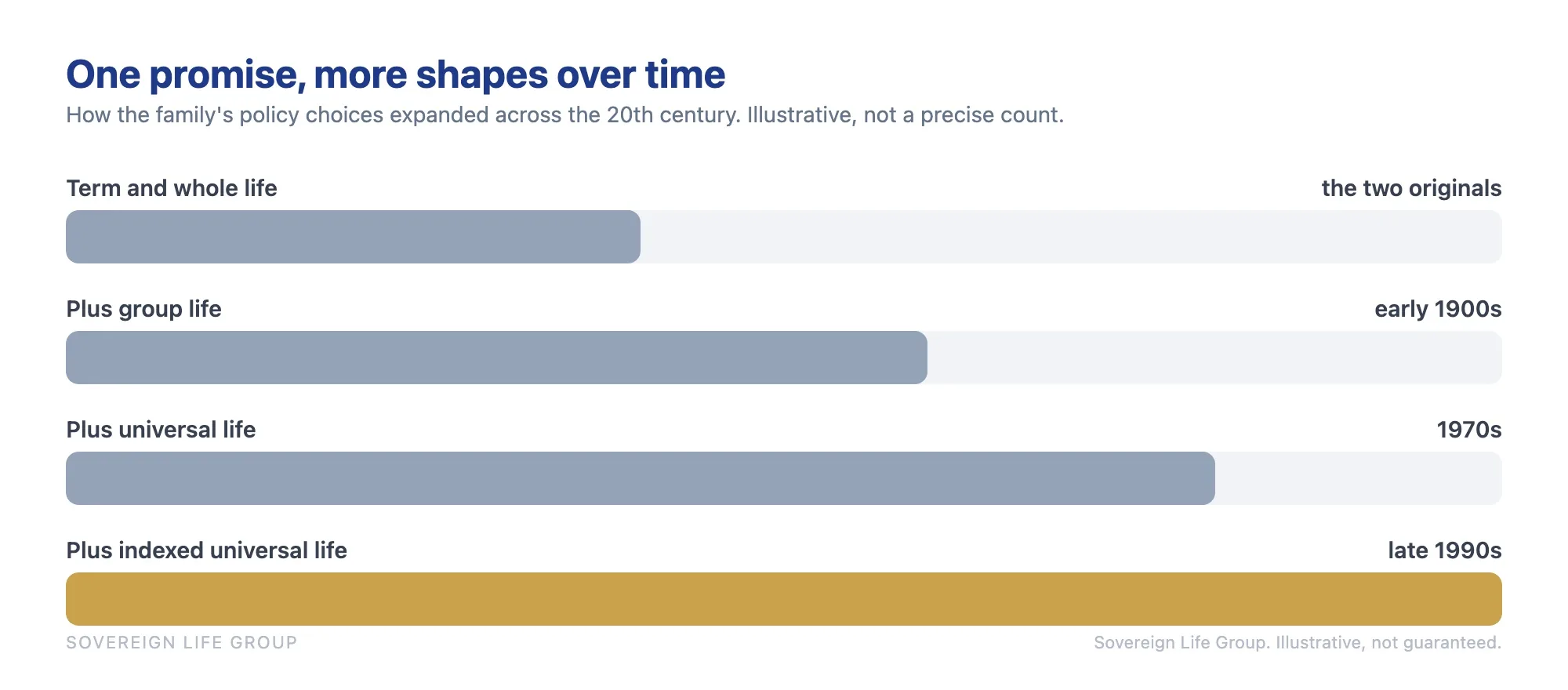
For a long time, you mostly had two choices: term life, which covers you for a set number of years, and whole life, which lasts your whole life and builds cash value. Both are still excellent tools. If you want the plain-English breakdown, we wrote a whole piece on term versus whole life.
The early 20th century also brought two big structural changes. First, group life insurance arrived, letting an employer cover a whole workforce under one plan, which is how a great many Americans got their first coverage and still do. Second, state regulation matured after public investigations into how the big insurers were run, producing the consumer protections, reserve requirements, and licensing rules that govern the business today. Insurance is regulated state by state, which is why product availability and features still vary depending on where you live.
From Halley to modern mortality tables
The quiet engine under all of this is the mortality table, and it never stopped improving. Halley's rough 1693 sketch grew into vast, regularly updated tables built from the records of millions of lives, refined by a profession of actuaries with their own standards and exams. Standardized industry tables let carriers price coverage consistently, and they get revised as people live longer, which is part of why level term coverage has generally become more affordable per dollar of benefit over the long run rather than less. The better the data, the fairer the price, and the safer the promise. That straight line from a single astronomer counting deaths in one city to today's actuarial science is the most underappreciated chapter in the whole story.
Then the economy forced some invention. In the 1970s, high inflation and rising interest rates made the old fixed whole life policies feel stale, so the industry created universal life, a more flexible policy that let owners adjust premiums and death benefits and respond to current interest rates. In the late 1990s came indexed universal life, which ties part of the policy's growth to a market index like the S&P 500, with guardrails against the down years and caps that limit the up years. If you are weighing that kind of policy, our overview of an indexed universal life policy walks through the trade-offs honestly, because the structure and fees matter a great deal and the growth is not guaranteed.
More options can mean more confusion, which is exactly why a good agent matters. The product zoo is large, but the question underneath it never changed since Rome: if you are gone, are the people you love okay?
The digital age: faster, simpler buying
The most recent chapter is the one happening right now, and it is changing the experience more than the product. For most of the 20th century, buying life insurance meant an agent at your kitchen table, a stack of paper, a medical exam with a nurse, and weeks of waiting for an answer. A lot of families simply never got past that friction, which is part of why so many households remain underinsured.
Two shifts have eased that. The first is accelerated underwriting, where carriers use data and algorithms to make a decision quickly for healthy applicants, often skipping the traditional medical exam entirely. The second is the move online, where you can compare options and apply from a phone in an afternoon. The 2020s pushed this forward sharply, as remote everything became normal and no-exam coverage went mainstream. There are real no-exam options now that simply did not exist for earlier generations.
Be honest about the trade-offs, though, because the history warns against believing in a free lunch. Faster does not always mean cheaper or better for your situation. No-exam policies can carry a higher price for a given benefit, or cap the coverage amount, and an algorithm that says yes quickly is still pricing your risk, just with different inputs. Convenience is a genuine gain. It is not a substitute for matching the policy to what your family actually needs. The technology is new. The questions worth asking are the same ones the Equitable's customers should have asked in 1762.
A timeline of the history of life insurance, at a glance
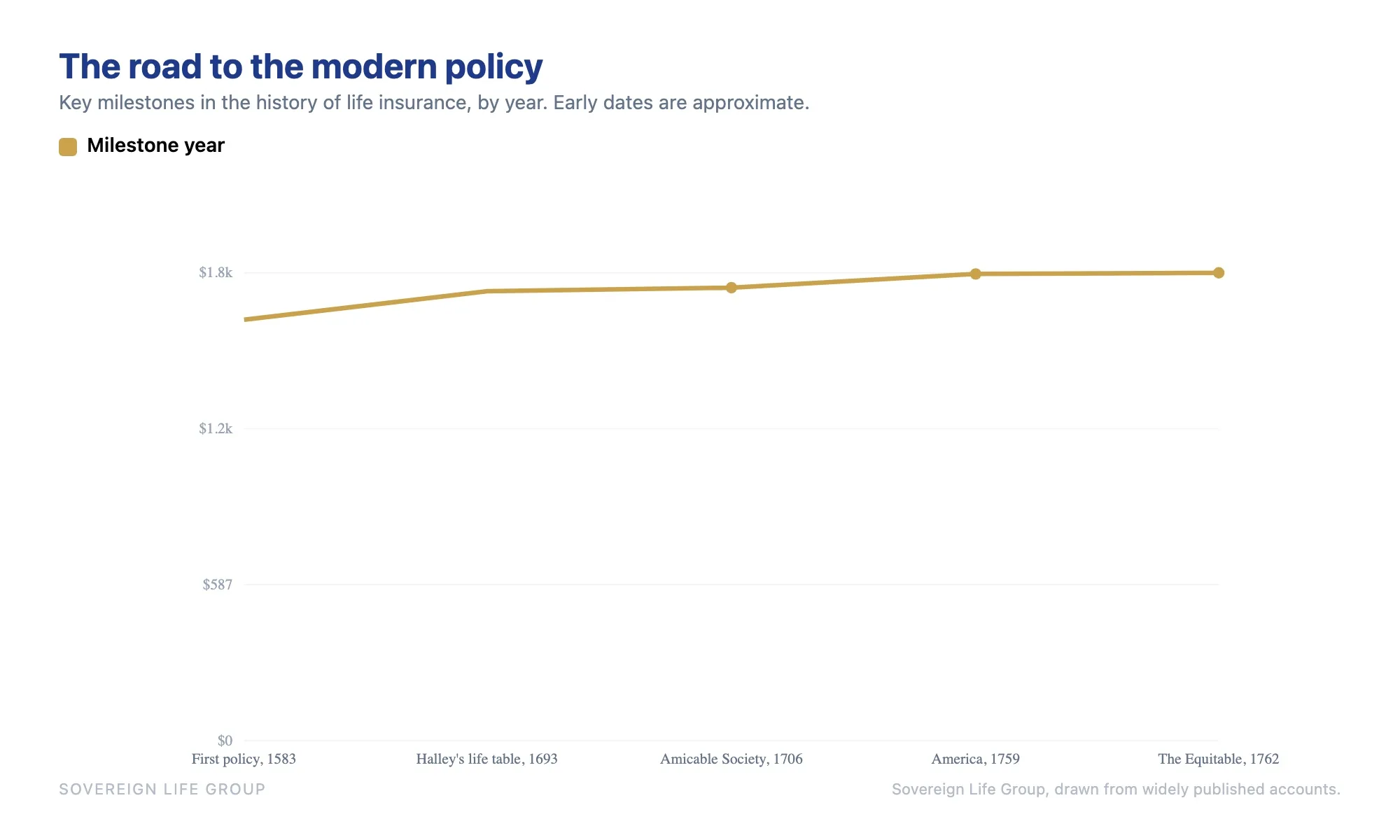
If you skimmed the story above, here is the whole arc in one place. Dates for the earliest events are approximate, because record-keeping was thin, but the order and the direction are solid.
| Era | What happened | Why it mattered |
|---|---|---|
| Ancient world | Egyptian craftsmen and Greco-Roman benefit clubs pool dues for burials | The core idea appears: many contribute, the pool pays at death |
| Roman era | Collegia and soldiers' burial clubs formalize regular dues and payouts | Contributions plus a death benefit, organized as a group |
| Middle Ages | Craft guilds and friendly societies run mutual aid funds | Protection moves from charity to agreed rules a family can rely on |
| 1583 | The first documented life insurance policy, on William Gibbons in London | A single life insured by contract, though priced by guesswork |
| Late 1600s | Lloyd's coffeehouse becomes a marine insurance market | Underwriting, pricing, and trust networks take shape |
| 1693 | Edmond Halley publishes an early life table | Mortality becomes measurable, so fair pricing is finally possible |
| 1706 | The Amicable Society opens in London | Often called the first life insurance company |
| 1762 | The Equitable launches with level premiums | The first true actuarial pricing, the modern policy is born |
| 1759 | The Presbyterian Ministers' Fund is incorporated in Philadelphia | The first life insurance company in America |
| 1800s | Mutual companies, industrial policies, and door-to-door agents | Coverage reaches ordinary and working families |
| 1900s | Group life, state regulation, universal life, indexed universal life | One promise splits into many policy types and protections |
Then versus now: what actually changed, and what did not
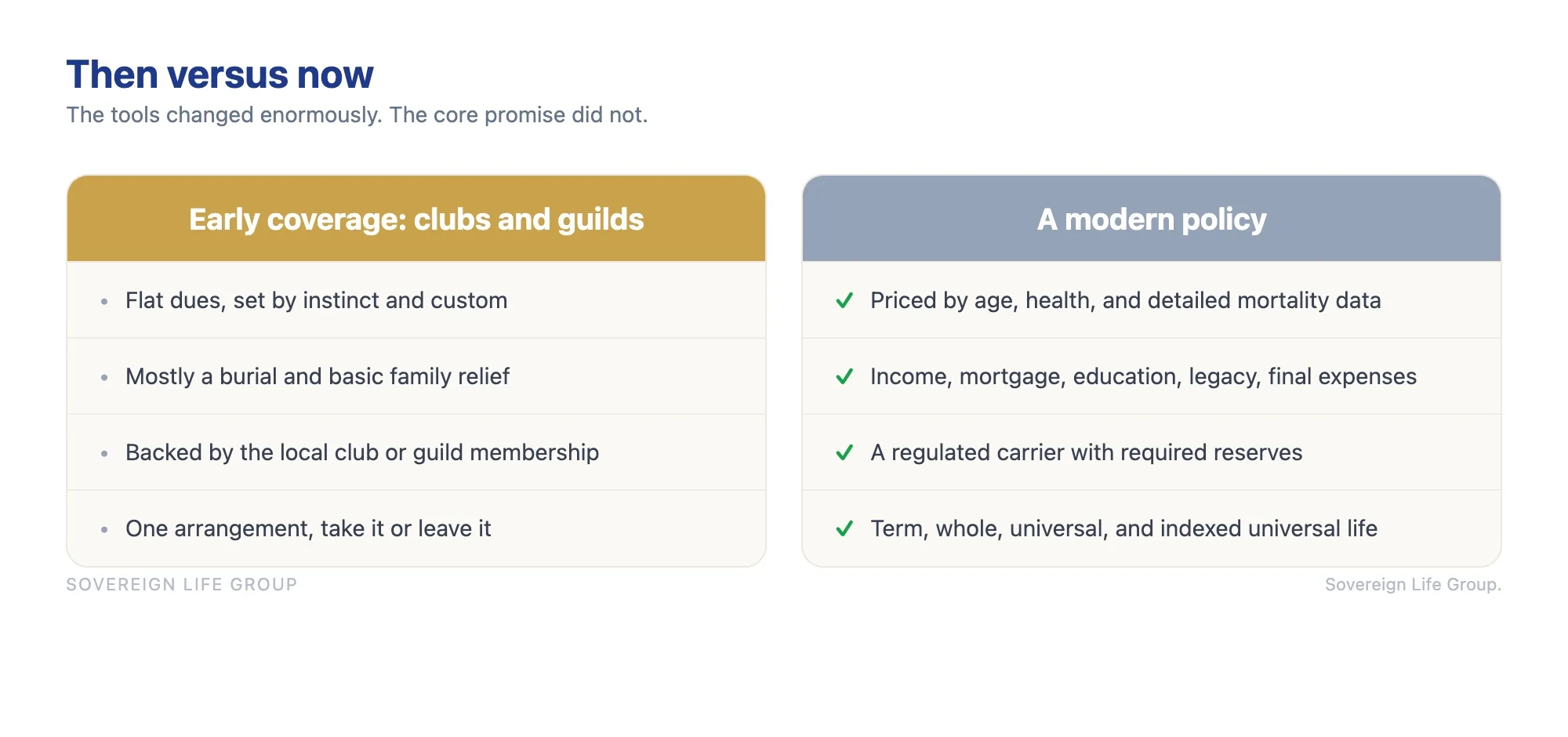
It is tempting to think modern life insurance is a completely different animal from a Roman burial club. In the machinery, yes. In the mission, not at all. The table below lines up the old way against the new, so you can see exactly which parts evolved and which part stayed put.
| Feature | Early coverage (clubs and guilds) | Modern policy |
|---|---|---|
| How it is priced | Flat dues, set by instinct and custom | Priced by age, health, and detailed mortality data |
| What it pays for | Mostly a burial and basic family relief | Income replacement, mortgage, education, legacy, final expenses |
| Who stands behind it | The local club or guild membership | A regulated carrier with required reserves, overseen by the state |
| Policy choices | One arrangement, take it or leave it | Term, whole life, universal, and indexed universal life |
| Fairness to the young | Limited, the young often subsidized the old | A healthy young buyer can lock a low level rate |
| The core promise | Do not leave the family with nothing | Do not leave the family with nothing |
That last row is the point of the whole article. Every other line changed. The bottom line never did.
What the history of life insurance teaches a modern buyer
This is not just a story for trivia night. The 2,000-year arc carries a few practical lessons that are still worth real money to a family shopping for coverage today. Here is what the history actually teaches:
- A promise is only as strong as the reserves behind it. The carriers that failed in hard years were the ones that priced too cheap or kept too little in reserve. When you compare policies, the financial strength of the company matters as much as the premium, because you are buying a promise that may not come due for forty years.
- Fair pricing rewards the young and healthy. Ever since Dodson's level premium, the system has been built to lock in a rate based on your age and health at purchase. That is why buying earlier, when you are younger, usually costs less over time. The math has favored the early buyer for 250 years.
- Match the policy to the actual job. The reason there are so many policy types now is that the single original product split to fit different needs. Term covers a temporary need like income years or a mortgage cheaply. Permanent coverage serves lifelong needs. Neither is simply better, and the honest move is to fit the tool to the job rather than buy the most expensive option by default.
- Beware a promise that looks too cheap. The earliest schemes that charged everyone the same, or guessed at the odds, eventually strained or collapsed. Be a little skeptical of any pitch that sounds like a free lunch, and ask what the trade-offs and fees really are.
None of that requires you to become an actuary. It just means asking the boring, durable questions the last three centuries taught the industry to answer.
Why a 2,000-year-old idea still matters for your family
Strip away the centuries and the jargon, and the history of life insurance has always pointed at one job. It keeps a death from becoming a financial catastrophe for the people left behind. A Roman family kept their dignity. A widow in a medieval town kept a roof. A minister's children in 1759 kept a future. The tools got more sophisticated. The mission did not.
Knowing the history changes how you shop, too. It reminds you that the steady, fairly priced policy you can buy today is the product of 300 years of hard lessons about reserves, pricing, and keeping promises, which is why the boring questions, is the carrier financially strong, does the policy actually fit my need, am I paying for coverage I will keep, matter more than the flashy ones. A policy is a promise stretched across decades, and the history is really a long argument for taking that promise seriously.
That is the part that pulls me into this work. At Sovereign Life Group, the whole point is to honor that original promise without the pressure or the fine-print games. We look at your actual life, your income, your kids, your mortgage, and we match it to the simplest coverage that protects them, whether that is term to cover the income years or a mortgage protection plan to keep the family in the home. If you want to see how we think before you ever talk to anyone, our guide for families lays it out, and you can read more plain-English breakdowns on our resources page. When you are ready, working with Sovereign Life Group, your life insurance strategist, means a real human walking you through the trade-offs, not a robot pushing the most expensive product.
Curious where your family fits in this story?
Fifteen minutes. We will look at your situation and show you the simplest way to protect the people who count on you. No pressure, no jargon, just a straight answer for where you actually stand.
Get a Quote Book a 15-Min Review Prefer to start small? Reach out and ask a real person a question.Frequently asked questions
What is the oldest life insurance company?
The Amicable Society for a Perpetual Assurance Office, founded in London in 1706, is widely considered the first life insurance company. The Society for Equitable Assurances on Lives and Survivorships, started in London in 1762, was the first to price policies using real actuarial math, which makes it the true ancestor of the modern policy.
When did life insurance start in America?
It started in 1759, when Presbyterians in Philadelphia incorporated the Corporation for Relief of Poor and Distressed Widows and Children of Presbyterian Ministers. It later became the Presbyterian Ministers' Fund and is recognized as the first life insurance company in America.
What was the first life insurance policy?
The earliest documented life insurance policy is usually dated to June 1583 in London, when a group of merchants insured the life of a man named William Gibbons for one year. It came before real actuarial pricing, so it was closer to a one-time wager on a single life than to a modern policy, but it shows the idea of insuring a life was already alive in the 1500s.
Who invented modern life insurance?
No single person, but two names stand out. Edmond Halley built one of the first life tables in 1693, and mathematician James Dodson designed the level premium method behind the Equitable Life Assurance Society in 1762. Their work turned life insurance from a gamble into a science.
How did the Roman burial clubs work?
Roman burial clubs, often organized as collegia, collected small regular dues from members into a shared fund. When a member died, the fund paid for a proper burial and the associated rites. The structure mirrors modern insurance almost exactly: regular contributions, a pooled fund, and a payout triggered by death.
How is today's life insurance different from the early versions?
Early coverage was basically a shared burial fund priced on instinct. Modern policies are priced with detailed mortality data and come in several forms, including term, whole life, universal life, and indexed universal life, so a family can match the coverage to their real goals and budget.
Joseph McDermott is a licensed life insurance agent (NPN 22121673), licensed in 27 states. Brokered through Family First Life, in partnership with Catalyst Life. This article is educational and is not financial, tax, or legal advice. Historical dates are drawn from widely published accounts and are approximate where records are incomplete. Please talk with a licensed professional about your specific situation. Product availability, features, and rates vary by state and carrier, and any coverage is subject to underwriting approval. Guarantees are subject to the claims-paying ability of the issuing insurance company.