Overfunded Whole Life Insurance: How It Works


The Short Version
Overfunded whole life insurance keeps the base coverage small and pours the rest of your premium into a paid-up additions rider, so cash value builds fast and stays liquid. You fund it right up to the IRS MEC limit without crossing it, which keeps loans and growth tax-advantaged. It rewards patience, not speed, and the design has to be right or it quietly loses to a plain policy.
Most people meet whole life insurance in its worst possible form: a big death benefit, a tiny premium, and a cash value that barely moves for a decade. Then someone shows them overfunded whole life insurance, where the same product is turned almost inside out, and it looks like a different thing entirely. Same carriers, same contracts, wildly different result. The difference is not luck. It is design. This guide walks through what overfunding actually does, how the MEC limit governs it, why paid-up additions are the engine, what it costs, a year-by-year example with real numbers, and the honest trade-offs that most sales pitches skip.
I write this as a licensed agent who builds these policies for families and reads the illustrations line by line. I will tell you where this strategy shines and where it falls apart, because I have watched both happen.
What this guide covers
- What overfunded whole life insurance is
- How overfunded whole life insurance works
- The MEC limit and the seven-pay test
- Paid-up additions, the engine of high cash value
- What it costs and how it is priced
- A year-by-year example with real numbers
- The honest pros and cons
- Overfunded whole life vs max funded IUL
- Who it is really for
- How to tell if a policy is designed right
- Is overfunded whole life insurance worth it?
- Frequently asked questions
What overfunded whole life insurance is
Overfunded whole life insurance is a permanent life insurance policy deliberately structured to build cash value quickly. You pay more than the minimum premium and steer the extra into a paid-up additions rider, so a large share of every dollar becomes usable cash value early instead of being eaten by first-year costs. The goal is high cash value life insurance you can borrow against, not a big death benefit.
Here is the plain-English version. A normal whole life policy is sold around the death benefit. The agent quotes the smallest premium that keeps a large payout in force, and the cash value comes along slowly as a byproduct. Overfunding flips the priority. You start with a smaller death benefit than your budget could buy, then you feed the policy extra money on purpose. That extra money does not buy more base insurance. It buys paid-up additions, which are almost all cash value from day one.
You will hear this same idea called a few different names, and they mostly point at the same design intent:
- Max funded whole life. Funded as close to the legal limit as the contract allows, to maximize early cash value.
- High cash value life insurance. A description of the result: a policy where cash value tracks close to what you have paid in, fast.
- Cash value life insurance, structured for growth. The umbrella category, tuned toward liquidity rather than a large payout.
The mistake I see most is people thinking overfunding is a special product you go buy. It is not. It is a way of building an ordinary participating whole life policy so that it does a different job. If you want the broader foundation first, our explainer on how cash value life insurance actually builds money is a good companion to this piece.
No medical exam for a ballpark. Free, and no pressure.
How overfunded whole life insurance works
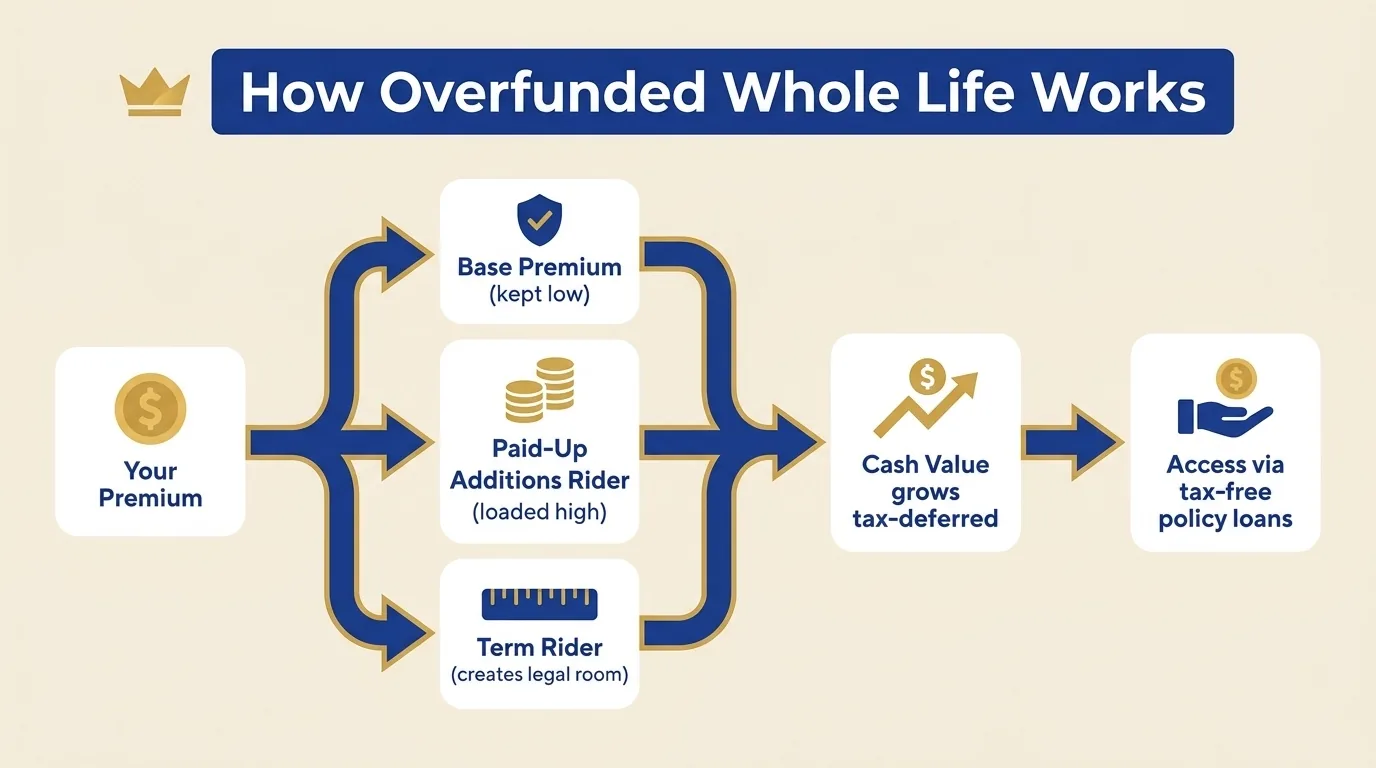
Overfunded whole life insurance works by splitting your premium into three parts: a small base whole life premium, a large paid-up additions rider, and often a term insurance rider that creates legal room for the extra money. The base keeps the policy alive, the paid-up additions build cash value fast, and the term rider lets you pay in more without triggering a tax reclassification.
Let me slow that down, because the mechanics are where the whole thing lives or dies.
The base policy
Every whole life contract has a base premium that guarantees a level death benefit and a guaranteed cash value schedule. In an overfunded design, the agent sets this base deliberately low. A smaller base means less of your money goes toward the expensive part of the policy, the first-year commissions and insurance charges, and more is free to build cash. Counterintuitive, I know. Less death benefit for the same money is exactly the point here.
The paid-up additions rider
This is the workhorse. A paid-up additions rider lets you buy small blocks of fully paid-up whole life insurance with extra premium. Each block adds cash value and death benefit immediately, with no new medical exam. Because there is almost no acquisition cost on a paid-up addition, roughly 85 to 90 cents of each dollar can show up as cash value right away in a well-built policy. That is the number that separates a real overfunded design from a dressed-up ordinary one.
The term rider that makes room
There is a ceiling on how much you can stuff into a policy before the IRS changes the rules, and that ceiling rises with the death benefit. So designers add a term insurance rider to raise the death benefit just enough to open more legal room for paid-up additions, without paying for a permanently large base. It sounds like a loophole. It is really just using the tax code the way it is written. More on that ceiling next.
Once the cash value is there, it grows tax-deferred, and you can borrow against it through policy loans that are generally tax-free. The loan does accrue interest and reduces the death benefit until repaid, so this is a tool with a cost, not free money. This borrow-and-repay rhythm is the heart of what people call the be your own bank or infinite banking approach, and overfunded whole life is the vehicle it usually runs on.
The MEC limit and the seven-pay test
The MEC limit is the maximum amount you can pay into a life insurance policy before the IRS reclassifies it as a Modified Endowment Contract. It is set by the seven-pay test, which compares what you pay in the first seven years against the amount needed to make the policy paid-up in seven level payments. Overfund past that line and you lose the tax perks.
This is the single most important rule in the whole strategy, so it is worth understanding rather than just trusting. Congress created the seven-pay test in 1988 to stop people from using life insurance as a pure tax shelter. According to the Internal Revenue Service, a contract that fails the seven-pay test becomes a Modified Endowment Contract, and once a MEC, always a MEC. There is no undo.
Why does that matter so much? Because a MEC keeps the tax-free death benefit but loses the living benefits that make overfunding attractive:
- Distributions flip to last-in, first-out. In a MEC, gains come out first and are taxed as ordinary income. In a normal policy, you can access your basis tax-free before you ever touch gains.
- A 10 percent penalty can apply. Take money out before age 59 and a half from a MEC and the taxable portion can carry an extra 10 percent penalty, similar to an early retirement withdrawal.
- Policy loans lose their edge. The tax-free loan feature, the whole reason people overfund, does not work the same way once the contract is a MEC.
So the entire craft of building one of these policies is funding it as heavily as possible while staying just under the MEC line. The exact dollar limit is personal. It depends on your age, your health class, the death benefit, and the carrier's pricing assumptions. A 40-year-old buying a one million dollar death benefit has a different seven-pay limit than a 55-year-old buying the same face amount. This is why a generic online quote cannot tell you your number, and why a good illustration is built around it.
Paid-up additions, the engine of high cash value
Paid-up additions are small pieces of fully paid whole life insurance you buy with extra premium or with dividends. Each one adds both cash value and death benefit right away, with no new underwriting. They are the reason overfunded whole life insurance builds cash so quickly, because a paid-up addition is almost entirely cash value on the day you buy it.
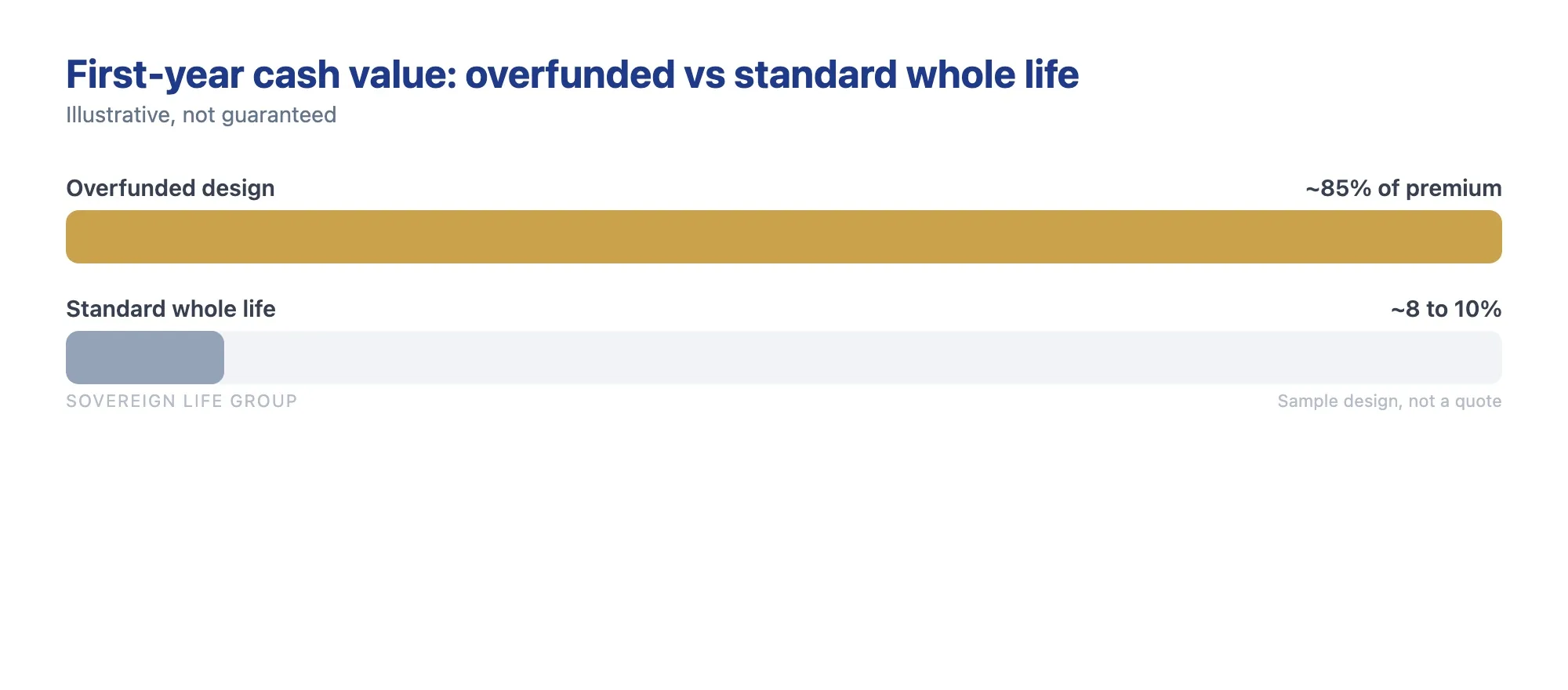
Think of a regular whole life premium as buying a car that loses most of its value the second you drive it off the lot. The first-year cash value is low because commissions and setup costs come out up front. A paid-up addition is the opposite. It carries almost no load, so nearly the entire dollar converts to equity you can use. Stack enough of them and your cash value can sit at 85 to 90 percent of everything you have paid in, even in the early years when a standard policy is still deep underwater.
Two things about paid-up additions that people misunderstand:
- They compound. Each paid-up addition is itself a tiny whole life policy that earns dividends and builds its own cash value. Over 20 or 30 years, additions on top of additions are what turn a modest premium into a meaningful pool of money.
- Dividends are not guaranteed. Mutual carriers have long histories of paying dividends, some stretching over a century, but a dividend is declared each year, not promised. In a weak year it can shrink. Any illustration showing dividends is showing a projection, not a contract.
That second point is where honest and dishonest presentations part ways. A projection at today's dividend scale is reasonable to look at. Treating it as a guarantee is not. Whenever I show a family an illustration, we look at the guaranteed columns first and the projected columns second, in that order, so the floor is clear before the upside gets exciting.
What it costs and how it is priced
Overfunded whole life insurance costs whatever you decide to fund it with, within a range the carrier sets. Unlike term life with one required premium, an overfunded policy has a minimum you must pay and a maximum defined by the MEC limit. Most designs target the top of that range. The real cost question is not the premium, it is how much of each dollar becomes usable cash.
That framing matters because "how much does it cost" is the wrong question here. You are not spending the money the way you spend a term premium. You are moving it from one place, your bank, to another place, the policy, where it keeps growing and stays reachable. The cost is the difference between what you put in and what shows up as cash value plus death benefit, which is why the design quality dominates everything.
Here is what actually drives the numbers, and which direction each one pushes.
| Factor | Effect | Why |
|---|---|---|
| Base to paid-up additions ratio | More PUA, faster cash | Paid-up additions carry almost no load, so they convert to cash value quickly |
| Your age | Younger funds more efficiently | Lower insurance cost leaves more room for cash accumulation |
| Your health class | Better health, better design | A preferred rate lowers the cost of the base and raises the MEC limit |
| Funding period | Longer horizon, more compounding | Paid-up additions build on each other over time |
| Carrier and dividend history | Varies by company | Dividend scale and pricing differ, and dividends are never guaranteed |
| Consistency of funding | Skipped years hurt | Missing planned PUA payments can shrink available room and slow growth |
A fair expectation for a healthy buyer funding steadily: expect your cash value to trail your premiums for the first few years, cross over somewhere around years 7 to 12 depending on design and dividends, and then pull ahead over the long run. Anyone promising you positive returns in year one, or a guaranteed rate, is selling harder than the product supports. There is no free lunch in a contract this conservative, and honestly, the conservatism is the feature.
A year-by-year example with real numbers
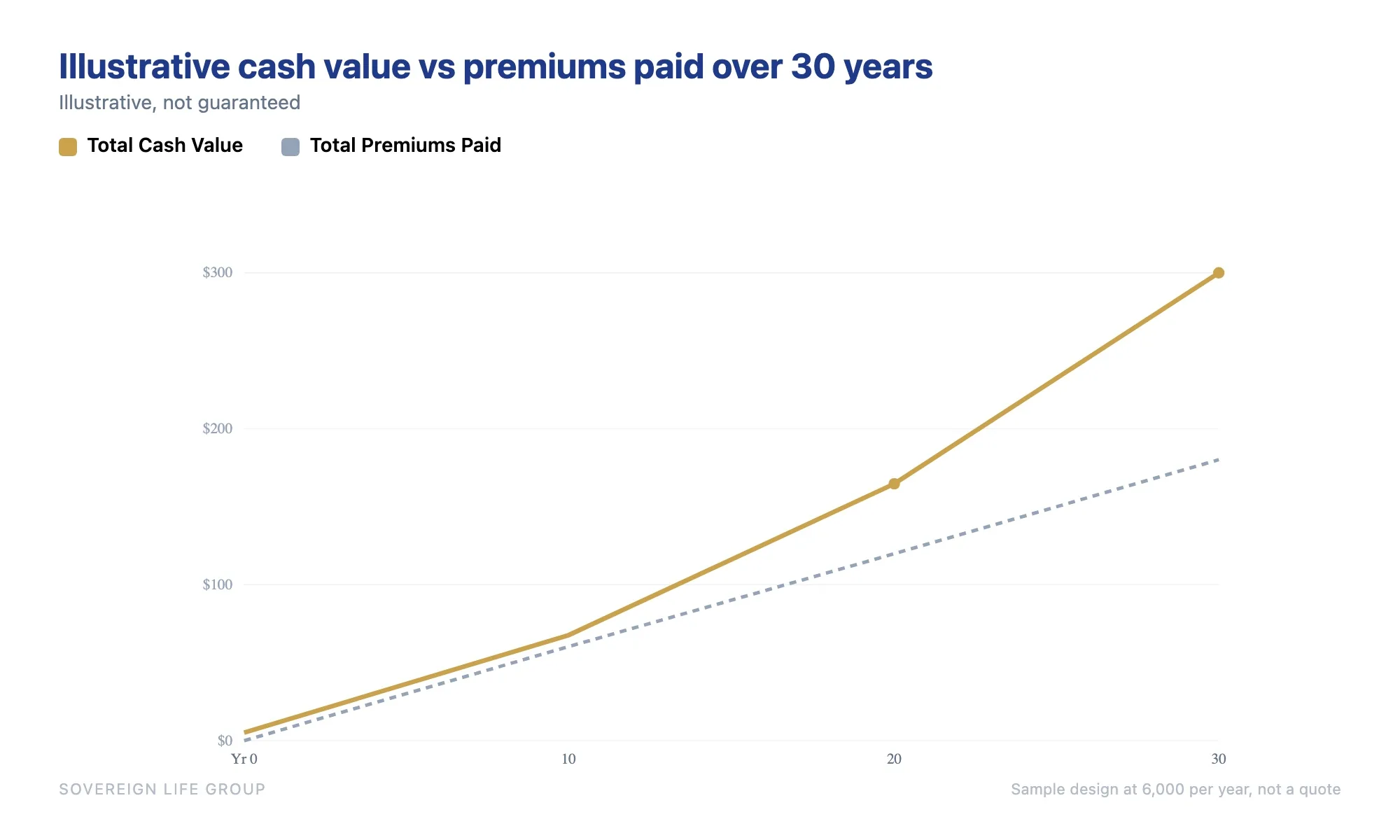
The clearest way to understand overfunded whole life insurance is to watch the money move. Below is an illustrative design for a healthy 40-year-old funding 6,000 dollars a year, roughly 500 a month, into a policy built with a small base and a heavy paid-up additions rider. These figures are a sample to show the shape, not a quote and not guaranteed.
Watch three things happen in that picture.
The early years feel slow
In the first two or three years, cash value sits a little under what you have paid in. Even a well-built overfunded policy has some cost, so a properly designed one might show cash value around 85 to 90 percent of premiums early on, not 100. If yours shows 40 percent, the design is wrong, and that is a real thing I check for. This early gap is why patience is not optional. People who cash out in year three lose money and then tell everyone the strategy is a scam.
The crossover
Somewhere around year 10 to 12 in this kind of design, total cash value passes total premiums paid. From that point on, every dollar of guaranteed growth and every dividend is compounding on a base larger than what you contributed. This is the quiet moment the whole plan is built around. Nothing dramatic happens on screen, but the math has turned.
The long compounding
By year 30 in this sample, the cash value has grown well beyond the 180,000 dollars paid in, and the death benefit has grown too, because paid-up additions raised it along the way. The family now has a large pool of tax-advantaged, liquid money they can borrow against for a car, a business, a college bill, or retirement income, plus a death benefit that never went away. That combination, use it while living and still leave it behind, is the appeal.
Two honest caveats on that rosy end state. First, the projected part depends on dividends that are not guaranteed, so the real number could land lower. Second, borrowing against the policy reduces the death benefit until you repay, so the two benefits share one pool. You cannot spend the same dollar twice.
Get a fast, free estimate tailored to your age and health.
The honest pros and cons
Overfunded whole life insurance offers a rare mix of guaranteed cash value growth, tax-advantaged access, and a death benefit in one place, which is genuinely useful for the right person. The trade-offs are equally real: modest returns, real fees, decades-long commitment, and a design that has to be built correctly. Both sides are true at once, and anyone showing you only one is selling.
Let me lay them out plainly, because the internet tends to shout the pros and whisper the cons, or the reverse.
| Strengths | Trade-offs |
|---|---|
| Guaranteed floor under the cash value | Returns are modest, not market-level |
| Tax-deferred growth, generally tax-free loans | Loans accrue interest and reduce the death benefit until repaid |
| High early liquidity when built right | Cash value still trails premiums for the first several years |
| Death benefit stays in force for life | Fees and insurance costs are real, especially early |
| Dividends can grow cash and coverage over time | Dividends are declared yearly, never guaranteed |
| No contribution limits like an IRA or 401(k) | Requires steady funding for years to work |
The pro I care about most is the one people underrate: liquidity you control. The money is reachable without a bank's permission, without a credit check, and without a taxable event in most cases. For a business owner who needs capital on short notice, that access can matter more than the interest rate. The con I care about most is the flip side: this only works if you fund it for years. A policy surrendered early is often the worst of both worlds, and I have talked more than one person out of starting one precisely because their cash flow could not commit.
There is also a plain structural comparison worth doing before you decide, which our breakdown of term versus whole life insurance and where each one fits covers in more depth. For pure death benefit protection, term almost always wins on cost. Overfunding is for a different job entirely, the living-money job, and mixing up the two goals is how people end up disappointed.
Overfunded whole life vs max funded IUL
Overfunded whole life and max funded IUL chase the same goal, high cash value with tax-advantaged access, using different engines. Whole life gives you contractual guarantees and dividends from a mutual carrier. Indexed universal life ties growth to a market index with caps and a floor, offering more upside potential and more moving parts. Neither is universally better.
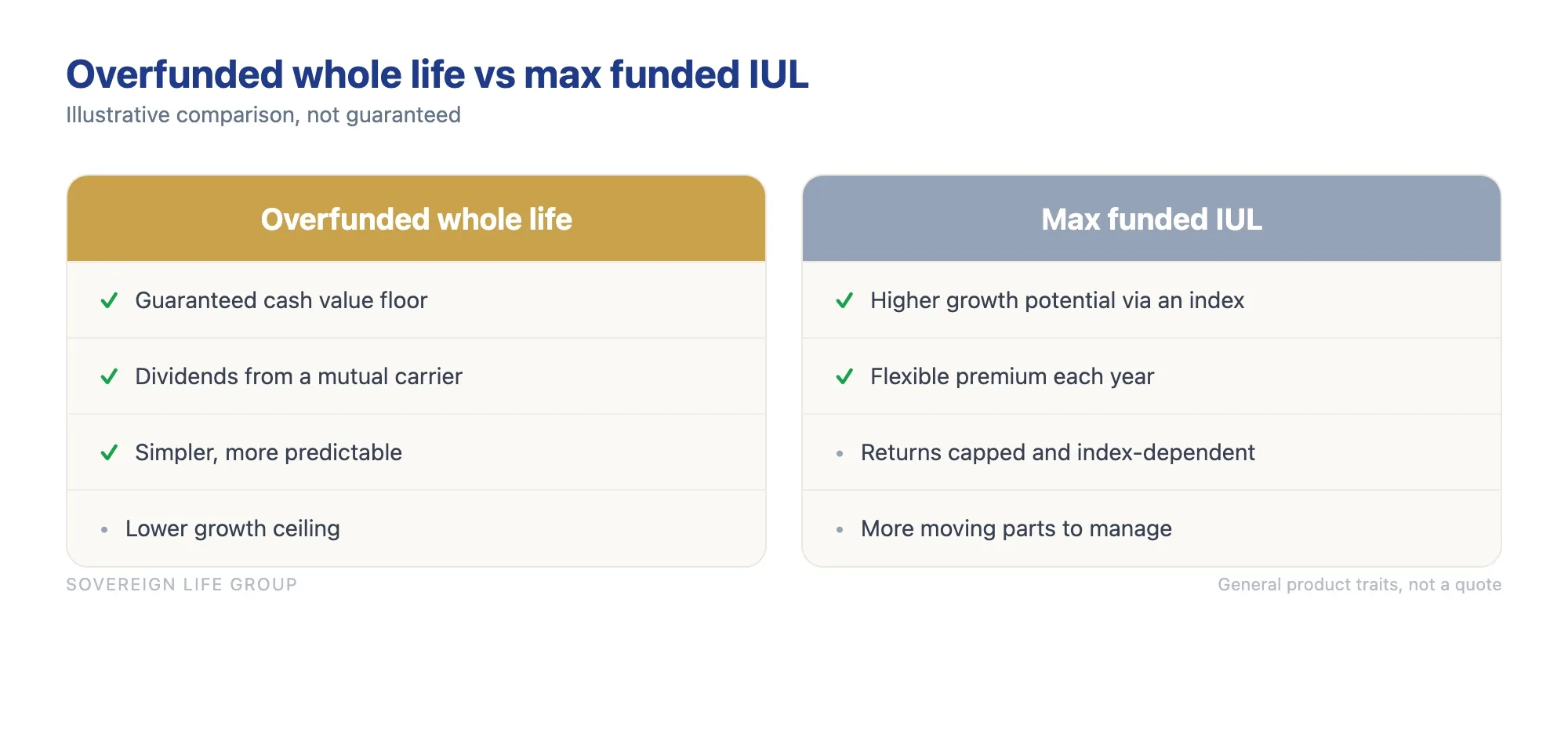
The way I explain it to families: whole life is the steady, contractual option. Your guarantees are written into the policy, your dividends come from an insurer with a long track record, and there is not much for you to manage. It is boring in the best way. The trade-off is a lower ceiling. You will not see a big index year show up in your statement, because there is no index.
A max funded IUL, by contrast, credits interest based on the performance of a market index like the S&P 500, up to a cap, with a floor that protects you from negative years. In strong markets it can outpace whole life. But the caps can change, the internal costs can rise as you age, and the policy needs monitoring so it does not underperform its own illustration. It asks more of the owner. If you want the full picture on that side, start with our guide to how an IUL compares to a Roth IRA for tax-free income, and see the indexed universal life coverage page for how we build them.
My honest take after building both: pick whole life if you value certainty and want to set it and forget it. Lean IUL if you want more growth potential and will actually review the policy each year. The worst outcome is buying either one without understanding which trade you just made.
Who it is really for
Overfunded whole life insurance fits people who have already maxed out tax-advantaged retirement accounts, want a conservative place for extra long-term money, value liquidity they control, and can commit to funding for at least a decade. It suits high earners, business owners, and disciplined savers far more than someone still building an emergency fund or carrying high-interest debt.
Over the years I have seen this strategy fit a fairly specific profile. It is worth being honest about who is on each side of that line.
It tends to fit
- High earners who have filled the usual buckets. If your 401(k) and IRA are maxed and you still have money to put away, an overfunded policy adds tax-advantaged room without a contribution cap.
- Business owners who need access to capital. The ability to borrow against cash value on short notice, for inventory, equipment, or a downturn, is worth real money to someone whose business runs on timing.
- Savers who want a floor. People who lost sleep in a market crash and want part of their money in something that does not go backward.
- Parents and grandparents thinking in decades. The compounding and the legacy piece both reward a long runway.
It usually does not fit
- Anyone without a solid emergency fund. Fund the basics first. This is for money you will not need to touch for years.
- People carrying high-interest debt. Paying off a credit card is a guaranteed double-digit return. Nothing here beats that.
- Buyers who might stop paying. If there is a real chance you surrender in year three, the early costs will bite and you will lose money.
- Anyone whose real need is a big cheap death benefit. That is a term life job, not this.
According to LIMRA research, a large share of U.S. adults say they carry less life insurance than they know they need, often because they assume permanent coverage is unaffordable or only for the wealthy. Overfunding does skew toward higher earners, but the core idea, structuring a policy for cash value instead of just a payout, is worth understanding for a much wider group than actually buys it.
How to tell if a policy is designed right
You can tell an overfunded whole life policy is designed correctly by checking a few numbers on the illustration: first-year cash value near 85 to 90 percent of premium, a paid-up additions rider doing most of the funding, a small base relative to the total, and a crossover point inside the first dozen years. If those are off, the design is working against you.
This is the section the competitor articles skip, and it is the one that protects your money, so read it twice. Two policies quoted at the same premium can perform completely differently based on how they are built. Here is what I look at, in order, and what a red flag looks like.
- The first-year cash value ratio. Divide year-one cash value by year-one premium. In a real overfunded design it should land near 85 to 90 percent. If it is 40 or 50 percent, too much money is going to base coverage and commission, and the policy is not actually overfunded.
- The base to paid-up additions split. Ask to see how the premium is allocated. A cash-value-focused design leans heavily on paid-up additions with a modest base. A big base with a token PUA rider is a traditional policy wearing a costume.
- The crossover year. Find where cash value passes total premiums paid. Inside 12 years or so is healthy for a well-funded design. Pushed out to year 18 or 20 usually signals a base-heavy build.
- Guaranteed versus projected columns. Read the guaranteed column first. If the plan only looks good in the projected column and falls apart in the guaranteed one, you are leaning entirely on dividends that are not promised.
- Who the carrier is. Dividend-paying mutual companies with long histories tend to build these best. This is one place where the company behind the contract genuinely matters, and our guide to the best whole life insurance for infinite banking breaks down which carriers earn that reputation and why.
The uncomfortable truth is that a policy sold by someone optimizing for commission often looks nothing like a policy built for your cash value, even from the same carrier. The bigger the base, the bigger the commission, and the slower your cash grows. When I review a design a family brings me from elsewhere, this is the first thing I check, and I have seen "overfunded" policies that were barely funded at all. Ask the numbers above out loud. A good agent will answer them without flinching. For the deeper philosophy behind building policies this way, the classic reference is summarized in our plain-English summary of Becoming Your Own Banker.
Is overfunded whole life insurance worth it?
Overfunded whole life insurance is worth it for a specific person: someone who has covered the financial basics, wants a conservative and tax-advantaged place for long-term money, values liquidity they control, and will fund the policy for years. For everyone else, cheaper or higher-growth tools usually do the job better. It is a good fit, not a universal one.
Strip away the hype from both sides and the verdict is genuinely two-sided. The strategy is real. The tax treatment is real, backed by decades of tax law. The guarantees and the liquidity are real. People have quietly built substantial, reachable pools of money this way for a long time, and it can anchor the conservative slice of a larger plan. That part is not in doubt.
What gets oversold is the idea that it is the best move for almost anyone. It is not. The returns are modest by design. The commitment is long. A badly built version underperforms a plain policy. And for pure protection, term life covers your family for a fraction of the cost. The right frame is not "is this the best asset" but "is this the right tool for the job I actually have." When the job is decades of tax-advantaged, liquid savings on top of a fully funded retirement plan, overfunded whole life insurance earns its place. When the job is something else, be honest about that and use the right tool instead.
That is the whole reason I walk families through the numbers before anyone signs anything. Coverage and cash strategy should fit your life, not a sales quota. If you want a straight read on whether this fits yours, that is exactly the conversation I am here for. You can also learn more about our approach at Sovereign Life Group, your life insurance strategist.
Want a straight answer for your situation?
Fifteen minutes. We will look at your goals, your other accounts, and whether a cash-value policy is built right for what you actually need. No pressure, no jargon, just the numbers laid out plainly.
Get a Quote Book a 15-Min Call Prefer to start with the basics? See how coverage fits a household plan on the families coverage page, or save my card for a quick quote later at my tax-advantaged strategy page.Frequently asked questions
What is overfunded whole life insurance?
Overfunded whole life insurance is a policy structured to hold the base premium low and pour extra money into a paid-up additions rider, so the cash value builds much faster than a standard policy. It is funded as close to the IRS MEC limit as allowed without crossing it, which preserves the tax advantages.
How much can you overfund a whole life policy?
You can overfund right up to the MEC limit set by the seven-pay test. The exact dollar amount depends on your age, health class, the death benefit, and the carrier's pricing. A well-designed policy often puts a large share of each dollar toward paid-up additions while keeping the base coverage small enough to stay under that line.
Is overfunded whole life insurance a good investment?
It is better described as a conservative, tax-advantaged savings vehicle than an investment. It offers steady cash value growth, a guaranteed floor, and tax-free access through loans, but returns are modest compared with the stock market, and fees are real. It fits people who value stability and liquidity, not those chasing the highest return.
What is the MEC limit on a life insurance policy?
The MEC limit is the maximum you can pay into a policy before the IRS reclassifies it as a Modified Endowment Contract under the seven-pay test. Cross it and loans and withdrawals lose their favorable tax treatment, with earnings taxed first and a possible 10 percent penalty before age 59 and a half.
What are paid-up additions in a whole life policy?
Paid-up additions are small chunks of fully paid whole life insurance you buy with extra premium or dividends. Each one adds cash value and death benefit right away without a new medical exam. They are the engine behind high cash value life insurance, because most of the money you put in shows up as cash value almost immediately.
Can you access the cash in overfunded whole life insurance?
Yes. You can borrow against the cash value through a policy loan, usually tax-free, and use the money for anything. Loans accrue interest and reduce the death benefit until repaid. You can also withdraw up to your basis without tax, but loans are the more common route because they keep the full balance compounding.
Joseph McDermott is a licensed life insurance agent (NPN 22121673), licensed in 27 states. Brokered through Family First Life, in partnership with Catalyst Life. This article is educational and is not financial, tax, or legal advice. Please talk with a licensed professional about your specific situation before acting on any strategy involving policy loans, paid-up additions, or the MEC rules. Product availability, features, riders, dividends, and results vary by state, age, health, and carrier, and any coverage is subject to underwriting approval. Dividends are not guaranteed. Policy loans and withdrawals reduce the death benefit and available cash value and may have tax consequences. Guarantees are subject to the claims-paying ability of the issuing insurance company.