Best Whole Life Insurance for Infinite Banking: What to Look For


The Short Version
The best whole life insurance for infinite banking is a dividend paying policy from a financially strong mutual company, built with a paid-up additions rider so cash value grows fast and stays accessible. The company matters, but the design matters more. A policy built for a big commission and a policy built for you can carry the same logo and behave nothing alike.
Clients ask me this constantly: "Which company has the best whole life insurance for infinite banking?" It's a fair question, and it's also the wrong first question. The truth I've learned after building a lot of these policies is that the carrier name on the front page decides less than most people think. How the policy is engineered decides almost everything. You can take the exact same top-rated mutual company and, depending on how the policy is structured, end up with cash value that works hard for you from year one or cash value that barely moves for a decade.
So this article does two things. It walks through the features that actually make a whole life policy good for banking-style cash value, and it names the kinds of companies worth looking at and why. I write this as a licensed agent, not someone selling you a course. Some of what follows is going to talk you out of the hyped version of this strategy. Good. You should understand the trade-offs before anyone opens an illustration in front of you.
What this guide covers
- What "best" actually means here
- How infinite banking works with whole life
- The features that make a policy good for banking
- Dividend paying whole life and mutual companies
- Why policy design beats the company name
- The whole life companies people ask about
- Whole life vs IUL for infinite banking
- A worked example of the numbers
- The honest trade-offs and risks
- Mistakes that wreck a good policy
- How to choose and get started
- Frequently asked questions
What "best" actually means for infinite banking
For infinite banking, "best" means a dividend paying whole life policy that builds usable cash value early, grows it steadily, and lets you borrow against it on fair terms, from a company strong enough to keep its promises for decades. It's a match between a well-designed policy and your own cash flow, not a trophy for one carrier.
I want to be honest about the word "best" because the whole internet is fighting over it, and most of that fight is marketing. There's no legally cheapest, no universally top policy, and any agent who tells you one company wins for everyone is either lazy or selling something. Your health, your age, your budget, how long you can leave the money alone, and how much you value guarantees over upside all change the answer.
What does stay constant is the shortlist of qualities you're screening for. When people search for the best cash value life insurance to run a personal banking strategy, they're really looking for four things underneath the surface: money that shows up early, money that grows without market drama, money you can access without asking a bank's permission, and a company that will still be standing when your kids are grown. Hold onto those four. Everything below is really just detail on how to find them.
No medical exam for a ballpark. Free, and no pressure.
How infinite banking works with a whole life policy
Infinite banking is a strategy where you overfund a dividend paying whole life policy, let the cash value grow, then borrow against that cash value for purchases or opportunities and pay yourself back over time. The policy keeps compounding on the full balance while you use the loan, so you recycle the same dollars for life's expenses instead of handing all the interest to a bank.
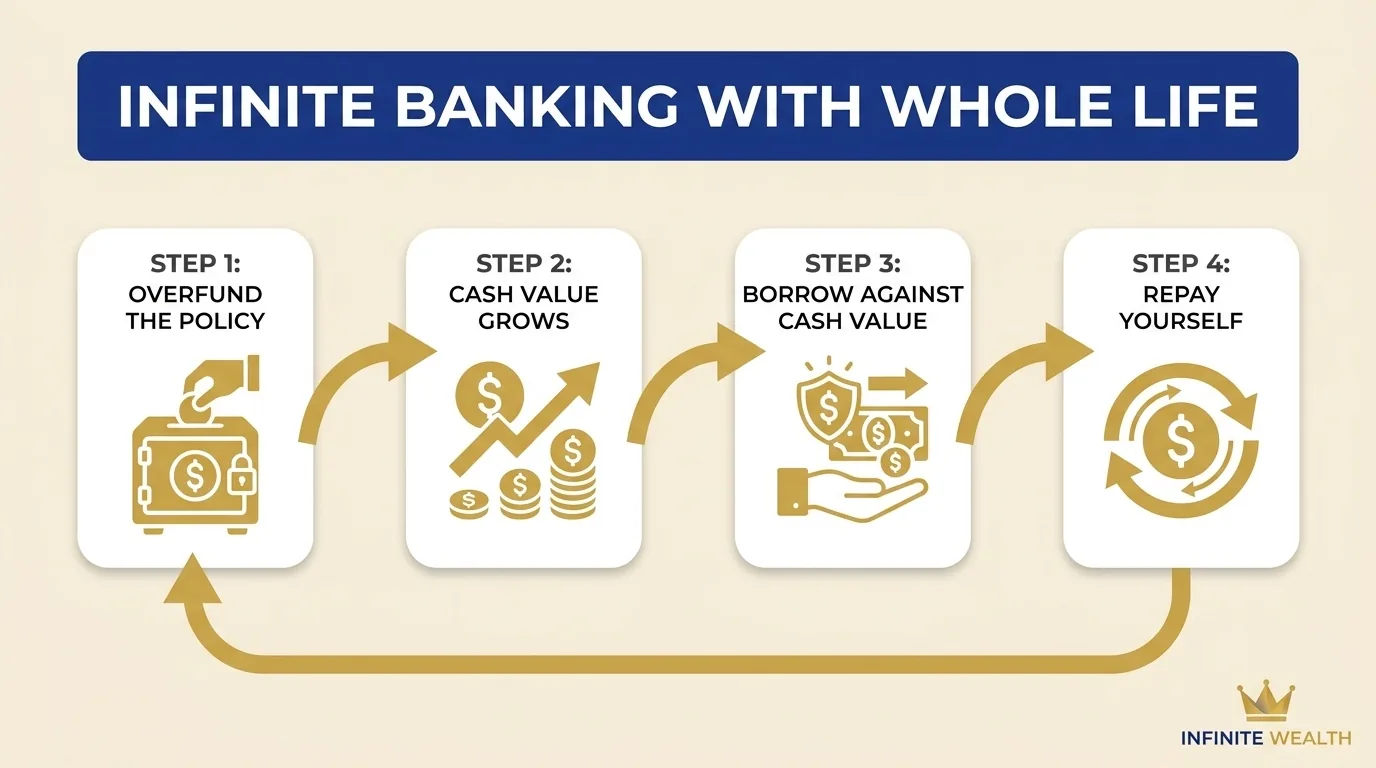
Here's the part that trips people up. When you borrow against a whole life policy, you're usually taking a loan from the insurance company using your cash value as collateral, not withdrawing your own money. Your cash value stays in the policy and keeps earning interest and dividends. You pay the insurer loan interest, and you set your own repayment pace. Done with discipline, that's a genuinely useful tool. Done carelessly, it's just an expensive way to borrow from yourself.
The concept traces back to Nelson Nash and his book "Becoming Your Own Banker," and I've written a fuller plain-English breakdown in our guide to the be your own bank infinite banking concept if you want the origin story and the mechanics from the ground up. For this article, the important thing is what kind of policy makes that loop actually work. Not every whole life policy does. A policy built for maximum death benefit, which is what most agents sell by default, can take years before there's enough cash value to borrow anything meaningful. That's the difference we keep coming back to.
The features that make a whole life policy good for banking
A whole life policy is good for infinite banking when it builds cash value early, uses a paid-up additions rider, comes from a dividend paying mutual company, and offers a fair loan provision. Those four features do more for your results than the brand name on the policy. Miss them and even a top carrier disappoints.
Let me break down what each one is doing, in plain terms, because these are the levers a good agent is actually pulling when they design a policy for you.
A paid-up additions rider (this is the big one)
Paid-up additions, usually shortened to PUA, are small chunks of extra paid-up insurance you buy with additional premium. The magic is that PUA dollars flow almost entirely into cash value with very little going to insurance costs. A strong, flexible PUA rider is the single feature that turns a slow whole life policy into a banking policy. Without it, you're pouring money into death benefit you didn't come here for.
Early, high cash value
You want a policy engineered so a large share of your premium is usable cash value quickly, ideally with a big chunk available in year one. This is a design choice, not a company feature. The trade-off is a smaller starting death benefit, which for a banking strategy is usually a trade you're happy to make.
A dividend paying mutual company
Mutual companies are owned by policyholders rather than stockholders, so profits can come back to you as dividends. Those dividends, when you use them to buy more paid-up additions, are the compounding engine. More on this in the next section, because it deserves its own space.
A fair policy loan provision
Read how the company handles loans. Look at the loan interest rate, and whether the company uses direct or non-direct recognition, which is just a fancy way of asking whether your borrowed money still earns the full dividend. Neither approach is automatically better, but you want to understand which one you're getting and how it affects your numbers.
Financial strength and a long dividend history
This is a multi-decade commitment. You want a company with high ratings from the independent agencies and a track record of paying dividends across good markets and bad ones. A great illustration from a shaky company is worth less than a solid illustration from a company that has paid dividends for a hundred years straight.
| Feature | Why it matters | What to ask |
|---|---|---|
| Paid-up additions rider | Drives fast cash value growth | Is the rider flexible, and how much can I overfund? |
| Early cash value | Lets you borrow sooner | How much cash value is available in year one? |
| Mutual ownership | You can share in dividends | Is this a true mutual, and what is the dividend history? |
| Loan provision | Sets your true cost to borrow | Direct or non-direct recognition, and what is the loan rate? |
| Financial strength | Promises must last decades | What are the current independent ratings? |
Dividend paying whole life and why mutual companies matter
Dividend paying whole life is a policy from a mutual insurer that can return a share of the company's surplus to policyholders each year. Those dividends aren't guaranteed, but strong mutual companies have paid them for generations. Reinvested into paid-up additions, dividends are the compounding fuel that makes a banking policy grow faster over time.
Here's why this is central and not a footnote. A whole life policy has a guaranteed side, the contractual cash value and death benefit the company must deliver, and a non-guaranteed side, the dividends. The guaranteed side alone is fine but modest. The dividends are what lift the results from "okay savings vehicle" to "engine worth building a strategy around." So you care a lot about a company's dividend track record.
Now the honest part, because compliance and plain decency both require it: dividends are not guaranteed. A company can pay a dividend for ninety years and still cut it in a hard year. The Insurance Information Institute is clear that participating policy dividends depend on the insurer's actual experience and are never promised in advance. Any illustration you see uses a current dividend scale that can change. Treat the guaranteed columns as the floor and the illustrated columns as a hopeful, not a certainty.
When you compare this to permanent policies more broadly, the choice between guaranteed steady growth and market-linked upside is really the whole debate. Our breakdown of term vs whole life insurance walks through where each type fits, and it's worth reading before you commit to a permanent policy for any reason, banking included.
Why policy design beats the company name
Policy design beats company choice because the same carrier can produce wildly different results depending on the base-to-PUA ratio. A policy built for maximum death benefit funnels your premium into insurance costs. A policy built for banking funnels most of it into cash value through paid-up additions. The design, not the logo, decides how fast your money works.
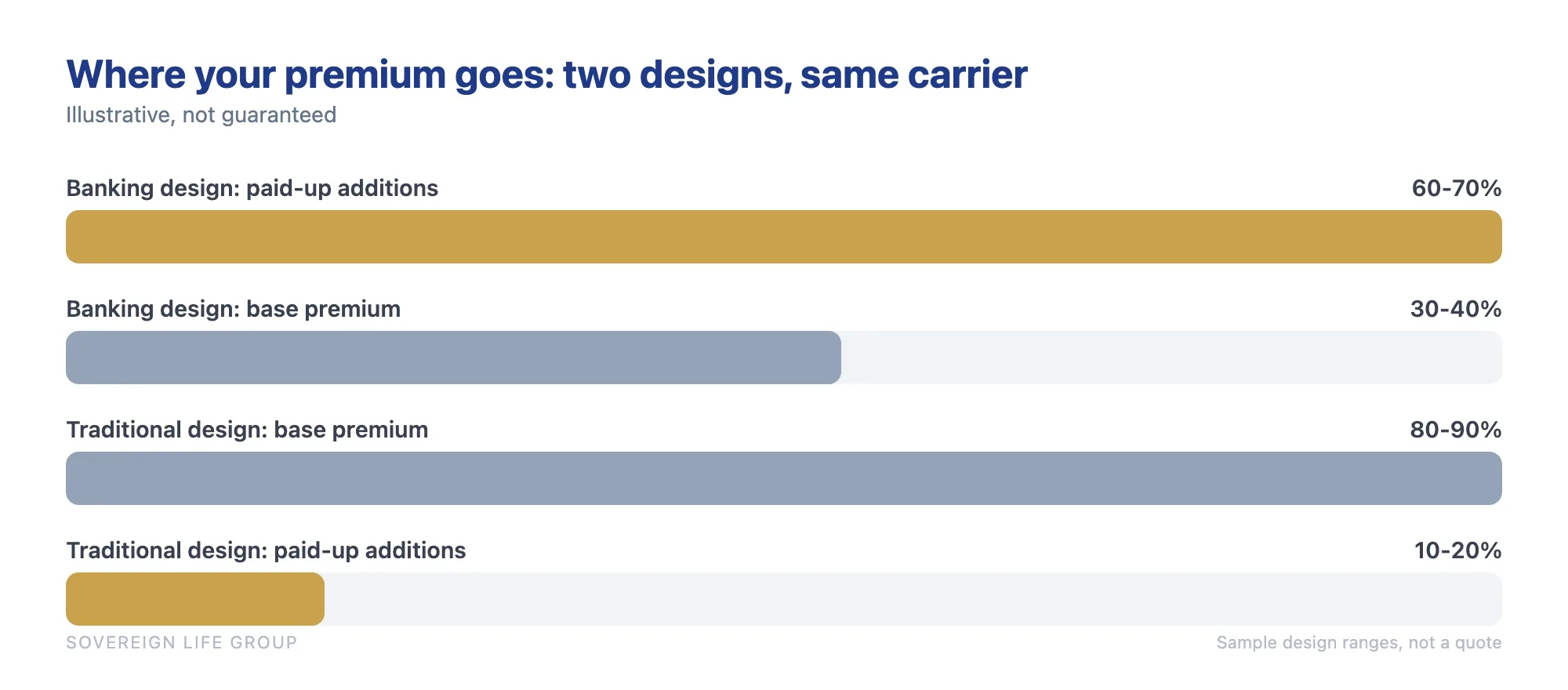
This is the point I wish more people understood before they shop. The mistake I see most is someone chasing "which company is best" when the bigger lever is sitting right in front of them: how the agent splits your premium between base coverage and paid-up additions. A common target for a banking-style policy is somewhere around 30 to 40 percent to base premium and 60 to 70 percent to PUA. Flip that ratio the wrong way and your early cash value collapses.
There's a reason this happens, and it isn't always malice. An agent gets paid mostly on base premium, not on paid-up additions. So the default policy, the one that pays the agent the most, is often the one with the least cash value in the early years. That's not a conspiracy, it's just an incentive you should know exists. A good agent will happily show you a design that trims their own commission to build your cash value faster. If someone won't, that tells you something.
One number frames the whole thing. In the infinite banking world, people often say that the vast majority of disappointing results trace back to bad policy design or quitting too early, not to picking the wrong carrier. I believe that from experience. I've seen policies from excellent companies underperform because they were built wrong, and I've seen modest companies deliver because the design was right and the client stayed the course.
The whole life companies people ask about
The whole life companies most often discussed for infinite banking are large, highly rated mutual insurers with long dividend histories, because those traits line up with what the strategy needs. No single company is best for everyone. The right one depends on your health, your budget, the rider flexibility you need, and how each carrier's loan provision fits your plans.
I'm going to describe the profile of the companies people gravitate toward rather than crown a winner, because a public article is exactly the wrong place to promise you a specific carrier or rate. The names that come up again and again in this space are long-established mutual companies with strong financial ratings and dividend records stretching back many decades, sometimes more than a century. That longevity is the point. You're trusting them with a multi-decade plan.
What separates the contenders from the rest usually comes down to the same features we already covered: a genuinely flexible paid-up additions rider, competitive internal costs, a loan provision that doesn't quietly eat your growth, and a dividend history that held up through recessions. Some carriers are known for strong early cash value designs. Others lean toward long-term dividend performance. Neither is automatically better for you until we know your actual situation.
| Trait to weigh | Why banking clients care | Trade-off to watch |
|---|---|---|
| Long mutual dividend history | Signals reliability across market cycles | Past dividends never guarantee future ones |
| Strong early cash value design | Lets you borrow sooner | Usually means a smaller early death benefit |
| Flexible PUA rider limits | More room to overfund toward cash value | Overfund too far and you risk a MEC (see below) |
| Favorable loan provision | Lowers your real cost to borrow | Direct vs non-direct recognition changes the math |
| Top independent ratings | Confidence the promises last decades | Highest-rated is not always lowest cost |
If you want me to name and compare the specific carriers that fit your health and budget, that's a conversation, not a blog post. You can reach out and ask a licensed human and I'll pull real designs from the companies I'm appointed with and lay the guaranteed numbers next to the illustrated ones so you see both.
Get a fast, free estimate tailored to your age and health.
Whole life vs IUL for infinite banking
Whole life is the traditional choice for infinite banking because its cash value growth is contractually guaranteed and predictable. Indexed universal life offers higher potential growth tied to a market index, but that growth isn't guaranteed and internal costs can rise over time. Whole life trades upside for certainty, which is why banking strategies usually start there.
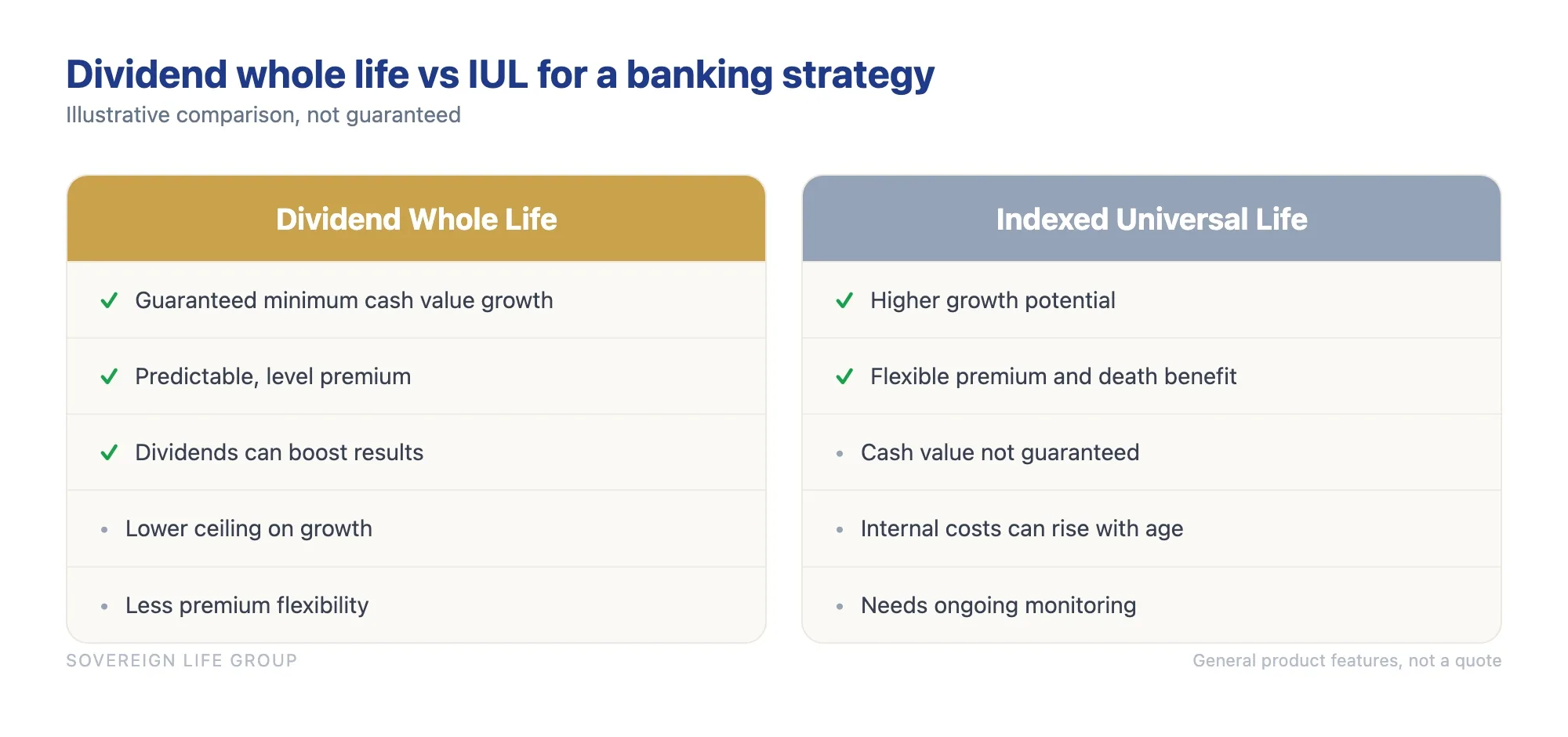
People fight about this online, and both camps oversell. Whole life purists act like IUL is a ticking bomb, and IUL sellers act like whole life is your grandpa's slow savings account. The reality is calmer. Whole life gives you a floor you can count on and a smoother ride, which is exactly what a banking strategy that depends on predictable, borrowable cash values wants. IUL can grow faster in good years, but the cash value isn't guaranteed the same way, and the internal cost of insurance rises as you age, which can pressure a policy that isn't funded and watched carefully.
My plain take: if the whole point is a stable pool of money you'll borrow against for decades, the predictability of dividend paying whole life fits the job better for most people. IUL is a legitimate tool with real strengths, but it asks more of you in monitoring and carries more variability. If tax-advantaged growth with more upside is what you're really after, that's a different conversation, and our indexed universal life coverage page lays out how that product works and where it fits. Choose the tool for the job, not the tool with the loudest pitch.
A worked example of the numbers
Here is an illustrative example of how cash value can build in a banking-designed whole life policy. In the early years, total cash value often sits below total premiums paid because of upfront costs. Over time, with paid-up additions and dividends, cash value crosses above what you've paid in and keeps compounding. The exact crossover year depends on design, carrier, and your health.
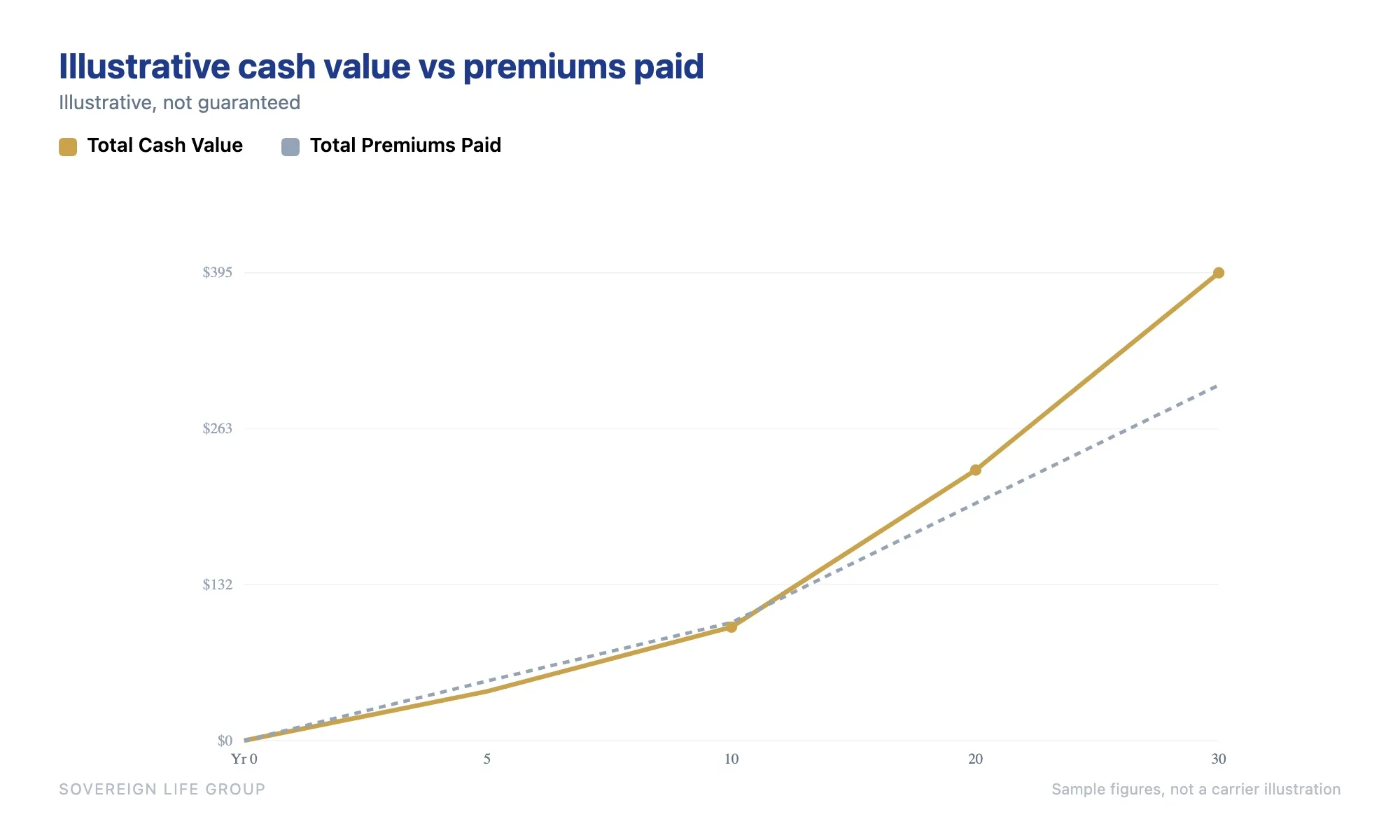
Let me put words to that chart, because the shape is the whole lesson. Say a family commits to funding a policy each year. In the first few years, the cash value is real but sits under what they've paid in. That gap is the cost of the insurance and the reason this is a patient strategy, not a quick one. Somewhere around year seven to ten in a well-designed policy, the lines cross, and total cash value moves above total premiums. After that, compounding does the heavy lifting, and the gap widens in your favor.
Now the banking part. Once there's meaningful cash value, the family can borrow against it, say to cover a vehicle or a business expense, while the full cash value keeps earning inside the policy. They repay the loan on their own schedule with interest going back toward rebuilding their available balance. Do that across a lifetime and you finance a lot of things without sending all the interest to an outside lender. That's the appeal, and it's real, as long as you actually repay yourself and don't treat the policy like a piggy bank you never refill.
I want to be blunt about the numbers above: they're a sample to show the shape, not a quote and not a promise. Real figures come from a real illustration built on your age and health, with a guaranteed column and a non-guaranteed column side by side. If an agent only ever shows you the rosy illustrated column, ask for the guaranteed one too. The honest picture lives between them.
The honest trade-offs and risks
Infinite banking has real trade-offs: slow early growth, opportunity cost versus other investments, the discipline it demands, and the fact that dividends and long-term costs aren't guaranteed. It's a legitimate strategy, not a magic one. Anyone selling it as free money or a guaranteed win is skipping the parts you most need to hear.
This is the section the hype videos leave out, so here's my straight list of what you're signing up for.
- Slow start. Most whole life policies take years before cash value passes total premiums paid. If you cancel early, you can walk away with less than you put in. This punishes people who bail before the strategy matures.
- Opportunity cost. Dollars committed to premiums aren't in the market. Over long stretches, a low-cost index fund may grow faster. What whole life offers instead is stability, guarantees, tax treatment, and a death benefit. Whether that trade is worth it depends on you, not on a sales pitch.
- It demands discipline. The strategy only works if you actually repay your policy loans. Borrow and never pay yourself back and you've just drained your own account slowly. The product doesn't create the discipline. You do.
- Not everything is guaranteed. Dividends can change. Loan rates vary. The guaranteed cash value is the promise, the rest is a projection. Plan around the guarantees and treat the upside as a bonus.
- It's oversold. A lot of online marketing wildly overstates the returns and understates the years of patience required. Judge the illustration and the design, never the enthusiasm.
According to research published by LIMRA in 2025, roughly half of American adults own life insurance and a meaningful share say they know they need more than they have. That gap tells me most families should get the basic protection question answered first. Infinite banking is a strategy for money you can commit to for the long haul, after your core coverage and emergency savings are handled, not before.
Mistakes that wreck a good policy
The most common mistakes with an infinite banking policy are overfunding into a Modified Endowment Contract, weak policy design with too little paid-up additions, borrowing without repaying, and quitting in the early years. Each one turns a sound strategy into a disappointment. Most are avoidable with a careful design and honest expectations.
Triggering a MEC by overfunding
There's a limit to how fast you can stuff money into a life insurance policy before the IRS reclassifies it as a Modified Endowment Contract, or MEC. Cross that line and you lose some of the favorable tax treatment on loans and withdrawals. The IRS rules on life insurance spell out how this works, and a competent agent designs your policy to fund it aggressively while staying just under the MEC limit on purpose. Overfund past it by accident and you've quietly damaged the tax advantage you came for.
Too little paid-up additions
We covered this, but it's worth repeating because it's the number one killer. A policy with a thin PUA allocation builds cash value slowly no matter how good the carrier is. If your early cash value looks weak, the design is usually the culprit.
Borrowing and not repaying
Policy loans accrue interest. If you borrow and don't pay yourself back, the loan balance grows and can eventually eat into your death benefit or, in a worst case, put the policy at risk of lapsing. The strategy assumes you behave like a disciplined bank, not a desperate borrower.
Quitting before it matures
This is a seven-plus year strategy at minimum. The people who feel burned are often the ones who canceled in year three, right before the compounding starts to show. If you can't commit to funding it for the long haul, be honest with yourself before you start, not after.
How to choose and get started the right way
To choose the best whole life insurance for infinite banking, confirm your core protection is handled first, then compare designs and carriers with a fiduciary-minded agent who shows the paid-up additions split and the guaranteed columns. Screen for a strong mutual company, a flexible PUA rider, a fair loan provision, and a design built for early cash value.
Here's the order I'd walk a friend through, and it's the same order I use with clients.
- Cover the basics first. Make sure your family's income and debts are protected and you have some liquid emergency savings. Banking is a strategy for surplus dollars, not your only safety net.
- Decide your real funding number. Pick an annual amount you can commit to for many years without strain. Overcommitting and then stopping is how policies fail.
- Compare designs, not just companies. Ask every agent for the base-to-PUA split and the year-one cash value. Two illustrations from the same carrier can look completely different here.
- Read the guaranteed column. Look at what the company must deliver, not only the illustrated dividends. Comfort with the floor is what lets you sleep at night.
- Use an agent who shows options. If someone only ever pitches one product and won't discuss trade-offs, that's your signal. You want a strategist, not a salesperson.
When you're ready to see this laid out against your actual numbers, a real conversation beats another article. You can start with a clear, no-pressure look at the design and the guarantees with Sovereign Life Group, your life insurance strategist, and decide from there whether whole life banking fits your life or whether something simpler does the job.
Want a straight answer for your situation?
Fifteen minutes. We will look at your goals, your budget, and whether a dividend paying whole life policy is the right tool for you or whether something simpler fits better. Guaranteed and illustrated numbers, side by side.
Get a Quote Book a 15-Min Call Prefer to start with the basics? Visit the families coverage page to see how protection fits a household budget first.Frequently asked questions
What is the best whole life insurance for infinite banking?
There is no single best policy for everyone. The strongest fit is usually a dividend paying whole life policy from a financially strong mutual company, structured with a paid-up additions rider so cash value builds quickly. The company matters, but how the policy is designed matters more. Two agents can sell the same carrier and build very different policies.
Do you need whole life insurance for infinite banking, or can you use IUL?
The original concept was built on dividend paying whole life because its cash value is contractually guaranteed to grow and is predictable. Some people use indexed universal life for higher potential growth, but IUL cash value is not guaranteed the same way and depends on index performance and internal costs. Whole life trades upside for certainty, which is why most banking-style strategies start there.
How much cash value do you have in the first year?
With a policy designed for banking and a strong paid-up additions rider, a large share of your first-year premium can show up as usable cash value, often well above half. A traditional whole life policy built for maximum death benefit may show very little in year one. That design difference is the whole game.
What features make a whole life policy good for cash value banking?
Look for a mutual company with a long dividend history, a flexible paid-up additions rider, a fair policy loan provision, and strong financial ratings. The best cash value life insurance for this strategy prioritizes early liquidity and steady growth over the largest possible death benefit.
Can you lose money with infinite banking?
Yes, especially early. Most whole life policies take several years before cash value exceeds total premiums paid, and if you cancel before then you can get back less than you put in. Poor policy design, overfunding past the MEC limit, or borrowing more than you can service all create real risk. This is a long-hold strategy, not a quick one.
Is infinite banking a scam?
No, but it is often oversold. It is a legitimate use of a real financial product, using a whole life policy as a place to store and borrow against cash value. The problems come from unrealistic pitches, hidden costs, and policies built to pay a big commission instead of serving the client. Judge the design and the numbers, not the marketing.
Joseph McDermott is a licensed life insurance agent (NPN 22121673), licensed in 27 states. Brokered through Family First Life, in partnership with Catalyst Life. This article is educational and is not financial, tax, or legal advice. Please talk with a licensed professional about your specific situation. Whole life policy values, dividends, and loan features vary by state, age, health, and carrier, and any coverage is subject to underwriting approval. Dividends are not guaranteed. Guarantees are subject to the claims-paying ability of the issuing insurance company.