Money Moves That Build Wealth in Your 30s and 40s


The Short Version
The money moves that build wealth in your 30s and 40s are not secrets. Build a cash cushion, capture your full 401(k) match, kill high-interest debt, choose your tax buckets, invest in low-cost index funds, raise your savings rate, and protect the income it all runs on. Boring, automated, and repeated for years is what compounds. Clever rarely does.
If you want the honest answer on the money moves that build wealth in your 30s and 40s, here it is: there is no trick. The people who quietly get there do a handful of plain things, in a sensible order, for a long time. No hot stock. No side hustle that prints money while they sleep. Just steady moves that stack on top of each other until the pile is bigger than they expected.
The good news is that your 30s and 40s are the prime years for this work. You earn more than you did at 25, you still have decades of compounding ahead of you, and you are old enough to ignore most of the noise. This guide walks through the moves in the order that actually works, with the math laid out plainly, the trade-offs shown honestly, and no get-rich promises. Read it once, set a few things up, then let the years do the heavy lifting.
What this guide covers
- Why the order matters more than the moves
- Move 1: Build a cash cushion first
- Move 2: Capture your full 401(k) match
- Move 3: Kill high-interest debt
- Move 4: Choose your tax buckets
- Move 5: Invest in low-cost index funds
- Move 6: Raise your savings rate
- Move 7: Protect the income it all runs on
- The order of operations, on one page
- Building wealth in your 30s vs your 40s
- Five mistakes that quietly cost you
- A simple 90-day starting plan
- Frequently asked questions
Why the order of your money moves matters more than the moves
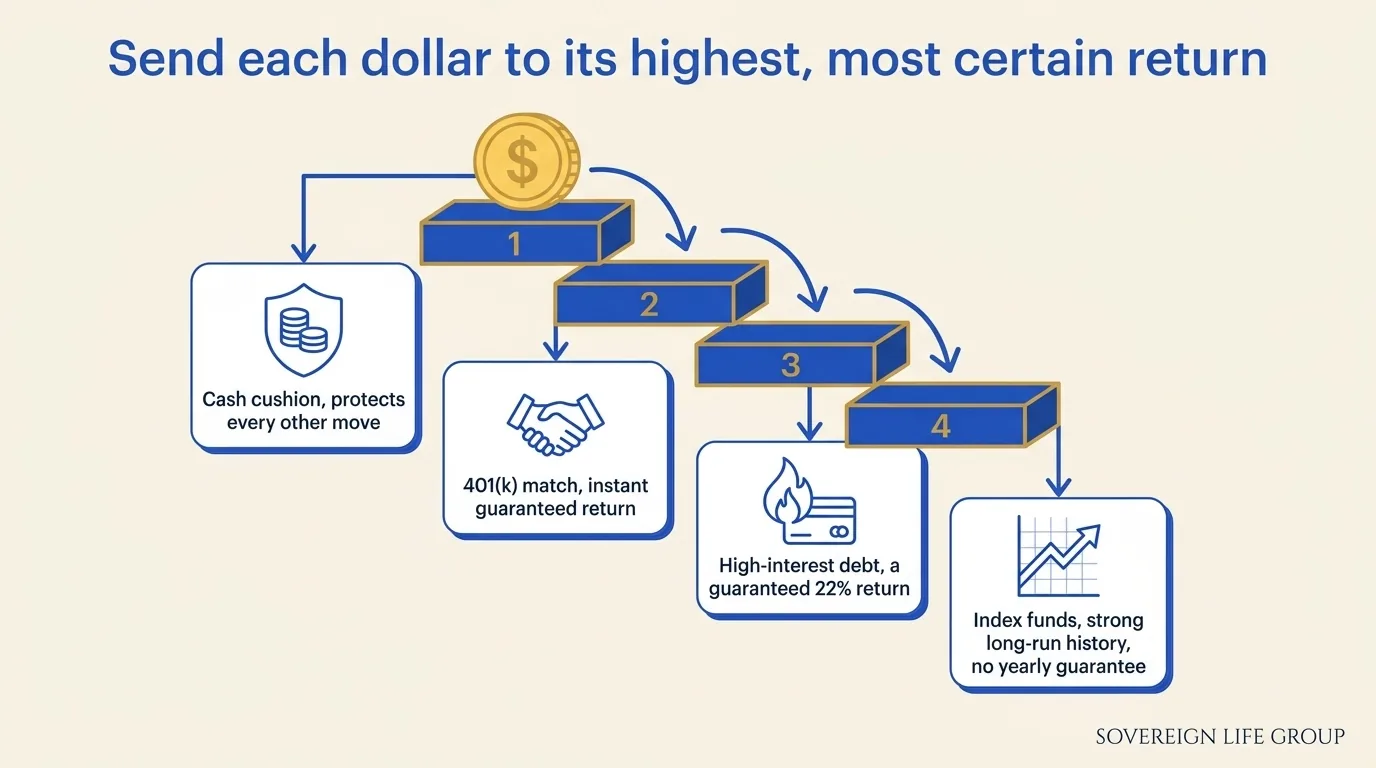
Every dollar you have can do exactly one job at a time. The smart move is to send each dollar to wherever it earns the highest, most certain return. A 401(k) match is an instant, guaranteed return that nothing else on this list can touch, so it usually goes first. Paying off a credit card charging 22 percent is a guaranteed 22 percent return, which beats almost any investment, so it goes near the top. A diversified index fund has a strong long-run history but no guarantee in any given year, so it comes after the sure things. A cash cushion earns very little, but it protects every other move from a bad month, so a starter version goes first of all.
Hold that idea, highest and most certain return first, and the rest of this guide falls into place. None of these moves require you to be smarter than the market. They require you to do plain things in a sensible order, on repeat.
Tax-advantaged growth with a floor against losses. Quick and free.
Move 1: Build a cash cushion before you do anything fancy
Wealth gets built on a stable base. Without one, the first flat tire or surprise medical bill goes straight onto a credit card, and you slide backward while you were trying to move forward.
Start small. One month of expenses in a plain savings account beats zero, and it is reachable for almost anyone within a few paychecks. That first month is not really about the money. It is about breaking the cycle where every unexpected cost becomes new debt. Once you have it, you stop bleeding and you can start building.
From there, work toward three to six months of essential bills over time. Lean toward three months if your income is steady and predictable, like a salaried job with good security. Lean toward six months, or even a little more, if your income is variable, you are self-employed, you own a home with its surprise repairs, or you are the only earner for a family. Keep this money boring and reachable. A high-yield savings account at an FDIC-insured bank is the right home for it, not stocks, not crypto, not a long-term lockup. This is not money you invest. It is the thing that keeps you from having to sell investments at the worst possible moment, which is exactly when markets are down and everyone is panicking.
One nuance worth naming: you do not need the full six months before you start the next moves. Get one month banked, capture your match and knock down high-interest debt, then circle back and finish the emergency fund. A fully funded emergency account sitting next to a maxed-out credit card is a common and expensive mistake. The cushion and the debt payoff can take turns.
Move 2: Capture every dollar of your 401(k) match
and you are not taking it, you are turning down a raise. A common structure is 50 cents on the dollar up to 6 percent of your pay, though it varies by employer. Put in enough to capture the full match and you have earned an instant return before the market does anything at all. There is no investment on this list that reliably beats free money, which is why the match comes before even high-interest debt.You do not need to max the account on day one. The annual limits are generous and most people grow into them. For 2026, the elective deferral limit for a 401(k) is in the mid twenty-thousands, and there are additional catch-up contributions allowed once you reach age 50, which is worth knowing if you are reading this in your late 40s. Because these numbers are adjusted over time, confirm the current figure before you assume it. The official limits are published each year by the IRS, and according to the IRS retirement pages they are updated regularly for inflation.
The practical play is simple. Contribute at least enough to get the full match, then nudge your contribution up one percentage point every time you get a raise. You will barely feel a one percent bump, but over a decade those small increases do remarkable work. If you are deciding where your tax-advantaged dollars belong beyond the match, our honest IUL vs 401k comparison weighs the two head to head, including the trade-offs each one carries.
Move 3: Kill high-interest debt like it is on fire
Once the match is captured, turn to high-interest debt. Credit card balances at 20 percent or more are the single biggest drag on building wealth in your 30s and 40s. No investment reliably beats that rate, so paying it off is one of the best guaranteed returns you will ever get, and it is tax-free and risk-free on top of that. The Consumer Financial Protection Bureau has free tools and guides for tackling that kind of debt if you want a neutral, non-sales resource.
Pick a method and run it. The two that work are the avalanche and the snowball, and they trade math against motivation.
| Method | How it works | Best for | Trade-off |
|---|---|---|---|
| Avalanche | Pay minimums on everything, throw all extra cash at the highest interest rate first | Saving the most money mathematically | The first win can feel slow if your biggest rate sits on a large balance |
| Snowball | Pay minimums on everything, throw all extra cash at the smallest balance first | People who need a quick, visible win to stay motivated | You may pay a little more in total interest along the way |
The math favors the avalanche. The psychology often favors the snowball, because crossing a whole balance off the list feels good and keeps you going. There is no wrong choice here. The right method is the one you will stick with until the expensive debt is gone.
Lower-rate debt is a different animal. A mortgage at a modest rate, a reasonable car loan, or a low-rate student loan can usually ride alongside your investing rather than blocking it, because the interest is low enough that steady investing has a fair shot at out-earning it over time. You do not have to be completely debt-free to start building wealth. You just have to get the expensive, high-interest stuff off your back first, because that is the debt that quietly outruns everything else you are trying to do.
Move 4: Choose your tax buckets, Roth vs traditional
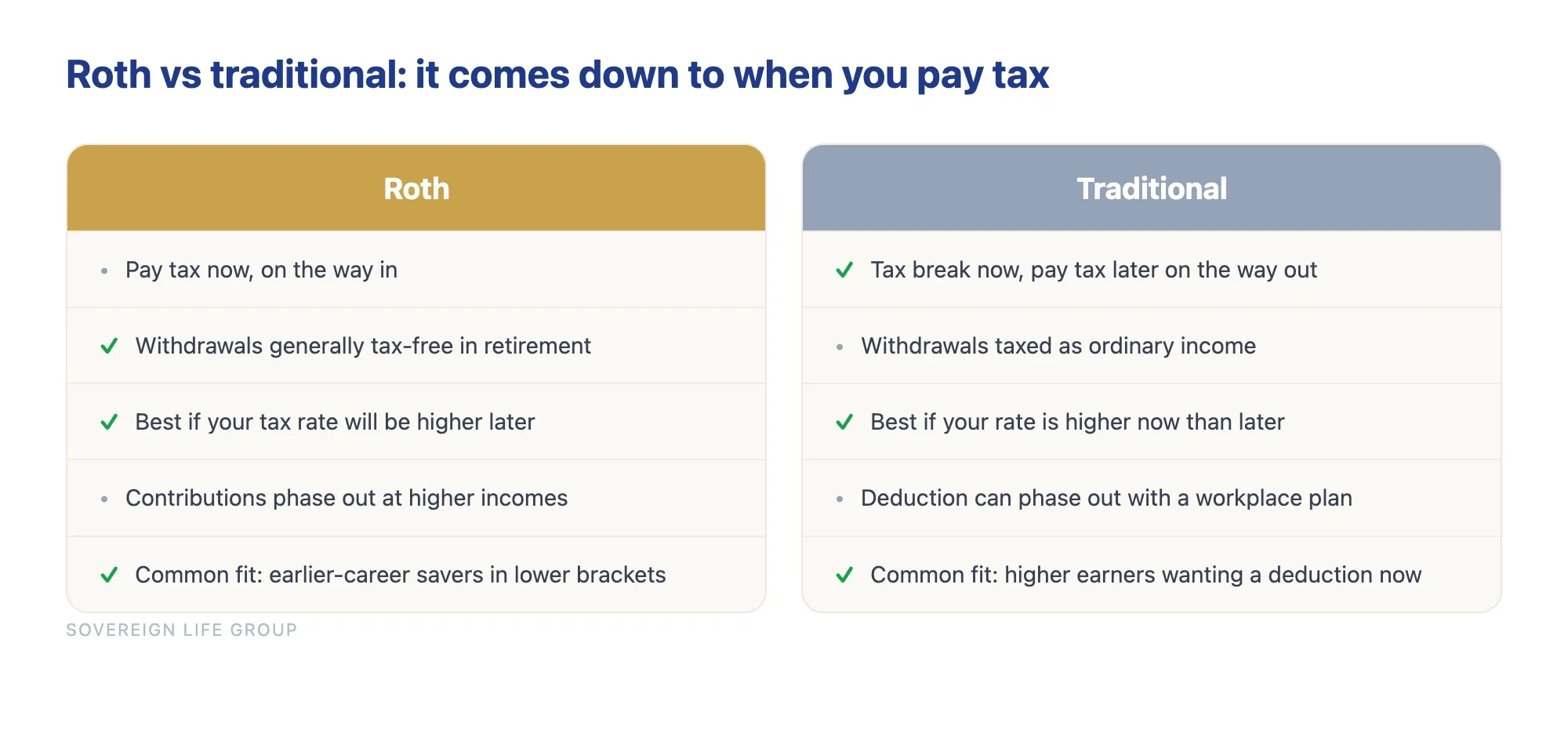
| Feature | Roth | Traditional |
|---|---|---|
| When you pay tax | Now, on the way in | Later, on the way out |
| Withdrawals in retirement | Generally tax-free if rules are met | Taxed as ordinary income |
| Best when you think | Your tax rate will be higher later | Your tax rate is higher now than it will be later |
| Income limits | Yes, Roth contributions phase out at higher incomes | Deduction can phase out if covered by a workplace plan |
| Common fit | Earlier-career savers in lower brackets today | Higher earners wanting a deduction now |
Here is the simple way to think about it. Roth means you pay tax now and pull the money out tax-free in retirement, which is great if you expect your tax rate to be higher later, a common situation for people earlier in their careers or anyone who expects to earn more over time. Traditional means you take the tax break now and pay tax when you withdraw, which is useful if you are in a high bracket today and expect a lower one in retirement.
If you cannot decide, you do not have to. Many people split the difference and hold some of each, which gives them flexibility to manage their tax bill in retirement instead of being locked into one outcome. Just be aware there are income limits on Roth contributions, so check where you land before you assume you qualify. If you want to go deeper on the tax side of long-term planning, see our piece on building tax-free retirement income with an IUL, which covers a different tax-advantaged tool and its honest trade-offs.
Move 5: Invest in low-cost index funds and then leave them alone
This is where people overthink it the most, and overthinking is expensive. You do not need to pick winning stocks, time the market, or follow anyone on social media who promises a system. Decades of evidence show that a low-cost index fund tracking a broad market, like a total-market or S&P 500 fund, beats most actively managed strategies over long stretches, largely because the fees are tiny and tiny fees compound in your favor instead of against you.
The mechanics are boring on purpose. Set up automatic monthly contributions into broad index funds across your 401(k) and your IRA. Add some international exposure for balance, and consider a small bond allocation that grows as you age and your horizon shortens. Then, and this is the hard part, stop checking it every day. The market will drop sometimes. That is normal and expected. The investors who win are usually the ones who keep buying through the dips instead of panic-selling at the bottom and missing the recovery.
Automating the contribution is the move that makes this work, because it takes your emotions out of the decision. When the money leaves your paycheck before you see it, you invest in good months and scary months alike, which is exactly the behavior that builds wealth. This steady, unglamorous approach is sometimes called dollar-cost averaging, and its whole value is that it keeps you consistent when your gut wants to do something clever.
One honest caveat, and it matters: nobody can promise you a specific return, and anyone who does is selling something. Past performance does not guarantee future results. What history shows is that broad, low-cost, consistent investing has tended to grow real wealth over multi-decade periods. That is the bet you are making, and it is a reasonable one, but it is a bet on the long run, not a guarantee for any single year. Money you will need within five years generally does not belong in the stock market at all.
See the strategy applied to your age and goals. No pressure.
Move 6: Raise your savings rate and beat lifestyle creep
Here is the quiet wealth killer that nobody warns you about: every time you get a raise, your spending creeps up to match it. A bigger house, a nicer car, pricier everything. Your income climbs year after year, but your savings rate stays flat, and you wonder why the bank balance is not moving even though you earn far more than you used to. This is lifestyle creep, and it is the reason plenty of high earners reach their 40s with surprisingly little saved.
Your savings rate, the share of your income you keep and invest, is the single most powerful lever you control. It matters more than picking the perfect fund and more than squeezing an extra fraction of a percent from your returns. A common target is putting around 15 percent of your gross income toward retirement, including any employer match, but the honest version is that the right number is the highest one you can sustain without burning out and quitting. If you are starting late, your number may need to be higher.
The fix is one habit. When your pay goes up, send a chunk of the raise straight to savings and investing before it ever touches your lifestyle. Bank half, enjoy half. You still get to feel the reward of earning more, you just do not let all of it vanish into a fancier life that you will then have to maintain forever. Automating the increase, the same way you automated your contributions, means the discipline only has to happen once.
Why does this matter so much in your 30s and 40s specifically? Compounding. Money invested in your early 30s has 30 years or more to grow on itself before a typical retirement age. Your returns start earning returns, and those earnings earn more, so a dollar invested early can become several dollars later without you lifting a finger. The earlier and more consistently you feed it, the harder it works for you. Time in the market is the closest thing to a real edge that ordinary people have, and your 30s and 40s are when that edge is largest.
Move 7: Protect the income everything is built on
This is the move people skip, and it is the one that can quietly erase all the others. Every plan above runs on a single engine: your paycheck. The cash cushion, the match, the debt payoff, the index funds, the rising savings rate, all of it assumes your income keeps showing up. If that income stops because something happens to you, the saving stops, the debt payoff stops, and the people who depend on you are left holding the bag at the worst possible time.
Two simple guards handle most of this risk, and both are part of a real wealth plan rather than an add-on to it.
- Term life insurance replaces your income for your family if you pass away during the term. For a young, healthy person it often costs about the price of a couple of streaming subscriptions a month, though your actual rate depends on your age, health, coverage amount, and carrier. It is the most affordable way to put a large safety net under your family during the decades they depend on you most.
- Disability insurance covers you if an injury or illness keeps you from working. People underestimate this one, but during your working years a disabling injury or illness is statistically more likely than dying, and it stops your income just as completely. Many workers have some coverage through an employer; it is worth checking whether it would actually be enough.
This is the part of wealth-building that most people get wrong, and it is the part I help families sort out every week. The goal is not to over-insure or to buy the most expensive product someone can sell you. The goal is simple: make sure one bad event cannot erase years of progress for the people who rely on you. Industry research consistently finds a large protection gap here. Research published by LIMRA has long reported that many households know they carry less life insurance than they need, often because they assume it costs far more than it does.
If you want to understand the coverage options before you talk to anyone, our guide on term vs whole life insurance lays out the differences in plain language, and our breakdown of the best age to buy life insurance explains why waiting tends to raise the cost. Some families also use permanent policies as a long-term savings tool, which is the idea behind being your own bank, though that approach carries fees and trade-offs worth understanding before you commit.
The order of operations, on one page
If you remember nothing else, remember the sequence. Here is the whole plan in the order that sends each dollar to its highest and most certain use. Work down the list, and when life disrupts it, come back to the top and keep going.
| Step | Move | Why it is here |
|---|---|---|
| 1 | Starter emergency fund (about one month) | Stops new debt and protects every later step |
| 2 | Capture the full 401(k) match | An instant, guaranteed return you cannot get elsewhere |
| 3 | Pay off high-interest debt | A guaranteed, risk-free return equal to the interest rate |
| 4 | Finish the emergency fund (three to six months) | Full protection before you tie up more cash |
| 5 | Fund an IRA, Roth or traditional | Tax-advantaged growth and a wider fund menu |
| 6 | Increase 401(k) and invest in index funds | Long-run growth on the strong, low-cost base |
| 7 | Protect the income with term life and disability | Keeps one bad event from undoing steps 1 through 6 |
Notice that protecting your income sits at the end of the list but should not be left for someday. If you already have a family or a mortgage, it can run in parallel with the early steps, because the cost of going without it is the one cost you cannot undo after the fact. The order is about where your investing dollars go. The protection is about making sure those dollars are never the only thing standing between your family and a crisis.
Building wealth in your 30s vs your 40s
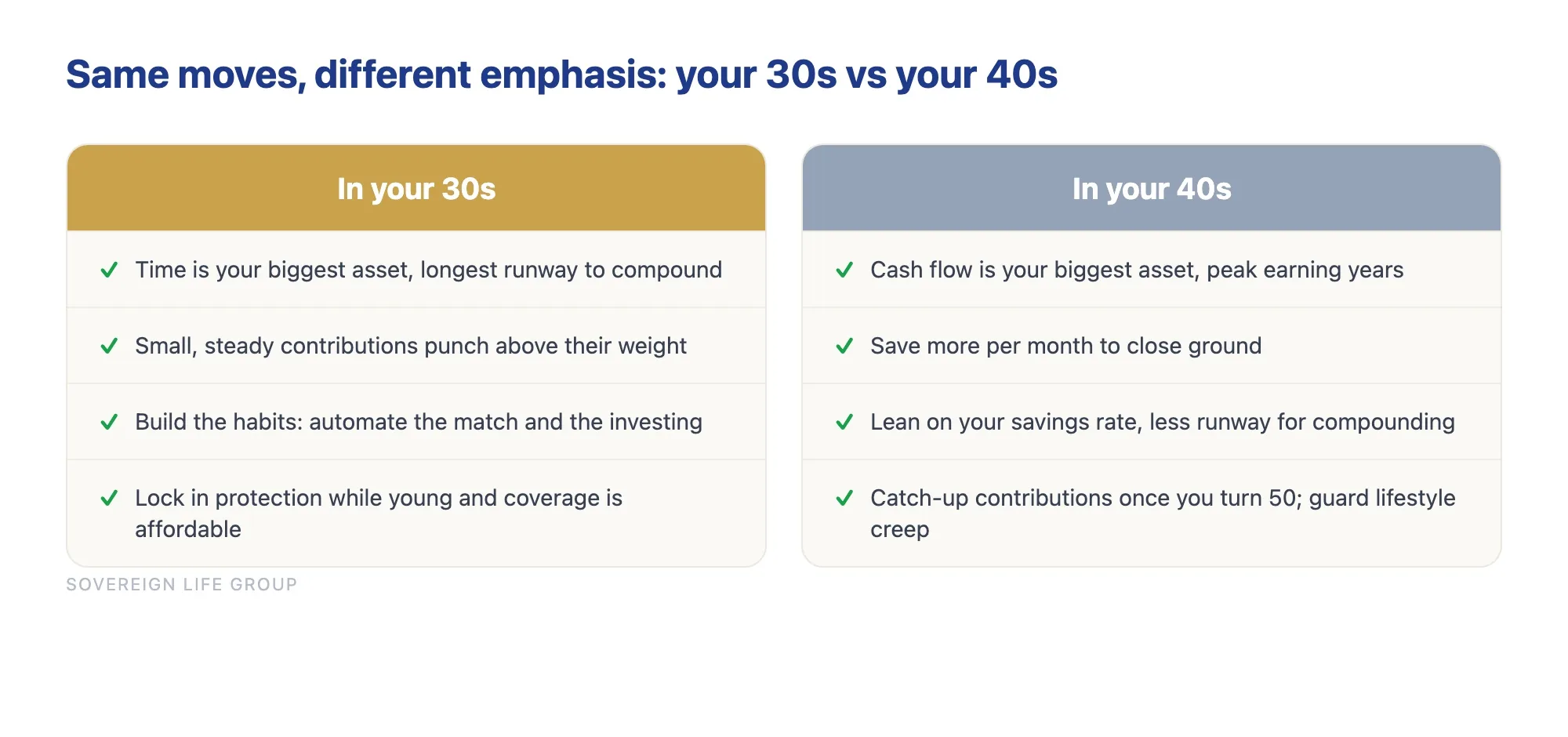
Building wealth in your 30s: time is your biggest asset
In your 30s, your superpower is time. You may not earn as much as you eventually will, but every dollar you invest now has the longest possible runway to compound, which means small, consistent contributions punch far above their weight. The play in your 30s is to build the habits and the systems: automate the match, automate the investing, knock out high-interest debt, and lock in protection while you are young and healthy and coverage is most affordable. You will not feel rich doing it. You are planting, not harvesting. The families who start these habits in their 30s, and even carry a few of them back into their 20s, tend to be the ones with real options later.
Building wealth in your 40s: cash flow is your biggest asset
If you are reading this in your 40s and feeling behind, breathe. Your 40s are often your peak earning years, which means you can save more per month than you ever could before, and that higher cash flow can close a surprising amount of ground. You have less runway for compounding, so the math changes: you cannot rely on time alone, so you lean on your savings rate instead. Crank up the percentage you save, max out the tax-advantaged accounts you can reach, take advantage of catch-up contributions once you turn 50, and guard hard against lifestyle creep, which is most dangerous exactly when your income is highest.
Your 40s are also the decade to handle the basics that protect a family: a simple will, named and up-to-date beneficiaries on every account and policy, and a clear plan so your loved ones are not left guessing during a hard moment. None of this is glamorous, and all of it is the difference between leaving a plan and leaving a mess. Less time does not mean no time. It means be deliberate, and use the cash flow advantage while you have it.
Five mistakes that quietly cost you
Knowing the moves is half the job. Avoiding the predictable mistakes is the other half. These are the ones I see most often, and each one is a slow leak rather than a single disaster, which is exactly why they go unnoticed for years.
- Investing before capturing the match. If you are putting money into a brokerage account while leaving employer match dollars on the table, you are skipping a guaranteed return for an uncertain one. Match first, always.
- Trying to time the market. Waiting for the perfect moment to invest usually means missing months or years of growth. Time in the market has historically mattered far more than timing the market, and the cost of sitting in cash while you wait is real.
- Chasing hot tips and single stocks. The dopamine of a winning pick is not a strategy. Concentrated bets can wipe out years of patient saving. Broad, boring, and diversified is what compounds reliably.
- Letting lifestyle creep absorb every raise. A rising income with a flat savings rate is the most common reason capable earners stay broke. Bank part of every raise before it becomes a habit you cannot unwind.
- Leaving the income unprotected. Building a careful plan on top of an uninsured paycheck is like building a house with no roof. One storm, and the work washes away for the people who needed it most.
None of these mistakes feels expensive in the moment. That is the trap. They cost you quietly, a little at a time, until you look up a decade later and wonder where the progress went. Avoiding them does not require willpower so much as a few systems set up once and left to run.
A simple 90-day starting plan
Knowledge that never turns into action is just entertainment. So here is a concrete, low-stress way to put the most important moves in place over your next three months. You do not need a finance degree, a spreadsheet you will abandon, or a perfect plan. You need to start and then keep going.
- Days 1 to 30: Open a separate high-yield savings account and automate a transfer into it every payday, even a small one, until you reach one month of expenses. At the same time, log into your 401(k) and raise your contribution to at least the full match. These two steps alone change your trajectory.
- Days 31 to 60: List every debt with its interest rate. Pick the avalanche or the snowball, and set up an automatic extra payment toward your target debt. Then take ten honest minutes to ask who would feel a financial hole if your income disappeared, because that answer tells you whether protection belongs near the top of your list.
- Days 61 to 90: Open an IRA if you do not have one and set up an automatic monthly contribution into a low-cost broad index fund. If anyone depends on your income, get a real quote for term life and disability coverage so you know the actual cost rather than the imagined one. Then schedule a calendar reminder to revisit all of this once a year.
That is it. By the end of 90 days you will have a cushion growing, free match money captured, a debt plan running, money flowing into investments automatically, and a clear picture of your protection. Then your only job is to raise the dials a little each year and otherwise leave it alone while compounding does the slow, quiet work.
Want a free financial-foundation review?
Fifteen minutes. We will look at where you stand, what is protected, and the simplest next move for your situation. No pressure, no jargon, just a straight answer.
Get a Quote Book a 15-Min Call Prefer to start with the protection piece? See how we help families.Frequently asked questions
What are the most important money moves to build wealth in your 30s and 40s?
In rough order: build a small emergency fund, capture your full 401(k) match, pay off high-interest debt, then invest steadily in low-cost index funds while protecting your income. The order matters more than the cleverness. None of it is exciting, and that is exactly why it works. Boring, automated, and repeated for years is what compounds.
How do I start building wealth in my 30s if I have nothing saved?
Start with a small emergency fund of about one month of expenses, then grab any 401(k) match your employer offers, then attack high-interest debt. You do not need a big income to start. You need to start, automate it, and let the years do the heavy lifting. A small amount invested consistently beats a large amount you keep meaning to begin.
Is it too late to build wealth in my 40s?
No. Your 40s are often your highest earning years, which means you can save more per month than you could in your 20s. You have less time to compound, so the move is to raise your savings rate, max tax-advantaged accounts where you can, avoid lifestyle creep, and handle estate basics like a will and beneficiaries. Less time is not no time. It means be deliberate.
Should I pay off debt or invest first?
Grab your full 401(k) match first, because that is an instant return you cannot get anywhere else. After that, pay off high-interest debt like credit cards before investing more, since few investments reliably beat a 20 percent interest rate. Lower-interest debt like a mortgage can usually run alongside investing rather than blocking it.
How much of my income should I be saving in my 30s and 40s?
A common target is around 15 percent of gross income toward retirement, including any employer match, but the right number is the highest one you can sustain without burning out. If you are starting late, you may aim higher in your 40s. The single most powerful lever is your savings rate, so raise it a little every time your pay goes up, before lifestyle absorbs the raise.
Why does life insurance matter for building wealth?
Your income is the engine behind every other money move. If that income stops, the plan stops. Term life and disability coverage protect the paychecks your wealth is built on, so one bad event does not erase years of progress for the people who depend on you. It is not the exciting part of a plan, but it is the seatbelt that lets the rest survive a bad year.
None of these seven moves is clever, and that is the point. Wealth in your 30s and 40s is not built by being smarter than the market. It is built by doing the plain things in the right order, on repeat, protecting what you have got, and giving compounding the years it needs. If you would like a second set of eyes on your plan from a real human and not a robot, the team at Sovereign Life Group, your life insurance strategist, is glad to help, or you can simply reach out and we will talk it through.
Joseph McDermott is a licensed life insurance agent (NPN 22121673), licensed in 27 states. Brokered through Family First Life, in partnership with Catalyst Life. This article is educational and is not financial, tax, investment, or legal advice. Please talk with a qualified professional about your specific situation. Product availability, features, and rates vary by state, age, health, and carrier, and any coverage is subject to underwriting approval. Guarantees are subject to the claims-paying ability of the issuing insurance company.