Paid-Up Additions Explained: How PUAs Supercharge a Policy


The Short Version
Paid-up additions are small pieces of extra whole life insurance you buy on top of your base policy, each one fully paid for on day one and each one carrying its own cash value and death benefit. Because a PUA dollar skips most of the early insurance cost, it turns into usable cash value far faster than a base premium dollar. Used through a PUA rider, they are how a policy gets overfunded. The catch is the IRS MEC limit, which caps how fast you can pour money in before the tax perks go away.
Paid-up additions are the quiet engine behind almost every well-built cash value policy, and hardly anyone explains them without either overselling the magic or burying you in jargon. I want to do neither. Clients ask me about paid-up additions constantly, usually after a friend told them whole life is a scam and someone else told them it is a secret bank the wealthy use. The truth sits in the middle, and it lives almost entirely in how the additions are structured. Get that part right and a policy does real work. Get it wrong and you have an expensive, slow policy that earns the bad reputation.
So this is the walkthrough I give at the kitchen counter, minus the pressure. What PUAs actually are, the two ways to buy them, what they cost, how overfunding really works, the tax line you cannot cross, and the honest cases where none of this is worth it for you. I write as a licensed agent, not a hype man. Some of what follows will slow you down before it speeds you up, and that is on purpose.
What this guide covers
- What paid-up additions actually are
- How paid-up additions work
- PUA rider vs the dividend option
- What PUAs cost and where your dollar goes
- Overfunding a policy without breaking it
- A worked example, base only vs overfunded
- The MEC trap and the IRS 7-pay limit
- Designing a policy around PUAs
- The flexibility most people miss
- PUAs and policy loans
- When overfunding is the wrong move
- Frequently asked questions
What paid-up additions actually are
Paid-up additions are small, single-payment chunks of whole life insurance you add to your base policy. Each one is fully paid for the instant you buy it, which is what "paid up" means, so it carries no future premium. And each addition brings its own cash value and its own bit of death benefit, all growing inside the one policy you already own.
Picture your base policy as the main account and each paid-up addition as a tiny, fully funded policy stacked on top of it. You are not opening anything new, taking another medical exam, or restarting underwriting. You are buying a little more of the same permanent coverage, and every piece you buy starts contributing to the cash value right away. That is the whole idea in one sentence: more permanent coverage, bought efficiently, with the growth pointed at cash value instead of at a bigger required premium.
Why does anyone care? Because base whole life, on its own, builds cash value slowly in the early years. A lot of your first few premiums go toward the cost of the insurance and the way the policy is loaded up front. Paid-up additions flip that. They let you feed the cash value directly, which is why anyone using a policy for savings, for the be your own bank idea, or for tax-advantaged growth leans on them so heavily. If the mechanics of the underlying account are fuzzy, our primer on how cash value life insurance works is the piece to read alongside this one.
No medical exam for a ballpark. Free, and no pressure.
How paid-up additions work
Paid-up additions work by taking extra money, either a dividend or a payment you choose to make, running it through a small one-time charge, and converting almost all of what remains into cash value plus a matching slice of paid-up death benefit. Those additions can then earn dividends of their own, which buy still more additions. That loop is where the compounding comes from.
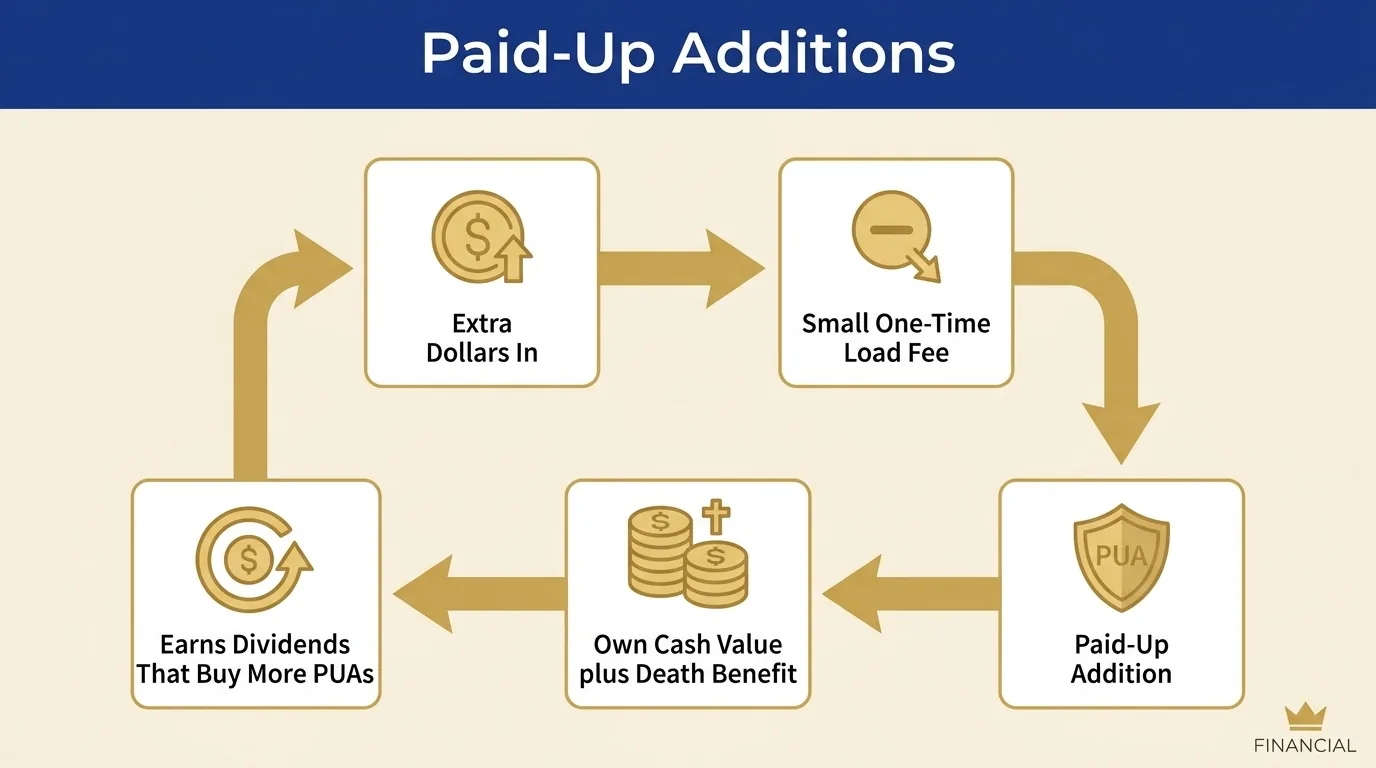
Let me slow it down, because the order of operations is the part people miss. When a dollar goes in as a paid-up addition, the insurer takes a small one-time load off the top, then applies the rest to buy a bit of paid-up coverage. The cash value credited is close to the amount that went in. That is very different from a base premium dollar, where a big share early on is buying the insurance itself and the cash value shows up slowly.
The compounding loop
Here is the part that actually earns the "supercharge" label. Participating whole life, the kind sold by mutual insurers, can pay an annual dividend when the company declares one. Dividends are not guaranteed, and I want to be plain about that. But when they are paid, you can point them at more paid-up additions. Now those additions earn dividends too. Year after year, the additions you bought last year help buy the additions you buy this year. It is slow at first and then it is not, the way a snowball behaves once it gets rolling.
No new underwriting
One feature that surprises people. When you buy additions with dividends or through the rider, you are usually not re-qualifying medically. You bought your health at the original application. That matters most for anyone whose health has changed since. A policyholder who developed a condition after issue can often keep growing coverage through additions that a brand new application would price much higher or decline outright. I have watched that single feature quietly save a family's plan.
PUA rider vs the dividend option
There are two ways to buy paid-up additions, and they are not rivals, they work together. The dividend option uses the policy's annual dividend, when one is paid, to buy additions automatically. The PUA rider lets you add your own extra money on top of the base premium to buy additions on purpose. The rider is what makes serious overfunding possible.
People mix these up all the time, so here is the clean split. The dividend option is passive. You set the policy so that any dividend the company declares goes toward buying additions instead of coming to you as a check or reducing your bill. You do nothing each year and the policy quietly grows. The catch is that you are limited to whatever the dividend happens to be, and again, it is not guaranteed.
The PUA rider is active and it is the real workhorse. It gives you permission to send in extra dollars, within a limit, that go almost entirely to cash value. If you want a policy to build value fast, this is the lever you pull. Most well-designed policies use both at once: the rider to front-load meaningful money in the early years, and the dividend option to keep the compounding going for life.
What PUAs cost and where your dollar goes
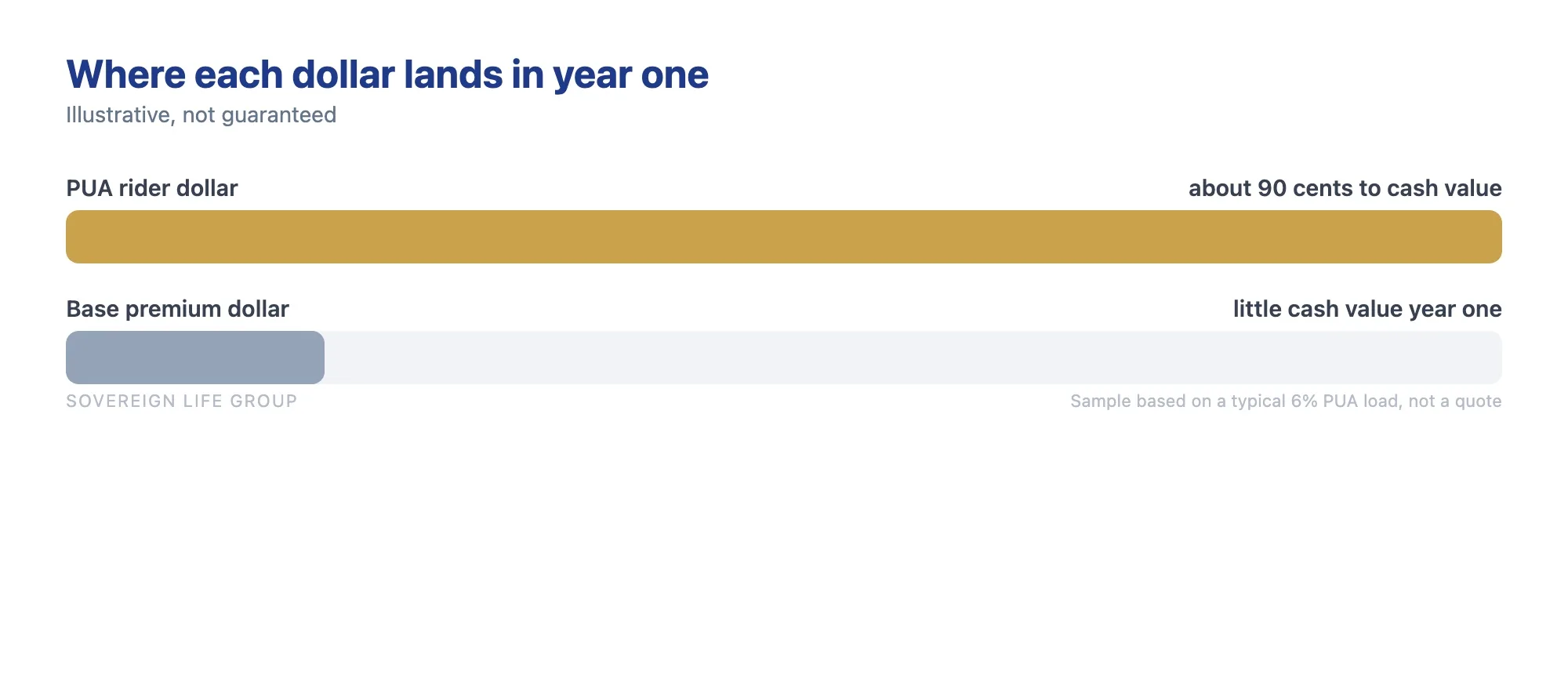
Paid-up additions carry a small one-time load, commonly in the range of about 4 to 10 percent of the amount you put in, and that is the entire cost. After that charge, close to all of the remaining money shows up as cash value, and the addition never asks for another premium. Compared with a base premium dollar, a PUA dollar is far more efficient in year one.
This is the number that reframes the whole conversation, so let me sit on it. Say you send 10,000 dollars into a PUA rider and the load is 6 percent. The insurer keeps 600 dollars, and roughly 9,400 dollars lands as cash value more or less immediately, along with a chunk of additional paid-up death benefit. Contrast that with the base premium, where a large slice of your early dollars is buying the cost of insurance and the cash value climbs slowly for the first several years. Same policy, two very different jobs for the money.
A fair question follows: if PUA dollars are so efficient, why not put everything there? Two reasons. First, the insurer requires a real base policy underneath, so you cannot buy only additions. Second, the IRS caps how fast you can fund, which we get to shortly. The load itself also varies by carrier and by product, and a lower load is not automatically the better deal if the rest of the policy is weaker. I have seen people chase the cheapest load into a policy with a thin dividend history and worse long-term numbers. Price the whole thing, not one line of it.
| Factor | Effect | Why it matters |
|---|---|---|
| PUA load fee | Lower load, more cash value day one | The load is the one-time charge before your money becomes cash value |
| Your age at purchase | Older buys less death benefit per dollar | Each addition is priced on your age when you buy it |
| Base premium size | Sets the ceiling for the rider | The MEC limit is tied to the base coverage you own |
| Carrier dividend strength | Stronger history, more compounding | Dividends buy more additions, though they are never guaranteed |
| Rider design | A richer rider allows more overfunding | The split between base and PUA controls early cash value |
Overfunding a policy without breaking it
Overfunding means deliberately keeping the base premium low and pouring extra money into the PUA rider, so cash value builds far faster than in a standard policy. The goal is to fund as close to the IRS limit as the design allows, capturing the efficiency of PUA dollars, without paying in so fast that the policy loses its tax advantages.
Here is the reframe that makes overfunding click. In a traditional whole life policy sold for maximum death benefit, most of your premium buys insurance and the cash value is an afterthought for years. An overfunded policy inverts the recipe. You buy the smallest base death benefit the carrier will allow for a given amount of funding, then load the rest into paid-up additions. Because PUA dollars are almost all cash value on day one, the account grows quickly, and the death benefit rides along as a byproduct rather than the point.
This is the structure behind the strategies people call infinite banking or being your own bank. The policy becomes a pool of accessible, growing cash you can borrow against, while it keeps compounding. If that concept is new to you, our deeper walkthrough of the be your own bank strategy with whole life lays out the mechanics and, just as important, the honest limits. The same tax-advantaged growth idea shows up in other permanent products too, which is why families comparing options often look at both whole life and permanent cash value coverage side by side before deciding.
The mistake I see most with overfunding is people treating it as a pure investment and forgetting it is still life insurance with costs, surrender charges early on, and real trade-offs. It is a savings and access tool with a death benefit wrapper, and it rewards patience. If you need the money back in two or three years, this is the wrong vehicle. If your horizon is ten years and up, the efficiency starts to show.
A worked example, base only vs overfunded
Comparing a base-only policy with an overfunded one is the fastest way to see what paid-up additions do. The overfunded design puts far more money to work as cash value in the early years, so its value pulls ahead within the first decade and the gap tends to widen over time. The numbers below are illustrative, not a quote, and not guaranteed.
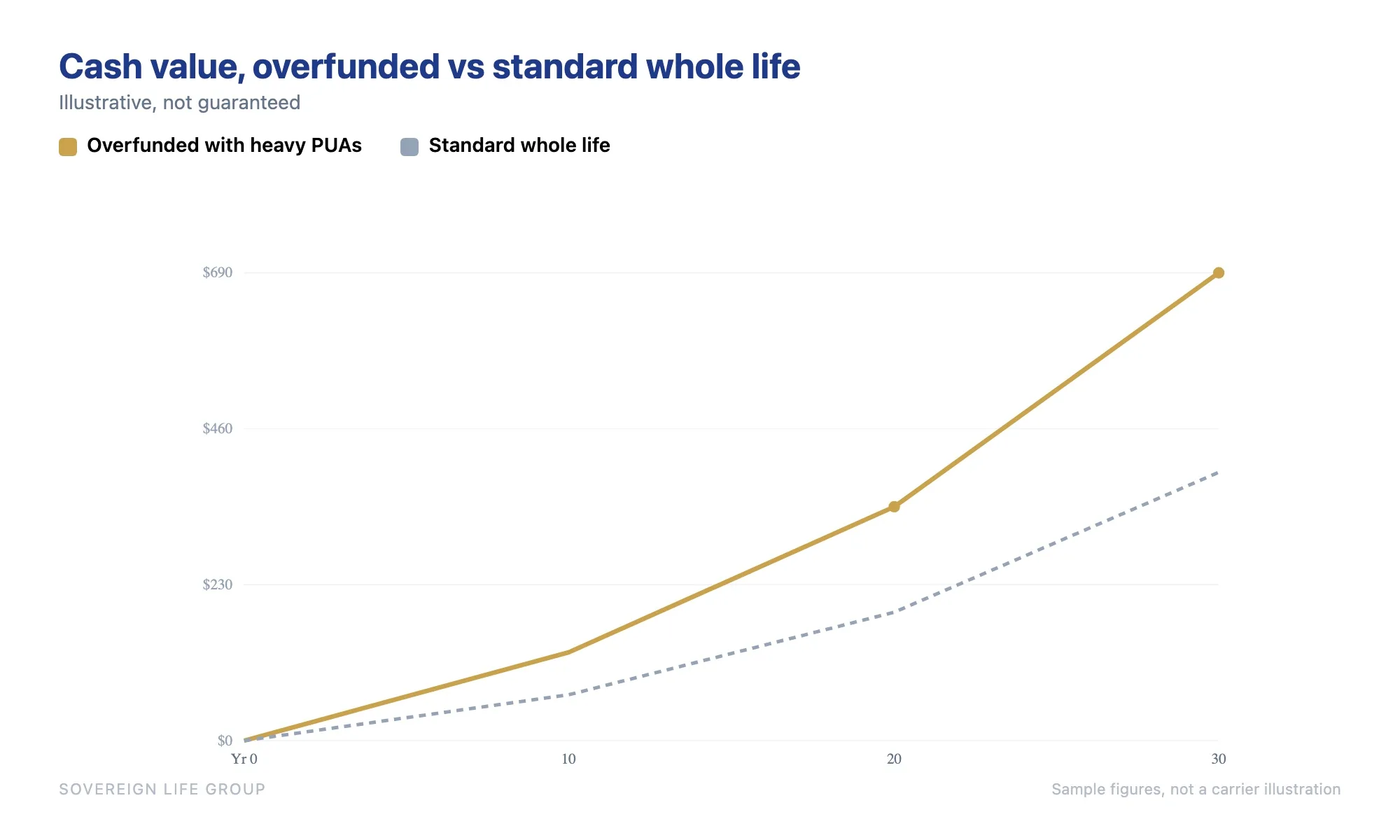
Walk through what the picture is showing. Two people put in similar total dollars. One buys a standard whole life policy built for death benefit. The other builds an overfunded policy with a small base and a heavy PUA rider. In the first few years, the overfunded policy already has meaningfully more cash value available, because those PUA dollars skipped most of the early insurance drag. By year ten the difference is not subtle. By year thirty the compounding has done its work.
Now the honest asterisk, because a chart like this is where sales pitches lie by omission. The standard policy is carrying a much larger death benefit for the same money, which is the whole reason its cash value is lower early. Neither line is guaranteed, since dividends drive a big part of the growth and dividends can rise or fall. And the overfunded policy still has early surrender costs, so the usable value in year one or two is less than the total you paid in. A responsible illustration from a carrier will show you the guaranteed column and the non-guaranteed column side by side. Always read the guaranteed one first. If a design only looks good on the non-guaranteed side, that tells you something.
One more thing I tell every client at this stage. The right amount of paid-up additions is not the maximum the software will let you type in. It is the amount that fits your actual cash flow for the long haul, because the strategy only works if you keep funding it through the early years when the numbers look their worst. A policy you overfund for three years and then abandon is often worse than a simpler one you would have kept.
Get a fast, free estimate tailored to your age and health.
The MEC trap and the IRS 7-pay limit
A modified endowment contract, or MEC, is what your policy becomes if you fund it faster than the IRS allows. The test is called the 7-pay test, and it has existed since the Technical and Miscellaneous Revenue Act of 1988. Cross it and your loans and withdrawals lose their favorable tax treatment, which defeats most of the reason to overfund in the first place.
Here is why this rule exists and why it matters so much to PUA strategy. Congress did not want people using life insurance purely as a tax shelter, so it set a ceiling on how quickly you can pay premiums relative to the death benefit. If your cumulative payments in the first seven years exceed the 7-pay limit, the policy is classified as a MEC. According to the IRS, life insurance keeps favorable tax treatment only when it stays within these rules, and a MEC changes how distributions are taxed, generally to a gains-first, taxable basis with a possible penalty before age 59 and a half.
The practical takeaway is almost reassuring. Overfunding is the art of driving right up to the MEC line without touching it. A good policy design leaves a deliberate cushion so a market timing quirk or an extra dividend does not accidentally tip you over. This is also why you cannot simply dump unlimited money into paid-up additions. The base death benefit sets your MEC limit, so if you want to contribute more, you generally need a larger base to raise the ceiling. That trade-off, more room to fund versus more insurance cost, sits at the center of good design.
Designing a policy around PUAs
Designing a policy around paid-up additions comes down to one dial: the split between base premium and PUA rider. A higher share to PUAs means faster early cash value and less death benefit per dollar. A higher share to base means more death benefit and slower early cash value. The right split depends on why you are buying the policy in the first place.
People love to argue about the perfect ratio, and I understand the appeal of a clean rule. But the honest answer is that it depends on your goal, your time horizon, and how much death benefit you actually need. A saver focused on early access leans heavier toward PUAs. Someone who wants a large permanent death benefit and treats the cash value as a bonus leans toward base. Neither is wrong. They are answers to different questions.
| Design leaning | Early cash value | Death benefit per dollar | Tends to fit |
|---|---|---|---|
| Heavier base, lighter PUAs | Slower | Higher | Wants maximum permanent coverage |
| Balanced base and PUAs | Moderate | Moderate | Wants both protection and access |
| Lighter base, heavier PUAs | Faster | Lower | Focused on cash value and banking |
The term rider blend
There is a design trick worth understanding. Carriers often let you add a term insurance rider alongside the PUA rider. The term rider temporarily props up the total death benefit, which raises your MEC limit, which lets you pour more into paid-up additions without becoming a MEC. As the paid-up additions grow, they gradually replace the term coverage. Used carefully, it is a legitimate way to squeeze more early funding into a policy. Overused, it adds cost and complexity you may not need. If you are still deciding between permanent and temporary coverage at all, start with the basics in our comparison of term versus whole life insurance before layering on riders.
Why more PUAs is not always better
It is tempting to assume the heaviest possible PUA design wins. It does not always. A policy tilted hard toward additions carries very little death benefit, which can be a problem if protection was part of your reason for buying. It also demands consistent funding to look good, and life does not always cooperate. I would rather build a policy a client can comfortably feed for twenty years than a maximally aggressive one they strain to keep alive for five.
The flexibility most people miss
The most underrated feature of the PUA rider is flexibility. Unlike your base premium, which you must pay to keep the policy in force, PUA contributions can usually be dialed up, dialed down, or paused within the policy's rules. That means the extra funding can flex with your income, and a good year and a lean year do not have to be treated the same.
This is the part that gets glossed over in most explanations, and it is a genuine advantage over a rigid savings commitment. Your base premium is the non-negotiable part, the amount that keeps the coverage alive. The PUA rider sits on top as the elastic part. In a strong year you can fund it near the limit. In a tight year you can trim it or skip it, keep the base premium going, and the policy stays perfectly healthy. Most carriers do set a minimum to keep the rider active and a window in which it stays available, so the flexibility is real but not unlimited, and the exact rules vary by product.
Why does this matter for a real family? Because rigid savings plans fail when life gets bumpy, and a plan you abandon returns nothing. I have watched people stick with an overfunded policy through a job change or a slow season precisely because they could ease off the rider for a year without wrecking anything. The elastic design is not a footnote. For a lot of households it is the difference between a strategy they keep and one they quit.
PUAs and policy loans
Paid-up additions build the cash value you can borrow against, which is the mechanical heart of using a policy as your own bank. When you take a policy loan, you are borrowing against your value while the full amount, additions included, generally keeps earning as if you never touched it. That is the feature people find almost too good to believe, so it deserves a clear-eyed look.
Here is how it fits together. Every paid-up addition you buy adds to the cash value pool. That pool is what you can access through a policy loan, without a credit check, on your own schedule, for whatever you decide. Because a well-designed participating policy can keep crediting the whole balance while a loan is outstanding, your money can, in effect, keep compounding while you also use it. That is the mechanic behind the be your own bank idea. The additions are what make the pool big enough to matter.
Now the trade-off, because there is always one. A policy loan charges interest, and if it is left unpaid the balance and interest reduce the death benefit and can, in a poorly managed policy, threaten to collapse it. A loan is not free money, it is access to your own money with a cost and a responsibility attached. When a family is weighing whether to fund the PUA rider more or pay down an existing policy loan, there is a real decision to make, and it is worth thinking through on purpose rather than by default.
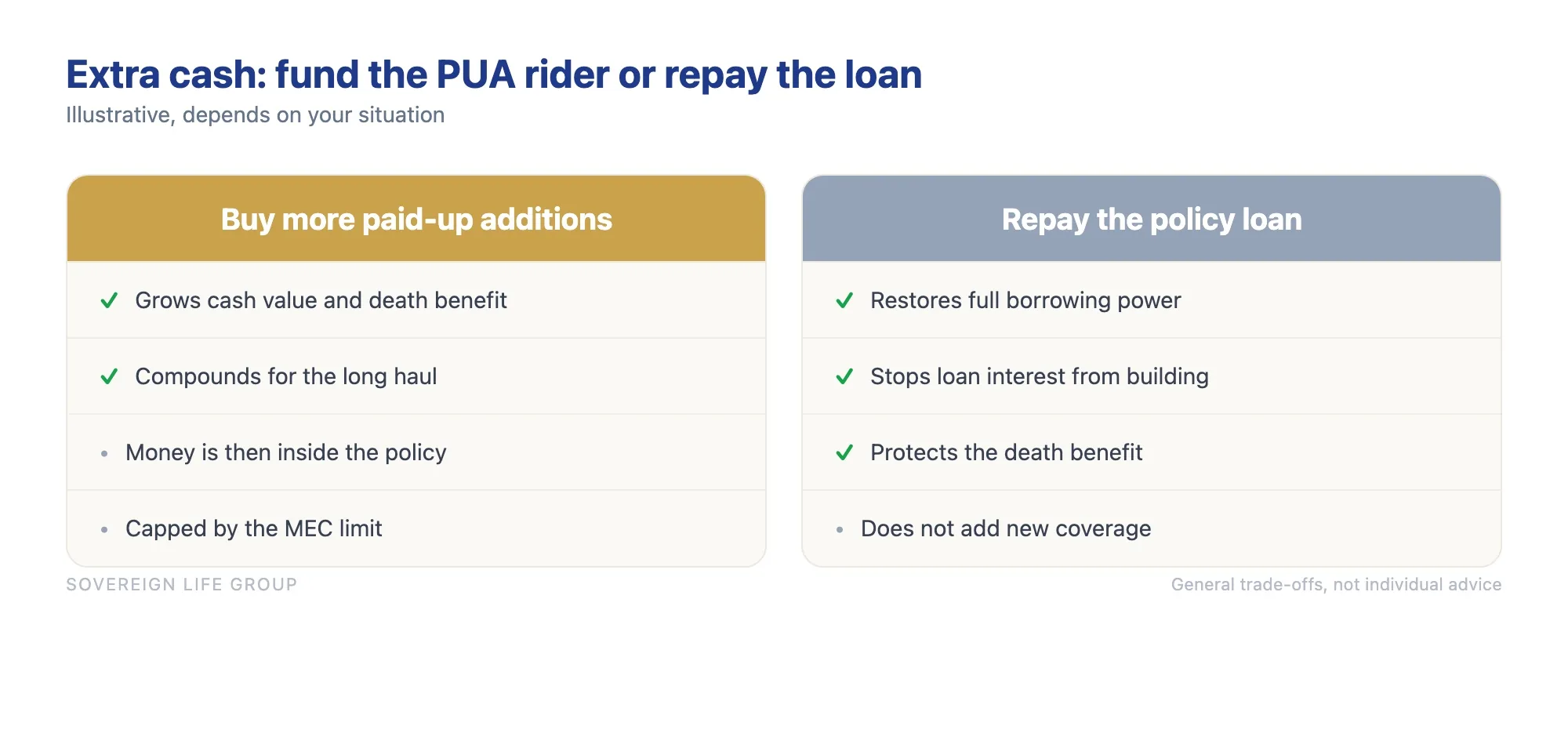
For most people I talk with, the answer is not either or, it is sequencing. Keep the loan under control so it never endangers the policy, and fund the rider when cash flow allows. The worst outcome is ignoring a growing loan for years while chasing more additions, then watching the interest quietly eat the very value you were trying to build.
When overfunding is the wrong move
Paid-up additions and overfunding are not for everyone, and an honest guide has to say so. If you need pure death benefit at the lowest cost, term life almost always wins. If you cannot commit to funding for at least ten years, the early surrender costs work against you. And if you have not yet handled more basic financial ground, a fancy policy is the wrong first move.
Let me be specific about who should slow down, because this is where I talk people out of things. If your budget is tight and your family is underinsured, your first dollars belong in enough death benefit to protect them, not in a slow-building cash value strategy. This is not a small problem to ignore. According to LIMRA's 2024 research, roughly 100 million American adults say they live with a life insurance gap, meaning they have none or know they need more. If that is you, coverage comes first and optimization comes later.
A few more honest cases where I would pump the brakes on heavy PUAs:
- You carry high-interest debt. Paying that down usually beats any illustrated policy growth, guaranteed against not guaranteed.
- You have not maxed simpler tax-advantaged accounts that fit your situation, where a licensed professional says those come first.
- Your income is unstable enough that you could not keep funding through a rough patch, even with the rider's flexibility.
- You are being pushed toward the most aggressive design by someone whose pay rises with your premium. That is a reason to get a second look, not a reason to sign.
None of that makes paid-up additions bad. Whole life remains a real part of the market for a reason, and industry data from LIMRA has shown whole life holding a large share of new individual life premium in recent years, which tells you plenty of families find it useful once it is built correctly. The point is simply that the tool has to match the job. When it does, PUAs are one of the most efficient things you can do inside a policy. When it does not, they are an expensive detour. If you want a straight read on which camp you fall in, you can talk it through with a licensed agent who will tell you when the answer is no.
That balance is the whole reason I write these. A policy built around paid-up additions can quietly do more for a patient family than almost anything else in the permanent insurance world. It can also be sold badly, funded carelessly, and abandoned early. The difference is not the product. It is the design and the honesty behind it, which is what any decent life insurance strategist should bring to the table before a single dollar goes in.
Want a policy built right, not just sold?
Fifteen minutes. We will look at your goals, your budget, and whether a paid-up additions strategy actually fits you, or whether something simpler does the job better. No pressure, no jargon.
Get a Quote Book a 15-Min Call Prefer to explore first? See how coverage fits a household on the families coverage page.Frequently asked questions
What are paid-up additions in life insurance?
Paid-up additions are small chunks of extra whole life insurance you buy on top of your base policy. Each one is fully paid for the moment you buy it, so it carries no future premium, and each brings its own cash value and its own death benefit that grow inside the same policy.
Are paid-up additions worth it?
For someone who wants a whole life policy to build usable cash value quickly, paid-up additions are usually the single most efficient lever, because a PUA dollar puts far more into cash value in year one than a base premium dollar does. They are less useful if your only goal is the largest possible death benefit for the lowest premium, where term life often wins.
Can you cash out paid-up additions?
Yes. Paid-up additions carry cash value you can borrow against or surrender. Surrendering an addition trades its future growth and death benefit for cash today, and gains above your cost basis can be taxable. Many people borrow against the value instead so the addition keeps working while they use the money.
Do paid-up additions increase the death benefit?
Yes. Every paid-up addition adds a small amount of permanent death benefit on top of your base policy, and because those additions can earn dividends that buy still more additions, the death benefit can keep climbing over time without any increase in your required premium.
What is the difference between a PUA rider and the dividend option?
The dividend option uses the policy's annual dividend, when one is paid, to buy paid-up additions automatically. A PUA rider lets you add your own extra dollars above the base premium to buy additions on purpose. The rider is what makes real overfunding possible, and using both together is the common design.
Can too many paid-up additions create a tax problem?
They can. If you pay in faster than the IRS 7-pay test allows, the policy becomes a modified endowment contract, or MEC, and loans and withdrawals lose their favorable tax treatment. A well-designed overfunded policy is built to fund right up to that limit without crossing it.
Joseph McDermott is a licensed life insurance agent (NPN 22121673), licensed in 27 states. Brokered through Family First Life, in partnership with Catalyst Life. This article is educational and is not financial, tax, or legal advice. Please talk with a licensed professional about your specific situation. Policy features, riders, dividends, and results vary by carrier, product, age, health, and state, and any coverage is subject to underwriting approval. Dividends are not guaranteed. Policy loans accrue interest and reduce cash value and death benefit if not repaid. Guarantees are subject to the claims-paying ability of the issuing insurance company.