Final Expense Insurance: Costs, Coverage, and Who It Fits


The Short Version
Final expense insurance is a small whole life policy built to cover funeral and end-of-life costs. Coverage usually runs 5,000 to 25,000 dollars, most plans need no medical exam, and the rate is locked for life. It is meant for seniors who do not want to leave a bill behind, and the price depends mostly on your age and health when you start.
Here is a quiet question most families never sit with: if you passed away next month, who would write the check for the funeral? Final expense insurance exists to answer that question so the people you love never have to scramble for it. In this guide we will walk through what it actually is, what it costs by age, how burial insurance works, the honest difference between the two main types, how much funeral insurance cost to plan for, and who it is genuinely for. No pressure, no jargon, just the math and the trade-offs laid out plainly.
What this guide covers
- What final expense insurance actually is
- What it covers, and what it is for
- What it costs by age
- Why funerals cost what they do
- Simplified issue vs guaranteed issue
- How the waiting period works
- Does it build cash value?
- Who final expense for seniors fits
- When it is not the right fit
- How much coverage you need
- How to apply and what carriers ask
- Buying a policy for a parent
- How to choose the right plan
- Common mistakes to avoid
- How it compares to other options
- Frequently asked questions
What final expense insurance actually is
Final expense insurance is a small whole life policy designed to cover the costs that arrive at the end of life: the funeral, the burial or cremation, leftover medical bills, and small debts. You may also hear it called burial insurance or funeral insurance. They are all the same idea wearing different names, and none of them is a separate product category with secret rules. It is simply a modest whole life policy aimed at one job.
Unlike a large term policy meant to replace decades of income, this coverage is small and built for that single purpose. It never expires as long as you pay the premium, the rate is locked in for life, and the benefit is paid to the beneficiary you name. That payout is generally free of federal income tax, and your family can use it for anything they need. It is the difference between your family grieving and your family grieving while also fundraising for a casket.
Cover the funeral and last bills. Simple health questions, about 2 minutes.
What it covers, and what it is really for
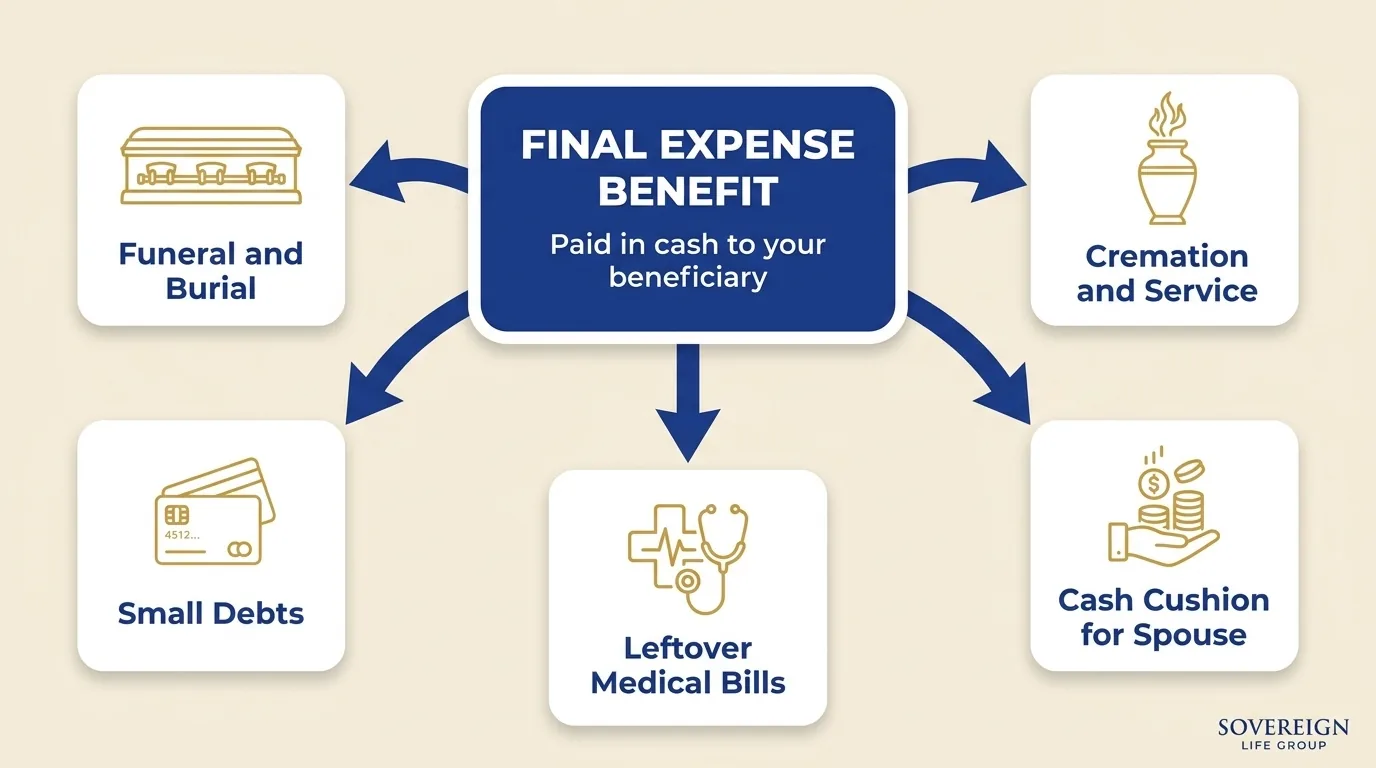
One thing surprises a lot of people: a final expense policy does not pay a funeral home directly, and it is not earmarked for a casket the way a layaway plan would be. It pays cash to your named beneficiary, usually a spouse or adult child, and they decide how to use it. The name describes the intent, not a restriction.
In practice, families use the benefit to cover a mix of the following:
- Funeral and burial costs: the service, the casket or urn, the plot, the headstone, transportation, and the funeral director's fees.
- Cremation costs, which are usually lower than a full burial but still add up once you include a service.
- Leftover medical bills from a final illness or hospital stay that insurance did not fully cover.
- Small debts like a credit card balance, a personal loan, or the last few utility and household bills.
- A small cushion of cash so a surviving spouse is not suddenly short while an estate settles.
Because the money is flexible, the real product you are buying is breathing room. The benefit lands quickly once a claim is filed, often within days, which matters because funeral costs do not wait for a will to clear probate.
What does final expense insurance cost by age
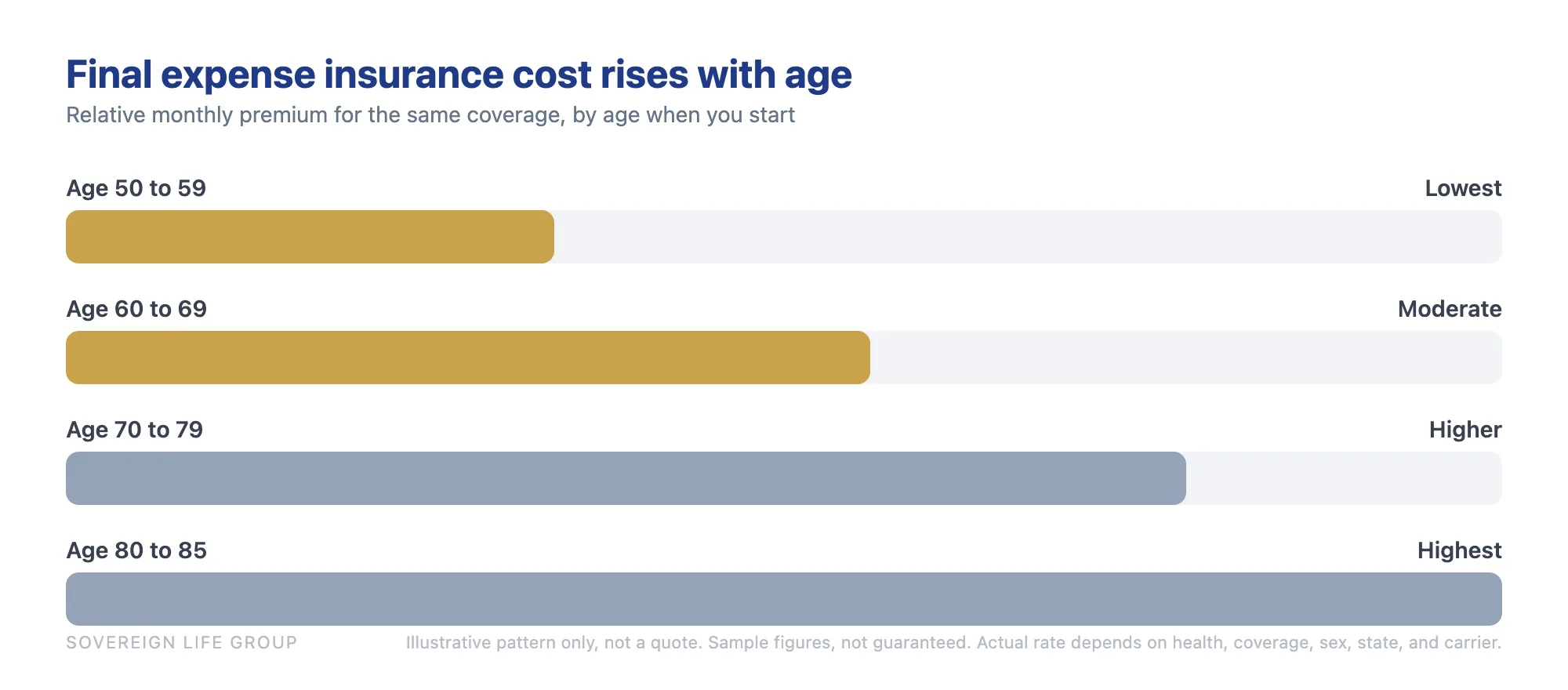
Less than most people guess, and a lot less than the bill it is built to cover. Most final expense policies provide 5,000 to 25,000 dollars of coverage, and the monthly premium depends on five things: your age, your health, the coverage amount you choose, your sex, and the carrier. A healthy person in their early 60s will pay noticeably less than someone in their 80s, because premiums rise as you age.
That age math is the single biggest driver of funeral insurance cost. The same coverage almost always costs more the longer you wait, so locking a plan sooner keeps the rate lower for life. Women also tend to pay a little less than men at the same age, because they live longer on average. The table below shows the general pattern. These are illustrative ranges to show direction, not a quote or an offer of coverage, and your real number depends on your health and the carrier.
| Age when you start | Typical monthly range | What usually changes |
|---|---|---|
| 50 to 59 | Lowest | Best rates, widest carrier choice, easiest approval |
| 60 to 69 | Moderate | Still very affordable, the most common age to buy |
| 70 to 79 | Higher | Health questions matter more, fewer top-tier options |
| 80 to 85 | Highest | Guaranteed issue becomes a common fit, smaller benefits |
The honest answer to "what will mine cost" is that it varies, and the only way to know your real number is a personalized quote based on your actual age and health. Be cautious of anyone who quotes you a flat rate before they know either, and be just as cautious of a rate that seems too good, since it may be a guaranteed issue plan with a waiting period that was not explained. We will get to that waiting period in a moment, because it is the detail most articles gloss over.
Why funerals cost what they do
It helps to understand the bill this coverage is built to meet. Funerals are expensive for reasons that are easy to underestimate until you are the one planning one. According to the National Funeral Directors Association, a funeral with a viewing and burial now runs around 8,000 dollars or more once you add a vault, and even a cremation with a service is several thousand dollars by the time you include the urn and the gathering.
The line items add up fast: the funeral home's basic services fee, transportation of the body, embalming or refrigeration, a casket or urn, the cemetery plot or columbarium niche, opening and closing the grave, a headstone or marker, flowers, an obituary, and the death certificates the family will need copies of. None of these are luxuries. They are the ordinary cost of laying someone to rest with dignity, and they arrive all at once, usually within a week, at the exact moment a family is least able to think about money.
That is the whole reason final expense insurance exists. It turns a sudden five-figure bill into a small, predictable monthly premium you handle while you are alive and well.
Simplified issue vs guaranteed issue: the difference that matters most
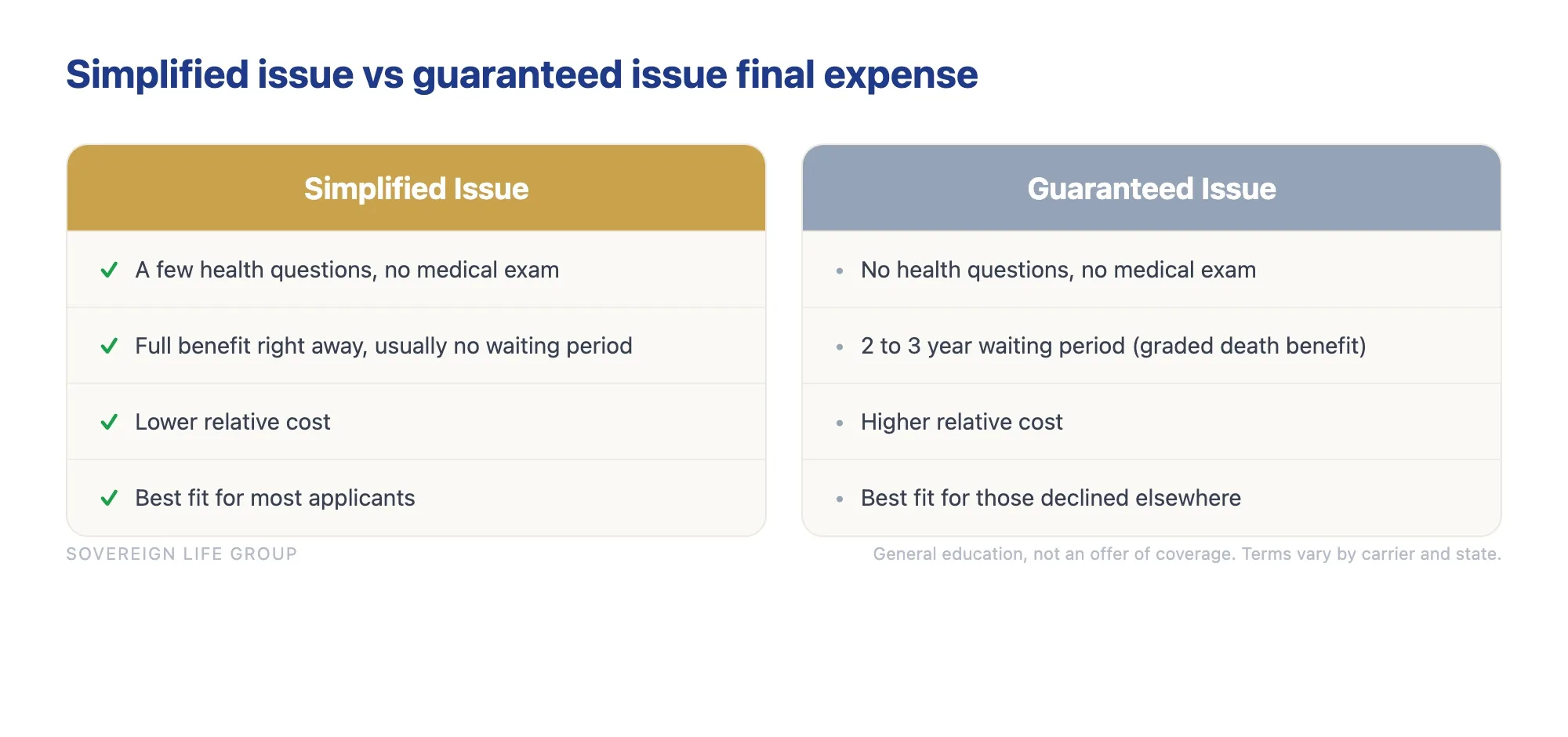
This is the part most articles skip, and it matters more than anything else, so we will tell it straight. There are two main ways to qualify for this kind of coverage, and the difference affects both your price and when your family actually gets paid.
Simplified issue asks a handful of health questions, requires no medical exam, and in most cases the full benefit is available right away. The carrier may still check a prescription history or other records, but there are no blood draws or appointments. It is the best value for most people, which is why it is always the first thing worth checking. Many common, managed conditions, like controlled high blood pressure, treated high cholesterol, or stable type 2 diabetes, still qualify for simplified issue with the right carrier, the same way life insurance with pre-existing conditions gets approved every day.
Guaranteed issue asks no health questions at all and accepts applicants in a set age band, commonly 50 to 85. That makes it a real option for someone who has been declined elsewhere or who has a serious condition. The honest trade-off is twofold: it costs more, and it typically carries a two to three year waiting period, known as a graded death benefit, before the full benefit is paid. If you pass away during that window from natural causes, your family usually receives the premiums you paid plus interest rather than the full coverage amount. After the waiting period, the full benefit is in force.
| Feature | Simplified Issue | Guaranteed Issue |
|---|---|---|
| Health questions | A few | None |
| Medical exam | No | No |
| Typical age band | Varies by carrier, often 45 to 85 | 50 to 85 |
| Waiting period | Usually none, full benefit right away | Typically 2 to 3 years (graded death benefit) |
| Relative cost | Lower | Higher |
| Best fit | Most applicants | Those declined elsewhere or with serious conditions |
If a medical exam is your main worry, it is worth understanding how these no-exam paths work in general. Our guide to no-exam life insurance breaks down what carriers ask instead of running labs, and why a simplified-issue application is often quick to approve.
How the waiting period works, and why it exists
A graded death benefit is the single most misunderstood feature in this whole category, so it deserves its own section. Here is what it actually is, in plain terms.
When a carrier asks no health questions, it has no way to tell a healthy applicant apart from someone who is seriously ill. To stay fair to everyone and remain solvent, the carrier builds in a waiting period, usually the first two to three years of the policy. If you die from natural causes during that window, the policy returns the premiums you paid, typically with some interest added, rather than the full benefit. If you die from a covered accident, most guaranteed issue policies pay the full amount even during the waiting period. Once the waiting period ends, the full benefit is payable for any cause.
The practical takeaway: most people do not need a guaranteed issue plan. They qualify for simplified issue, which has no waiting period and a lower price. Guaranteed issue is a genuine safety net for people who truly cannot qualify any other way, and for them it is a good thing to exist. It is just not the starting point.
Does final expense insurance build cash value?
Because most final expense policies are whole life, they can build a small amount of cash value over time, money that accumulates inside the policy and that you may be able to borrow against while you are alive. It is a real feature, but it is easy to oversell, so here is the honest picture.
The cash value in a small policy like this grows slowly, and it is never the reason to buy one. You are buying the death benefit, not an investment. Two things are worth knowing. First, any loan or withdrawal you take against the cash value reduces the death benefit your family receives if it is not repaid, so borrowing from it works against the policy's main purpose. Second, the guarantees in a whole life policy are backed by the issuing insurance company, not by any outside fund, so the strength of the carrier matters. If you are specifically looking for cash-value growth as a strategy, a small burial policy is the wrong tool, and a larger permanent policy designed for that job is a different conversation entirely.
Who final expense for seniors is really for
This coverage is not for everyone, and a good agent will say so. It tends to make sense when:
- You are a senior, often somewhere between 50 and 85, and want a plan sized to a funeral rather than to decades of income.
- You do not have a large term or whole life policy already covering these costs.
- You have had health issues, or have been turned down before, and want a path that still accepts you.
- You want to protect a spouse so the person you leave behind is not choosing between grief and a stack of bills.
- You prefer a fixed premium that never rises and coverage that never expires.
- You want the money to land quickly and go directly to a person you trust, outside the delays of probate.
A lot of the fear around this topic comes from things people believe that simply are not true, like "I am too old" or "my health rules me out." We cleared up several of those in these common life insurance myths. The short version: more people qualify than assume they do, and the only way to know your real options is to ask.
A small policy that pays fast. See your rate in about 2 minutes.
When final expense insurance is not the right fit
An article that only says "buy this" is a sales pitch, not advice. So here are the honest cases where final expense insurance is the wrong tool or simply not needed yet:
- You are young with dependents who rely on your income. If a family depends on your paycheck, a small burial policy will not replace your income. A larger term policy usually does that job for far less per dollar of coverage. Our breakdown of term vs whole life insurance lays out when each one earns its keep.
- You already carry plenty of coverage. If an existing policy plus savings already covers final costs, you may not need to add more. More is not always better.
- You are healthy and want the most coverage per dollar. A healthy applicant in their 50s or early 60s may qualify for a small term or simplified-issue policy with a larger benefit for a similar price. It is worth comparing before defaulting to a burial plan.
- You can comfortably self-fund. If you have liquid savings set aside specifically for final expenses and your family can access them quickly, insurance may be optional. The catch is that money has to be truly available and untouched.
The goal is the right coverage for your actual situation, not the biggest policy or the most expensive product. Sometimes the best move is a different structure, and an honest agent will tell you that.
How much coverage you need
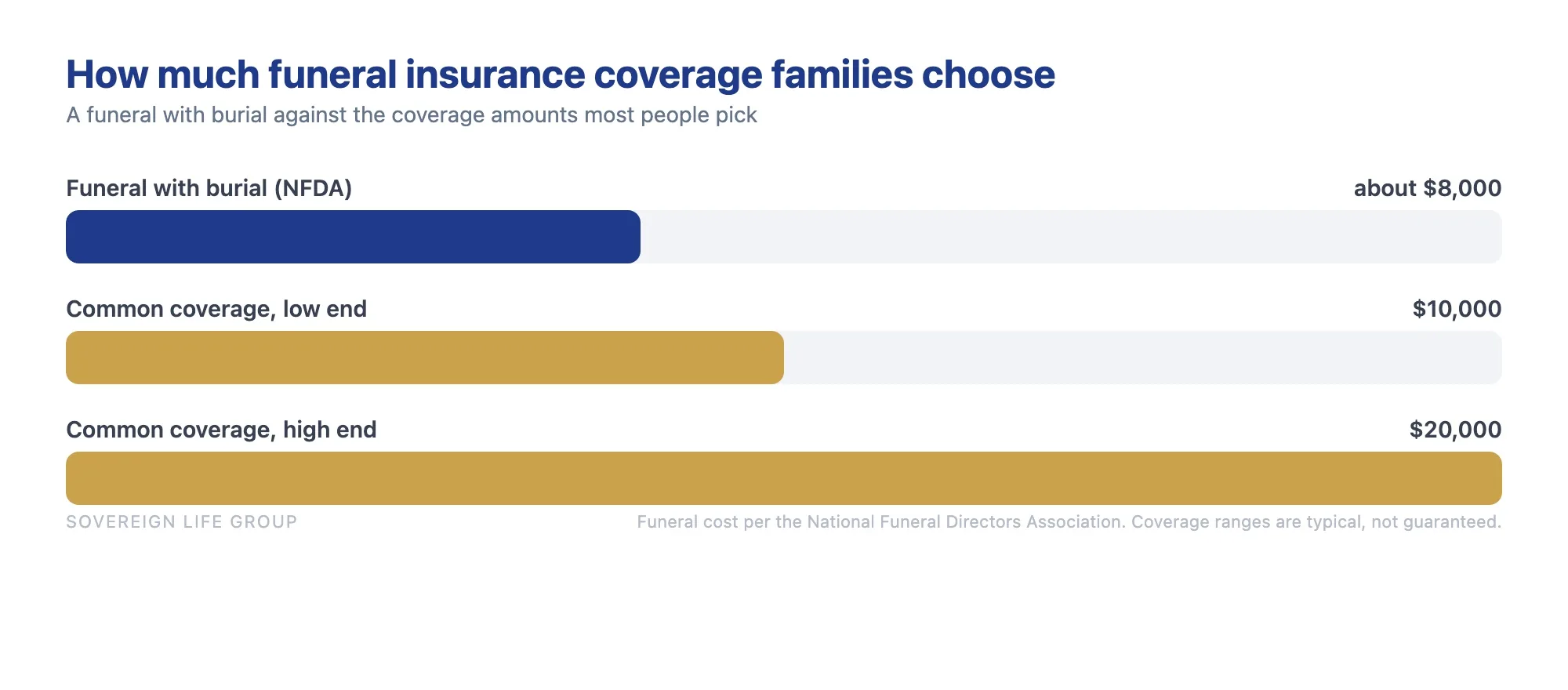
Most families choose enough to cover the funeral plus a small cushion for the odds and ends that follow. Since a funeral with burial runs around 8,000 dollars or more, coverage in the range of 10,000 to 20,000 dollars is common. Some people add a bit more to cover lingering medical bills or to leave a small gift behind, and some choose less if they only want to cover a cremation.
A simple way to size it: add up the funeral or cremation you actually want, any medical bills or debts you expect to leave, and a small buffer of a few thousand dollars for the surviving spouse. Subtract anything already set aside for this purpose, including any VA burial benefits if you have served, since final expense is built to fill the gap those benefits leave, as our guide to life insurance for veterans explains. The number you land on is a reasonable starting benefit. There is no universal right answer here. The goal is simply that your family is not left paying the bill or selling something to cover it.
How to apply, and what carriers actually ask
The application for final expense insurance is short, and that surprises people who expect the medical gauntlet of a large policy. Here is what the process usually looks like:
- A few health questions. For simplified issue, expect questions about major conditions like recent heart events, cancer treatment, oxygen use, or a terminal diagnosis. Many managed conditions are fine. For guaranteed issue, there are no health questions at all.
- Basic information. Your age, sex, state, and the beneficiary you want to name.
- A prescription and records check. Most carriers run a quick electronic check of your prescription history and other databases. There is no exam, no blood, and no appointment.
- A decision, often the same day. Simplified issue plans frequently approve within minutes to a few days, and coverage can be in place that week.
Answer every question honestly. A policy issued on inaccurate answers can be contested by the carrier during the first two years, which is exactly the outcome you are trying to protect your family from. Honesty on the application is what makes the claim pay smoothly later.
Buying a policy for an aging parent
A common reason people land on this page is not for themselves but for a parent, and our fuller guide to life insurance for elderly parents is built for exactly that situation. You can absolutely buy a final expense policy on a parent, and it is one of the more loving things an adult child can quietly arrange. A few practical points:
- The parent has to participate. They must consent, answer the health questions themselves, and sign the application. You cannot insure someone without their knowledge.
- You need insurable interest. As a child paying for a parent's final expenses, you have a clear, legitimate reason to insure them, which satisfies this requirement.
- Decide who owns and who benefits. Often the adult child is the policy owner and pays the premium, while being named the beneficiary so the money flows to the person handling the arrangements.
- Have the conversation early. Rates rise every year, and some conditions narrow the options. Starting the conversation while a parent is in their 60s or 70s usually opens more doors than waiting.
It can be a tender conversation to start. Framing it as "I want to take this worry off your plate" usually lands better than leading with numbers.
How to choose the right plan
Because different carriers price age and health very differently, the same person can get very different offers from different companies. One carrier might treat your blood pressure medication as a non-issue while another bumps you to a higher tier for it. The work is in the matching. An independent agent who can compare multiple A-rated carriers will look for the one most likely to approve you at a fair rate for your situation, instead of selling you the single product one company happens to offer.
A few things to look for in any plan you consider:
- Is it simplified issue or guaranteed issue? Always confirm which one you are being offered, and whether there is a waiting period.
- Is the premium level for life? A true whole life final expense policy locks the rate. Avoid plans whose premium increases as you age unless you fully understand why.
- How strong is the carrier? Any guarantees rest on the claims-paying ability of the issuing company, so a financially strong, well-rated carrier matters.
- Does the benefit match the job? Right-size it to your actual final costs rather than a round number that looks good.
If you want to see how this looks in your state, you can explore final expense coverage in your state, or look at a worked example like final expense in Texas to get a feel for the process. The right move is to talk it through with a licensed professional who knows your situation before you sign anything. None of this is one-size-fits-all, and it should never feel like a hard sell. For broader context on how many families are underinsured for exactly these costs, the Insurance Information Institute publishes neutral background on how life insurance works.
Common mistakes to avoid
After enough of these conversations, the same avoidable missteps show up again and again. Here are the ones worth steering around:
- Defaulting to guaranteed issue. Many people who could qualify for simplified issue, with no waiting period and a lower price, end up in a guaranteed issue plan because no one checked first. Always ask whether you qualify for simplified issue before settling.
- Buying more than you can keep. A premium that strains the budget leads to a lapsed policy, which protects no one and wastes what you already paid.
- Naming the wrong beneficiary, or none at all. Keep your beneficiary current, especially after a divorce or a death in the family. A policy with no living beneficiary can end up stuck in probate, the exact delay you bought it to avoid.
- Not telling your family the policy exists. A benefit no one knows to claim does no good. Tell the person who will handle your arrangements where the policy is.
- Shopping a single carrier. One company's "no" or high rate is not the market's answer. Comparing several is how you find the right fit.
- Confusing this with prepaid funeral plans. A prepaid plan locks you to one funeral home and one set of services. A final expense policy pays cash your family controls, which is far more flexible.
How final expense insurance compares to other options
Final expense insurance is one way to handle end-of-life costs, but it is not the only one. Knowing the alternatives helps you decide whether it is right for you:
- Term life insurance. Cheaper per dollar of benefit, but it expires at the end of the term, which is a problem for a need that has no deadline. Many seniors outlive a term policy, leaving nothing for final costs. Term is a great tool for income replacement, less so for guaranteed final expenses.
- Larger whole life insurance. Same permanent structure, just a bigger policy. If you want both final expenses covered and a legacy left behind, a larger whole life policy can do both, at a higher premium.
- Prepaid or pre-need funeral plans. Paid directly to a funeral home for a specific set of services. They lock in today's prices but tie you to one provider, and the money is not flexible if plans change or you move.
- A payable-on-death bank account or earmarked savings. Simple and flexible, but only works if you have actually saved enough and the funds stay untouched and accessible to your family quickly.
For many seniors, especially those with health conditions or modest savings, a small whole life final expense policy hits the sweet spot: guaranteed to be there whenever it is needed, flexible cash to the family, and a premium that never rises. For others, one of the alternatives fits better. The right answer depends on your health, your savings, and what you want the money to do.
Want a straight answer for your situation?
Fifteen minutes. We will look at your age, your health, and the simplest plan to take the final bill off your family. No pressure, no jargon, just a clear next step.
Get a Quote Book a 15-Min Call Prefer to start now? Save my card and get a quick final expense quote.Frequently asked questions
What does final expense insurance cost?
It depends on your age, your health, the coverage amount, your sex, and the carrier. Most plans are small whole life policies between 5,000 and 25,000 dollars, and many seniors pay a modest amount each month for a rate locked for life. Premiums generally rise the older you are when you start. The only way to know your exact number is a personalized quote based on your real age and health.
What is included in final expenses?
Final expenses are the costs your family faces right after you pass away. They usually include the funeral or cremation, the casket or urn, the burial plot or niche, the headstone, and the funeral home's service fees. They can also cover unpaid medical bills, small remaining debts, and the everyday bills that keep coming while your family settles things. A final expense policy hands your family a tax-free check to cover these without dipping into savings.
Is final expense insurance the same as burial insurance?
Yes, in practice they are the same thing. Final expense, burial insurance, and funeral insurance are all common names for a small whole life policy designed to cover end-of-life costs. The benefit is paid to your named beneficiary, is generally income-tax-free, and can be used for anything, not only the funeral.
What is the difference between simplified issue and guaranteed issue?
Simplified issue asks a few health questions, requires no exam, and usually pays the full benefit right away. Guaranteed issue asks no health questions and accepts applicants in a set age band, but it costs more and typically has a two to three year waiting period, called a graded death benefit, before the full benefit is paid. Most people qualify for simplified issue, which is why it is worth checking first.
Do I need a medical exam for final expense for seniors?
Usually no. Most final expense plans for seniors are simplified issue, meaning a few health questions and no medical exam, often with coverage in place within days. Guaranteed issue plans ask no health questions at all. Carriers may still run a quick electronic check of your prescription history as part of underwriting.
How much funeral insurance coverage do I need?
Most families choose enough to cover a funeral plus a small cushion. A funeral with burial runs around 8,000 dollars or more, so coverage between 10,000 and 20,000 dollars is common. The right amount depends on whether you want to cover only the funeral or also leftover medical bills and small debts.
What if I have health problems or have been turned down before?
There are still options. Simplified issue accepts many common conditions such as controlled diabetes or high blood pressure, and guaranteed issue accepts applicants in a set age band with no health questions. Guaranteed issue plans typically include a two to three year waiting period before the full benefit is paid, so they are used when they fit rather than as a default.
Does final expense insurance build cash value?
Most final expense policies are whole life, which can build a modest cash value over time that you may borrow against. The cash value in these small policies grows slowly and is not the reason to buy one. The main purpose is the death benefit that pays your family, and any loan or withdrawal reduces that benefit if it is not repaid.
If you would rather start with a few questions in writing, the contact page is the easiest way to reach me. You can also see the full range of life insurance options for families first, with no pressure to decide anything today.
Joseph McDermott is a licensed life insurance agent (NPN 22121673), licensed in 27 states. Sovereign Life Group is brokered through Family First Life, in partnership with Catalyst Life. This article is general educational information, not financial, tax, or legal advice. Please talk with a licensed professional about your specific situation before making a decision. Product availability, features, rates, and waiting periods vary by state, age, health, and carrier, and any coverage is subject to underwriting approval. Guaranteed issue plans may include a graded death benefit with a waiting period before the full benefit is paid. Any guarantees are subject to the claims-paying ability of the issuing insurance company.