Life Insurance for Elderly Parents: An Honest Guide


The Short Version
Yes, you can buy life insurance for elderly parents, as long as they consent and you have insurable interest. For most aging parents the practical option is a small whole life or final expense policy that covers the funeral and any leftover bills. It costs more the longer you wait, and health matters, so the honest move is to look now, compare a few carriers, and size the coverage to the actual job.
Watch: Can You Get Life Insurance on Elderly Parents? Yes.
Most people come to this topic the same way. A parent is getting older, a hard conversation finally happens, and someone in the family asks the question out loud: if Mom or Dad passed away, who is paying for the funeral, and where does that money come from? That is the real reason people search for life insurance for elderly parents. Not investment strategy. Just a son or daughter who does not want to be blindsided by a bill during the worst week of their life.
I write this as a licensed agent who has helped families set this up, and also as someone who will tell you when the answer is "you may not need a policy at all." Some of what follows is going to save you money by talking you out of the fanciest option in the room. That is the point. This guide covers whether you can even insure a parent, the coverage types that actually apply after 60, what it costs, how age and health change the picture, the step by step of buying it, and the parts most articles skip: splitting the cost with siblings and the conversation itself.
What this guide covers
- Can you buy life insurance on your parents?
- Why families insure aging parents
- Types of coverage for elderly parents
- What life insurance for elderly parents costs
- Age and health after 70 and 80
- How to buy a policy on your parent
- Who owns it, pays, and gets paid
- Splitting the cost with siblings
- Mistakes I see families make
- When you may not need it
- Frequently asked questions
Can you buy life insurance on your parents?
Yes. You can buy life insurance on your parents, but two things are required. Your parent has to consent, sign the application, and usually answer health questions, and you need insurable interest, meaning their death would cost you money. An adult child almost always has that. What you cannot do is take out a secret policy on someone.
Consent is not optional
This trips people up, so let me be plain about it. There is no legitimate way to insure a parent who has not agreed to it. The parent signs the application, the insurer often calls to verify identity, and health questions get answered honestly by the person being insured. If a website ever implies you can quietly cover Mom without her knowing, close the tab. That is not how any real carrier works, and it is the sort of thing that gets claims denied later.
What insurable interest actually means
Insurable interest is just the legal idea that you should only be able to insure a life you would genuinely suffer a loss over. A child paying for a parent's funeral, or losing a caregiver, or covering a shared debt, clearly qualifies. You do not have to prove much. Being the son or daughter is usually enough on its own, and the insurer confirms the relationship during the application.
The clients who ask me this most are adult kids who already know they will handle the arrangements when the time comes. They are not being morbid. They are being the responsible one. If that is you, the answer to "can I get life insurance on my parents" is yes, and the harder question is which kind and how much, which is the rest of this guide.
No medical exam for a ballpark. Free, and no pressure.
Why families insure aging parents
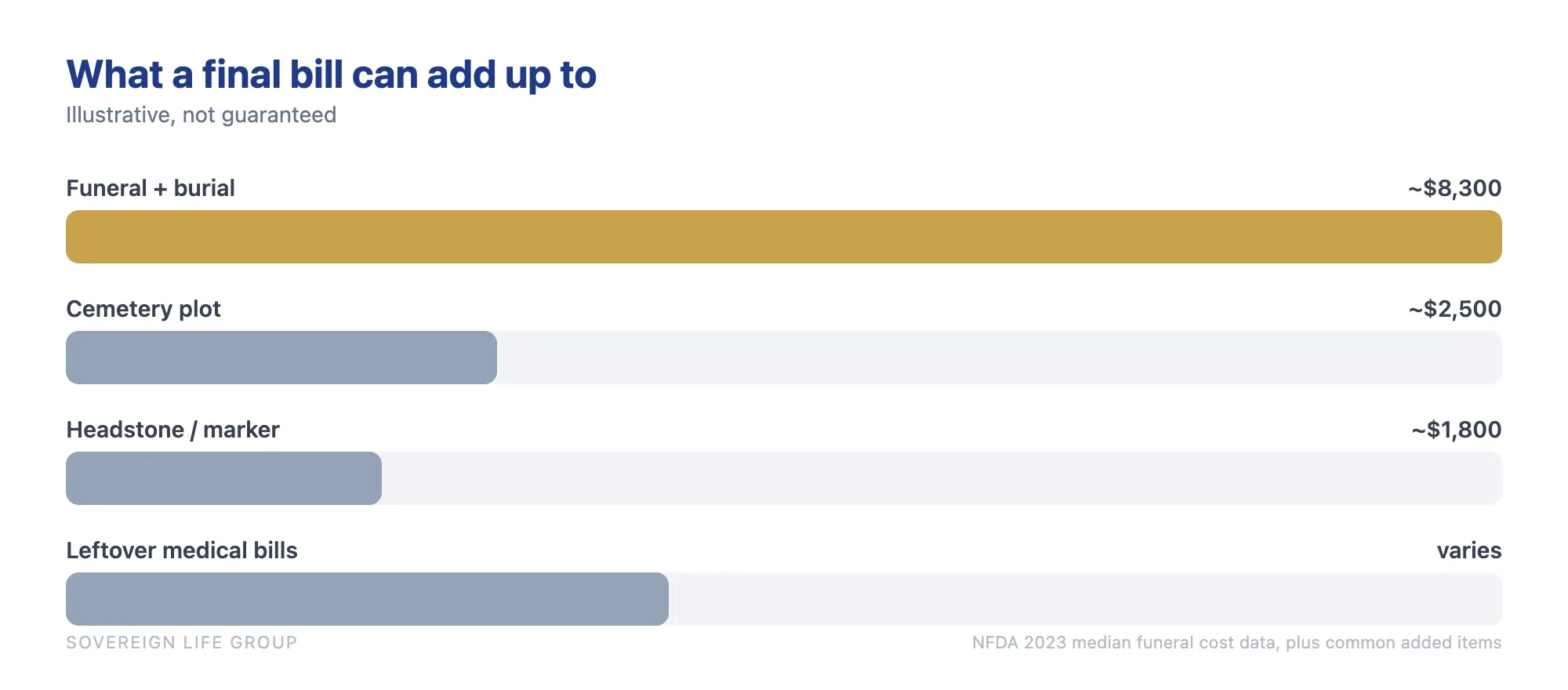
Families buy life insurance for elderly parents mostly to cover final expenses. A funeral, burial or cremation, medical bills left behind, and small debts add up fast. According to the National Funeral Directors Association, the 2023 median cost of a funeral with viewing and burial was about 8,300 dollars, and that is before a cemetery plot, headstone, or unpaid bills.
Here is what actually happens without coverage. The bill does not wait for the estate to settle. The funeral home wants payment up front, often within days, and it lands on whichever family member steps up. I have watched adult children put a parent's funeral on a credit card and carry that balance for a year. A small policy exists to prevent exactly that moment.
Beyond the funeral, there are a few other honest reasons families set this up:
- Final expenses and small debts. Medical copays, a car loan, a credit card balance, the cost of clearing out and selling a home. Coverage gives the family cash that is not tied up while an estate is in probate.
- Replacing a caregiver or a pension. If a parent still helps with grandchildren, or a surviving spouse leans on a pension that shrinks at death, a policy can soften that gap.
- Leaving something behind. Some parents simply want to leave a modest legacy to kids or grandkids and like knowing the check clears quickly and usually income-tax-free to the beneficiary.
- Peace of mind for the parent. Do not underestimate this one. A lot of seniors carry quiet worry about being a burden. Handing that worry to an insurance company can be a real gift to them, not just to you.
The mistake I see most is families assuming savings will cover it. Sometimes they will. But savings meant for a surviving spouse's living expenses is a different pot than money for a funeral, and draining the first to pay for the second is how a grieving parent ends up financially squeezed on top of everything else. Our full guide to final expense and burial insurance walks through how that coverage is built specifically for this job.
Types of coverage for elderly parents
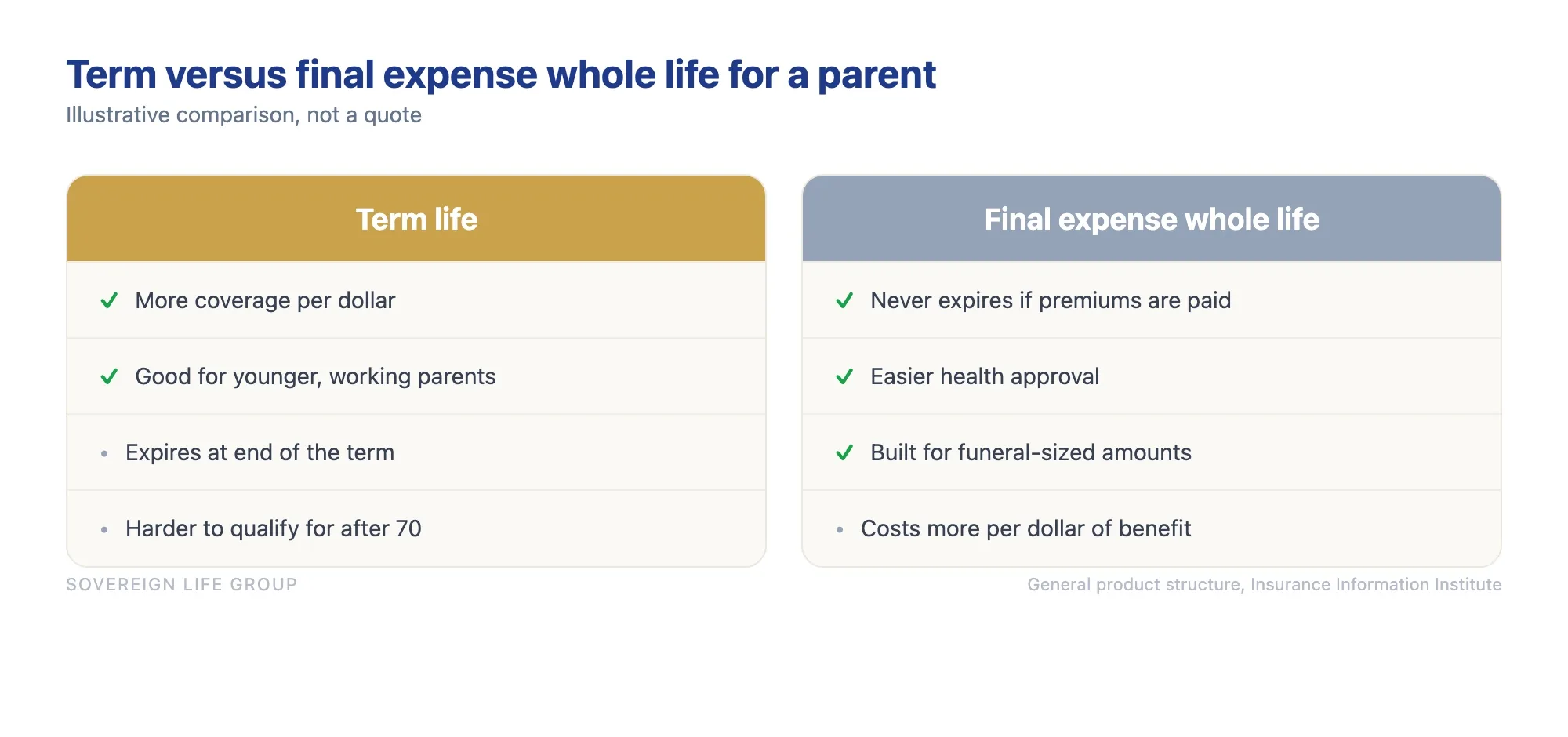
The main options for aging parents are term life, traditional whole life, final expense whole life, and guaranteed-issue whole life. Term suits younger parents still working. For most elderly parents, a small whole life or final expense policy is the realistic fit, because it never expires and is built for smaller, funeral-sized amounts.
Let me walk through each, because the names get blurry and the differences matter.
Term life
Term is pure death benefit for a set number of years, and it gives you the most coverage per dollar. It fits a parent in their late 50s or early 60s who is still working, still carries a mortgage, or still supports someone. The catch for elderly parents is qualification and expiration. After about 70 the price climbs and the health bar rises, and a term policy can expire while the parent is still living, leaving nothing. For a truly elderly parent, term is usually the wrong tool.
Traditional whole life
Whole life is permanent. It does not expire, the premium is level, and it slowly builds a small cash value. For a healthy parent in their 60s, a modestly sized whole life policy can be a clean fit that covers the funeral and a bit more, for life. It costs more per dollar than term because it is designed to still be in force at a claim, which for an older parent is the entire point.
Final expense whole life
This is the workhorse for elderly parents, and it is what most families actually buy. Final expense is small whole life, usually 5,000 to 25,000 or 30,000 dollars, sized to cover a funeral and leftover bills. Approval is simplified, meaning a short list of health questions and no medical exam, so a parent with common conditions can often qualify at a full benefit from day one. Coverage lasts for life as long as premiums are paid. If your parent is over 65 and you want one thing handled, this is usually it. Our overview of senior life insurance options goes deeper on how carriers price these.
Guaranteed-issue whole life
Guaranteed-issue asks no health questions and cannot turn anyone down within its age band, which makes it the safety net for a parent whose health rules out everything else. The trade-off is real and you should know it going in: these policies almost always carry a graded death benefit, meaning if the parent passes from natural causes in the first two or three years, the policy refunds the premiums plus interest rather than paying the full amount. After the waiting period, the full benefit is payable. It is the most expensive coverage per dollar, so it is a fallback, not a first choice.
| Type | Best fit | Health check | Full benefit from day one? |
|---|---|---|---|
| Term life | Younger, working parent under about 70 | Usually a full exam | Yes, while the term lasts |
| Traditional whole life | Healthy parent in their 60s | Exam or simplified | Yes |
| Final expense whole life | Most elderly parents | Health questions, no exam | Usually yes if answers pass |
| Guaranteed-issue whole life | Serious health issues | None | No, typical 2 to 3 year wait |
What life insurance for elderly parents costs
Final expense coverage for an elderly parent commonly runs about 30 to 130 dollars a month for 10,000 to 25,000 dollars of benefit. The price is driven mostly by age, health, tobacco use, gender, and the amount of coverage. A healthy parent in their early 60s pays far less than a parent in their late 70s, and every year of waiting nudges it up.
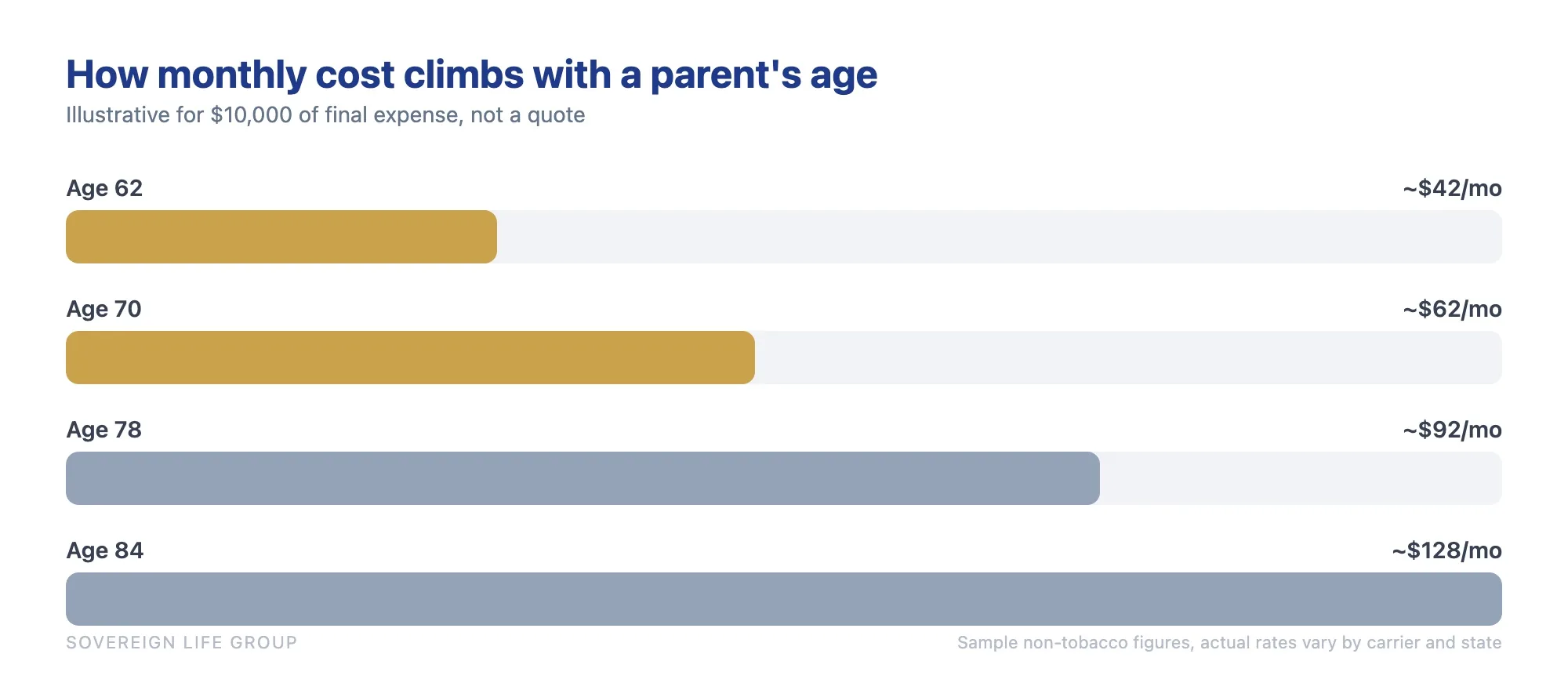
Those numbers are illustrative, not a promise. No honest agent can quote a parent's exact rate from an article, and you should be wary of anyone who does. What I can do is tell you which levers move the price and in which direction, so nothing surprises you.
- Age. The biggest single factor. Rates step up each year, and some carriers stop accepting new applicants in the mid 80s, so options thin out as well.
- Health. Simplified-issue carriers weigh conditions differently. One company may rate diabetes gently while another does not, which is exactly why shopping multiple carriers matters.
- Tobacco. A parent who smokes pays meaningfully more. Underwriting treats nicotine as a major risk factor.
- Gender. Women statistically live longer, so they usually pay a bit less than men at the same age.
- Coverage amount. More benefit means more premium. Sizing the policy to the actual need, rather than rounding up, keeps it affordable.
Here is the reframe I give families who flinch at the monthly cost. Compare it to the alternative, which is not zero. The alternative is the full funeral bill landing on you in a single week. Set against roughly 8,300 dollars for a funeral with burial, a premium in the range of a phone bill starts to look like what it is: prepaying a certain expense in small, manageable pieces instead of one shock. If cost is the real barrier, size the policy down rather than skipping it. A 10,000 dollar policy that gets bought beats a 25,000 dollar one that never does.
Age and health after 70 and 80
Coverage is still very possible for a parent over 70, and often into the 80s, but the picture changes. The number of carriers shrinks, prices rise, and health history starts steering you toward specific products. Life insurance for seniors over 70 usually means final expense or guaranteed-issue whole life rather than term, and the sooner you look, the more options a parent tends to have.
What changes at 70
At 70 a healthy parent still has real choices. Many simplified-issue final expense carriers happily write new coverage in the 70s, and a parent who manages common conditions well can often land a full day-one benefit at a reasonable rate. This is the window where being proactive pays off, because health at 71 is usually better than health at 77, and the application always captures today's version of your parent.
What changes at 80
At 80 the door is still open, just narrower. Fewer companies accept brand-new applicants that late, guaranteed-issue with a waiting period becomes more common, and the monthly cost is higher because the insurer is covering a shorter, riskier stretch. It is still worth doing. I would rather help a family put a modest policy in place at 82 than watch them cover the whole funeral out of pocket because someone assumed it was too late to try.
When health is complicated
Serious or recent diagnoses do not automatically mean no. They mean you need the right carrier. This is the single strongest argument for using an independent agent instead of buying the first policy you see advertised. One carrier treats a heart stent from five years ago as a manageable risk; another treats it as a decline. Matching the parent's exact history to the friendliest carrier is most of the job, and it is why our writeup on life insurance with health conditions exists. If a parent's health rules out simplified issue entirely, guaranteed issue is the floor that still gets something in place.
Get a fast, free estimate tailored to your age and health.
How to buy a policy on your parent
Buying life insurance for an elderly parent follows a clear path: have the conversation, gather their basic health picture, decide who owns and pays, compare a few carriers matched to their health, then complete the application together with the parent signing and consenting. Done in that order, it usually takes a couple of short sessions, not weeks.
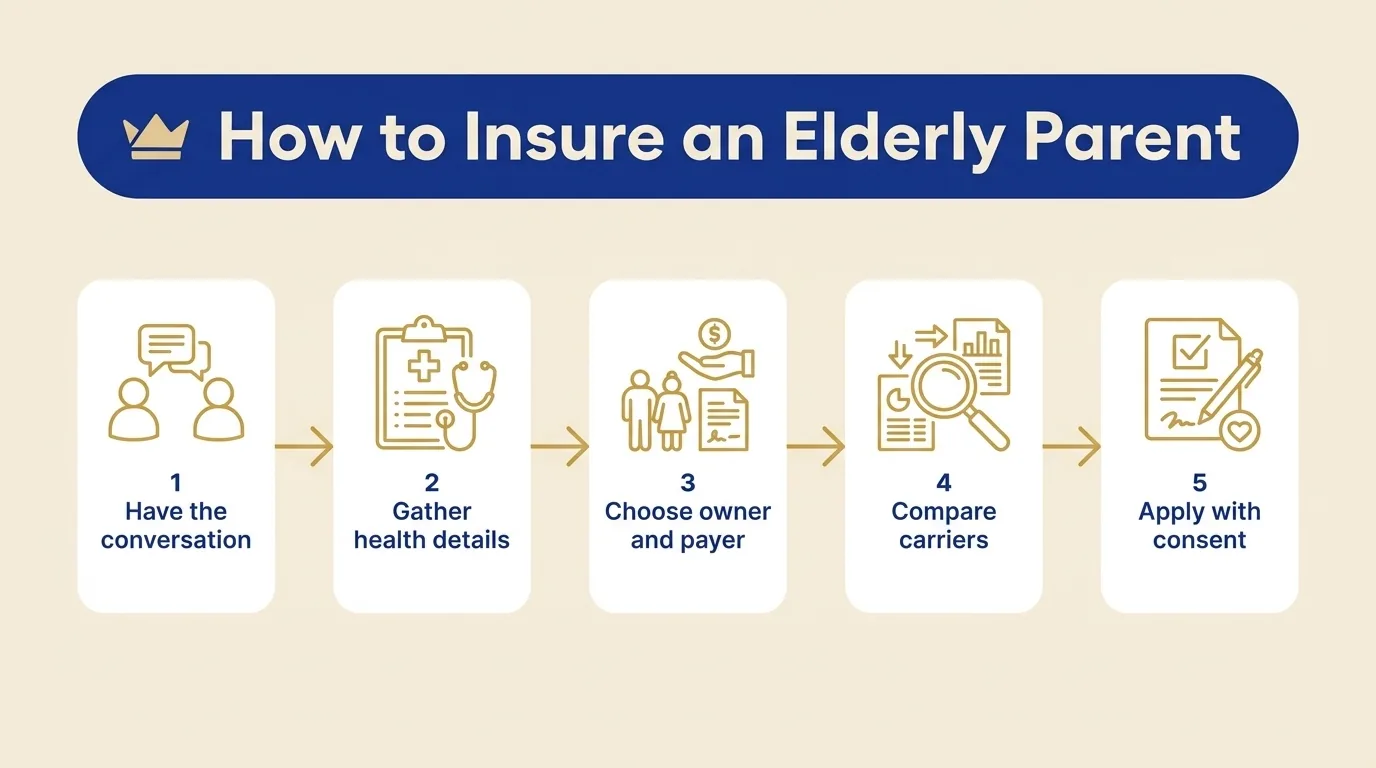
Let me expand each step, because the details are where families get stuck.
1. Have the conversation first
Nothing else happens without this. Sit with your parent and talk plainly about what they want, what they can afford, and what they already have. Some parents already own an old policy nobody remembers. Others have a burial plot but no cash for the service. You cannot size coverage until you know the real gaps, and your parent has to be a willing participant anyway, since they are signing. I put more on the conversation itself further down, because it is the part people dread and rush.
2. Gather the health picture
You do not need medical records, just a straight summary: age, height and weight, tobacco use, major conditions, and current medications. That short list is enough for an agent to point toward the carriers most likely to accept your parent at the best available rate. Honesty here protects the claim later, so resist the urge to round the health picture up.
3. Decide who owns and pays
You will settle who owns the policy, who pays the premium, and who is the beneficiary. Common setups are the parent owning it with a child as beneficiary, or a child owning and paying it with themselves as beneficiary. I cover the trade-offs in the next section. Deciding this before you apply keeps the paperwork clean.
4. Compare a few carriers
This is where an independent agent earns their keep. Rather than one company's rate, you want the two or three carriers that treat your parent's specific age and health most kindly, side by side. For a parent with health issues especially, the spread between carriers can be large, and comparing is the difference between a full day-one benefit and a waiting period.
5. Apply together
The application is short for final expense. Your parent answers the health questions, signs, and the carrier often does a quick phone or electronic verification. Many simplified-issue policies approve within days. Once it is in force, set the premium on autopay from an account that will not lapse, because a policy that quietly cancels for a missed draft helps no one.
Who owns it, pays, and gets paid
Three roles exist on any policy: the owner controls it, the payer funds it, and the beneficiary receives the money. On a parent's policy these can be split among family members. The two clean setups are the parent owning it with a child as beneficiary, or an adult child owning and paying it while being the beneficiary. Both are legitimate.
Parent owns, child is beneficiary
Here the parent holds the policy and names a child to receive the benefit. It keeps the parent in control, which some families prefer for dignity and simplicity. The risk is that if money gets tight, the parent could stop paying without telling anyone, and the policy lapses quietly. If you use this setup, make sure the premium is automated and someone besides the parent gets the lapse notices.
Child owns and pays, child is beneficiary
Here the adult child is the owner, the payer, and the beneficiary, with the parent consenting and being the insured. This is popular when the child is footing the bill anyway. You control the policy, you know it will not lapse, and the benefit comes to you to handle the arrangements. It requires the parent's cooperation on the application, but after that the child runs it. When several siblings share the cost, one of them is usually named owner while the payout gets divided by agreement, which leads into the next section.
One quiet advantage worth knowing: a life insurance death benefit is generally paid income-tax-free to the beneficiary, and it usually passes outside of probate, so the family gets cash quickly rather than waiting months for an estate to settle. That speed is often the whole reason to use insurance instead of just earmarking savings. For a broader look at protecting the household, our guide to life insurance for parents covers younger families too.
Splitting the cost with siblings
Most articles skip this, and it is where families actually get stuck. When several adult children want to cover a parent, you can split the premium among siblings and divide the eventual benefit by agreement. The cleanest approach is one policy, one sibling named as owner, and a written understanding of who pays what and who receives what.
I have seen good families get tangled here, so here is how to keep it simple.
- One policy, one owner. Rather than three siblings each buying a small policy on the same parent, put one appropriately sized policy in place with one sibling as owner. It is cheaper, simpler, and avoids three separate lapse risks.
- Split the premium on paper. Agree in writing who contributes what each month, even if it is a group text everyone acknowledges. Money resentment between siblings usually starts with a vague arrangement, not a written one.
- Decide the benefit split ahead of time. The owner controls the payout, so the family should agree in advance whether it is divided evenly, used only for the funeral with the remainder split, or handled some other way. Settle it while everyone is calm, not at the funeral home.
- Name a backup. Make sure the policy names a contingent beneficiary so the money has somewhere clean to go if the primary passes first.
The honest tension in a sibling arrangement is control versus fairness. Whoever owns the policy has the legal say, and the others are trusting them. A short written agreement is not about mistrust, it is about protecting the relationships you actually care about from a stressful week. If your family has a history of money friction, that written plan matters even more.
Mistakes I see families make
The most common mistakes are waiting too long, over-buying coverage, chasing the cheapest premium without reading the waiting period, and assuming savings will cover the funeral. Each one is avoidable once you know it exists, and most of them come from good intentions rather than carelessness.
Waiting for the "right time"
There is rarely a comfortable moment to bring this up, so families put it off, and every year of waiting raises the price and narrows the options. The right time is while the parent is healthy enough to qualify and calm enough to talk. That is almost always sooner than feels natural.
Buying more than the job needs
The opposite mistake is over-insuring. If the goal is a funeral and a few bills, a 15,000 dollar policy may do it, and paying for 50,000 dollars just strains the budget until someone cancels it. Size the coverage to the actual need. More is not automatically better, and a right-sized policy you keep beats a big one you drop.
Chasing the lowest number
A rock-bottom premium usually hides a graded benefit with a waiting period. For a healthy parent who could qualify for a full day-one benefit, taking a cheaper graded policy by mistake is a real loss, since the family gets only premiums back if death comes early. Read what the low price is actually buying before you sign.
Assuming savings will handle it
Savings can, until they cannot. The money is often needed for a surviving spouse, or it is locked in probate, or it turns out to be smaller than everyone assumed. Insurance turns an uncertain, lump-sum expense into a small, predictable one and delivers cash fast. That is the entire pitch, and it is a fair one. If you want to compare the permanent options more closely, our breakdown of term versus whole life insurance lays out the trade-offs.
When you may not need it
An honest guide has to include the cases where a policy is the wrong move. You may not need life insurance on an elderly parent if the funeral is already prepaid, if the parent has ample liquid savings set aside for it, or if existing coverage already handles final expenses. Buying a policy you do not need is just an expense.
- The funeral is already prepaid. Some parents have a prearranged, prepaid funeral plan with a funeral home. If it is genuinely paid and locked in, a new policy may be redundant.
- There is dedicated savings for it. A parent with a healthy, liquid cushion earmarked for final expenses, that the surviving spouse will not need for living costs, may not need to insure the same dollars twice.
- Existing coverage already covers it. An old whole life policy or a group policy through a former employer may already handle the funeral. Check what exists before buying more.
- The premium would strain the parent's essentials. If a policy would crowd out food, medicine, or rent, that is a sign the amount is wrong or the timing is off. Coverage should relieve stress, not add it.
Even here, it is worth a five-minute check rather than an assumption. Prepaid plans sometimes do not cover everything the family wants, and "we have savings" can mean less than people think once probate and a surviving spouse enter the math. The goal is the right coverage for your parent's real situation, not the biggest policy or none at all. When a family wants a straight read on which camp they are in, that is exactly the kind of no-pressure look we do at Sovereign Life Group, your life insurance strategist.
For context on how common the coverage gap is, according to research from LIMRA, a large share of Americans say they own less life insurance than they know they need, often because they assume it costs far more than it does. The Insurance Information Institute is a neutral place to read up on how whole and term policies are structured before you talk to anyone selling one.
Want a straight answer for your parent's situation?
Fifteen minutes. We will look at your parent's age, health, and what you are trying to cover, then lay out a few options side by side. No pressure, no jargon, just the honest path.
Get a Quick Quote Book a 15-Min Call Prefer to start by reading? See how coverage fits a household on the families coverage page.Frequently asked questions
Can I get life insurance on my parents without them knowing?
No. To buy life insurance on a parent, the parent has to know, give consent, sign the application, and often answer health questions or take a brief exam. You also need insurable interest, meaning you would face a real financial loss at their death, which an adult child usually has. No honest carrier will issue a policy on someone who has not agreed to it.
What is the best type of life insurance for elderly parents?
There is no single best type. For a parent in their 60s or early 70s in decent health, a small whole life or simplified-issue policy often fits. For an older parent or one with health issues, final expense or guaranteed-issue coverage is usually the realistic path. The right choice depends on their age, health, and what you are trying to cover, so it is worth comparing a few options before deciding.
How much does life insurance for elderly parents cost?
Final expense policies for seniors commonly run about 30 to 130 dollars a month for 10,000 to 25,000 dollars of coverage, driven mostly by age, health, tobacco use, and gender. A healthy parent in their 60s pays far less than a parent in their late 70s or 80s. Prices vary by carrier and state, and any coverage is subject to underwriting, so the only accurate number comes from a real quote on their details.
Can you get life insurance for a parent over 80?
Often yes. Many final expense and guaranteed-issue carriers accept new applicants into their early or mid 80s, though the list of companies shrinks and prices rise with each year. Guaranteed-issue policies ask no health questions but usually include a two- or three-year waiting period before the full benefit is payable. The sooner you look, the more options a parent tends to have.
Can I be the owner and beneficiary of my parent's policy?
Yes, and it is common. An adult child can own the policy, pay the premiums, and be named beneficiary, as long as the parent consents and there is insurable interest. Owning it means you control the policy and the premiums cannot lapse without your knowledge. Many families instead let the parent own it and name the child as beneficiary. Both setups work, so pick the one that fits how your family handles money.
What if my parent has health problems like diabetes or heart disease?
Coverage is usually still possible. Many common conditions like controlled diabetes, high blood pressure, or a past heart event are workable with simplified-issue final expense carriers, sometimes at a standard rate. More serious or recent diagnoses may point to a guaranteed-issue policy with a waiting period. The right carrier depends on the specific condition, so an independent agent who shops multiple companies can find the one that treats that diagnosis most favorably.
Joseph McDermott is a licensed life insurance agent (NPN 22121673), licensed in 27 states. Brokered through Family First Life, in partnership with Catalyst Life. This article is educational and is not financial, tax, or legal advice. Please talk with a licensed professional about your specific situation. Product availability, features, riders, and rates vary by state, age, health, and carrier, and any coverage is subject to underwriting approval. Guarantees are subject to the claims-paying ability of the issuing insurance company.