Life Insurance for Veterans: Your Options After Service


The Short Version
In 2026, as America marks its 250th year, the country owes a debt to the veterans who defended it. One quiet part of coming home rarely gets explained: the life insurance that was automatic in uniform does not follow you out. SGLI ends 120 days after you separate. VGLI can keep group coverage without health questions, but its price climbs every five years. For most healthy veterans the strongest move is to lock a level private policy while you are young and insurable, so your family's protection never expires and never depends on a job or a program again. VALife and final expense fill the gaps for those whose health makes private coverage hard.
This year the United States turns 250, and Independence Day is a fitting moment to thank the men and women who served for the freedom the rest of us inherit. Thank you for your sacrifice. If you are a veteran, here is one piece of coming home that nobody sat you down to explain: the life insurance that used to be automatic does not come home with you. While you were in uniform, coverage ran through SGLI without you thinking about it. The day your separation processes, that safety net starts a 120-day countdown to zero. This guide to life insurance for veterans walks you through every option on the table, the deadlines that actually matter, and the one lesson that saves families the most: your own coverage, locked in while you are young and healthy, is protection no program or employer can ever take away. We will cover the SGLI to VGLI conversion window, VGLI vs private life insurance, VALife for veterans with a service-connected disability, final expense, a worked example with real numbers, and the one thing most articles leave out: how VA benefits do and do not replace private coverage.
I write this as a licensed agent, not a recruiter for any single carrier or program. Some of what follows will point you toward a government option and away from a policy I could sell you. That is the job. Getting a veteran the right coverage matters more than the sale.
What this guide covers
- The options veterans have after service
- SGLI, VGLI, and the conversion window
- VALife for veterans with a disability
- VGLI vs private life insurance
- Best life insurance for veterans, and how to compare
- Final expense for veterans
- A worked example: one veteran's decision
- Why VA benefits do not replace life insurance
- How much coverage and how to shop
- Frequently asked questions
The options veterans have after service
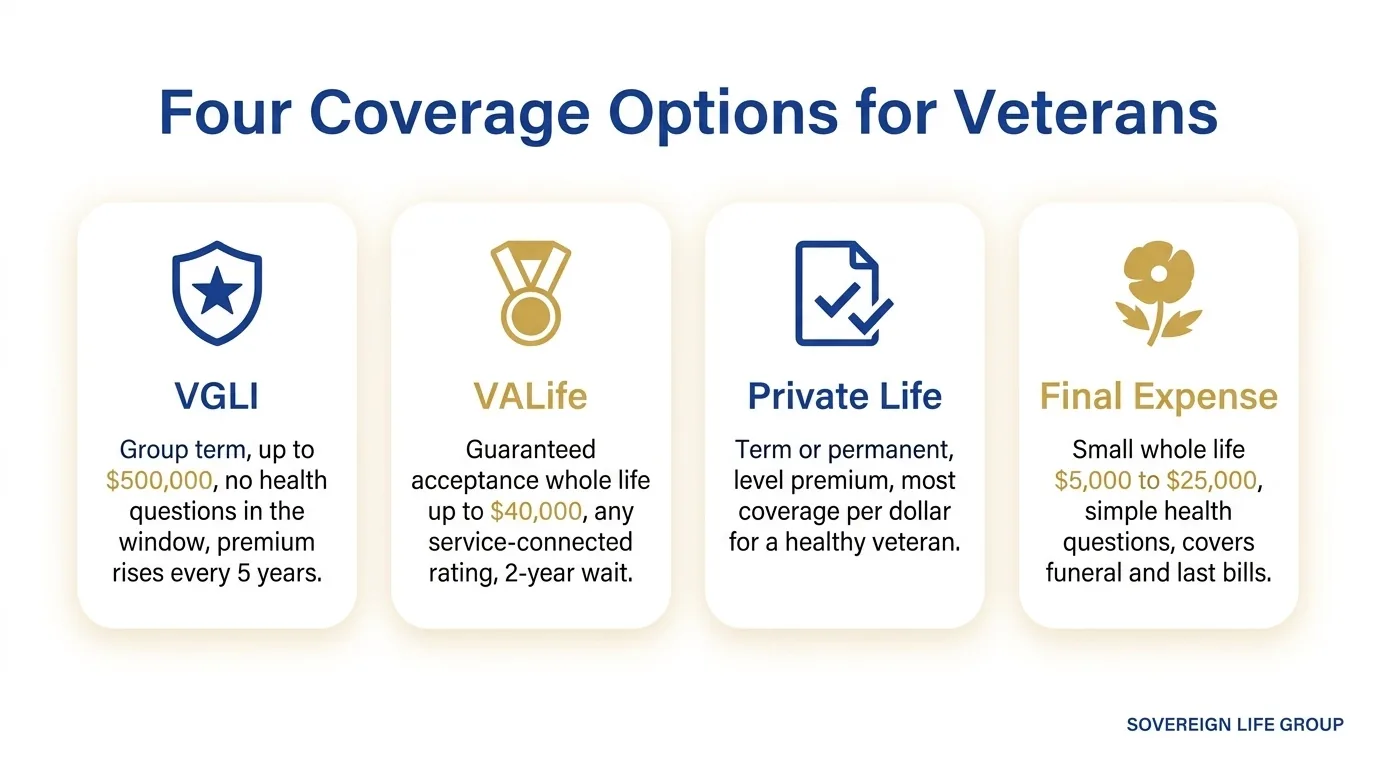
Life insurance for veterans comes in four broad buckets: VGLI, the group term coverage you can carry after service without new health questions; VALife, guaranteed-acceptance whole life for veterans with a service-connected disability; private life insurance, meaning individually underwritten term or permanent policies from commercial carriers; and final expense, a small whole life policy built for burial costs. Most veterans end up using more than one.
The reason there is no single answer is that veterans are not one group. A healthy 32-year-old who just separated has completely different options than a 58-year-old with a service-connected heart condition. The programs exist to cover both ends of that spectrum. Understanding which bucket fits you starts with an honest look at two things: your health today, and how long you need the coverage to last.
Here is the quick map before we go deep on each one.
- VGLI (Veterans' Group Life Insurance). Keeps your group coverage after service, up to 500,000 dollars, with no health questions if you enroll in the window. Premiums rise every five years as you age.
- VALife (Veterans Affairs Life Insurance). Guaranteed-acceptance whole life up to 40,000 dollars for veterans with any service-connected disability rating, including 0 percent. No medical exam, level premiums, a two-year waiting period on the full benefit.
- Private life insurance. Term or permanent coverage from commercial carriers. Often the most coverage per dollar for a healthy veteran, and the payout goes to whoever you name.
- Final expense. Small whole life, typically 5,000 to 25,000 dollars, using simple health questions. Built to cover a funeral and last bills, useful for older veterans or those with conditions.
The rest of this guide takes each one apart so you can see where it shines and where it falls short. None of these is universally best. The skill is in matching the tool to your actual situation, which is the whole point of working with someone who is not tied to a single product.
You can often beat VGLI with a level private policy. About 2 minutes.
SGLI, VGLI, and the conversion window
SGLI is the automatic coverage you had on active duty, up to 500,000 dollars. It ends shortly after you separate. VGLI is how you keep that group coverage without proving your health, but only if you act inside the deadline. You have one year and 120 days from separation to apply, and if you enroll within the first 240 days you are accepted with no health questions at all.
That 240-day figure is the single most important date in this entire guide, so let me slow down on it. According to the Department of Veterans Affairs, if you apply for VGLI within 240 days of leaving the military, you are accepted regardless of your health. After 240 days and up to the full deadline of one year and 120 days, you can still apply, but you must submit evidence that you are in good health. Miss the deadline entirely and you generally lose the guaranteed path, which means your only route back to coverage is full private underwriting where your health history is fair game.
How SGLI to VGLI conversion actually works
The SGLI to VGLI conversion is not automatic. Nobody enrolls you. You have to apply, either online through the VA or by mail, and choose your coverage amount up to what you carried under SGLI. You can start as low as 10,000 dollars and build up to 500,000 dollars in 10,000-dollar increments. If you took less than the maximum, you may have limited chances to increase later, so choosing your amount deliberately at conversion matters.
What VGLI costs, and why it changes
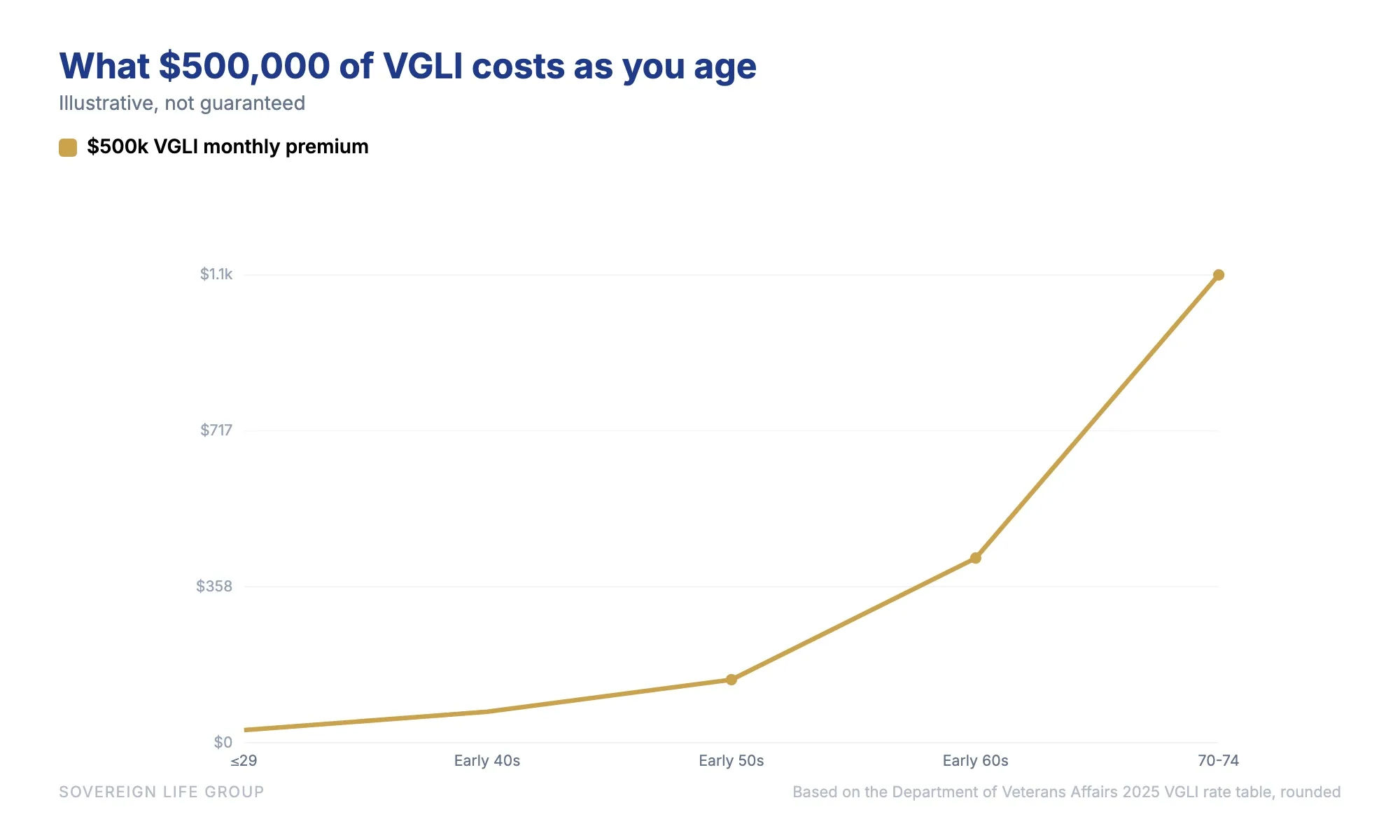
VGLI is group term insurance with premiums set by age band, and the jump between bands is bigger than most veterans expect. Using the Department of Veterans Affairs 2025 rate table, 500,000 dollars of VGLI runs about 30 dollars a month for a veteran age 29 or under. That same coverage is roughly 70 dollars a month in your early 40s, about 145 dollars in your early 50s, around 425 dollars in your early 60s, and about 1,075 dollars a month by ages 70 to 74. The acceptance never asks about your health again once you are in, which is exactly why VGLI can be worth every dollar for someone who has become hard to insure privately. But for a healthy veteran, watching that premium climb toward a thousand dollars a month is the clearest argument there is for locking in a level private policy now, while age and health are still on your side.
A smart bridge strategy
Here is a move a lot of veterans miss. You do not have to choose VGLI or private coverage as a permanent either-or on day one. If you are healthy but short on time before the 240-day cutoff, you can enroll in VGLI to lock in guaranteed coverage, then take your time applying for a private policy. Once the private policy is approved and in force, you can reduce or drop the VGLI you no longer need. You never want a gap where your family is uncovered, and VGLI is a reliable placeholder while you shop the open market.
VALife for veterans with a disability
VALife is the VA's answer to a hard problem: how to get life insurance to veterans whose service left them with a condition that private carriers would decline or heavily rate. It offers guaranteed-acceptance whole life of up to 40,000 dollars to any veteran with a VA service-connected disability rating, even a 0 percent rating. There is no medical exam, no health questions, and no time limit to apply once you have the rating.
This program matters because it fills the exact gap where life insurance with health conditions gets difficult. Private underwriting is built to price risk, and a serious service-connected condition can push a veteran into a decline or a rate class that feels punishing. VALife sidesteps that entirely. If you have a rating, you are in, full stop. That is a rare and valuable guarantee.
The two-year waiting period, explained honestly
VALife comes with an important trade-off you need to understand before you rely on it. For the first two years the policy is in force, it does not pay the full death benefit if you pass away. Instead, it typically returns the premiums you paid plus interest. After you have held the policy for two years and kept it current, the full face amount becomes payable. This waiting period is the price of guaranteed acceptance with no health screening, and it is standard across guaranteed-issue products. It is not a catch hidden in the fine print so much as the structure that makes no-questions coverage possible.
Who VALife fits, and who should look wider
VALife is a strong fit for a veteran with a service-connected disability who wants a dependable base of coverage and either cannot qualify privately or wants a guaranteed floor under everything else. The honest limitation is the 40,000-dollar cap. For a veteran with a mortgage, young children, and years of income to replace, 40,000 dollars is a foundation, not a full plan. That is where layering a private policy on top, if health allows, or a larger simplified-issue policy, becomes the difference between a nice gesture and real protection.
One more note for service-disabled veterans: VALife replaced the older S-DVI program for new enrollments. If you held S-DVI from years past you may still have it, but new applicants today are directed to VALife. Do not chase the old program name; VALife is the current guaranteed path.
VGLI vs private life insurance
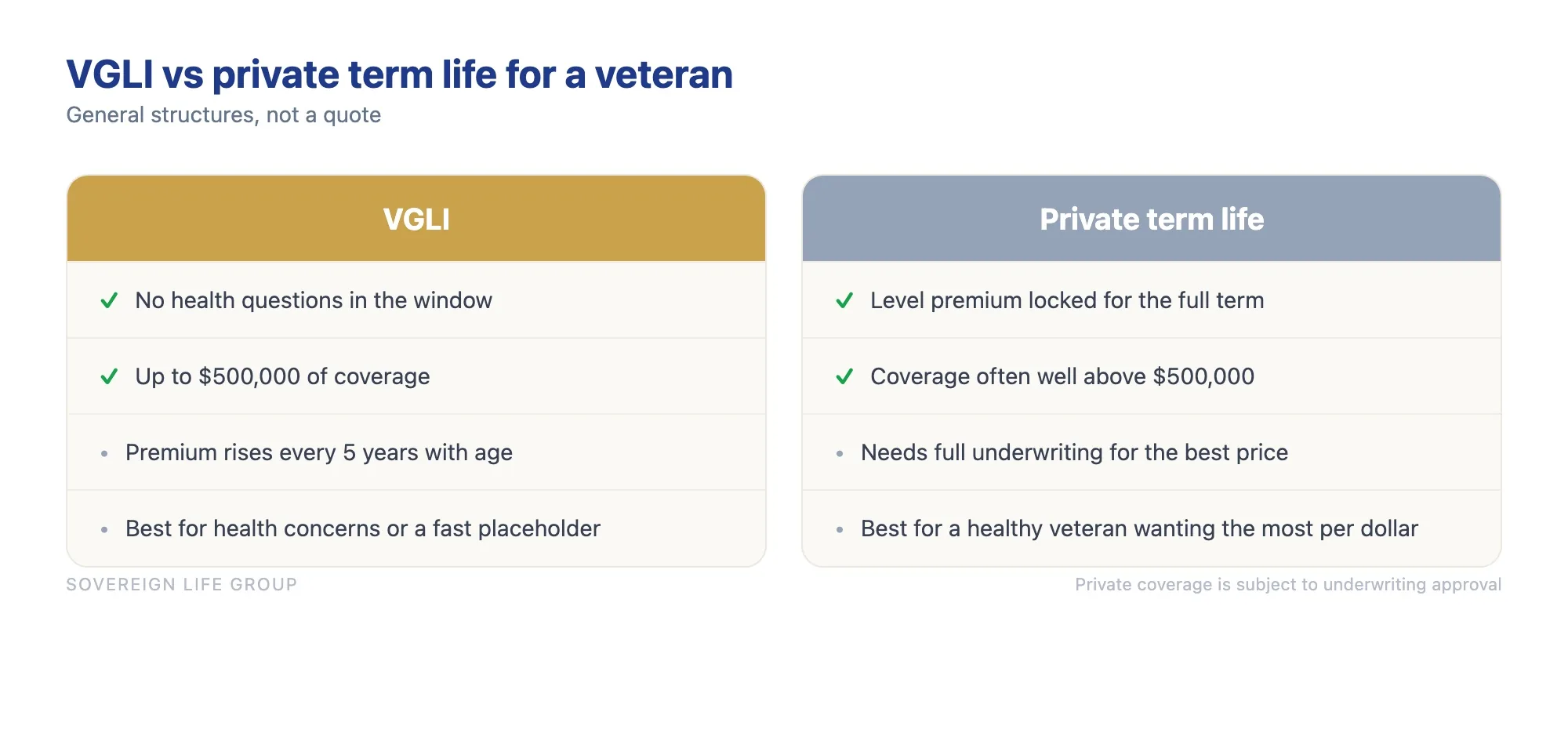
VGLI vs private life insurance is the decision most healthy veterans actually face, and the honest answer is that it hinges on your health and your time horizon. VGLI wins on guaranteed acceptance and simplicity. Private term life often wins on cost and coverage amount for a healthy veteran, because it locks a level premium for 20 or 30 years instead of climbing every five years the way VGLI does.
Think of it as two different shapes of cost over time. VGLI starts cheap and rises with each age bracket. A level term policy costs a bit more than young VGLI at the start, then holds flat while VGLI keeps climbing past it. Somewhere in your 40s or 50s the lines usually cross, and from there private level term is typically the cheaper coverage, assuming you locked it in while healthy. The catch is the assumption: you have to be insurable to get that level term, and health does not wait.
| Factor | VGLI | Private term life |
|---|---|---|
| Health questions | None if you enroll in the window | Full underwriting for the best price |
| Premium over time | Rises every five years with age | Level and locked for the full term |
| Maximum coverage | Up to 500,000 dollars | Often much higher, based on need and income |
| Best fit | Health concerns, or a fast placeholder | Healthy veteran wanting the most per dollar |
| Who gets the money | Your named beneficiary | Your named beneficiary |
| Portability | Yours regardless of job or health | Yours regardless of job or health |
So when does each one win? If you are healthy, under roughly 50, and want the most protection for the lowest long-run cost, private level term usually comes out ahead, and you keep the flexibility to size it to your full need rather than the 500,000-dollar VGLI ceiling. If you have a health history that would make private underwriting expensive or impossible, VGLI is often the smarter home for your coverage because it never re-checks your health. Many veterans keep a slice of VGLI for the guarantee and add private term for the bulk of their need. Our companion breakdown of term versus whole life insurance is worth reading if you are weighing how long you want that private coverage to last.
There is also a permanent-coverage angle that VGLI cannot match. If your goal is lifelong coverage plus a tax-advantaged place to build cash value, an indexed universal life policy can do things a term or group product cannot. That is a bigger conversation with real trade-offs, and our guide to using indexed universal life for tax-free retirement income lays out both the upside and the fees honestly before you decide.
Best life insurance for veterans, and how to compare
There is no single best life insurance for veterans, because the best policy is the one that fits your health, your budget, and the people counting on you. What separates a good decision from a bad one is comparing on the right criteria instead of chasing a brand name or a headline rate. The best coverage is simply the one you qualify for, can afford to keep, and that is large enough to do the job.
When veterans ask me to name the best company, I push back gently, because it is the wrong question. A carrier that is excellent for a healthy 35-year-old can be a poor fit for a 60-year-old with diabetes, and the reverse is true too. Underwriting is where the real difference lives. One carrier treats a controlled condition as a minor factor; another rates it heavily. That is why an independent agent who shops many carriers usually beats a single-company quote, especially for veterans carrying a service-connected condition.
The criteria that actually matter
- Will they insure you, and at what class. The friendliest carrier for your specific health history matters more than any ranking. This is the whole game for veterans with conditions.
- Coverage amount you can get. A policy that only offers 40,000 dollars is not competing with one that offers 500,000. Match the tool to the size of the need.
- Level versus rising premium. A locked premium you can hold for 20 or 30 years beats a low starter rate that escalates, if you plan to keep the coverage.
- Financial strength of the carrier. A death benefit is only as good as the company behind it. Favor established, highly rated insurers.
- How you have to apply. Exam, no-exam, or simplified issue changes both your price and your odds of approval. The fastest path is not always the cheapest.
Notice that none of these is a logo. The right answer for you is a combination of the carrier that views your health most favorably and the product type that fits your goal. For younger and healthy veterans that is often fully underwritten term life. For veterans with conditions it might be simplified issue, VGLI, or VALife. Getting the right coverage matched to your situation is exactly the work an independent shop does, because we are not obligated to make one company's product fit every person.
Healthy veterans can often beat VGLI with a level private policy. About 2 minutes, no pressure.
Final expense for veterans
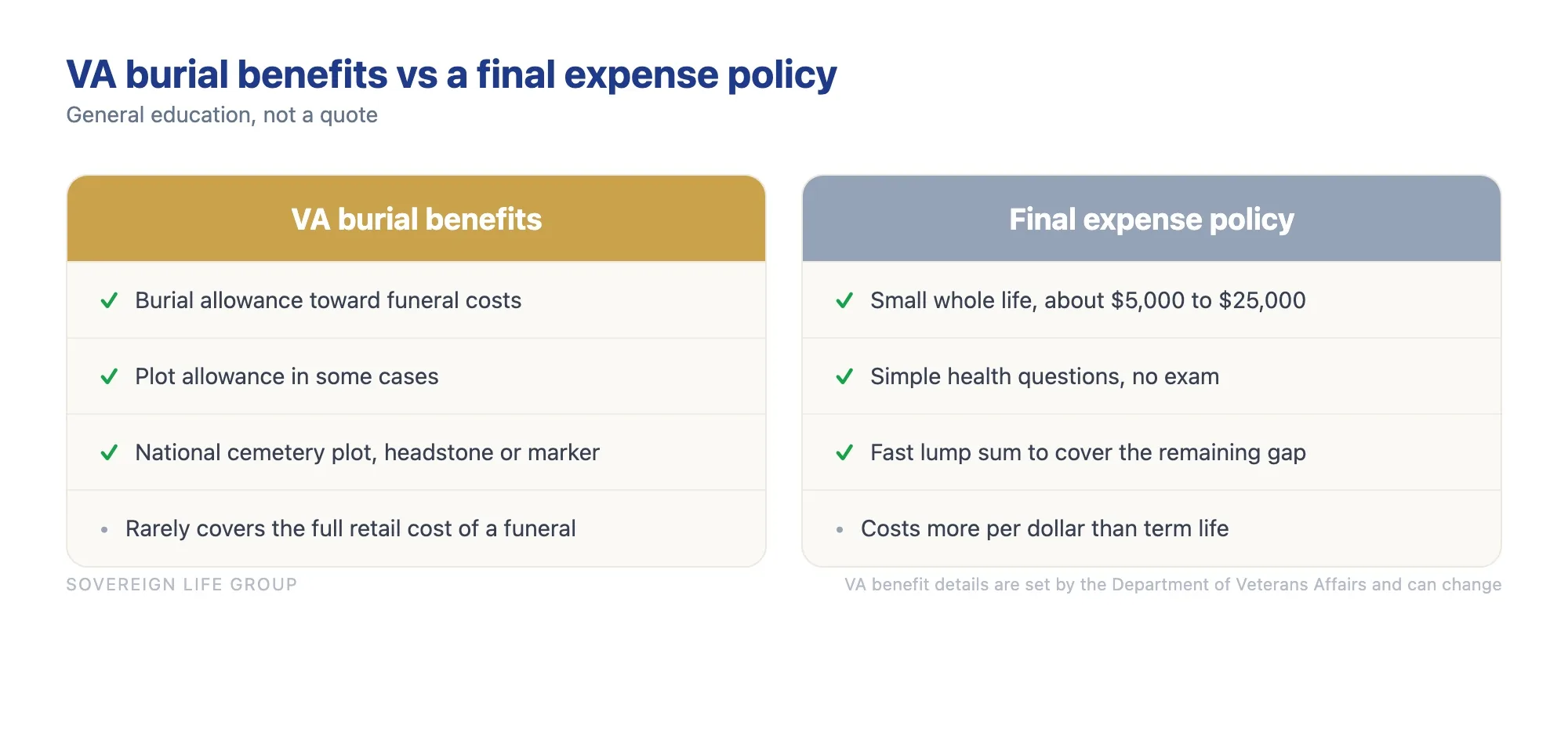
Final expense for veterans is small whole life insurance, usually 5,000 to 25,000 dollars, designed to cover a funeral, burial or cremation, and the last medical and household bills. It uses a handful of simple health questions instead of a full medical exam, which makes it reachable for older veterans and those with health conditions who would struggle to qualify for a large fully underwritten policy.
This category exists because funerals are expensive and they arrive at the worst possible moment for a family's cash flow. A modest, guaranteed lump sum that lands quickly keeps your family from putting a funeral on a credit card or passing a hat. Final expense is not about replacing decades of income; it is about making sure the smallest, most immediate bills are covered without drama. Our full final expense and burial insurance guide walks through how the coverage is priced and what to watch for in the fine print.
How final expense pairs with VA burial benefits
Veterans have a specific advantage and a specific gap here. The VA offers real burial benefits, including a burial allowance, a plot allowance in some cases, and burial in a national cemetery with a headstone or marker at no cost. Those benefits genuinely help. What they usually do not do is cover the full retail cost of a modern funeral, which can run well past what the allowances provide. Final expense insurance is built to fill that gap, and it pairs neatly with VA burial benefits rather than duplicating them.
One honest caveat: final expense costs more per dollar of coverage than term life, because it is whole life on older or higher-risk applicants. That is a fair trade for guaranteed, permanent coverage that will not expire while you are still relying on it, but it is the reason final expense is a poor tool for a large income-replacement need. Use it for what it is good at, and use term or permanent coverage for the bigger jobs.
A worked example: one veteran's decision
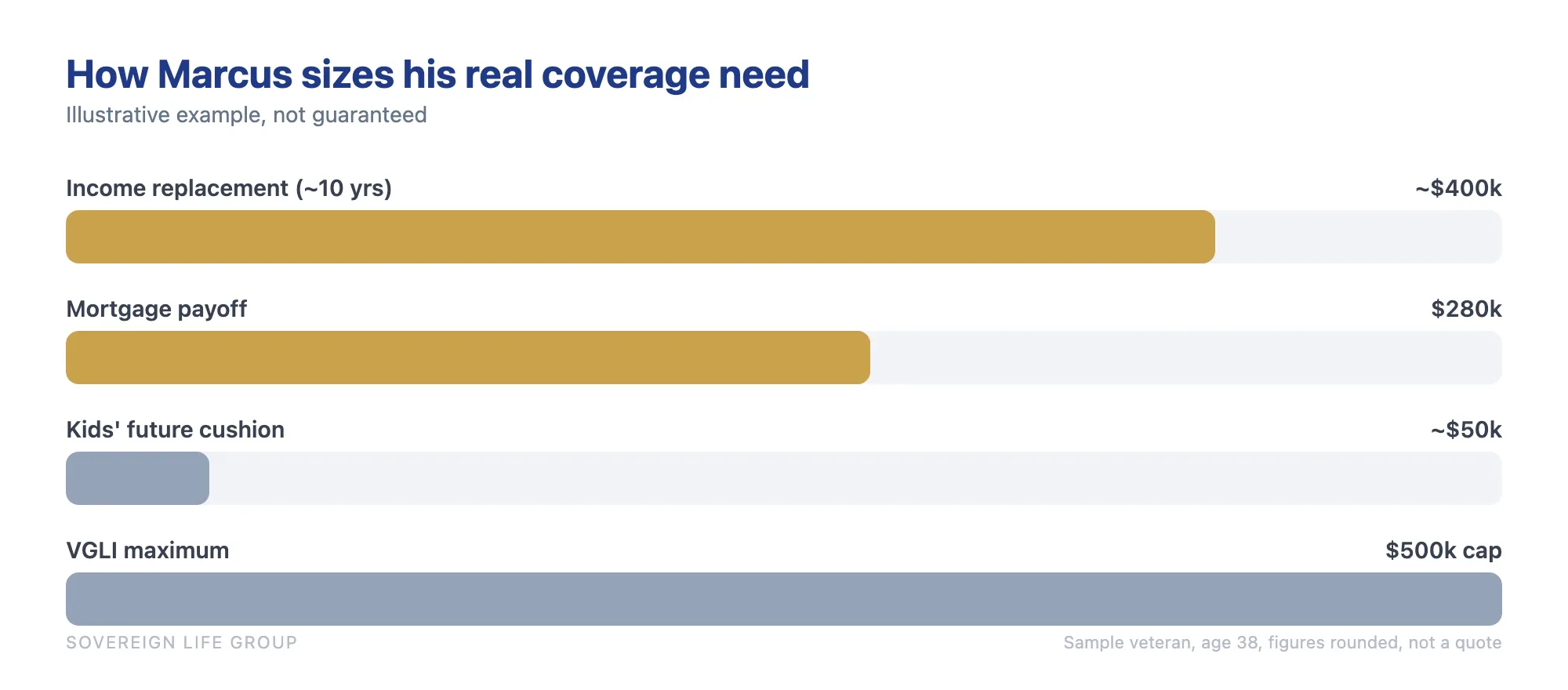
Numbers make this concrete, so here is a realistic case, illustrative and not a quote. Meet a veteran we will call Marcus. He is 38, healthy, separated 90 days ago, married with two kids, a 280,000-dollar mortgage, and a 10 percent service-connected rating for a knee injury. His question is the one everyone asks: what should I actually do with all these options?
Step one: secure the guaranteed floor
Because Marcus is inside the 240-day window, he could lock in VGLI with no health questions today. He is healthy, so he does not strictly need the guarantee, but the deadline is real and shopping takes time. A sensible move is to enroll in VGLI as a placeholder so there is never a gap, knowing he can trim or drop it once better coverage is in force. His 10 percent rating also means he qualifies for VALife, a guaranteed 40,000-dollar base he can hold for life regardless of what happens to his health later.
Step two: size the real need
Marcus adds it up: a 280,000-dollar mortgage, roughly 400,000 dollars to replace about ten years of income, and a cushion for his kids' future costs. Subtract modest savings and he lands near 700,000 dollars of need. VGLI caps at 500,000 and its premium will climb for decades. That gap is the signal that a healthy veteran like Marcus is a strong candidate for private term life, which can cover the full number for a level premium locked for 20 or 30 years.
Step three: choose the mix
Marcus's likely best answer is not one product but a deliberate stack. He applies for a large private 30-year term policy for the bulk of the need, using a friendly carrier for his minor knee rating, which is a non-issue for most underwriters. He keeps VALife as a permanent 40,000-dollar base that no future diagnosis can take away. Once the private term is approved and in force, he lets the temporary VGLI go. The result covers his whole need at a locked cost, with a guaranteed permanent floor underneath, for less than he expected. If Marcus's health had been complicated, the same plan would lean harder on VGLI and VALife instead, which is exactly why the guaranteed programs exist.
The lesson is not the specific numbers, which vary by person and are subject to underwriting. It is the sequence: protect the guaranteed door first, size the real need second, then choose the cheapest reliable way to cover it. That order keeps a family from ever being uncovered while you optimize.
Why VA benefits do not replace life insurance
This is the section most guides skip, and it is the one that costs families the most. VA disability compensation and VA survivor benefits are valuable, but they are not the same as life insurance, and assuming they are can leave a family badly short. Disability compensation is a monthly payment to you while you are living. It stops when you pass away. It does not become a lump sum for your family.
Survivors may be eligible for Dependency and Indemnity Compensation, known as DIC, but the eligibility rules are specific. DIC generally applies when a veteran's death is connected to a service-related condition, or in certain situations tied to a long-standing total disability rating. Many veterans die of causes that do not trigger DIC at all, and even when it pays, it is a monthly benefit sized to help, not a lump sum sized to pay off a mortgage or replace a career of earnings. Treating DIC as your family's plan is a gamble on both eligibility and adequacy.
The gap in plain terms
Here is the distinction that matters. VA benefits are designed around your service and your disability. Life insurance is designed around your family's need for cash the moment your income disappears. They solve different problems. A veteran can have an excellent disability rating and still leave a family unable to keep the house, because the compensation that supported the household stopped the day it was needed most.
This is not a knock on VA benefits, which are earned and important. It is a warning against a common and expensive assumption. If you want to see how the math actually works for your household, our walkthrough of how much life insurance you actually need gives you a clear method that folds any VA benefit into the picture honestly.
How much coverage and how to shop
If you have decided coverage makes sense, two questions remain: how much, and how to buy it without overpaying or getting pressured. Neither requires you to become an insurance expert. A common starting point is ten times your income, plus your mortgage and other debts, plus a cushion for future costs like your children's education, minus savings and any coverage you already carry. The remainder is a reasonable target to discuss with an agent.
Coverage need is not just about income, either. The research published by LIMRA has repeatedly found that a large share of American adults know they do not carry enough life insurance, and one of the top reasons is the belief that it costs far more than it actually does. Veterans are not exempt from that gap, and the fix is almost always to run real numbers rather than guess.
A simple shopping order
- Protect the deadline first. If you are near the VGLI window, secure the guaranteed coverage before you optimize. You can always trade up later.
- Decide what the money is for. Just a funeral, or a mortgage and income too? The job determines whether you need final expense, term, VALife, or a combination.
- Compare programs against private coverage. Put VGLI, VALife, and private term side by side. For a healthy veteran, private term often wins on price and amount. For a veteran with conditions, the guaranteed programs often win.
- Apply while your health is on your side. The application captures today's health, and today is, on average, the best it will be going forward. This is doubly true for veterans managing service-connected conditions.
- Use a licensed agent who shops many carriers. If someone only ever shows you one product or one company, that is a flag. You want options and trade-offs, not a single pitch.
When you are ready for a real conversation, you can get a clear, no-pressure look at your numbers and your options with Sovereign Life Group, your life insurance strategist. The goal of that call is not to sell you the biggest policy in the room. It is to show you the honest menu, including the government programs I do not earn a cent on, and let you choose on purpose. If you would rather start by seeing how coverage fits a household budget, the families coverage page is a gentle place to begin, and you can always book a short review when the timing is right.
Not sure which option fits your service?
Fifteen minutes. We will map your VGLI window, your VALife eligibility, and whether private term beats them for your health and budget. No pressure, no jargon, just the honest menu laid out plainly.
Get a Quote Book a 15-Min Call Prefer to start now? Healthy veterans wanting larger term or permanent coverage can save my card for a quick higher-coverage quote, or for a smaller burial-focused plan, get a quick final expense quote for veterans.Frequently asked questions
Is VGLI or private life insurance better for veterans?
It depends on your health. VGLI takes no health questions if you enroll in the window, which makes it the safer choice for veterans with a serious diagnosis. But its premiums rise every five years as you age. A healthy veteran can often lock in more coverage for a level premium with private term life, so it is worth comparing both before you decide.
Can disabled veterans get life insurance?
Yes. Veterans with any VA service-connected disability rating, even a 0 percent rating, can apply for VALife, a guaranteed-acceptance whole life policy of up to 40,000 dollars from the VA with no medical exam. Many disabled veterans also qualify for private simplified-issue or final expense coverage depending on the specific condition and carrier.
How long do I have to convert SGLI to VGLI?
You have one year and 120 days from your separation date to apply for VGLI. If you apply within the first 240 days, you are accepted with no health questions. After 240 days and up to the deadline, you can still enroll but you must show evidence of good health. Missing the deadline usually means reapplying with full underwriting.
How much life insurance do veterans need?
A common starting point is ten times your income, plus any mortgage, debts, and future costs like children's education, minus savings and existing coverage. VA disability compensation and survivor benefits do not replace life insurance, so most veterans with dependents still need private coverage on top of any VA program.
Does VA disability compensation count as life insurance?
No. VA disability compensation is a monthly payment to you while you are living and it stops when you pass away. Dependency and Indemnity Compensation may pay eligible survivors, but only in specific situations and often less than a family needs. Life insurance is the tool that delivers a lump sum to your family when you die.
Is there final expense insurance for veterans?
Yes. Final expense insurance is small whole life coverage, often 5,000 to 25,000 dollars, built to pay for a funeral and last bills. It uses simple health questions instead of an exam, which helps older veterans or those with health conditions. It pairs well with VA burial benefits, which help but rarely cover the full cost of a funeral.
Joseph McDermott is a licensed life insurance agent (NPN 22121673), licensed in 27 states. Brokered through Family First Life, in partnership with Catalyst Life. This article is educational and is not financial, tax, or legal advice. Please talk with a licensed professional about your specific situation. VGLI, VALife, and VA benefit details are set by the Department of Veterans Affairs and can change; confirm current terms at va.gov. Product availability, features, riders, and rates vary by state, age, health, and carrier, and any private coverage is subject to underwriting approval. Guarantees are subject to the claims-paying ability of the issuing insurance company.