Why the Wealthy Treat Life Insurance as an Asset, Not an Expense


The Short Version
Most people see life insurance as a bill. The wealthy see permanent, cash value life insurance as an asset that sits on the balance sheet, grows tax-deferred, can be borrowed against, and moves money to heirs with a generally income-tax-free death benefit. Term life is pure protection with no living value. This is the difference between paying for coverage and owning something you can use.
Here is a question I ask families all the time: if you listed everything you own on one sheet of paper, would your life insurance show up as a number, or would it show up as a line item in your monthly budget next to the streaming services? For most people it is the budget. For the wealthy, life insurance as an asset is a real balance on the ledger, right alongside the brokerage account and the rental property. That difference in framing is not an accident, and it is not reserved for people with a family office. It comes down to which kind of policy you own and how you use it.
I write this as a licensed agent, not as someone trying to talk you into the biggest policy in the room. Cash value life insurance is a genuinely useful tool for the right person, and a poor fit for the wrong one. I am going to show you both sides. We will cover what it actually means to treat a policy as an asset, why affluent families lean on it, how cash value works, whether any of this counts as an investment, how it stacks up against other assets, a worked example with real numbers, the tax rules underneath it, and the honest cases where you should skip it.
What this guide covers
- What it means to treat life insurance as an asset
- Why the wealthy use life insurance differently
- Cash value life insurance as an asset
- Is life insurance an investment?
- How it compares to other assets
- How affluent families put the asset to work
- A worked example over 30 years
- The tax rules that make it behave like an asset
- When life insurance is not an asset
- How to build this into your plan
- Frequently asked questions
What it means to treat life insurance as an asset
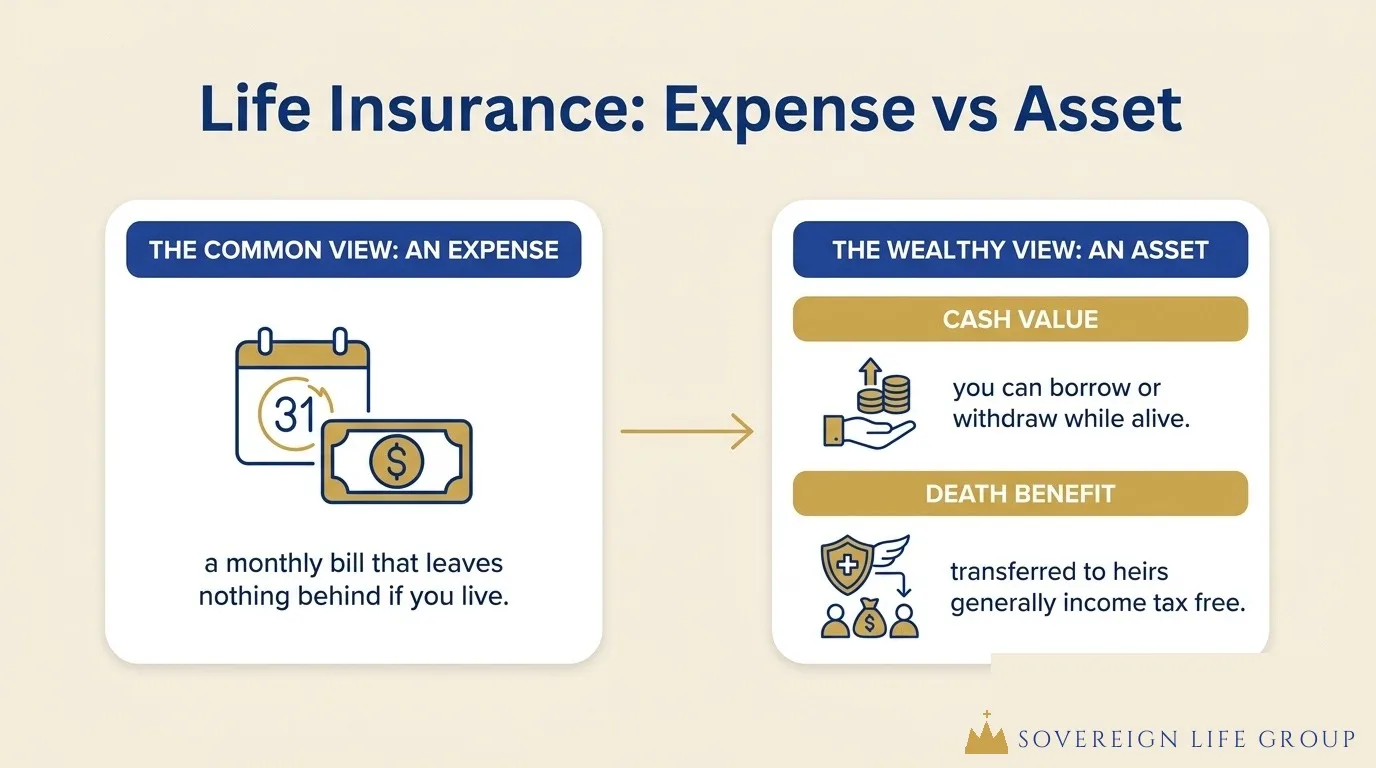
Treating life insurance as an asset means owning a policy that has real, usable value while you are alive, not just a payout after you die. That living value is the cash value inside a permanent policy. You can borrow it, withdraw it, or use it as collateral, and it shows up on a net worth statement as a number you control. That is what turns coverage into an asset.
An asset, in plain terms, is something you own that has value you can use or convert to cash. A house, a brokerage account, a business, all of them qualify because they hold value you can tap. Term life insurance does not clear that bar. It pays only if you die during the term, and if you outlive it, you walk away with nothing but the peace of mind you rented along the way. That is not a criticism. Term does its job beautifully and cheaply. It is just not an asset in the accounting sense, because there is no living balance behind it.
Permanent life insurance is different. Whole life, universal life, and indexed universal life all pair a death benefit with a cash value account that builds over time. As you pay premiums, part of the money funds the insurance and part accumulates inside the policy. That accumulated cash value is yours to use, and it is why a permanent policy can legitimately be listed as an asset. The clients who understand this stop asking "what does it cost" and start asking "what does it hold."
The mistake I see most is people lumping all life insurance together and deciding the whole category is either a scam or a magic bullet. Neither is true. The honest version is narrower: term is protection, permanent cash value is protection plus an asset, and the right answer for you depends entirely on what job you need the money to do. If you want a deeper walk through the mechanics, our explainer on how cash value life insurance works breaks the moving parts down piece by piece.
No medical exam for a ballpark. Free, and no pressure.
Why the wealthy use life insurance differently
The wealthy use life insurance as an asset because it does things their other accounts cannot. It moves large sums to heirs with a generally income-tax-free death benefit, it creates instant cash to cover estate costs so nothing has to be sold in a rush, and it holds a stable pool of value they can borrow against without triggering a taxable sale. It is a conservative, tax-favored tool that complements investing rather than replacing it.
When you have more than enough income, your problems change. The question stops being "how do I protect my paycheck" and becomes "how do I keep and transfer what I have built without handing a big slice to taxes and forced sales." Life insurance answers that question in a way a taxable brokerage account struggles to match. The death benefit is generally received income-tax-free by beneficiaries under longstanding federal tax rules, which the IRS explains in its guidance on life insurance proceeds. That single feature does a lot of quiet work in a wealthy family's plan.
There is also a behavioral reason that rarely gets mentioned. A permanent policy is a forced, disciplined place to park money that most people will not raid on a whim. I have watched disciplined savers do fine without it and I have watched impulsive high earners protect themselves from their own worst instincts by funneling money into a policy they cannot easily touch. For the second group, the structure itself is worth something.
None of this is a secret club. The same tools are available to a small business owner, a dual-income couple, or a nurse who wants a conservative sleeve in her plan. The wealthy just tend to have advisors who frame it correctly. According to research published by LIMRA in 2024, about half of American adults own life insurance and about 102 million say they live with a coverage gap, which tells you most households are still thinking about this as a bill to minimize rather than an asset to build.
Cash value life insurance as an asset
Cash value life insurance is the version that functions as an asset. Inside the policy sits an account that grows over time on a tax-deferred basis. You can borrow against that balance, withdraw from it, or surrender the policy for its cash value. That living access is what separates a cash value life insurance asset from term coverage, which has no balance to draw on.
Here is how the money moves. Each premium you pay is split. A portion covers the actual cost of insuring your life, a portion covers the insurer's expenses, and the remainder flows into your cash value account, where it grows. In the early years most of the money is going toward setting up the policy, so the cash value looks thin. That is the part people quit over. But permanent policies are back-loaded by design, and the account tends to build momentum in the later years as the cost drag shrinks and compounding does more of the work.
The three main flavors of permanent coverage
Not all cash value is built the same way, and the differences matter for how the asset behaves.
- Whole life. The most predictable version. Premiums are fixed, the cash value grows at a contractually stated minimum, and many policies from mutual insurers may pay dividends on top, though dividends are never guaranteed. This is the slow, steady, sleep-at-night asset.
- Universal life. More flexible. You can adjust premiums and the death benefit within limits, and the cash value earns interest based on the insurer's crediting rate. Flexibility is the selling point and the risk, because underfunding it can put the policy in trouble later.
- Indexed universal life. The cash value earns interest tied to a market index like the S&P 500, usually with a floor that protects against index losses and a cap or participation rate that limits the upside. It aims for more growth potential than whole life with downside protection, in exchange for more moving parts and fees. Our overview of indexed universal life coverage lays out how the caps, floors, and costs actually work.
Whichever version you own, the principle is the same. You are building a balance you can use while alive, wrapped inside protection that pays out when you die. That dual nature is the whole reason it earns a spot on the asset side of the ledger. If you want to see how this connects to using a policy like a personal bank, our piece on using life insurance to be your own bank covers the borrowing mechanics in depth.
Is life insurance an investment?
Cash value life insurance shares features with an investment, like tax-deferred growth and a balance you can access, but it is not a pure investment and should not be sold as one. It is protection first, with a savings component attached. Judge it as a conservative, tax-advantaged part of a plan, not as a substitute for a diversified portfolio aiming for market returns.
This is where a lot of bad advice lives, on both extremes. One camp insists life insurance is a terrible investment and you should always buy term and invest the rest. The other pitches whole life as a can't-lose wealth machine. Both are selling a story. The truth sits in the middle, and it depends on what you are comparing it to and why.
If you line up cash value growth against a low-cost stock index fund over 30 years, the index fund will usually win on raw return, and it is not close. So no, a policy is not the place to chase growth. What a policy offers instead is a different set of features: a death benefit that is generally income-tax-free, tax-deferred internal growth, protection from market losses in the case of whole life and the floor on an indexed policy, and access to cash you can borrow without selling anything or triggering a taxable event. You are not buying maximum return. You are buying stability, tax treatment, and protection wrapped together.
I tell clients to think of it like the bond or cash sleeve of a plan, not the stock sleeve. Nobody expects their savings account to beat the market. They keep it because it is stable and available. Cash value life insurance plays a similar role, with the added feature of a large death benefit attached. Frame it that way and the "is it a good investment" argument mostly dissolves, because you stop asking a conservative tool to do an aggressive job.
How it compares to other assets
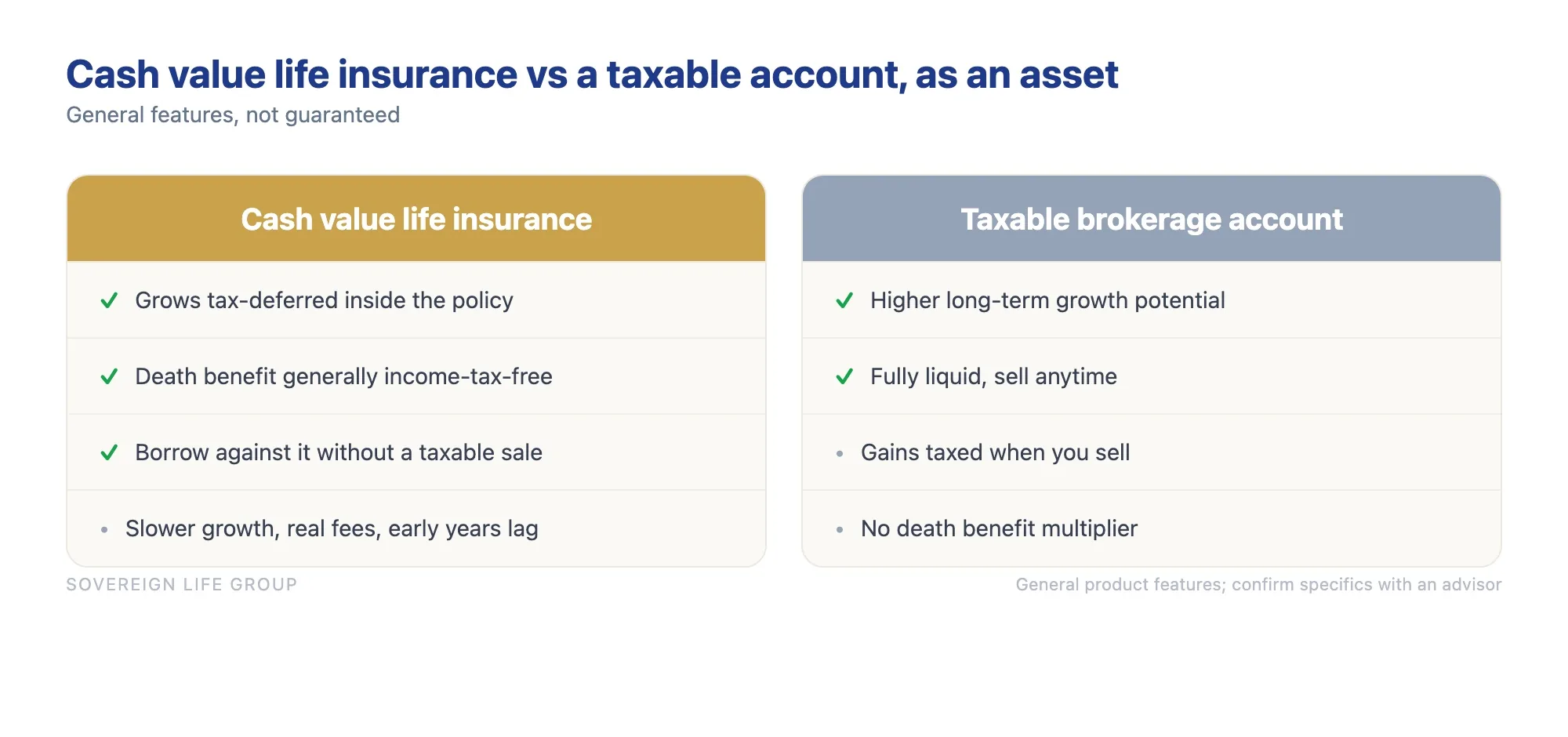
As an asset, cash value life insurance trades raw growth for tax advantages, stability, and a built-in death benefit. It is less liquid and slower-growing than a brokerage account, but it offers tax-deferred growth, tax-favored access through loans, and a transfer to heirs that most accounts cannot match. It behaves more like a bond or cash reserve than a stock holding.
No single asset does everything. The point of comparing them is to see where each one earns its keep, so you hold the right mix instead of forcing one tool to cover every need. Here is how a permanent policy lines up against the assets most families already own.
| Asset | Growth potential | Tax treatment | Liquidity | Transfers to heirs |
|---|---|---|---|---|
| Cash value life insurance | Modest, conservative | Tax-deferred growth, generally tax-free death benefit | Access via loans or withdrawals, some limits | Fast, generally income-tax-free |
| Taxable brokerage account | Higher over long periods | Gains taxed when sold | High, sell anytime | Passes through the estate, may owe taxes |
| Bank savings or CD | Low | Interest taxed yearly | High to moderate | Passes through the estate |
| Real estate | Can be strong | Various, complex | Low, slow to sell | Slow, may force a sale |
| Retirement account (401k, IRA) | Higher over long periods | Tax-deferred or Roth, with withdrawal rules | Locked until retirement age in most cases | Heirs often owe income tax on traditional accounts |
Read that table and the role becomes obvious. You do not buy a permanent policy to beat your 401k or your index fund. You buy it for the corner of the plan those accounts handle poorly: a stable value that grows without a yearly tax bill, cash you can reach without selling and paying capital gains, and a large, fast, generally tax-free transfer to the people you love. It is the piece that stays calm when the market does not.
One honest caveat belongs right here. Those tax advantages depend on the policy being structured and maintained correctly, and on tax law, which can change. This is education, not tax advice, and the specifics deserve a conversation with a licensed professional who can look at your actual situation.
Get a fast, free estimate tailored to your age and health.
How affluent families put the asset to work
Affluent families use the asset in specific, practical ways: creating liquidity to pay estate costs, funding business buy-sell agreements, borrowing against cash value for opportunities or income, replacing a pension with a stable death benefit for heirs, and holding it as the conservative anchor of a broader plan. Each use solves a problem that would otherwise force a sale or a tax hit.
These are not exotic maneuvers. They are the everyday reasons a policy earns its place once the numbers get large enough. Here are the ones that come up most.
Estate liquidity so nothing gets fire-sold
When someone with a large estate passes away, the bills can arrive fast: final expenses, settlement costs, and in some cases estate taxes at the federal or state level. If most of the wealth is tied up in a business, a farm, or property, the family can be cash-poor at the worst possible moment. A life insurance death benefit lands quickly and generally income-tax-free, giving heirs the cash to pay those costs without dumping the family business or the land in a hurry. That is the single most common reason I see larger policies bought.
Funding a business buy-sell agreement
Two partners own a company. If one dies, the other does not want to suddenly be in business with a grieving spouse who never worked there, and the spouse wants fair value for the share, not a job. A buy-sell agreement funded with life insurance solves both. The policy pays the surviving partner enough to buy out the deceased partner's stake at a pre-agreed value. For owners who care about continuity, this is close to essential. Our overview of key person and business coverage digs into how these are structured.
Borrowing against the cash value
Once the cash value has built up, the owner can borrow against it for almost any purpose: a business opportunity, a real estate down payment, a bridge during a lean year, or tax-favored supplemental income in retirement. Because a policy loan is generally not treated as taxable income while the policy stays in force, this can be an efficient way to access money without selling an appreciated asset and paying capital gains. The trade-off is real: unpaid loans plus interest reduce the death benefit, and a policy that lapses with a large loan can create a tax bill. Used carefully, it is powerful. Used carelessly, it can hollow out the policy.
A stable anchor and a legacy tool
Some families simply want a piece of their net worth that does not swing with the market and that will hand a defined sum to the next generation. A permanent policy fills that seat. It can also equalize an inheritance, for example leaving the business to the child who runs it and an equivalent death benefit to the child who does not. For families who value fairness across heirs, that flexibility is worth a lot.
A worked example over 30 years
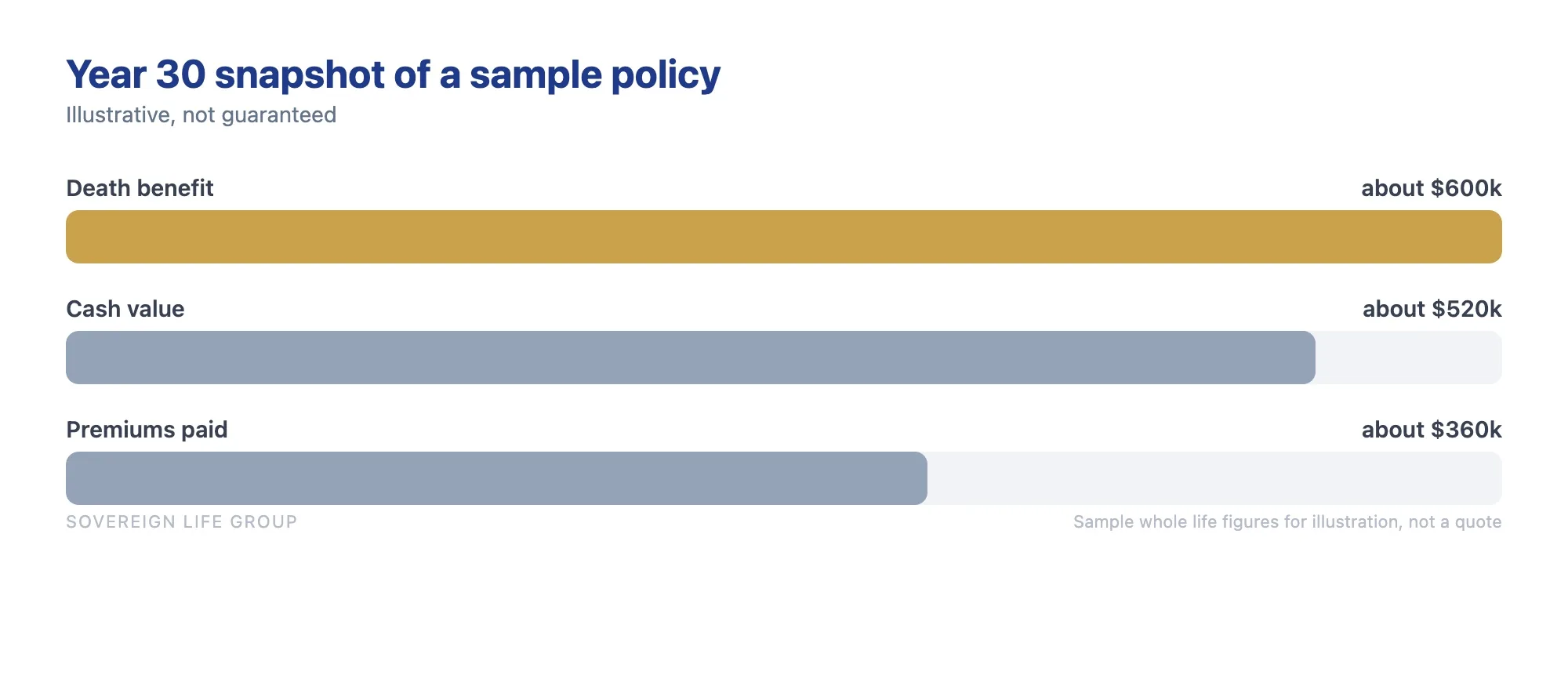
A worked example makes the asset concrete. Picture a healthy 45-year-old who funds a permanent policy with roughly $12,000 a year. The numbers below are illustrative, not a quote, and real results depend on the carrier, the policy design, health, and market conditions. The point is to show the shape of how the asset behaves, not to promise a figure.
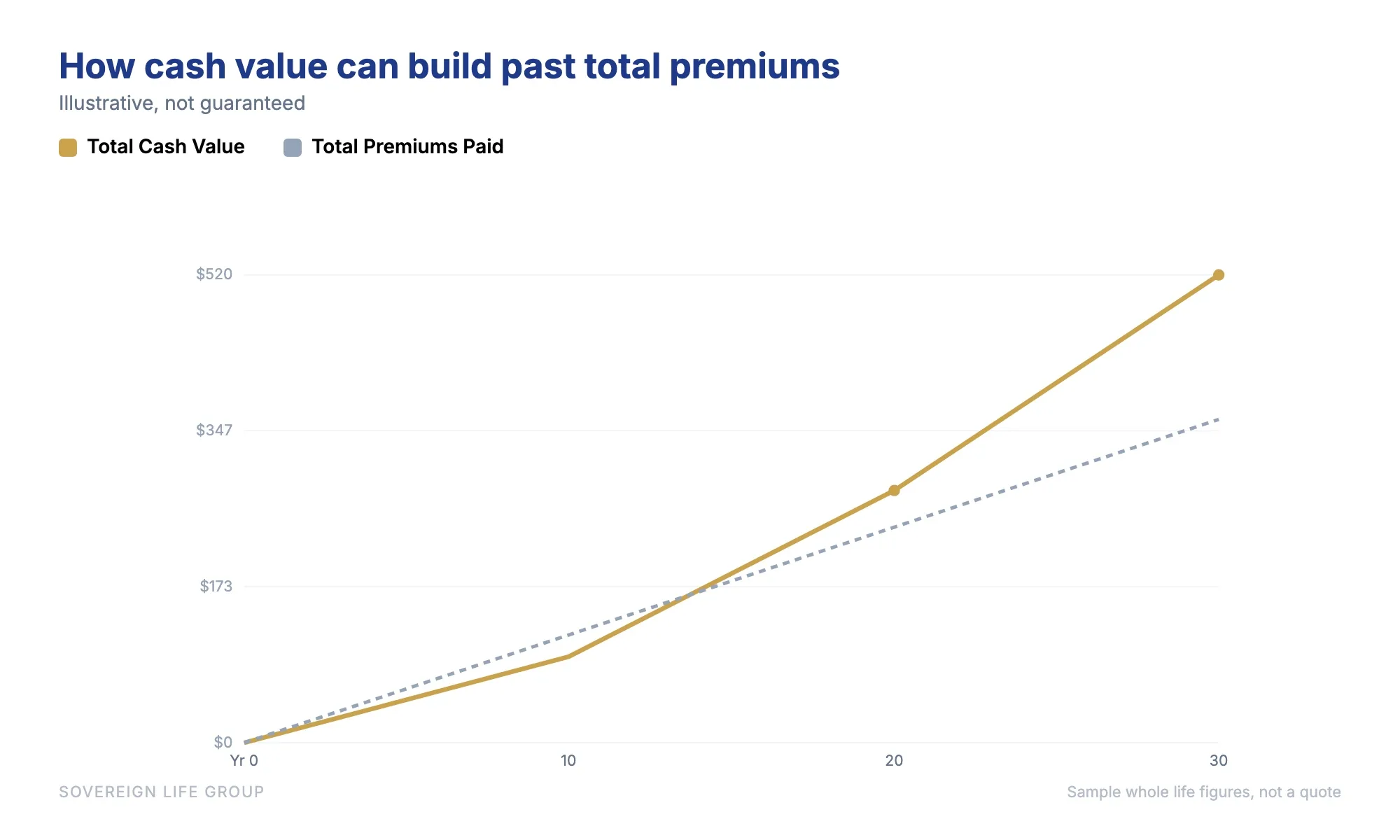
Over 30 years this person pays in about $360,000 total. In the early years the cash value trails the premiums, because the first years fund the cost of the insurance. Somewhere in the middle stretch the cash value tends to catch up to and then pass the total paid in, as the cost drag falls and tax-deferred growth compounds. By year 30, in this illustration, the cash value might sit somewhere around $520,000 and the death benefit somewhere around $600,000. Again, illustrative, and not guaranteed.
Now look at what the family actually holds. There is a living asset of roughly half a million dollars that can be borrowed against for income or opportunity, and a death benefit that pays out larger still, generally income-tax-free, if the insured passes away. The policyholder got lifelong coverage, a tax-deferred savings vehicle, and a legacy in one contract. That is the case for treating it as an asset rather than an expense.
Here is the honest other side of the same example. For the first decade, if you measured the policy purely on cash value versus dollars paid in, it would look like a losing trade. Someone who bailed at year seven, frustrated that the account was smaller than the premiums, would lock in a loss. Permanent life insurance rewards patience and punishes short holding periods. If you are not confident you will fund it for the long haul, that is a signal the tool may not fit, and I would rather tell you that now than sell you something you cancel in year four.
The tax rules that make it behave like an asset
Three tax rules give life insurance its asset-like power. Cash value grows tax-deferred inside the policy, policy loans are generally not treated as taxable income while the policy stays in force, and the death benefit is generally received income-tax-free by beneficiaries. Together they let money grow, be accessed, and be transferred with less tax friction than most ordinary accounts.
Take them one at a time, because each one does real work.
- Tax-deferred growth. The cash value grows without a yearly tax bill on the gains, unlike a savings account or a taxable brokerage where interest and realized gains are taxed as you go. Deferral lets more money stay invested and compound.
- Tax-favored access through loans. When you borrow against the cash value, the loan is generally not counted as taxable income while the policy remains in force, because it is a loan, not a withdrawal of gains. This is the mechanism behind using a policy for tax-favored retirement income. It only works if the policy is kept in force and not allowed to lapse.
- Generally income-tax-free death benefit. Beneficiaries typically receive the death benefit free of federal income tax, which is what makes life insurance such an efficient way to transfer money. The IRS describes this treatment in its guidance on life insurance proceeds, linked earlier in this article.
Two cautions keep this honest. First, over-funding a policy beyond federal limits can turn it into a Modified Endowment Contract, which changes the tax treatment of loans and withdrawals, so policy design matters. Second, tax law is not frozen in stone, and the death benefit can still be part of your taxable estate depending on ownership and the size of the estate. This is general education, not tax or legal advice, and it is exactly the kind of thing to run past a licensed professional. For a structural comparison of how different policy types handle all of this, see our breakdown of term versus whole life insurance.
When life insurance is not an asset
Life insurance is not a useful asset when you own term coverage, when you cannot fund a permanent policy consistently for the long term, or when a simpler mix of term life and ordinary investing would meet your goals for less money. Buying permanent coverage you will not keep, or buying it before covering basic protection needs, turns the tool into an expensive mistake.
An article that only sells you is not advice, so here are the cases where I steer people away from treating life insurance as an asset.
- You only need coverage for a set season. If the real goal is protecting your family during the years you have a mortgage and young kids at home, level term does that job for a fraction of the cost. Layering permanent coverage on top of a temporary need is usually overpaying.
- The budget is tight or unpredictable. Permanent policies punish underfunding and early exits. If money is uncertain, a policy you have to surrender in a rough year can lose you real dollars. Cover the basics first.
- You have not maxed simpler tax-advantaged accounts. If you are not yet using your 401k match or an IRA, those usually come first. A cash value policy is rarely the opening move in a plan, it is a later layer once the foundation is set.
- You are being sold on returns alone. If someone is pitching a policy purely as an investment that will beat the market, be skeptical. That is not what it is for, and that framing tends to end in disappointment and a cancelled policy.
I have talked more than one family out of a large permanent policy because the honest answer was a bigger term policy and a nudge to fund their retirement accounts. That is the job. The asset is powerful when it fits and a burden when it does not, and knowing the difference is worth more than any single product. If your situation is closer to protecting a paycheck than transferring wealth, start with the coverage side and read our note on accessing living benefits from a policy to see what modern coverage can already do.
How to build this into your plan
To build life insurance into your plan as an asset, start with your goal, cover basic protection with term where it fits, then decide whether a permanent policy earns a place for tax-advantaged growth, estate liquidity, or business needs. Size it to a premium you can fund for decades, choose the policy type that matches your risk comfort, and review it over time.
Here is the order I would walk a friend through, and it is deliberately unglamorous.
- Name the job first. Are you protecting income for 20 years, transferring wealth, funding a buy-sell, or building a conservative tax-favored sleeve? The job decides the tool. Skip this step and you end up owning a product that does not match your actual need.
- Cover the temporary needs with term. Mortgage, income replacement, kids at home. Term is cheap and efficient for these. Get this in place before anything fancier.
- Fund the basics of investing. Employer match, tax-advantaged retirement accounts, an emergency fund. A permanent policy sits on top of a solid foundation, not in place of one.
- Then consider permanent coverage as an asset. If you have a lasting need for coverage, want tax-advantaged growth, or face an estate or business problem, this is where a cash value policy earns its keep. Size the premium to something you will comfortably pay for decades.
- Match the policy type to your temperament. Whole life for predictability, indexed universal life for more growth potential with a floor and more moving parts. Understand the fees and the trade-offs before you sign.
- Review it every few years. Lives change. A policy that fit at 40 may need adjusting at 55. Treat it like any other asset and check in on it.
When you are ready to look at real numbers for your situation, that is what I do. You can get a clear, no-pressure read on your options with Sovereign Life Group, your life insurance strategist. And if you want a neutral third-party primer before we talk, the Insurance Information Institute has a plain overview of how permanent policies are structured. Worth noting: permanent policies like whole life remain a common, established part of the market, a sign that plenty of families are already using permanent coverage on purpose.
Want a straight answer for your situation?
Fifteen minutes. We will look at your goals, your budget, and whether life insurance belongs on the expense line or the asset line of your plan. No jargon, no pressure, just the options laid out plainly.
Get a Quote Book a 15-Min Call Prefer to save your details for later? You can save my card and get a quick quote here.Frequently asked questions
Is life insurance really an asset?
Permanent life insurance with cash value can be an asset because you can use the cash value while you are alive through loans or withdrawals, and the policy has a real balance that appears on a net worth statement. Term life insurance has no cash value, so it is protection rather than an asset you can tap during your lifetime.
Is life insurance an investment?
Cash value life insurance shares some features with an investment, such as tax-deferred growth and a value you can access, but it is not a pure investment. It is protection first, with a savings component attached. You should not expect stock-market returns from it, and it is best judged as a conservative, tax-advantaged part of a plan rather than a replacement for investing.
Why do wealthy people use life insurance?
Wealthy families use life insurance to move money to heirs with a generally income-tax-free death benefit, to create instant cash to pay estate costs so assets are not sold in a hurry, to fund business buy-sell agreements, and to hold a stable pool of cash value they can borrow against. It behaves like a conservative asset with tax advantages that ordinary accounts do not offer.
What is the difference between cash value and the death benefit?
Cash value is the living balance inside a permanent policy that you can borrow or withdraw while you are alive. The death benefit is the larger amount paid to your beneficiaries when you pass away. On most policies the two are related, and using a lot of cash value can reduce the death benefit that is left.
Do you pay taxes on cash value life insurance?
Cash value generally grows tax-deferred, and policy loans are typically not treated as taxable income while the policy stays in force. Withdrawals above what you paid in can be taxable, and a lapsed or surrendered policy can trigger a tax bill. Rules depend on how the policy is funded, so it is worth confirming with a tax professional.
Is cash value life insurance worth it compared to buying term and investing the difference?
It depends on the goal. If you only need protection for a set number of years, term life plus investing the difference is often cheaper and simpler. If you want lifelong coverage, a tax-advantaged asset you can borrow against, or a tool for estate and business planning, cash value life insurance can earn its place. Many families use both.
Joseph McDermott is a licensed life insurance agent (NPN 22121673), licensed in 27 states. Brokered through Family First Life, in partnership with Catalyst Life. This article is educational and is not financial, tax, or legal advice. Please talk with a licensed professional about your specific situation. Product availability, features, riders, and rates vary by state, age, health, and carrier, and any coverage is subject to underwriting approval. Cash value figures shown are illustrative, not guaranteed, and depend on the policy and carrier. Guarantees are subject to the claims-paying ability of the issuing insurance company.