How to Start Infinite Banking: A Step-by-Step Guide

The Short Version
To start infinite banking, you fund a permanent life insurance policy that is built for high early cash value, then borrow against that cash value and pay yourself back on your own terms. The vehicle is usually dividend-paying whole life, sometimes indexed universal life. It is a real strategy, not a magic trick. It starts slow, costs more than term, and only works if you fund it consistently and repay your loans with discipline.
Almost every week, someone asks me how to start infinite banking after watching a video that made it sound like a secret the rich are hiding from everyone else. The truth is calmer than that, and better for it. Infinite banking is a way of using a specially designed life insurance policy as a place to store cash, borrow against it, and recycle the money through your own life instead of a bank's. This guide walks the whole path, from the first question you should ask yourself to the day you write your first policy loan. No hype, no pressure. I would rather talk some people out of it than sell one to someone it does not fit.
I write this as a licensed agent who sets these policies up for real families, not as a course seller. So you will get the parts most sales pitches skip: what it actually costs, how slow the early years really are, and where a plain investment account beats it. If it still fits after all that, you will know exactly how to begin.
What this guide covers
- What infinite banking actually is
- How to start infinite banking, step by step
- The policy you actually need
- How much money it takes to start
- A worked example, funded over time
- The borrow and repay cycle
- The mistakes I see people make
- Infinite banking vs the alternatives
- The honest trade-offs, fees, and risks
- Is it right for you
- Frequently asked questions
What infinite banking actually is
Infinite banking is a strategy where you use a high cash value permanent life insurance policy as your own source of financing. You overfund the policy, cash value builds inside it, and you borrow against that value for cars, real estate, emergencies, or business, then repay the loan so the money is there again. The bank in the phrase "be your own bank" is the policy.
The idea was popularized by Nelson Nash in his book "Becoming Your Own Banker," and the core insight is older than the branding. Whole life insurance has carried a guaranteed, borrowable cash value for well over a century. What Nash did was reframe it. Instead of treating the cash value as a side benefit, you treat the policy as a private pool of capital you can tap without asking a lender for permission. When you need money, you take a policy loan against your cash value. The insurer lends you their money and holds your cash value as collateral, which is why your money can keep growing while you borrow. You pay the loan back at a pace you set, with interest, and the cycle repeats.
None of that is exotic. It is a standard feature of a permanent policy used on purpose. The reason it needs a guide at all is that a normal policy, bought the normal way, is built to maximize the death benefit and grows cash value slowly. To make it work as a banking tool, the policy has to be designed differently from the start. That design is where most of the real work lives, and it is the part the internet tends to skip. If you want the plain-English foundation first, my explainer on how the be your own bank strategy really works is a good companion to this step-by-step.
No medical exam for a ballpark. Free, and no pressure.
How to start infinite banking, step by step
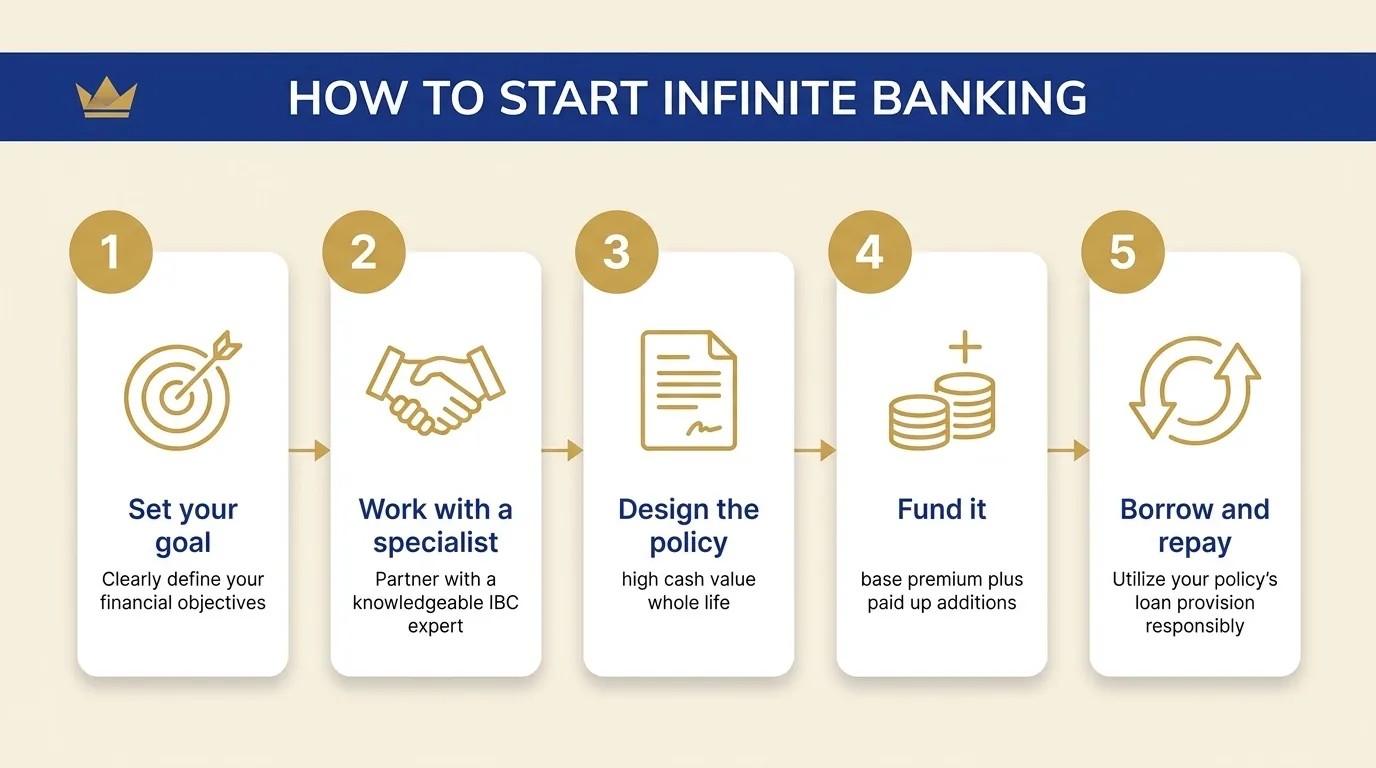
To start infinite banking, you set a clear goal, work with an agent who understands high cash value design, apply for a permanent policy structured for early cash value, fund it with base premium plus paid-up additions, and then use policy loans once value has built. Five moves, in order. Here is what each one really involves.
Step 1: Get honest about the goal
Before any policy, ask what the money is for. Infinite banking is a tool, and tools are only good for specific jobs. Some people want a disciplined place to store cash they would otherwise let sit in checking. Others want to self-finance cars or equipment instead of paying a bank's interest. Some want a tax-advantaged bucket for retirement income later. Each of those is a legitimate reason to start be your own bank, and each one shapes how the policy should be built.
The goal also tells you whether this is even the right first step. If you are carrying credit card debt at twenty-some percent, or you have no emergency fund at all, a life insurance policy is not where your next dollar should go. I tell people this often, and it costs me sales I am fine losing. Fix the leaking roof before you install the nice kitchen.
Step 2: Work with an agent who actually builds these
This is not a product you order off a shelf, and it is not one every agent knows how to structure. The difference between a policy designed for infinite banking and a standard whole life policy is night and day in the early years, and it comes down to how the premium is split. An agent who does this regularly will design the policy to push cash value up front, usually by adding a paid-up additions rider and trimming the base death benefit to the efficient minimum. An agent who has never done it may hand you a max death benefit policy that takes a decade to build usable value.
Ask direct questions. How much of my first year premium goes to cash value? What is the paid-up additions rider doing here? Can I see the guaranteed column, not just the projected one? A good agent answers plainly and shows you the illustration line by line. If someone dodges those questions or only shows you the rosy projection, keep looking. You can always talk it through with a licensed human before you commit to anything.
Step 3: Apply and get underwritten
Because this is life insurance, you apply and go through underwriting. That means health questions, often a short medical exam or an accelerated no-exam review, and a decision from the carrier. Your age and health drive both the cost of insurance inside the policy and whether you are approved at all. Younger and healthier means the mechanics work more in your favor, since less of your premium is eaten by the cost of insurance.
If your health is complicated, do not assume the door is closed. There are options, and sometimes a different structure or a different insured in the family makes it work. This is also the moment to be realistic. If underwriting comes back with a rating that makes the numbers ugly, it is fine to pause and rethink rather than force it.
Step 4: Fund it, and fund it consistently
Once the policy is in force, you fund it. A policy built for infinite banking usually has two parts to the premium: the base premium that keeps the whole life policy running, and the paid-up additions that pour extra money straight into cash value. Loading the paid-up additions is what gives you high early cash value, and it is what separates a banking policy from an ordinary one.
Consistency matters more than size. The engine only runs if you keep feeding it, and a policy you underfund or let lapse can undo the whole point. This is why I push people to fund an amount they can sustain through a rough year, not the biggest number their enthusiasm allows in month one.
Step 5: Let it build, then use the loan feature
Now you wait, at least a little. Even a well-designed policy needs some runway. Once you have meaningful cash value, you can request a policy loan against it, use the money for whatever you planned, and repay on your schedule. You are not required to repay on a fixed timetable the way a bank demands, but any unpaid loan balance plus interest reduces the death benefit if you pass away, so discipline is the whole game. Start small. Borrow for something real, pay it back, and watch the cycle work before you lean on it hard.
The policy you actually need
The policy for infinite banking is a permanent life insurance policy built for high early cash value, most often dividend-paying whole life from a mutual insurer, structured with a paid-up additions rider and a reduced base death benefit. Some people use indexed universal life instead. The label matters less than the design underneath it.
Here is the part worth slowing down on, because the word "whole life" alone does not get you there. Two whole life policies with the same premium can behave completely differently depending on how the agent structures them. A policy tuned for a big death benefit spends more of your early premium on insurance and builds cash slowly. A policy tuned for infinite banking flips that, using paid-up additions to front-load cash value while keeping the death benefit at the minimum the IRS rules allow. That minimum matters, because if you overfund past a certain line the policy becomes a Modified Endowment Contract and loses some of its tax advantages, so the design has to stay inside those limits.
Whole life, the traditional choice
Dividend-paying whole life is the classic vehicle for a reason. The cash value has a guaranteed floor, it grows every year regardless of the market, and mutual insurers may pay dividends on top, though dividends are never guaranteed. That certainty is the appeal. You trade upside for predictability, and for a strategy built on being able to count on your cash pool, predictability is worth a lot. If you want the deeper mechanics of how the cash side works, I break it down in this plain-English look at cash value life insurance.
Indexed universal life, the flexible cousin
Indexed universal life, or IUL, is the other path some people take. Instead of a fixed dividend structure, the cash value earns interest tied to a market index, with a floor that protects you from index losses and a cap that limits your gains. Premiums are more flexible, which some people love and some people misuse. The catch is less certainty. The cost of insurance can rise as you age, and the crediting rate can change, so an IUL needs monitoring in a way a whole life policy does not. Neither is simply better. Whole life gives you guarantees and simplicity, IUL gives you flexibility and index-linked upside potential with more moving parts to watch. If tax-advantaged growth is your main aim, our overview of indexed universal life and tax-free strategies lays out how that side works.
How much money it takes to start
There is no universal minimum to start infinite banking. Realistically, most well-designed policies make sense somewhere in the range of a few hundred dollars a month on the low end up into the thousands, but the honest answer is that the right number is the largest amount you can comfortably fund every year for the long haul. The policy is designed around your premium, not the other way around.
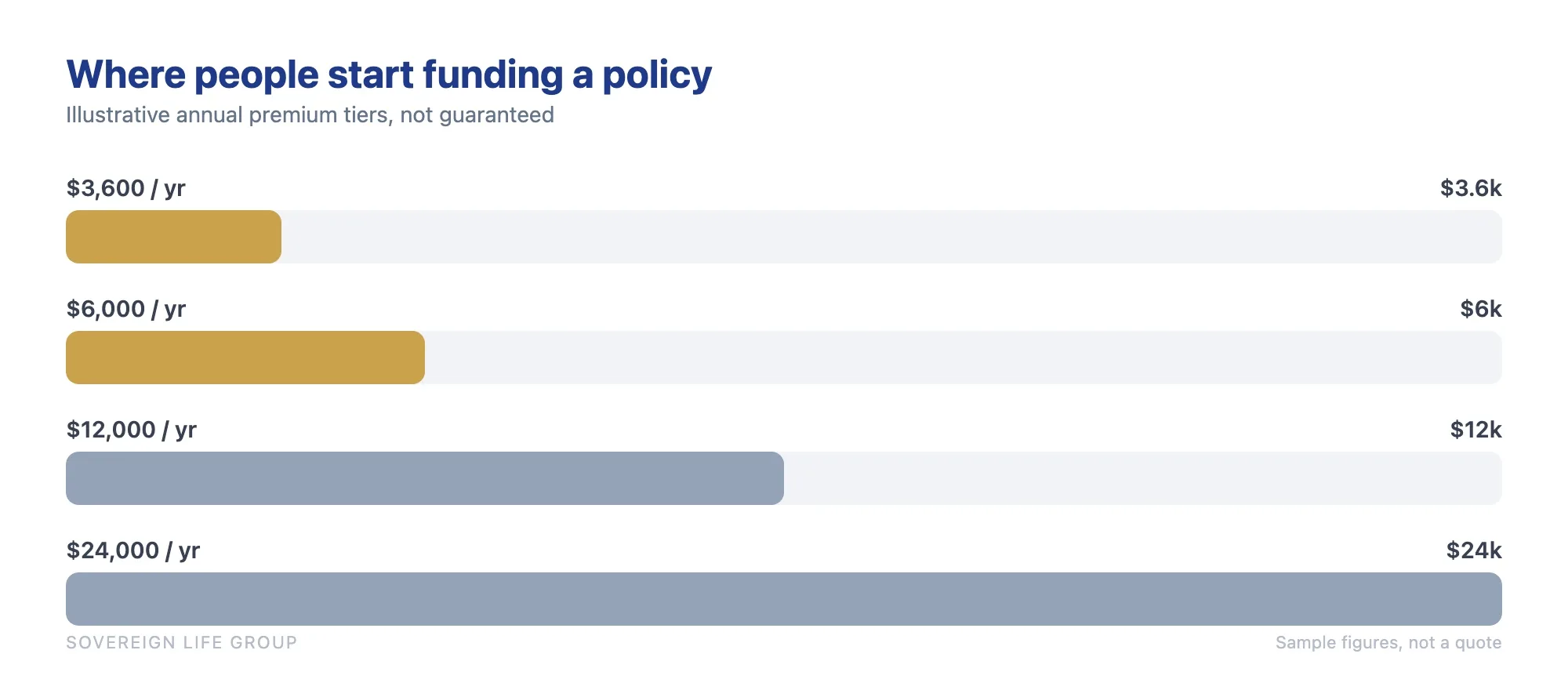
I want to be careful here, because this is where people get burned. A policy is not like a savings account you can top up or skip on a whim. You are committing to a premium, and the strategy assumes you keep paying it for years. The most common regret I see is not from people who funded too little. It is from people who stretched, funded a premium built for their best month, then hit a hard year and had to scramble. Fund for your worst year, not your best one.
A well-structured policy usually gives you flexibility inside the premium, which softens this. The paid-up additions portion often has some give to it, so in a tight year you may be able to dial back the extra funding while keeping the base policy alive. Ask your agent exactly how much flexibility you have before you sign, because "how low can I go in a bad year" is a better question than "how high can I go in a good one."
A worked example, funded over time
The best way to understand how to set up infinite banking is to watch the numbers move over time. What follows is an illustrative example, not a quote and not guaranteed, using round figures so the shape is easy to see. Every real policy differs by age, health, carrier, and design, so treat this as a picture of the mechanics rather than a promise.
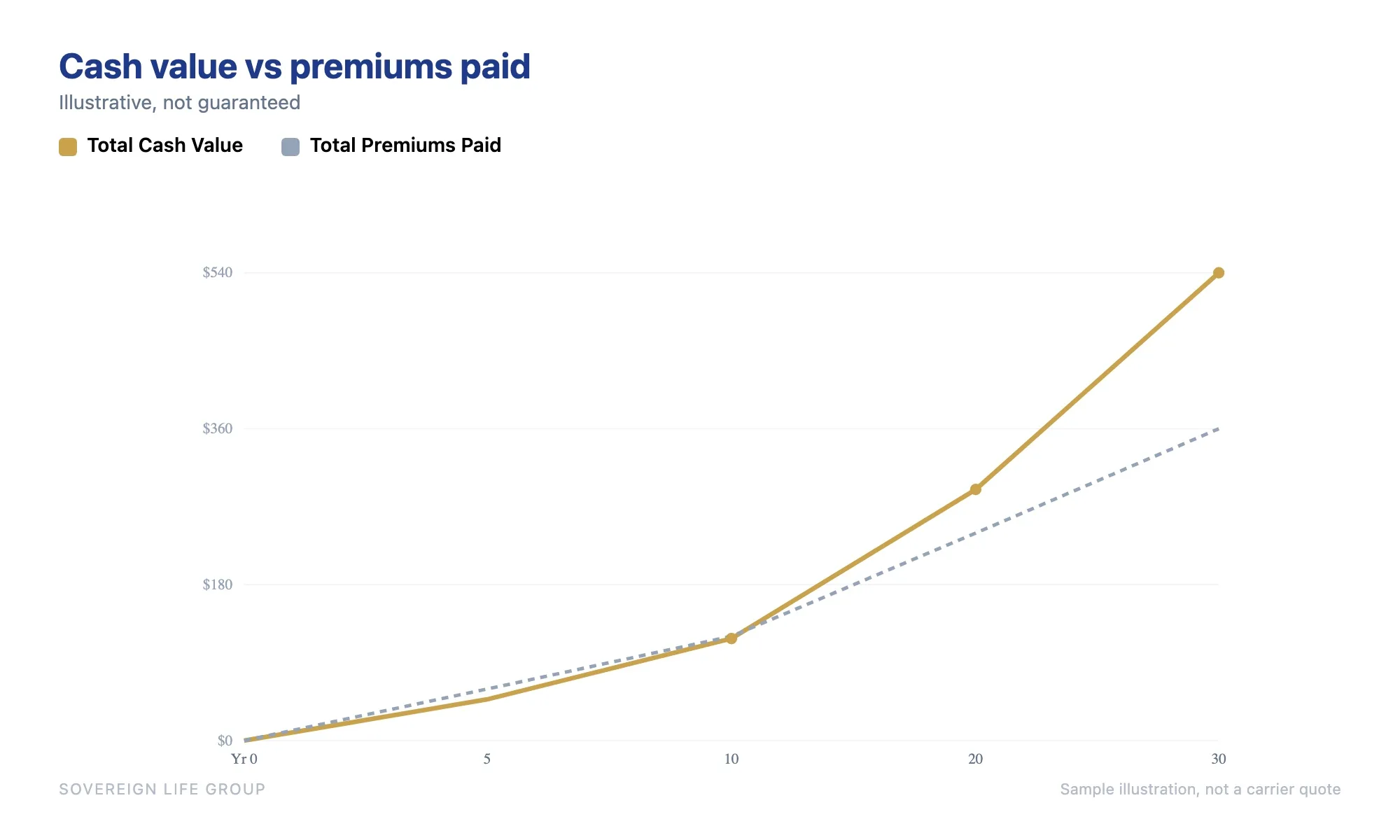
Picture someone funding twelve thousand dollars a year into a policy designed for high early cash value. In year one, a well-built policy might already show a large chunk of that first premium as usable cash value, sometimes most of it, because the paid-up additions did their job. That is the payoff of good design. A max death benefit policy funded the same way might show a fraction of that in year one, which is exactly the disappointment that turns people off the whole idea.
Look at the chart and notice the two lines. In the early years the premiums paid line sits above the cash value line. You are, in plain terms, a little underwater at first, because the cost of insurance and the policy's early expenses take their cut. Around the low double digits of years, in this illustration, the cash value line crosses above what you have put in, and from there the gap widens in your favor as guaranteed growth and any dividends compound. That crossover point is the whole reason patience is not optional here.
Putting the money to work
Now say that in year six this person needs eighteen thousand dollars for a used truck. Instead of financing it at a dealership, they request a policy loan against their cash value. The insurer sends the money, and here is the quiet magic: the full cash value keeps earning inside the policy, because the loan is collateralized against it rather than withdrawn from it. They drive the truck, then repay the loan over the next two or three years with interest, on their own schedule. When it is paid back, the cash value is whole again and available for the next need.
Run that cycle a few times over a couple of decades and you have financed cars, maybe a home repair, maybe a slice of a business, while your cash pool kept compounding in the background and a death benefit sat there protecting your family the entire time. That is the appeal in one paragraph. Just remember the illustration assumes discipline. Skip the repayments and the story ends differently, with a shrinking death benefit and a policy that can eventually collapse.
Get a fast, free estimate tailored to your age and health.
The borrow and repay cycle
The borrow and repay cycle is the engine of infinite banking. You take a policy loan against your cash value, use the money, and pay it back with interest on your own timeline. Because the loan is secured by your cash value rather than subtracted from it, your money can keep growing while it is out working. Discipline in repayment is what keeps the engine running.
Let me clear up the most misunderstood part, because the sales videos oversell it. When you take a policy loan, you are borrowing the insurer's money and using your cash value as collateral. That is why your cash value can continue to earn as if it were untouched. But you are still paying loan interest to the insurer, and that interest is real. Some policies use what is called a non-direct or wash loan structure where the borrowing cost and the crediting roughly offset, and some do not. The "your money grows while you spend it" line is true in a limited, mechanical sense, and it is not free money. Anyone who tells you it is free is selling, not teaching.
Repayment is where it lives or dies
You are not forced to repay a policy loan on a bank's schedule, and that freedom is a double-edged thing. Freedom without discipline is how these policies quietly fail. If you keep borrowing and never repay, the loan balance and its interest grow, eat into your death benefit, and can eventually cause the policy to lapse, which can even trigger a tax bill on gains you never actually pocketed. The families who do well with this treat their policy loans exactly like a real debt to a real bank, because in every way that matters, it is one. The bank is just you.
Living benefits are part of the picture
One thing that often gets lost in the borrow and repay conversation is that the policy is still life insurance. Many permanent policies include or offer riders for living benefits you can access if you get seriously ill, on top of the death benefit your family receives. So even in the years you are treating it as a bank, it is quietly doing the original job of protecting the people who depend on you. That dual purpose is a real part of the value, and it is easy to forget when the whole pitch is about borrowing.
The mistakes I see people make
Most infinite banking failures are not the strategy's fault. They come from a handful of avoidable mistakes: buying the wrong policy design, overfunding past what you can sustain, borrowing without repaying, and expecting fast results. Knowing these before you start is worth more than any illustration.
The mistake I see most is impatience. People watch a slick video, expect their cash value to explode in year one, and then feel cheated when the early years are slow. The early years are supposed to be slow. This is a long game measured in decades, and the crossover where it really starts working takes time to arrive. If you cannot commit to leaving it alone and feeding it for many years, this is not your tool, and there is no shame in that.
The second mistake is buying a badly designed policy from someone who does not specialize in this. I have reviewed policies people bought elsewhere that were sold as "infinite banking" but structured for maximum death benefit, so the early cash value was a trickle. The client did everything right and still got a poor result, because the design was wrong before the ink dried. Design is not a detail here. It is the whole thing.
The third is treating policy loans as free money. The freedom to skip a payment is not permission to never make one. And the fourth is starting before the basics are handled. If you do not have an emergency fund or you are carrying high-interest debt, those come first. A policy is a great third or fourth financial move and a poor first one.
- Impatience. Expecting big cash value fast. The early years are slow by design.
- Poor design. A max death benefit policy dressed up as a banking policy. Ask about the paid-up additions rider.
- Overfunding. A premium sized for your best month, not your worst year.
- Undisciplined loans. Borrowing freely and repaying rarely, which slowly hollows out the policy.
- Wrong order. Starting this before an emergency fund and before clearing high-interest debt.
Infinite banking vs the alternatives
Infinite banking is not the only way to store and access cash, and it is not automatically the best one. Compared with a savings account or a brokerage account, a policy adds tax-deferred growth, a death benefit, and borrowing without a credit check, but it starts slower, costs more, and demands discipline. The right choice depends on what you actually need the money to do.
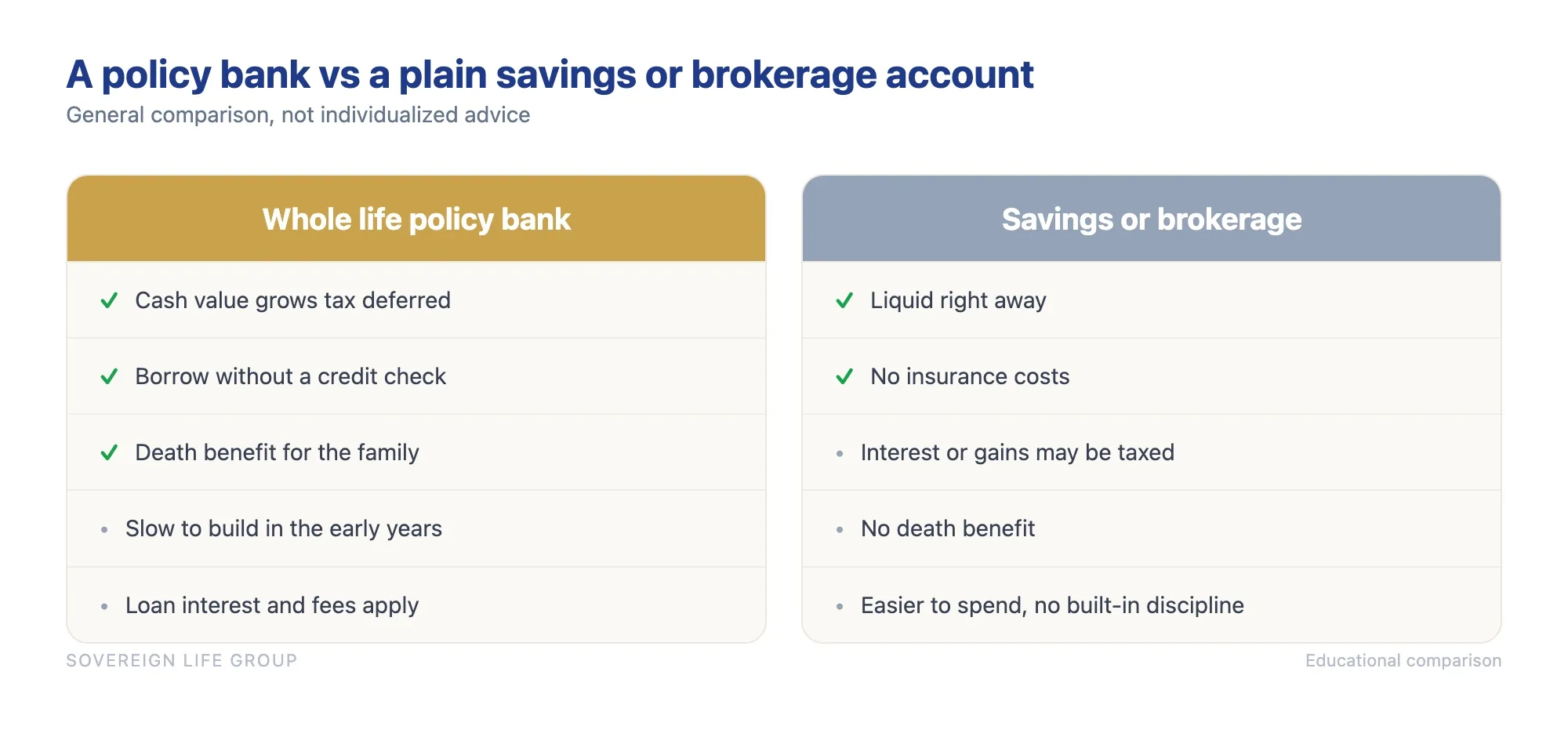
Here is how I frame it for people. A high-yield savings account wins on pure liquidity and simplicity. Your money is there tomorrow, no exam, no loan, no waiting years to break even. If your only goal is a parked emergency fund, a savings account is often the smarter, cheaper tool, and I say so.
A brokerage account wins on long-run growth potential. Over a few decades, a diversified stock portfolio has historically outrun the internal growth of a whole life policy, and it does not carry insurance costs. What it does not give you is a guaranteed floor, a death benefit, or the tax treatment of life insurance. It can also be gutted by a bad market at the wrong moment, and it is psychologically easy to raid.
A policy sits in the middle, and its edge is not raw return. Its edge is the combination: tax-advantaged growth, a guaranteed floor on the whole life side, a death benefit that protects your family the entire time, borrowing without a lender's permission, and a built-in discipline that a checking account never provides. You pay for that combination with slower early growth and higher cost. For the deeper structural comparison of the underlying products, my breakdown of term versus whole life insurance is worth reading before you decide.
| Feature | Whole life policy bank | High-yield savings | Brokerage account |
|---|---|---|---|
| Speed to full liquidity | Slow early, better over time | Immediate | Fast, but market dependent |
| Growth | Steady, guaranteed floor plus possible dividends | Low, tracks rates | Higher potential, no floor |
| Taxes on growth | Tax-deferred inside the policy | Interest usually taxable | Gains usually taxable |
| Death benefit | Yes, protects family | No | No |
| Access to cash | Policy loan, no credit check | Withdraw anytime | Sell holdings |
| Main risk | Underfunding or unpaid loans | Inflation erosion | Market loss, easy to spend |
The honest trade-offs, fees, and risks
Infinite banking has real costs that the marketing tends to bury. The early years are slow, the policy carries insurance costs and fees, loans accrue interest, dividends and IUL crediting are not guaranteed, and the whole thing depends on your discipline. None of this makes it a bad strategy. It makes it a strategy that has to be entered with eyes open.
Start with the slow start, because it is the number one reason people quit. In the first year or two, even a well-designed policy usually has less cash value than the premiums you have paid in. You are underwater at first. That is the cost of insurance and the policy's early expenses doing their work, and it is unavoidable. If someone shows you a policy with zero early cost, look harder, because it is in there somewhere.
Then there are the ongoing costs. A permanent policy has a cost of insurance, administrative charges, and, on an IUL, those costs can rise as you age. Policy loans carry interest. Dividends on a whole life policy are declared by the insurer and are not guaranteed, and IUL crediting depends on an index within caps and floors the insurer can adjust. According to consumer guidance from the Insurance Information Institute, permanent policies build cash value but come with higher premiums than term coverage, which is the trade-off you are accepting on purpose.
There is also a tax line you cannot ignore. The favorable tax treatment of cash value depends on the policy staying within federal limits. Fund it too aggressively and it becomes a Modified Endowment Contract under the tax code, which changes how loans and withdrawals are taxed. A policy that lapses with a loan outstanding can also create a taxable event on gains. This is real tax law, not a technicality, and it is one more reason to work with someone who designs these correctly and to talk with a tax professional about your own situation.
Now the honest counterweight, because the risk list is not the whole story. There is a genuine, measurable protection gap in this country. According to the 2024 Insurance Barometer Study from LIMRA, a large share of American adults say they do not have enough life insurance, and many overestimate what it costs. Permanent life insurance, used well, closes part of that gap while doing double duty as a cash tool. The strategy is not snake oil. It is a real financial instrument that rewards patience and punishes carelessness.
Is it right for you
Infinite banking is probably right for you if you already have an emergency fund and no high-interest debt, you can fund a policy consistently for many years, and you want tax-advantaged, borrowable cash paired with lifelong coverage. It is probably not right if money is tight, your timeline is short, or you expect quick results.
I would put people in the "yes, explore it" column when a few things are true at once. You have your financial basics handled. You have steady cash flow and can commit a premium comfortably for the long term. You value certainty and a death benefit, not just the highest possible return. And you like the idea of self-financing rather than handing every purchase to a lender. When those line up, this can be a genuinely useful piece of a broader plan.
I would gently steer people away when the opposite is true. If you are still building an emergency fund, if you carry credit card debt, if your income is unpredictable, or if you would need to borrow against the policy almost immediately because you have no other savings, the timing is wrong. Not the strategy, the timing. Come back to it when the foundation is set.
The right move is almost never to decide from an article, mine included. It is to see a real illustration built for your age and health, read the guaranteed column, and ask hard questions until the trade-offs are clear. If you want an unhurried, plain-English walkthrough with someone who will tell you when it does not fit, that is exactly the kind of conversation I have with families through Sovereign Life Group, your life insurance strategist.
Want a straight answer for your situation?
Fifteen minutes. We will look at your goals, your budget, your health, and whether a policy built for infinite banking actually fits before you spend a dollar. No jargon, no pressure, just the trade-offs laid out plainly.
Get a Quick Quote Book a 15-Min Call Want to save my card for later? Grab it here and reach out when you are ready.Frequently asked questions
How much money do you need to start infinite banking?
There is no fixed minimum. Some families start a policy on a few hundred dollars a month, others fund tens of thousands a year. What matters more than the number is that the amount is consistent and comfortable, because a policy built for infinite banking is designed around a premium you can pay for years without strain. Overfund what you can sustain, not what looks impressive on paper.
What type of life insurance is used for infinite banking?
The classic vehicle is dividend-paying whole life insurance from a mutual company, structured for high early cash value using paid-up additions. Some people use indexed universal life instead. Both build cash value you can borrow against, but they behave differently, so the right one depends on your goals, your health, and how much certainty you want.
Can you start infinite banking with an IUL?
Yes, some people do. An indexed universal life policy can build borrowable cash value and offers more flexible premiums, with growth tied to an index subject to caps and floors. The trade-off is less certainty than whole life, because the cost of insurance and the crediting can change. Whole life gives more guarantees, IUL gives more flexibility and upside potential with more moving parts.
How long does it take before you can borrow against the policy?
With a policy designed for high early cash value, you often have meaningful borrowable value within the first year or two, sometimes within the first months. A traditionally structured policy can take much longer to build usable cash value, which is exactly why the design matters so much when the goal is infinite banking.
Is infinite banking a scam or too good to be true?
It is not a scam, but it is often oversold. Infinite banking is a real strategy built on ordinary permanent life insurance and a policy loan feature that has existed for generations. The honest catch is that it starts slow, costs more than a term policy, and only works if you fund it consistently and repay your loans with discipline. Done right it is a tool, not a miracle.
Can I set up infinite banking on my own?
Technically you buy a life insurance policy, so you cannot issue it yourself. You need a licensed agent and an insurer. What you can control is who designs it. Because policy structure decides how much early cash value you get, working with someone who understands high cash value design matters more here than in almost any other kind of life insurance.
Joseph McDermott is a licensed life insurance agent (NPN 22121673), licensed in 27 states. Brokered through Family First Life, in partnership with Catalyst Life. This article is educational and is not financial, tax, or legal advice. Please talk with a licensed professional about your specific situation. Product availability, features, riders, dividends, and crediting vary by state, age, health, and carrier, and any coverage is subject to underwriting approval. Policy loans accrue interest and reduce cash value and the death benefit if not repaid. Dividends and index-linked crediting are not guaranteed. Guarantees are subject to the claims-paying ability of the issuing insurance company.