What to Do With Your 401k When You Retire


The Short Version
When you retire you have four real choices for your 401k: leave it in the plan, roll it over to an IRA, take a lump sum, or turn part of it into guaranteed lifetime income. Most people should cover their essential bills with reliable income first, then keep the rest invested for growth. The one move that quietly costs the most is a rushed lump sum.
Deciding what to do with your 401k when you retire is one of the biggest money decisions you will ever make, and almost nobody gets a second try at it. For thirty or forty years the job was simple: put money in, leave it alone, let it grow. Now the paycheck stops, the balance is the biggest number you have ever seen, and the question flips completely. How do you turn that pile into a paycheck that lasts as long as you do? This guide walks through every option for your 401k at retirement, in plain language, including the tax traps, the RMD deadlines, and the parts most articles skip.
I write this as a licensed agent who sits with families making this exact call. Some of what follows will slow you down and talk you out of the flashiest option in the room. Good. This is not a decision to rush, and the people selling you the fastest answer are rarely the ones who have to live with it.
What this guide covers
- Your four real options at retirement
- Leaving your 401k where it is
- Rolling over your 401k when you retire
- Taking a lump sum, and why it usually backfires
- Turning your 401k into guaranteed income
- The 4 percent rule and its limits
- A safe growth glidepath in retirement
- RMDs, taxes, and the 401k tax bomb
- A worked example: how one couple decided
- The mistakes I see most
- How to decide what fits you
- Frequently asked questions
Your four real options at retirement
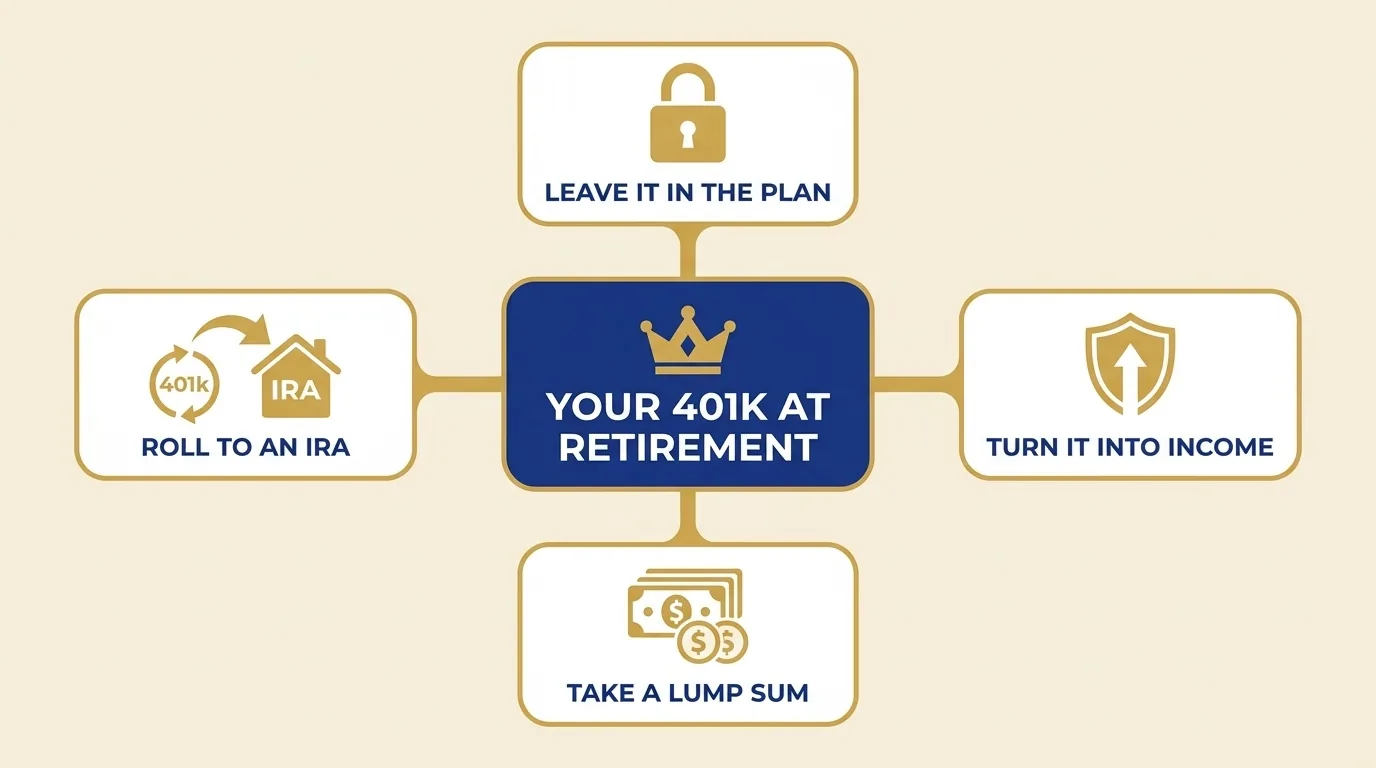
When you retire, you have four real options for your 401k: leave it in your employer's plan, roll it over into an IRA, cash it out as a lump sum, or convert part of it into guaranteed income you cannot outlive. You do not have to pick just one. Many retirees combine them, and that blend is usually the smartest path.
Here is what surprises people most: the account does not force your hand the day you clock out. Your 401k can keep sitting there, invested, while you take your time deciding. There is no rule that says you must move it, spend it, or convert it the moment you retire. The pressure you feel usually comes from a broker who earns more when you act fast, not from the IRS. The only hard deadline is your required minimum distribution, and for most people that is years away.
So slow down and think about the job the money now has to do. Before retirement, the job was growth. After retirement, the job splits in two: some of the money has to reliably pay your bills every single month, and the rest can keep growing to fight inflation and to leave something behind. Almost every good decision here comes from separating those two jobs and not asking one dollar to do both.
No medical exam for a ballpark. Free, and no pressure.
Leaving your 401k where it is
You can usually leave your 401k right where it is after you retire, as long as your balance is above the amount your plan is allowed to cash out automatically, a limit SECURE 2.0 lets plans set as high as 7,000 dollars. Nothing is forced. The money stays invested in the same funds, and you can take withdrawals as you need them. For some retirees this is genuinely the right call, and for others it is just the path of least resistance.
When does staying put make sense? A few real cases come up again and again in my conversations.
- Your plan has excellent, low-cost funds. Some large-employer 401k plans offer institutional share classes you simply cannot buy on your own. If your expense ratios are rock bottom, moving to a retail IRA could actually raise your costs.
- You retired between 55 and 59 and a half. There is a provision often called the rule of 55. If you leave your job in or after the year you turn 55, you can generally take penalty-free withdrawals from that employer's 401k, something an IRA does not allow until 59 and a half. Roll it too early and you can lose that access.
- You value strong creditor protection. Employer plans governed by federal law tend to have robust protection from creditors. IRA protection varies by state.
The downsides are real too. You are stuck with the plan's menu, which is usually a short list of funds. You cannot buy an annuity inside most plans, individual bonds, or the wider world of investments an IRA opens up. And if you have 401k accounts scattered across three or four old jobs, leaving them all in place means juggling multiple statements, multiple beneficiary forms, and multiple sets of rules. That clutter causes real mistakes, like a forgotten account or an ex-spouse still listed as beneficiary.
Rolling over your 401k when you retire
Rolling over your 401k when you retire means moving the money into an IRA, where you control the investments. A direct rollover, where the funds go straight from the plan to the IRA custodian, triggers no taxes and no penalties. This is the most common move at retirement because it opens up far more investment choices and lets you consolidate old accounts into one place you actually watch.
The word "direct" is doing heavy lifting there, and it is where people get burned. There are two ways to move the money, and only one is safe by default.
Direct rollover versus the 60-day rollover
In a direct rollover, the check is made out to your new IRA custodian, not to you. The money never touches your hands, nothing is withheld, and there is no tax event. This is what you want in almost every case.
In an indirect or 60-day rollover, the plan sends the money to you, withholds 20 percent for taxes, and gives you 60 days to redeposit the full amount into an IRA. Miss the window, or fail to replace that withheld 20 percent out of your own pocket, and the shortfall becomes a taxable distribution, plus a penalty if you are under 59 and a half. I have watched people lose thousands to a simple paperwork mistake here. If you take this path, treat that 60-day clock like a live grenade. Better yet, do not take it. Ask for a direct trustee-to-trustee transfer and skip the risk entirely. Say those exact words to your plan administrator, get the confirmation in writing, and the 20 percent withholding problem never starts.
Why most retirees choose an IRA
An IRA usually beats a left-behind 401k on three fronts. First, choice: instead of a dozen funds, you can hold index funds, individual stocks and bonds, dividend payers, and income products your plan never offered. Second, cost: many IRAs let you build a portfolio cheaper than a mediocre 401k menu. Third, simplicity: one account, one beneficiary form, one login. When you are 78 and your spouse is managing the money for the first time, that simplicity is worth more than any extra fund.
None of this makes a rollover automatic. If your 401k is genuinely great and cheap, or you need the rule of 55, staying can win. Compare the actual fees on paper before you move a dollar. The right answer is the one that fits your plan, not the one that fits the salesperson's commission.
Taking a lump sum, and why it usually backfires
Taking a lump sum means withdrawing your entire 401k balance at once. It is legal, and in rare cases it fits, but for most retirees it is the most expensive option on the table. A large withdrawal is taxed as ordinary income in a single year, which can rocket you into a much higher tax bracket and hand a big slice of your life's savings straight to the IRS.
Picture a retiree with 600,000 dollars in a traditional 401k who cashes it all out. That entire amount lands on one year's tax return as income. It can push them into the top brackets, trigger higher Medicare premiums through income-related surcharges, and make more of their Social Security taxable. The tax bill alone can run into six figures. Compare that to leaving the money in a tax-deferred account and pulling it out gradually over decades, taxed a little at a time in lower brackets.
There are narrow situations where a lump sum, or a partial one, has a place. If you hold highly appreciated company stock inside your 401k, a strategy called net unrealized appreciation can sometimes lower the tax on those shares, and that is worth a conversation with a tax professional. If you have a serious health situation and want to settle affairs, liquidity can matter more than tax efficiency. But those are exceptions. The default assumption that "it's my money, I'll just take it" usually costs far more than people expect.
Turning your 401k into guaranteed income
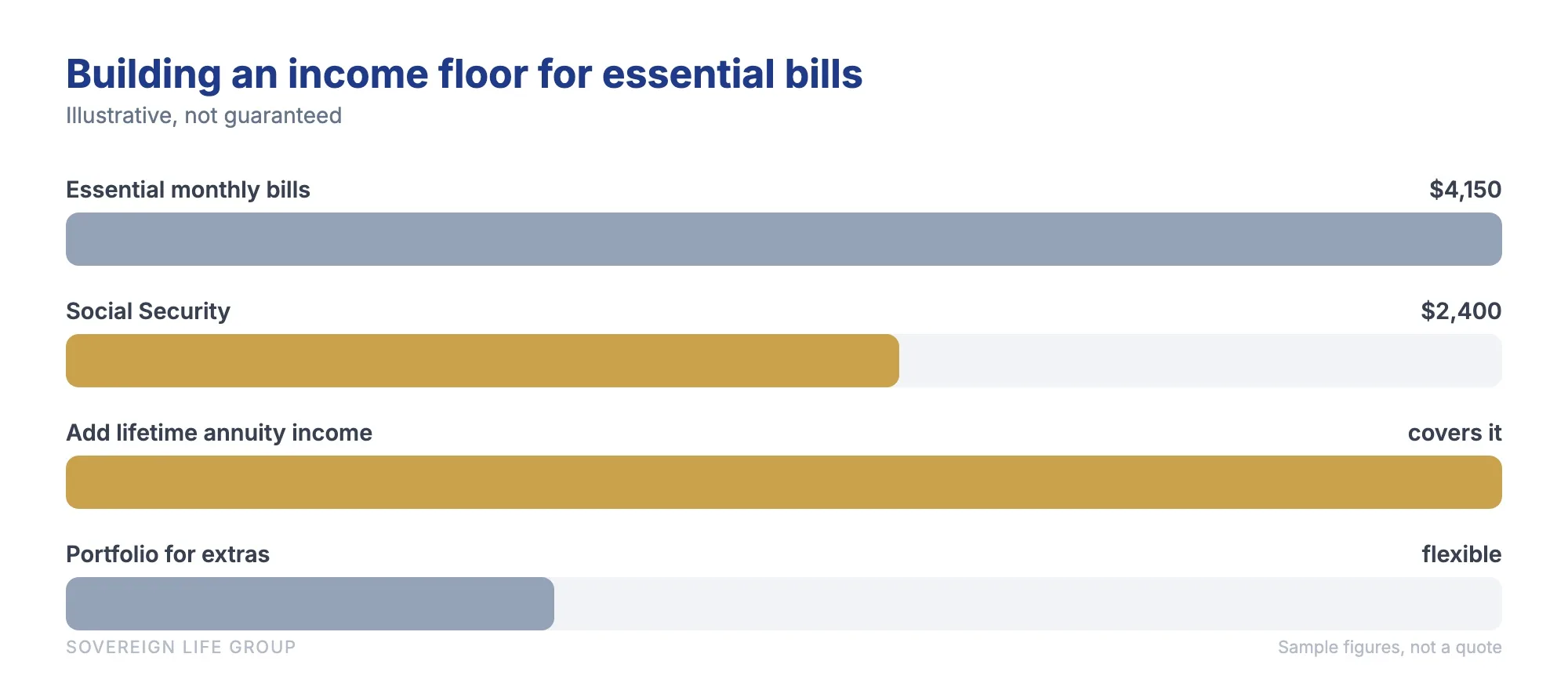
Turning part of your 401k into guaranteed income means using some of the balance to create a paycheck that lasts your whole life, no matter how markets behave. The most common tool is an annuity, which you buy from an insurance company in exchange for a stream of monthly income. The goal is simple: make sure your essential bills are always covered by money that cannot run out.
This is the piece most 401k articles skip entirely, and it is the piece that helps people sleep. Think about your monthly expenses in two buckets. The must-pay bucket is your housing, food, utilities, insurance, and medicine, the costs that do not care what the stock market did this morning. The nice-to-have bucket is travel, dining out, gifts, and hobbies. The strategy that calms most retirees is to cover the must-pay bucket with guaranteed income, then let the market handle the nice-to-have bucket.
For many households, Social Security is the first layer of that floor. According to the Social Security Administration, benefits replace about 43 percent of pre-retirement earnings for a medium earner who claims at full retirement age, while most financial advisers say you need roughly 70 to 80 percent of your pre-retirement income to live comfortably. That is the gap between what Social Security pays and what the essential bills cost. Filling that gap with lifetime income from part of your 401k is what turns "I hope this lasts" into "this is covered."
Where annuities fit, honestly
An annuity is a tool, not a religion. Used right, it converts a slice of your savings into a dependable paycheck and removes the fear of outliving your money. Used wrong, it locks up cash you needed, or piles on fees you did not understand. Both things are true, and any agent who only tells you one side is selling, not advising.
The honest trade-offs look like this:
- You give up some liquidity. Money committed to lifetime income is not sitting in an account you can raid for a new roof. That is the point, and also the cost. Never annuitize money you may need in a hurry.
- Fees and terms vary widely. A simple fixed annuity can be low cost and easy to understand. Some variable and complex products carry meaningful fees. Read what you are buying, and get the guarantees in writing.
- Guarantees rest on the insurer. Income guarantees are backed by the claims-paying ability of the issuing company, which is why the carrier's financial strength rating matters.
Retirees have been leaning into this idea for a reason. According to industry data from LIMRA, total U.S. retail annuity sales reached a record 434.1 billion dollars in 2024, up 13 percent from the year before, as people near retirement looked for protected income in an uncertain market. That does not mean an annuity is right for you. It means a lot of families are asking the same question you are: how do I make this money last?
Not every annuity is the same, and the differences matter. Our guide on fixed, indexed, and variable annuities explained breaks down the types without the sales gloss, and our guide to tax free retirement income covers the option people ask about most once they see their RMD projection. When you want to see how an income floor could fit your numbers, our annuity options for retirement income page lays out the plain version.
The 4 percent rule and its limits
The 4 percent rule says you can withdraw about 4 percent of your retirement balance in the first year, then adjust that dollar amount for inflation each year after, with a reasonable chance the money lasts around 30 years. It comes from research by financial planner William Bengen in 1994 and remains the most common starting point for retirement spending. It is a useful guideline, not a promise.
Run the math and it is refreshingly simple. On a 500,000 dollar balance, 4 percent is 20,000 dollars in year one. Add Social Security on top and that is the income you have to work with. The trouble is that the rule assumes an average, and you do not retire into an average. You retire into whatever the market actually does in your first few years, and that timing matters enormously.
Sequence of returns risk
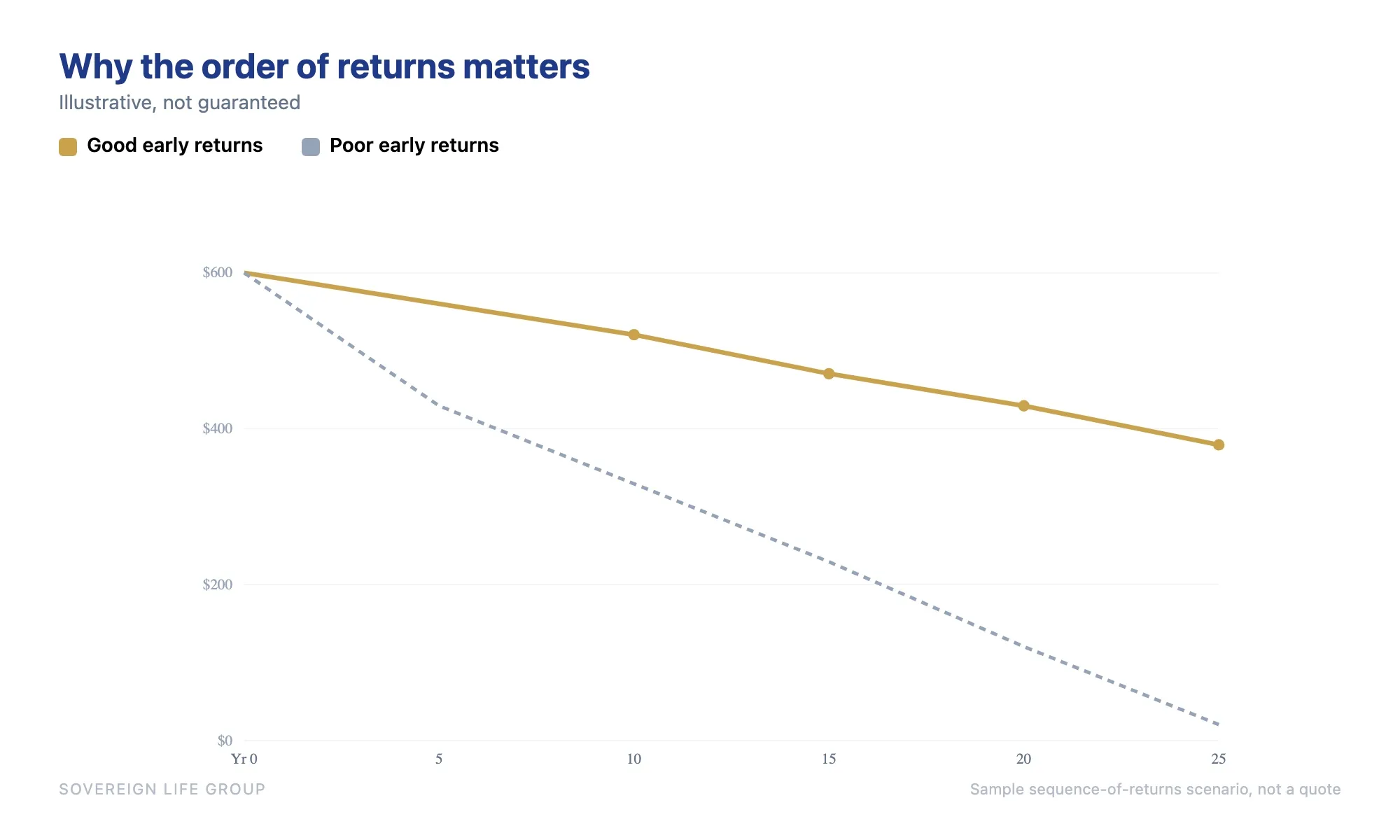
Here is the part that keeps me cautious with new retirees. Two people can earn the exact same average return over 25 years and end up in completely different places, purely because of the order those returns arrived. If the market falls hard in your first few retirement years while you are also pulling money out, you sell shares at low prices to fund your withdrawals, and the portfolio may never recover. The same crash ten years later would barely leave a mark. This is called sequence of returns risk, and it is the reason the 4 percent rule can strain in a bad-luck retirement.
It is also the strongest argument for the income floor from the last section. If your essential bills are covered by guaranteed income, you are not forced to sell investments in a down market to eat. You can let the portfolio ride out the storm and recover. That single fact, not selling at the bottom, is worth more to a retirement than chasing an extra point of return.
Most thoughtful retirees do not follow the 4 percent rule rigidly. They use a flexible version: spend a bit less in years the market drops, spend a bit more after strong years, and keep a cash cushion so a single bad year never forces a fire sale. The rule is a compass, not a cruise control.
Get a fast, free estimate tailored to your age and health.
A safe growth glidepath in retirement
A safe growth glidepath in retirement means gradually shifting how much risk your money takes as you age, so a market drop early in retirement does less damage while your money still has decades to grow. Instead of one static allocation, you plan how the mix of stable and growth assets should move over time, matched to when you actually need each dollar.
The old advice was blunt: get more conservative as you age, hold more bonds, hold less stock. It is not wrong, but it misses something. Retirement can last 30 years, and money you will not touch until your 80s still needs to grow, or inflation quietly erodes it. A gallon of milk and a Medicare supplement will both cost more in 2046 than they do today. Playing everything safe has its own risk: running out of purchasing power.
A better frame is the bucket approach, which pairs naturally with the income floor.
- Bucket one, cash reserve. One to two years of spending in cash or equivalents. This is what you actually live on, so a market crash never touches your grocery money.
- Bucket two, stable income. Guaranteed income sources and conservative holdings that refill bucket one. Social Security and any lifetime income sit here.
- Bucket three, growth. The money you will not need for 10 years or more, kept invested for growth to outpace inflation and fund your later years and your legacy.
The glidepath is how those buckets shift as you move through retirement. Early on, when sequence risk is highest, you keep the near-term buckets full so you are never a forced seller. Later, once you have cleared the danger zone of those first fragile years, you can let the growth bucket do more of the work. It is less about one perfect allocation and more about always having the next few years of income sitting somewhere safe.
RMDs, taxes, and the 401k tax bomb
A traditional 401k is tax-deferred, not tax-free, which means every dollar you eventually withdraw is taxed as ordinary income, and the IRS will not wait forever to collect. Required minimum distributions, or RMDs, force you to start pulling money out and paying tax on it at a set age, whether you need the income or not. Planning around this is how you keep a lifetime of savings from turning into a lifetime of avoidable taxes.
Under current law, RMDs generally begin at age 73, according to the Internal Revenue Service. That age is tied to your birthday, not to a calendar year: age 73 applies if you turned 72 after December 31, 2022, and for anyone born on or after January 1, 1960, the RMD age is 75, per the Congressional Research Service summary of the SECURE 2.0 changes. Each year after that, you must withdraw a minimum amount based on your age and your account balance. Skip an RMD and the penalty is steep, though it can be reduced if you correct the mistake quickly. If you are still working past 73 and do not own more than 5 percent of the company, you may be able to delay RMDs from that specific employer's plan until you actually retire.
The tax bomb nobody warned you about
Here is what catches diligent savers off guard. You spent decades being told to max out the 401k for the tax break, and it was good advice. But that break was a deferral, not a pardon. If most of your savings sits in a traditional 401k, your RMDs in your 70s and 80s can be large enough to push you into higher brackets, raise your Medicare premiums, and tax more of your Social Security. A great saver can accidentally build a tax bomb. I have sat with people genuinely shocked that being responsible their whole lives created a tax problem in retirement. If you still have working years left, our comparison of an IUL versus a 401k walks through how families spread money across taxable and tax advantaged buckets before they retire, and what each one costs them.
You have levers to defuse it, and the years between retiring and starting RMDs are the window to use them.
- Roth conversions. In lower-income years, especially after you retire but before RMDs begin, you can convert some traditional 401k or IRA money to a Roth, pay the tax now at a lower rate, and let it grow tax-free with no future RMDs. This is a coordination job for a tax professional, but the window is real.
- Spending from the right accounts in the right order. Which account you draw from first can shape your lifetime tax bill. There is no single rule, so this is worth mapping with a professional.
- Qualified charitable distributions. If you are charitably inclined and over the qualifying age, giving directly from an IRA can satisfy your RMD without adding to your taxable income.
This is exactly where "not tax advice" stops being a disclaimer and starts being the honest truth. The tax side of a 401k at retirement is worth a real conversation with a licensed tax professional who can see your full picture. The point here is only that you have moves, and that most of them work best when you plan before the RMD clock forces your hand.
A worked example: how one couple decided
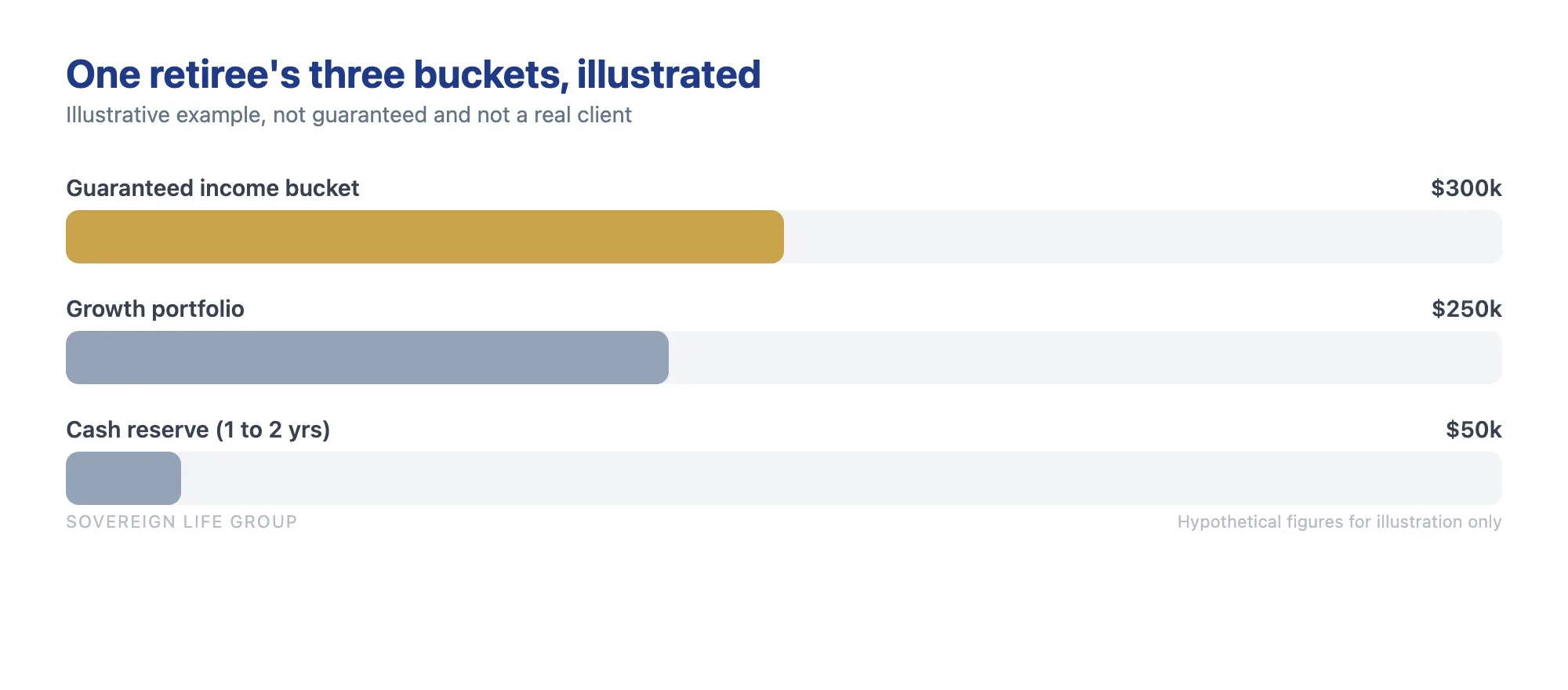
Let me make this concrete with a simple, hypothetical example. This is an illustration to show the thinking, not a real client and not a promise of any result. Picture a married couple, both 66, retiring with a combined 600,000 dollars in traditional 401k accounts and Social Security that covers a little more than half of their essential monthly bills. Their fear is the one I hear most: running out of money.
Working through their options, the plan came together in three parts.
- Cover the gap with guaranteed income. Social Security handled most of the essentials, but not all. They set aside a portion of the 401k to create lifetime income that filled the gap between Social Security and their must-pay bills. Now the mortgage, food, utilities, and insurance are covered by money that arrives every month regardless of the market.
- Keep the rest invested for growth. The larger share stayed invested in a diversified portfolio inside a rollover IRA. This is the money that fights inflation over a possible 30-year retirement and funds travel, gifts, and whatever they leave to their kids.
- Hold a cash cushion. They kept one to two years of spending in cash so that a bad market year never forces them to sell investments at a loss to pay bills.
Notice what this did to their stress. Because the essentials were covered by guaranteed income, a market drop in their first retirement years would sting on paper but would not threaten the roof over their heads. They were no longer forced sellers. That is the whole reason to build the floor first, and it is why the couple described the change less as a financial win and more as finally being able to exhale.
They also flagged the tax side early. With most of their money in traditional accounts, they mapped out a few years of modest Roth conversions with their tax preparer before RMDs kick in at 73, to keep those future required withdrawals from ballooning. None of this required exotic products. It required separating the jobs their money had to do, then matching each job to the right tool.
| Option | Best when | Main trade-off |
|---|---|---|
| Leave it in the plan | Great low-cost funds, or you need the rule of 55 | Limited menu, harder to manage multiple accounts |
| Roll it to an IRA | You want more choice, lower cost, and one account | Lose employer-plan perks like the rule of 55 |
| Take a lump sum | Rare cases like company stock or urgent liquidity | A large, immediate tax bill in a single year |
| Turn part into income | You want essential bills covered for life | Less liquidity on the money you commit |
The mistakes I see most
After enough of these conversations, the same handful of missteps come up again and again. None of them are exotic. They are ordinary errors made by careful people who were never taught the retirement side of money, only the saving side.
- Cashing out in a panic. A market scare or a big life change tempts people to pull everything out. The tax hit alone can undo years of careful saving. Slow down first.
- Rolling over without comparing fees. A rollover is often smart, but not automatically. Some people leave a cheap, excellent plan for a pricier IRA because a salesperson pushed it. Check the actual expense ratios on both sides.
- Ignoring the tax bomb until 73. The best planning years are the quiet ones between retiring and RMDs. Waiting until the IRS forces withdrawals throws away your best moves.
- Putting everything into one product. All-cash loses to inflation. All-market leaves you exposed the year you can least afford it. All-annuity gives up too much liquidity. The answer is a mix, matched to when you need each dollar.
- Taking advice only from someone paid to sell one thing. If every conversation ends with the same product, that is a flag. You want options and trade-offs laid out, then your choice.
Most people overthink the investment picks and underthink the structure. Which fund you choose matters far less than whether your essential bills are covered and whether you have a plan for taxes. Get the structure right and the rest gets a lot easier.
How to decide what fits you
Deciding what to do with your 401k when you retire comes down to a short sequence of questions, answered in order. Start with the income your bills require, then the taxes you can control, then the growth you need for the long haul. Work it in that order and the product choices mostly answer themselves.
Here is the path I would walk a friend through.
- Add up your essential monthly bills. Housing, food, utilities, insurance, healthcare. This is the number that has to be covered no matter what.
- Subtract your guaranteed income. Social Security first, plus any pension. The gap between your essentials and your guaranteed income is the piece worth covering with more reliable income.
- Decide how to fill that gap. For some, existing savings and a conservative bucket handle it. For others, converting part of the 401k into lifetime income does the job with less worry.
- Keep the rest invested for growth. The money you will not need for a decade should fight inflation, usually through a diversified rollover IRA.
- Map the taxes before RMDs. Use the low-income years after retirement to consider Roth conversions and a withdrawal order, with a tax professional.
- Hold a cash cushion. One to two years of spending so no down market ever forces a sale.
You do not have to do this alone, and you should not have to do it under pressure. If you want a second set of eyes, you can walk through your numbers with Sovereign Life Group, an independent life insurance and retirement strategist, and see the options side by side with no sales script. The goal is your plan, built around your bills and your family, not a product sale.
Want a straight answer for your 401k?
Fifteen minutes. We will look at your bills, your Social Security, your balance, and the simplest way to make it last. No pressure, no jargon, just your options laid out plainly.
Get a Quick Quote Book a 15-Min Call Prefer to start reading? See how income options fit a retirement plan on the annuities coverage page, or save my card and get a quick quote.Frequently asked questions
Should I roll over my 401k when I retire?
Often yes, but not always. Rolling your 401k to an IRA usually gives you more investment choices, lower fees, and one account to manage instead of several. But if your plan has strong low-cost funds, or you retired between 55 and 59 and a half and need penalty-free access, staying put can be the better call. Compare fees and access before you move anything.
What is the safest thing to do with my 401k at retirement?
There is no single safest move, because safety depends on the risk you are trying to avoid. The most common low-stress approach is to cover your essential monthly bills with guaranteed income sources, such as Social Security and a portion set aside for lifetime income, then keep the rest invested for growth and emergencies. That way a bad market year does not touch the money that pays your rent and groceries.
Are annuities worth it in retirement?
For some retirees, yes. An annuity can turn part of your savings into a paycheck you cannot outlive, which is valuable if you are worried about running out of money. The trade-offs are real: less liquidity, fees on some products, and money you commit for the long term. An annuity is a tool for the income floor, not a place for every dollar.
When do I have to start taking money out of my 401k?
Under current IRS rules, required minimum distributions generally begin at age 73 if you turned 72 after December 31, 2022. If you were born on or after January 1, 1960, your RMD age is 75 instead. If you keep working past 73 and do not own more than five percent of the company, you may be able to delay RMDs from that employer's plan until you retire.
How much of my 401k can I safely spend each year?
The 4 percent rule is the common starting point: withdraw about four percent of your balance in year one, then adjust for inflation. It is a guideline, not a guarantee, and it can strain if the market falls hard in your first few retirement years. Many retirees use a flexible version, spending less in down years and more in strong ones.
Can I leave my 401k with my employer after I retire?
Usually yes, as long as your balance is above the amount your plan is allowed to cash out automatically, a limit SECURE 2.0 lets plans set as high as 7,000 dollars. Leaving it in place can make sense if you like the funds and the fees are low. The downsides are fewer investment options than an IRA and the hassle of tracking multiple accounts if you have plans from several jobs.
Joseph McDermott is a licensed life insurance agent (NPN 22121673), licensed in 27 states. Brokered through Family First Life, in partnership with Catalyst Life. This article is educational and is not financial, tax, or legal advice. Please talk with a licensed professional about your specific situation. Product availability, features, riders, and rates vary by state, age, health, and carrier, and any coverage or income guarantee is subject to the claims-paying ability of the issuing insurance company.