Life Insurance After Buying a House: Where to Start


The Short Version
The day you take on a mortgage, you also take on a bill that does not stop if your income does. The first move for most new homeowners is simple: get enough life insurance after buying a house to clear the loan and steady the household, then compare mortgage protection insurance against plain level term so you pick the one that fits your family.
You just closed on a home. The keys are in your hand, the boxes are everywhere, and a quiet new fact is now true: a large monthly payment is tied to your name for the next 15 or 30 years. So here is the honest first question about life insurance after buying a house, and it is the one most new owners skip in the excitement: if your paycheck stopped tomorrow, could the people you love keep this home?
For most households, the answer is no, at least not for long. That gap is exactly what this article is about. Below we cover what changes the moment you sign, how new homeowner life insurance actually works, how to choose between mortgage protection insurance and a regular term policy, how much coverage to carry, what it costs, and the mistakes that quietly cost families the most. No pressure and no jargon, just the math and the trade-offs laid out plainly so you can decide on purpose.
What this covers
- Why it matters most right now
- What changes the day you get a mortgage
- Life insurance vs the coverage your lender required
- Mortgage protection insurance vs term life
- How much coverage a new homeowner needs
- What it costs and what moves your rate
- The policy types new owners actually use
- Two incomes, one income, and co-buyers
- Common mistakes new homeowners make
- Your first 30 days: a simple plan
- Frequently asked questions
Why life insurance after buying a house matters most right now
Before the mortgage, a missing paycheck was a hard problem your family could often manage by cutting back. After the mortgage, that same missing paycheck threatens the roof over their heads. The stakes simply changed, and they changed overnight.
This is not fear-mongering, it is arithmetic. The loan does not care that the household lost an earner. The payment is due on the first of every month, on time and in full, whether or not anyone is still earning the income that used to cover it. According to research published by LIMRA, a large share of households say they would feel financial strain within just a few months if a primary wage earner passed away. A mortgage makes that timeline shorter and the consequences bigger, because now one of those strained months ends with a missed payment on the largest debt the family carries.
There is a kinder side to this, though. Buying a home is also one of the best moments to set up coverage, because you are usually younger and healthier than you will be later, and pricing leans in your favor when you act early rather than waiting for "someday." Your rate is built on your age and health at the moment you apply, so the version of you signing closing papers this month is, on average, the most insurable version of you there will be. That is worth using while you have it.
There is also a practical reason the timing is good: you have just done the budgeting. You know your payment, your taxes, your insurance escrow, and what is left over. That clarity fades fast once life fills back in. Setting up new homeowner life insurance in the same season you bought the house means you are deciding with real numbers in front of you instead of guessing later.
Cover the loan so your family keeps the house. About 2 minutes.
What actually changes the day you get a mortgage
A mortgage adds a big, long, fixed obligation to your life. It is easy to feel the excitement of ownership and miss the quiet shift in risk that comes with it. Think through what your household would face if your income disappeared while that balance is still owed:
- The monthly payment continues, often for decades, no matter what happens to your paycheck.
- Whoever inherits the home also inherits the loan and the payments that come with it.
- Without coverage or savings, families are often forced to sell during the hardest season of their lives, while also grieving.
- Selling under pressure rarely happens at a good price, and it uproots everyone at once, including kids who would change schools and neighborhoods on top of losing a parent.
- Property taxes, homeowners insurance, and maintenance do not pause either, so even a paid-down balance still carries real monthly cost.
The job of coverage here is straightforward: protect the mortgage so your family gets to keep the home and make decisions on their own terms, not the bank's. That is the core idea behind both mortgage protection insurance and a term life policy sized to the loan. The goal is not to make anyone rich. The goal is to make sure that the worst day does not also become a moving day.
It helps to separate two related but different obligations. The first is the loan itself, the principal and interest you owe. The second is the cost of running the household the home sits inside: utilities, groceries, childcare, car payments, and the rest of ordinary life that your income also covered. A policy aimed only at the first leaves the second exposed. We will come back to that distinction when we talk about how much coverage to carry, because it is where most new owners either get it right or leave a gap.
Life insurance is not the insurance your lender required
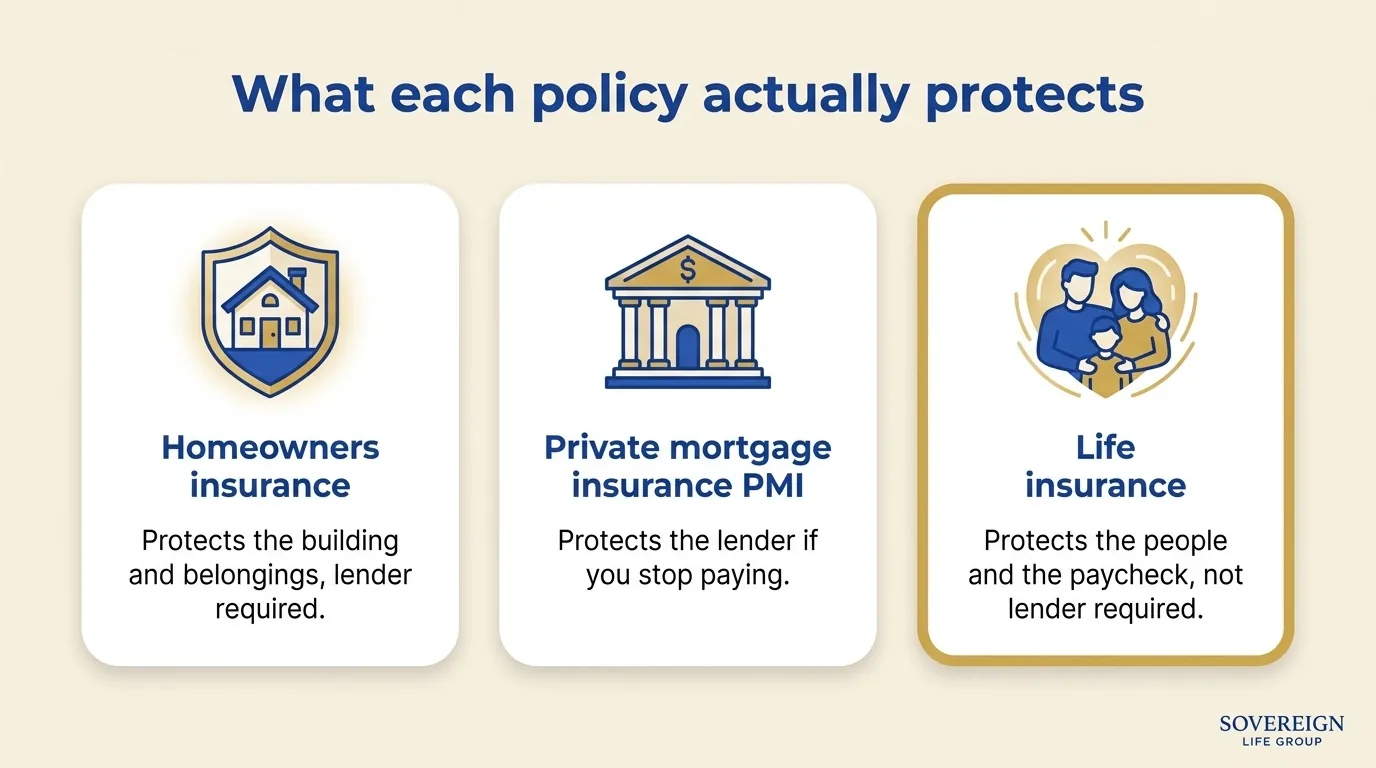
This trips up a lot of new buyers, so let us make it plain. At closing you were required to set up coverage, and you may now assume the house is "insured." It is, against some things, but not against the one this article is about. Here is how the pieces differ.
- Homeowners insurance covers the building and your belongings against events like fire, storms, and theft. It protects the structure, not your paycheck. Your lender requires it to protect the collateral on the loan.
- Private mortgage insurance, or PMI, is something many buyers pay when they put down less than 20 percent. It protects the lender if you stop paying, not your family. It does nothing for your household if you pass away.
- Life insurance protects the people. It pays a benefit your family can use to protect the mortgage, replace income, and keep daily life running. Unlike the first two, the lender does not require it, and that is exactly why so many new owners forget it.
To be clear on the requirement itself: lenders require homeowners insurance and sometimes PMI, but they do not require life insurance to approve a loan. State insurance regulators, organized through the National Association of Insurance Commissioners, oversee these products separately, and none of them obligates you to buy life coverage to get a mortgage. Mortgage protection is a choice you make for your family, not a box the bank checks.
Mortgage protection insurance vs term life, side by side
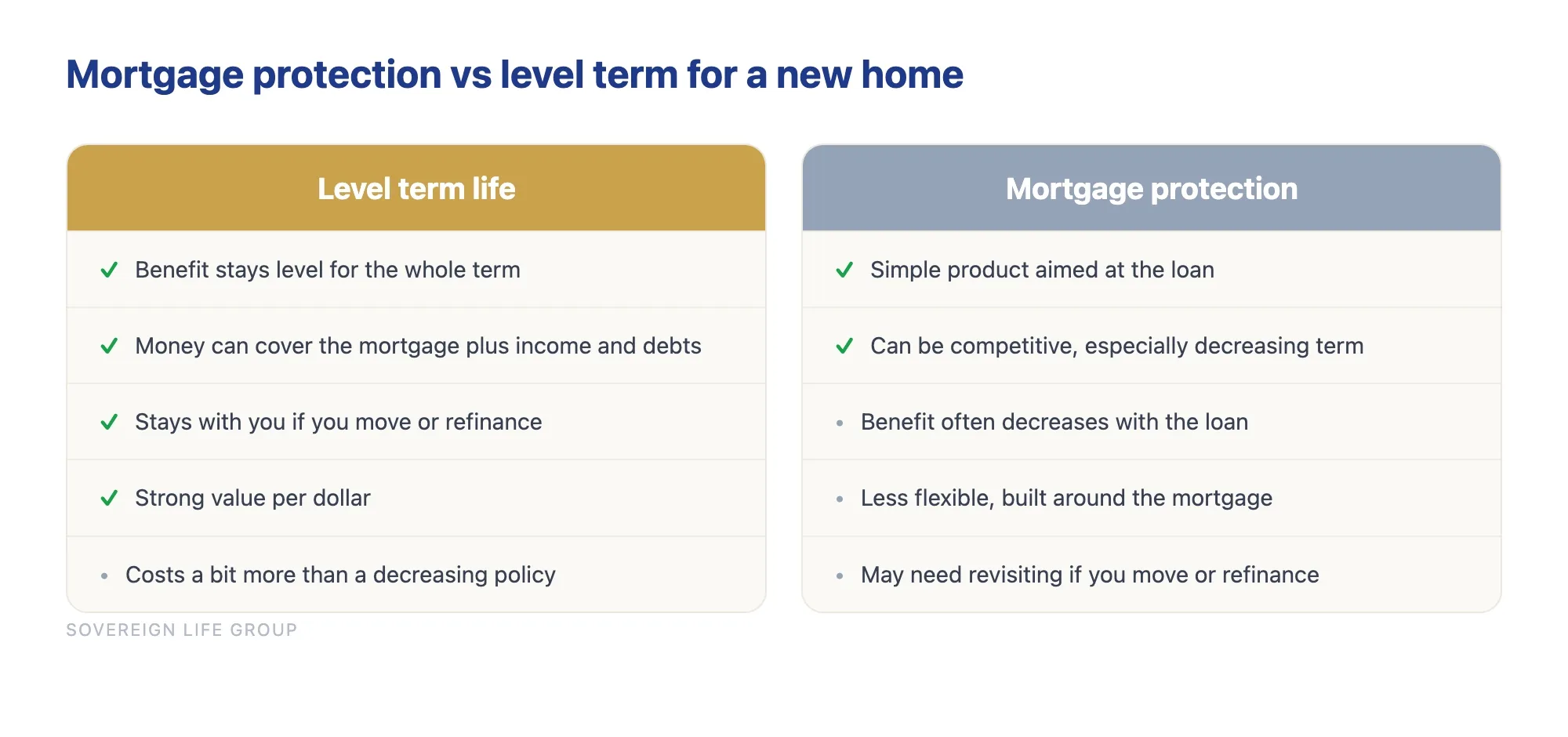
This is where most new owners get stuck, so let's make it plain. Both products can pay off your home if you pass away. They just hand your family different amounts of money and different amounts of freedom. Here is an honest comparison, including the trade-offs, with no thumb on the scale.
| What to look at | Mortgage protection insurance | Level term life insurance |
|---|---|---|
| Main purpose | Built specifically to clear or pay down the home loan | General coverage you can aim at the mortgage and more |
| Who receives the money | Usually your named beneficiary, often arranged around the loan | Your named beneficiary, who decides how to use it |
| Benefit over time | Often a decreasing benefit that tracks the loan balance, or a level option | Stays the same for the whole term you choose |
| Flexibility | Lower, since it is designed around the mortgage | Higher, since money can cover the loan plus income, childcare, or debt |
| Underwriting | Often simplified, sometimes with no-exam options | Ranges from no-exam to full medical, depending on carrier |
| Typical cost | Can be competitive, especially decreasing term | Often very affordable for the coverage you get; compare both |
| If you move or refinance | May need to be revisited, since it was built around a specific loan | Stays with you regardless of the property or loan |
| Best fit | You want a simple product aimed only at protecting the mortgage | You want one policy that protects the home and your family's income |
Neither column is the "right" answer for everyone, and any agent who tells you otherwise is selling, not advising. The honest summary is this: mortgage protection insurance wins on simplicity and a tight, loan-shaped purpose. Level term wins on flexibility and value per dollar, because the same benefit can do more than one job. For a lot of households a single level term policy quietly comes out ahead, because it protects the home and the income for a price that is often close to a mortgage-only product. For others, a clean decreasing policy aimed squarely at the loan is exactly the peace of mind they want, and that is a completely valid choice.
One nuance worth understanding is the decreasing benefit. A classic mortgage protection policy is designed so the payout shrinks over time, roughly tracking your falling loan balance. That can make it cheaper, which is appealing. The trade-off is that as the benefit shrinks, so does any cushion beyond the loan, and your income protection need does not shrink on the same schedule your mortgage does. A level term benefit costs a bit more but holds its full value the whole time, which leaves room for the rest of life. If you want a deeper, plain-English walk through how each option behaves year by year, our mortgage protection guide goes further into the mechanics.
How much coverage does a new homeowner need?
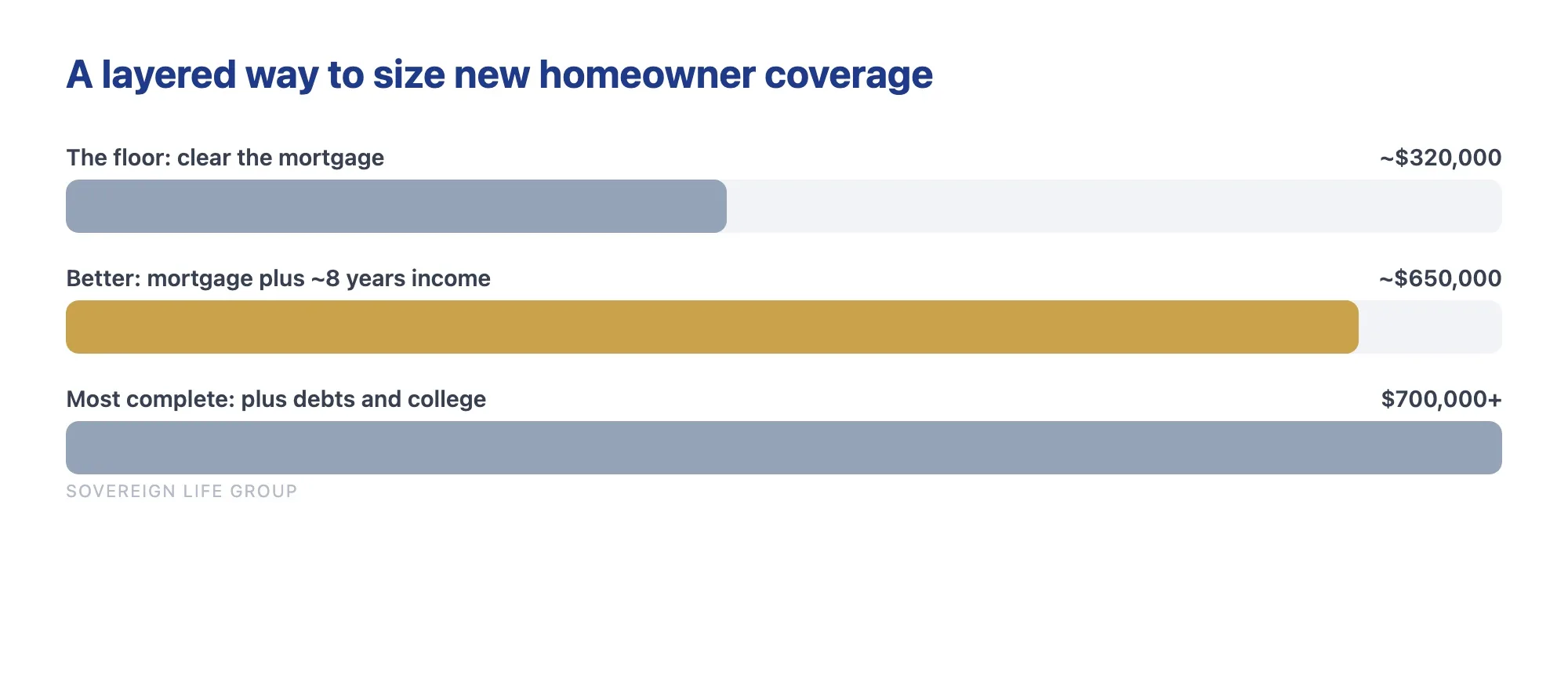
A simple starting point: enough to clear the mortgage balance. If you owe 320,000 dollars, a policy that pays at least 320,000 dollars keeps the home in the family's hands free and clear. That is the floor, and for some single buyers it is the whole answer.
But many families decide that protecting only the mortgage leaves real gaps. Your income did more than cover the loan. It also covered groceries, childcare, car payments, and everyday life. If a policy pays off the house but leaves nothing to run it, your family keeps the keys and still cannot keep the lights on. That is why a lot of new owners choose new homeowner life insurance sized a bit larger than the loan, so the same policy can protect the mortgage and replace some lost income.
A framework people find useful is to think in layers, from the bare minimum to the most complete:
| Layer | What it covers | Who it fits |
|---|---|---|
| The floor | The remaining mortgage balance, so the house is safe and clear | Single buyers, or anyone whose only goal is keeping the home |
| Better | The mortgage plus a few years of income, so daily life keeps running | Couples and young families who rely on the earner's paycheck |
| Most complete | The mortgage, several years of income, other debts, and future goals like college | Families who want the home and the plan protected, not just the loan |
A common shortcut is to start with the mortgage balance, add roughly seven to ten years of your take-home income, add any other debts a co-signer could inherit, add a rough number for children's future education if that matters to you, and then subtract what you already have in savings or existing coverage. The result is a starting figure, not a final one. It is meant to get you in the right neighborhood so a real conversation can fine-tune it.
Two adjustments matter for new owners specifically. First, do not forget the non-earner in a household. A stay-at-home parent provides care that would cost a great deal to replace if the surviving spouse suddenly had to pay for childcare, transportation, and everything else that parent quietly handles. Second, remember that the mortgage shrinks over time but your family's other needs may not, which is one more reason a level benefit often fits better than a decreasing one. If you are weighing the structure alongside the amount, our breakdown of term vs whole life insurance can help you match the policy type to your budget and timeline. And if you want a second set of eyes, families can see how we help households protect the home and income in one plan rather than a pile of disconnected products.
See what it costs to keep your family in the home. No pressure.
What it costs and what affects your rate
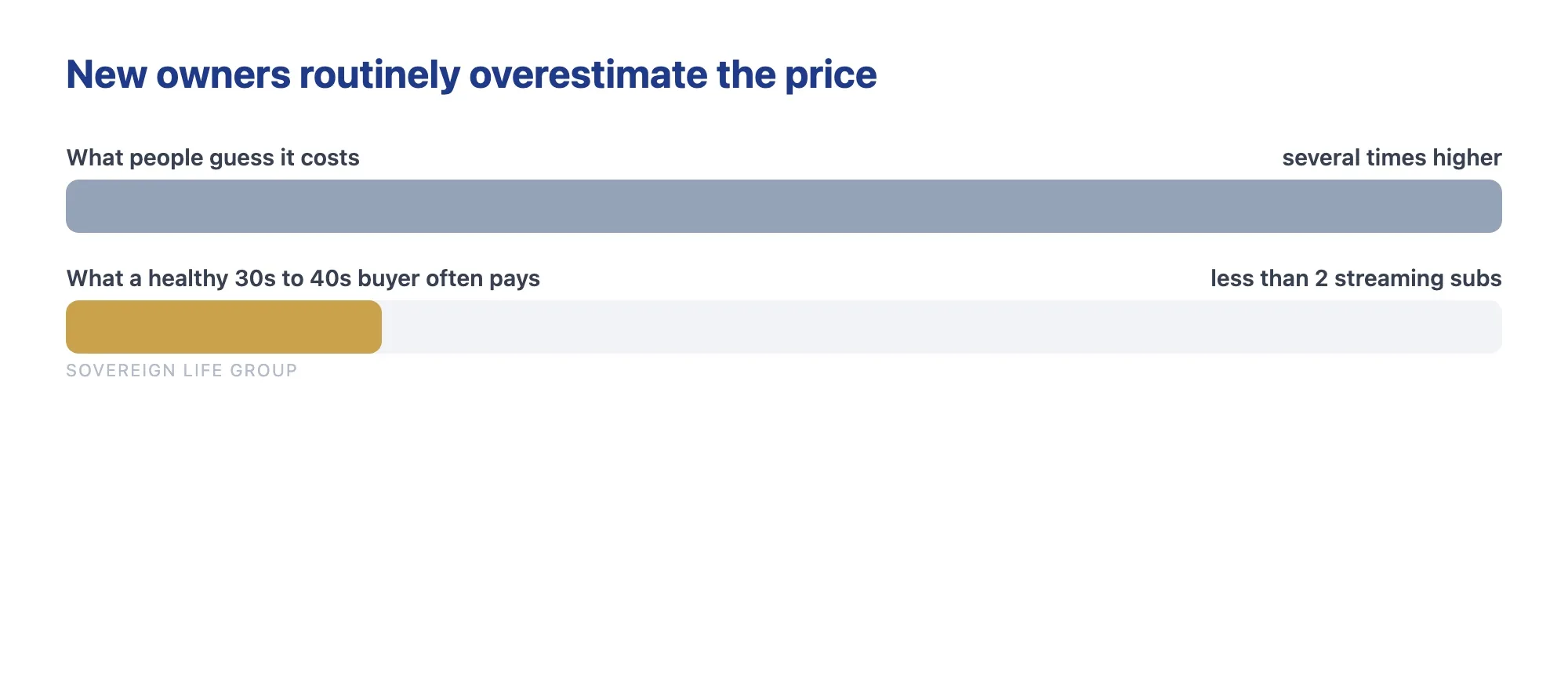
Most new owners overestimate the price by a wide margin. For a healthy person in their 30s or 40s, meaningful coverage often costs less per month than a couple of streaming subscriptions. People routinely guess a number several times higher than what they actually qualify for, and that wrong guess is one of the main reasons coverage gets put off.
Your actual premium is not a fixed number, though, and no one can promise a specific rate or guarantee approval before an application and underwriting. What an honest agent can tell you is what moves the price. Pricing generally depends on:
- Age and health. Younger and healthier usually means lower pricing, which is why acting early in your ownership tends to help.
- Coverage amount and term length. More coverage or a longer term raises the premium, so matching both to the actual need keeps it efficient.
- Tobacco use and lifestyle. These can meaningfully change your rate, sometimes more than people expect.
- Policy type and structure. Decreasing mortgage protection insurance and level term price differently, and permanent coverage prices differently again, so it pays to compare like with like.
- Term length matched to the loan. A 30-year mortgage often pairs naturally with a 30-year term, while a buyer with 18 years left on a refinance might not need to pay for 30.
The honest trade-off is this: cheaper is not automatically better. A decreasing benefit costs less but shrinks over time, while a level benefit costs a bit more but keeps its full value and leaves room beyond the loan. A no-exam policy is faster and easier but can price higher than a fully underwritten one for the same person. The right choice depends on your goals and your patience, not on a single headline price. Chasing the lowest possible premium can quietly leave your family with the least useful policy.
The policy types new homeowners actually use
You do not need to learn the entire insurance catalog. For protecting a home, new owners almost always land on one of a few options. Here is the plain-English version of each, with the honest upside and downside.
Level term life insurance
This is the workhorse for new homeowners. You pick a benefit amount and a term length, often 20 or 30 years, and the rate is locked for that whole term. If you pass during the term, your beneficiary receives the full benefit and decides how to use it, whether that is paying off the mortgage, replacing income, or both. The upside is flexibility and strong value per dollar. The downside is that the coverage ends when the term does, so you want the term to outlast the years your family truly depends on your income.
Decreasing term, the classic mortgage protection design
This is term insurance built so the benefit declines over time, roughly following your shrinking loan balance. It is simple and can be inexpensive, and it is purpose-built to protect the mortgage and little else. The upside is a clean, single-job product. The downside is that the benefit gives back value every year, so it offers less and less cushion for income, childcare, or other needs as time goes on.
Permanent coverage, used sparingly and on purpose
Whole life and indexed universal life are designed to last your whole life and can build cash value over time. Most new homeowners do not protect a mortgage with permanent insurance, because it costs significantly more per dollar of death benefit than term. Where it can fit is a lasting need that does not expire with the loan, such as final expenses or a legacy goal, sometimes layered as a smaller policy alongside term. The honest trade-off is real: permanent coverage is more expensive, the cash value growth is not guaranteed in indexed products, and structure and fees matter a great deal. It is better for specific lifelong jobs and worse as a way to get the most protection for the least money. If you are curious how the cash-value side works, you can read more about an indexed universal life policy before deciding whether it has any role in your plan.
For the large majority of new owners, the practical answer is a level term policy sized to the mortgage plus income, with a decreasing mortgage protection policy as the simpler alternative if you want a product aimed only at the loan. If you are weighing those two head to head, our breakdown of mortgage protection vs term life and which protects the house better lays out the trade-offs in detail. Permanent coverage is a tool for a different job, not the default for protecting a house.
Two incomes, one income, and buying with someone else
How you size and structure coverage depends a lot on who is living in the home and whose income carries it. A few common situations:
Two earners who both contribute to the payment
If the mortgage was approved on both incomes, losing either one puts the payment at risk. The cleanest approach is usually a policy on each person, sized so the survivor could keep the home and stay afloat on one income for a meaningful stretch. It is a common mistake to insure only the higher earner. If the household genuinely needs both paychecks to make the payment, both paychecks need protecting.
One earner with a stay-at-home partner
Here the earner clearly needs coverage, because the entire payment rides on that income. But the at-home partner is easy to overlook and should not be. If that parent passed, the surviving earner would suddenly be paying for childcare, transportation, and the dozens of things the at-home parent handled, often while trying to keep working. A smaller policy on the non-earner covers that very real cost.
Co-buyers who are not married
Buying with a partner, a sibling, or a friend creates a specific risk: if one co-owner passes, the other can be left holding a mortgage that was approved on two incomes. Naming each other as beneficiaries on policies sized to the loan keeps the survivor from being forced to sell or refinance under pressure. This is one of the clearest cases where life insurance after buying a house is not optional, it is the thing standing between your co-buyer and a forced sale.
Buyers who help support a parent or family member
If someone outside the home relies on money you send, that reliance does not end if you do. New homeowners sometimes focus so tightly on the mortgage that they forget the people their income supports beyond the front door. Size the coverage for the whole picture of who depends on you.
Common mistakes new homeowners make
Over many conversations with new buyers, the same avoidable missteps come up again and again. None of them require expert knowledge to dodge, just a heads-up.
- Assuming the lender's required insurance is enough. Homeowners insurance and PMI do nothing for your family's income. They are not substitutes for life coverage.
- Insuring only the mortgage and ignoring the income. A paid-off house your family cannot afford to run is only half a solution. Protect the loan and the life around it.
- Waiting until the boxes are unpacked. Months slip by, and the rate you could have locked while young and healthy slips with them. A new health finding can change your pricing or your options.
- Buying from the first official-looking letter. Some mailers after closing are marketing, not your lender. Compare before you commit, the same way you compared mortgage offers.
- Choosing decreasing coverage by price alone. The cheaper premium can hide a benefit that shrinks faster than your family's needs do. Cheaper is not the same as better.
- Forgetting to update the beneficiary. An old policy from before the home may still name a parent or an ex. Buying a house is a natural moment to check that the right people are listed.
- Letting a search for the perfect rate cost a year uninsured. The most expensive policy is the one you kept meaning to buy. Compare, decide, and protect the home while you are healthy enough to have options.
Your first 30 days: a simple plan
If you only do one thing this month, do this: figure out the number it would take to protect the mortgage and steady the household, then compare a mortgage protection insurance policy against a level term policy for that same coverage. Run them side by side. Look at the cost, the flexibility, and how each one would actually serve your family. Here is a practical sequence that does not require you to become an insurance expert.
- Write down the real numbers. Your loan balance, your term, your take-home income, your other debts, and anyone who depends on you. You just did this to buy the house, so it is fresh.
- Set the floor and the goal. The floor is the mortgage balance. The goal is usually the mortgage plus several years of income and any future costs you care about.
- Match the term to the need. A 30-year mortgage often pairs with a 30-year term. If your need ends sooner, do not pay for longer than you need.
- Compare both products honestly. Put a decreasing mortgage protection policy next to a level term policy for the same coverage and see which serves your family better, not just which costs a dollar less.
- Apply while your health is on your side. The application captures today's health, and today is, on average, the best it will be going forward. No-exam options exist if a medical exam is what has been stopping you.
- Check the beneficiary and revisit after big changes. Make sure the right people are named, and plan to look again if you refinance, have a child, or your income changes.
For a lot of households, a single level term policy quietly wins, because it protects the home and the income for a price that is often close to a mortgage-only product. For others, a simple decreasing policy aimed squarely at the loan is exactly the peace of mind they want. Both are valid. The goal is an informed choice, made on purpose, while you are healthy enough to have options. If you would rather not sort through it alone, that is the whole reason this work exists. You can learn how thoughtful life insurance planning fits a new homeowner's budget, and then decide what feels right for your family.
Just bought a home? Let's protect it.
In about 15 minutes we will look at your mortgage, your budget, and the simplest way to keep your family in the house. No pressure, no jargon, just a straight answer for your situation.
Get a Quote Book a 15-Min Call Prefer to start fast? Save my card and get a quick mortgage protection quote.Frequently asked questions
Do I need life insurance after buying a house if I am single with no kids?
If no one depends on your income and no one would inherit the mortgage, the need is smaller. But if a co-signer, partner, or family member would be stuck with the loan, life insurance after buying a house still helps protect them from having to sell or cover payments alone. A smaller policy can also lock in a low rate while you are young and healthy, which protects your future options.
Is mortgage protection insurance better than term life for new homeowners?
Neither is universally better. Mortgage protection insurance is simple and built around the loan, while a level term policy is usually more flexible because your family chooses how to use the money. Many new homeowners compare both before deciding, and for a lot of households a level term policy sized to the mortgage plus income does more for a similar price.
How soon after closing should I buy coverage?
Sooner is generally better, because rates are based partly on your age and health today. Waiting does not lower your risk, and a health change can affect eligibility or pricing later. Many people start the conversation within the first few weeks of owning a home, while the budget is still fresh in their minds.
Does the bank require life insurance to get a mortgage?
No. Lenders require homeowners insurance on the property and sometimes private mortgage insurance, but they do not require life insurance to approve your loan. Mortgage protection is a choice you make to protect your family, not a lender requirement, and the death benefit goes to your beneficiary rather than the bank.
Can one term life policy protect the mortgage and my family?
Often yes. A level term policy large enough to cover the mortgage plus income replacement can protect the home and your household with one policy, which is why it is worth comparing against a mortgage-only product. The beneficiary decides how to use the money, so it can cover the loan, daily costs, or childcare as needed. Talk with a licensed professional about your situation.
What happens to my life insurance once the mortgage is paid off?
A standalone life insurance policy does not end when the mortgage is paid off. With level term, the death benefit stays the same for the whole term you chose, so your family can use it for income, debts, or an inheritance even after the loan is gone. A decreasing mortgage protection policy, by contrast, is designed to shrink alongside the loan balance, so it offers less once the mortgage is mostly paid.
Joseph McDermott is a licensed life insurance agent (NPN 22121673), licensed in 27 states. Brokered through Family First Life. This article is educational and not financial, tax, or legal advice. Product availability, features, and rates vary by state and carrier, and any coverage is subject to application, underwriting, and the claims-paying ability of the issuing insurance company. Talk with a licensed professional about your situation.