The Health Conditions People Think Disqualify Them From Life Insurance (And What Actually Does)


The Short Version
We mapped roughly 70 of the most-prescribed medications to their conditions across 13 A-rated carriers. Most of the conditions people assume make them uninsurable are non-events to underwriters. The label on the diagnosis matters far less than how controlled it is and which carrier you apply to.
We mapped roughly 70 of the most-prescribed medications to their conditions across 13 A-rated carriers' underwriting guidelines. The finding surprised even us: most of the conditions people assume make them uninsurable are non-events to underwriters. People talk themselves out of applying every day because of a diagnosis on their chart, and in the vast majority of cases that diagnosis does not carry the weight they think it does.
Key findings
- The most common conditions are non-events. High blood pressure, high cholesterol, thyroid issues, acid reflux, mild depression or anxiety, asthma, and migraines are typically Standard or Preferred, no rating, with instant-decision paths open. These are the conditions people worry about most, and they barely move the needle.
- Type 2 diabetes, the condition people most assume disqualifies them, usually does not. Controlled Type 2 is ratable but insurable, and most cases still get covered, often through simplified issue with no exam.
- Only a short list are true knockout risks. Active heart disease, heart failure, a recent blood clot, bipolar with hospitalization, COPD on oxygen, dementia, active cancer, or dialysis. Even those have a guaranteed-issue path, so almost nobody is genuinely uninsurable.
- The diagnosis matters less than two things: how controlled it is, and which carrier you apply to. The same person can be declined by one carrier and approved at standard by another.
The conditions people fear most are usually fine
Start with the five conditions that show up most often on the medication lists we reviewed. These are the ones that fill waiting rooms and pharmacy counters, and they are exactly the ones people cite when they tell us they probably will not qualify. Here is how underwriters actually see them.
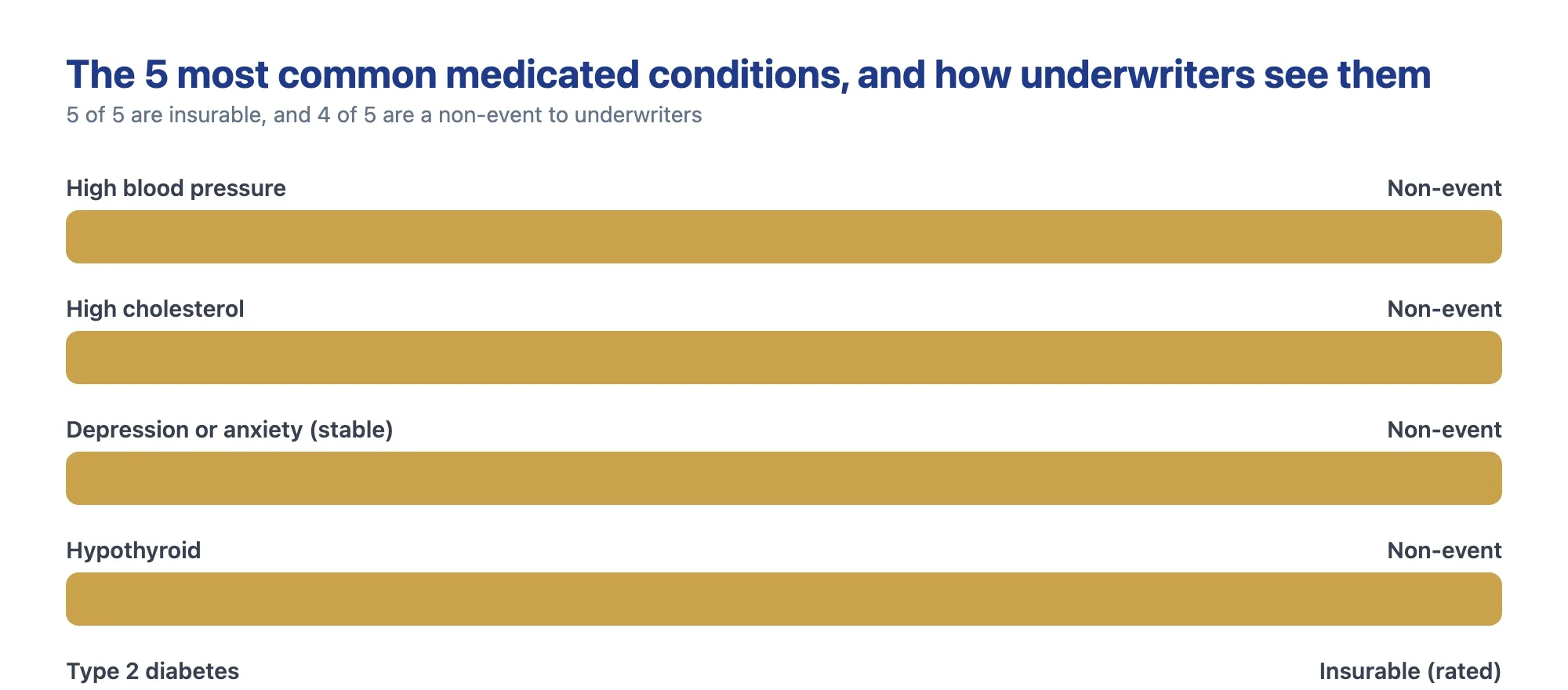
Four of these five are non-events. High blood pressure, high cholesterol, a stable case of depression or anxiety, and hypothyroid rarely cost you a better class of coverage on their own. Type 2 diabetes is the only one of the five that gets rated, and even then it stays insurable and usually gets covered. That is the pattern that repeats across the whole dataset: the everyday conditions people fear are the ones underwriters worry about least.
The three tiers, from our underwriting reference
When we sorted every condition in the reference, it fell cleanly into three groups. Thinking in these tiers is more useful than thinking in diagnoses, because it tells you what to actually expect when you apply.
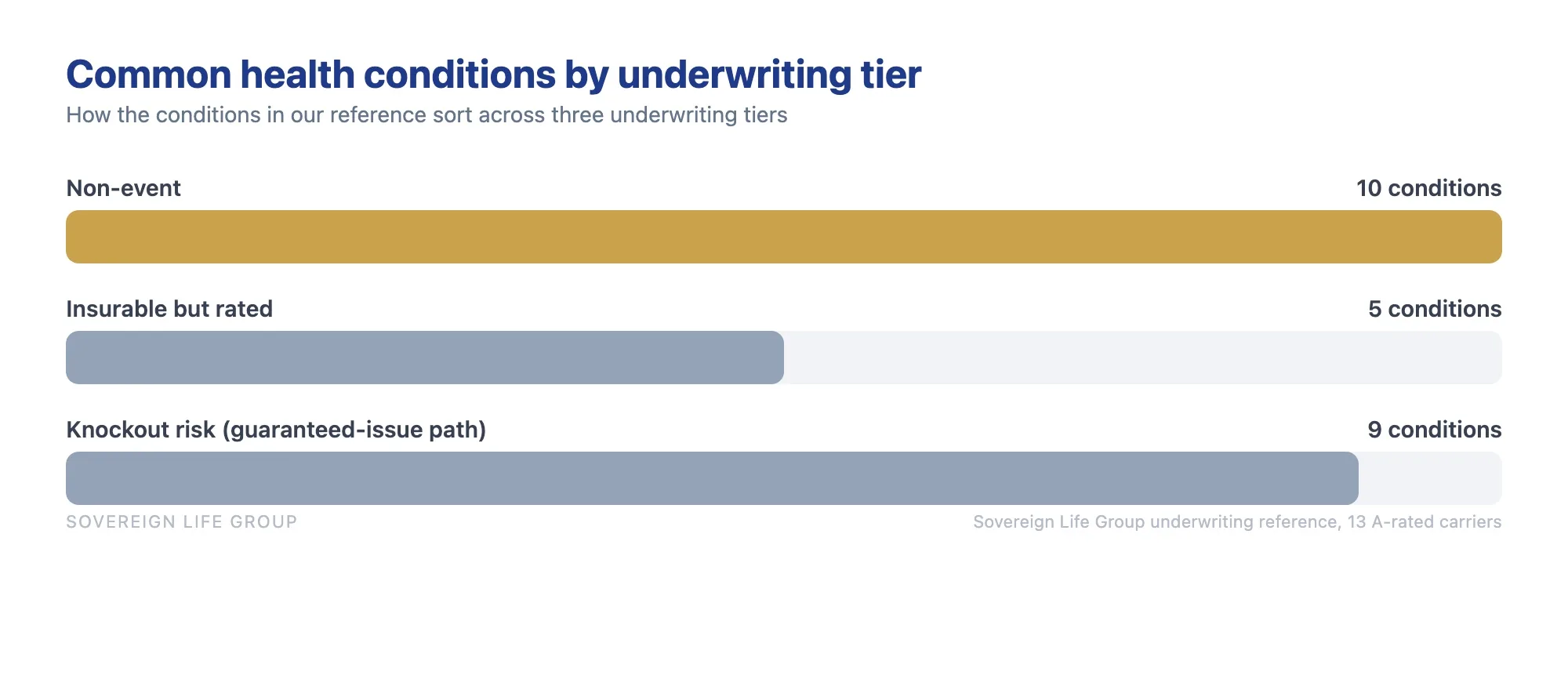
Non-event (Standard or Preferred possible)
These conditions typically do not stop you from qualifying at a strong class on their own: high blood pressure, high cholesterol, hypothyroid, GERD, stable depression or anxiety, asthma, migraine, gout, enlarged prostate, and ED. Most people carrying one or more of these can still reach Standard or Preferred, and many can go through an instant-decision path with no exam.
Insurable but rated (most still covered)
These conditions usually add a rating rather than a decline, and most applicants still get covered: Type 2 diabetes, controlled AFib, neuropathy, rheumatoid arthritis, and hyperthyroid. A rating means a higher price, not a closed door, and the size of that rating depends heavily on how well the condition is controlled.
Knockout risk (steer to simplified or guaranteed issue)
These are the conditions that can knock you out of fully underwritten coverage and steer you toward a simplified or guaranteed-issue path: active coronary disease, heart failure, a recent clot, bipolar with hospitalization, COPD on oxygen, Parkinson's, dementia, recent cancer, and dialysis. Even here, the guaranteed-issue path means there is almost always a policy available, which is why we say almost nobody is genuinely uninsurable.
The real takeaway
That last point is the one that costs people the most money. Because carriers grade the same condition differently, the same applicant can be declined at one company and approved at Standard at another. Applying blindly, or applying to the one carrier a friend used, is how a perfectly insurable person ends up with a decline on their record. Matching the condition to the right carrier is the entire game.
Methodology
This analysis is based on Sovereign Life Group's underwriting reference, compiled from the field underwriting guides of 13 A-rated carriers, covering approximately 70 of the most-prescribed medications and their associated conditions. It is a field-underwriting analysis, not a guarantee of individual outcomes. Underwriting is individual, and a specific offer always depends on your full profile, the carrier, and the state you apply in.
If you have been putting off coverage because of a diagnosis, the honest odds are better than you think. Our full guide to life insurance with a health condition walks through what to expect condition by condition, and our overview of life insurance built around real families shows how we shop more than a dozen carriers to match the right one to your situation.
Not sure which carrier fits your health?
Fifteen minutes. Tell us what is on your chart, and we will point you at the carriers most likely to approve you at the best class. No pressure, no jargon.
Book a 15-Min CallFor educational purposes only. Not financial or medical advice. Individual results vary by health, carrier, and full underwriting.