Key Man Insurance vs Buy-Sell Agreement: Which Do You Need?

The Short Version
Key man insurance protects the business itself, replacing the money you lose when a vital person dies. A buy-sell agreement protects ownership, deciding who buys a departing owner's share and putting the cash there to do it. They answer different questions, and a company with partners and real value usually needs both.
If your business lost its most important person tomorrow, would it survive the week? And if one of the owners died, who would end up owning their share, your family or theirs? Those are two separate questions, and they map almost exactly onto the choice between key man insurance vs buy sell agreement. I get asked to explain the difference all the time, usually by owners who suspect they need one but are not sure which, or whether they need both. This guide lays it out in plain language, with a real worked example, the tax angles most articles skip, and the 2024 Supreme Court ruling that quietly changed how a lot of buy-sell agreements should be built.
I write this as a licensed agent who places this coverage, not as a law firm. Nothing here is legal or tax advice for your specific company. But I have watched what happens to businesses that set this up early, and what happens to the ones that meant to and never did. The gap between those two outcomes is enormous, and it usually comes down to a couple of decisions made on an ordinary afternoon.
What this guide covers
- What key man insurance actually is
- What a buy-sell agreement actually is
- Key man insurance vs buy sell: the core difference
- Do you need both, or just one?
- The four types of buy-sell agreements
- How life insurance funds a partner buyout
- What the 2024 Connelly ruling changed
- A worked example: two partners, one buyout
- What business coverage costs
- How much coverage and valuing the business
- How to set it up without overpaying
- The mistakes I see most
- Frequently asked questions
What key man insurance actually is
Key man insurance, also called key person insurance, is a life insurance policy a business owns on someone whose death would seriously hurt the company. The business pays the premium, is the beneficiary, and receives the death benefit. That money buys time to steady the ship, cover lost revenue, and find a replacement without a fire sale.
Think about who really holds a small company together. It is rarely just the founder. It might be the one salesperson who owns half the client relationships, the engineer whose head holds the product, or the operator who keeps the whole thing running while everyone else sells. If that person dies suddenly, the business does not simply lose a salary. It loses momentum, contracts, lender confidence, and sometimes its nerve. Key man coverage exists to replace those dollars.
The policy can be term or permanent. Term is cheaper and covers a set number of years, which fits a working owner or a loan-tied need. Permanent coverage costs more and can build cash value the company controls, which some owners like for its flexibility. Our deeper explainer on key person and business life insurance walks through when each structure makes sense.
Here is the part owners underestimate. Lenders notice this. If you carry an SBA loan or a line of credit that leans on one person, the bank often wants a policy in place, sometimes assigned to them, before they fund. So key man coverage is about more than death. It can be the thing that lets you borrow and grow while that person is very much alive.
No medical exam for a ballpark. Free, and no pressure.
What a buy-sell agreement actually is
A buy-sell agreement is a legal contract among business owners that decides in advance what happens to an owner's share when they die, become disabled, retire, or leave. It sets the price, names who has the right or the duty to buy, and spells out how the purchase gets paid for. Life insurance is the most common way to fund it.
Picture a business with two equal partners and no agreement. One dies. His shares do not vanish. They pass to his estate, which usually means his spouse now owns half of a company she may know nothing about and never wanted to run. The surviving partner suddenly has a business co-owner who might want to sell, might want a salary, or might want out at a price nobody agreed on. That is the mess a buy-sell prevents. It turns a painful, uncertain fight into a pre-agreed transaction.
A good agreement answers a short list of hard questions before emotions and lawyers get involved. What is a share worth, and how is that number set. Who gets first right to buy. Is the buyout mandatory or optional. What events trigger it, death only or also disability, divorce, retirement, and a partner simply wanting out. And critically, where does the money come from. A contract that says a buyout must happen but never funds it is a promise with no wallet behind it.
Key man insurance vs buy sell: the core difference
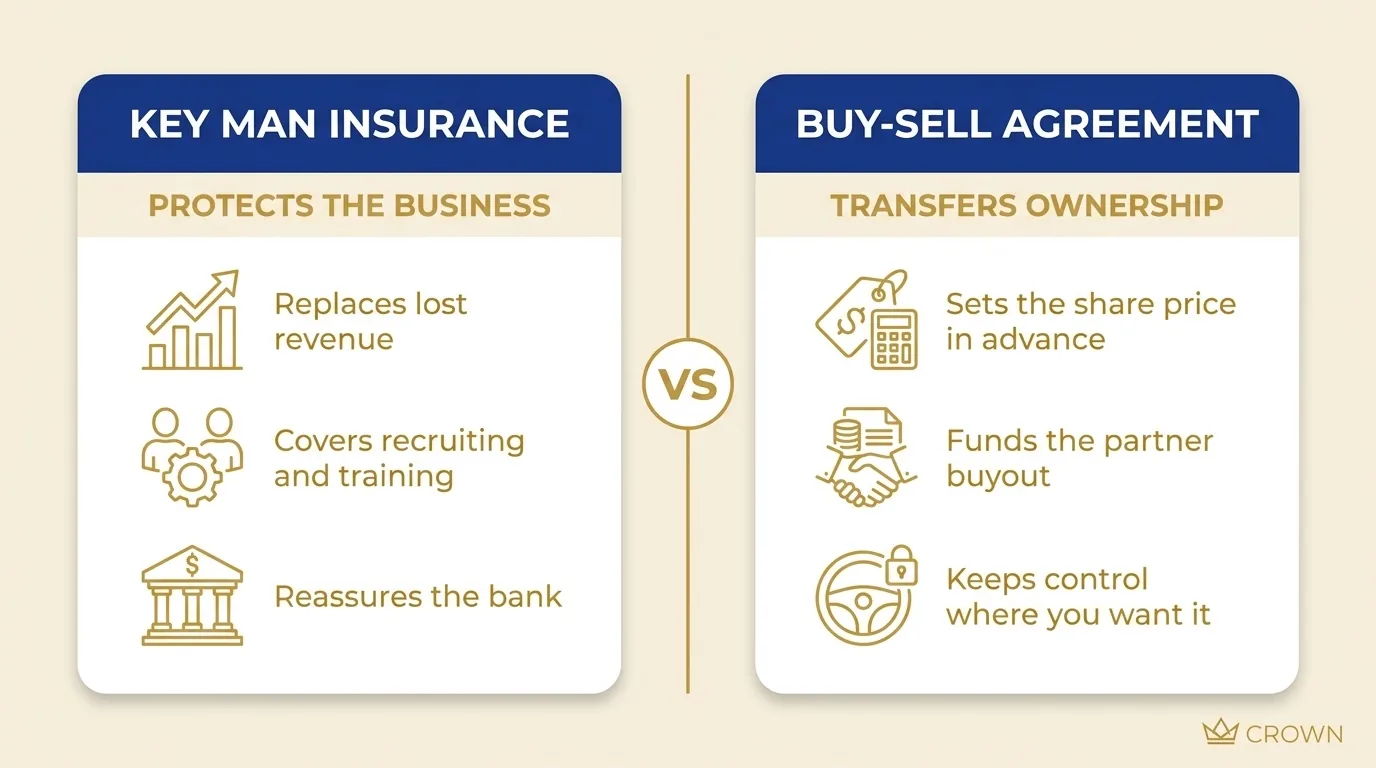
The simplest way to hold the difference in your head: key man insurance protects the company's earnings, while a buy-sell agreement protects the company's ownership. One keeps the lights on when a vital person dies. The other decides who ends up owning their piece. They overlap in that both use life insurance, but they are solving completely different problems.
Key man is about operations and cash flow. The check goes to the business so it can absorb the shock, replace revenue, and keep paying people while it recovers. It does nothing to settle who owns what. Buy-sell is about the cap table. It puts money in the right hands so the surviving owners or the company can buy out the departed owner's share at a fair, pre-agreed price, cleanly and without a court fight.
I like to say the buy-sell decides what happens, and the key man policy pays for the business to survive while it happens. When both are in place, a founder's death becomes a survivable event instead of a company-ending one. The money to run the business and the money to settle ownership come from two different buckets, and neither one has to rob the other.
Do you need both, or just one?
Most businesses with multiple owners and real value need both, because they cover gaps the other leaves open. If you only fund the buyout, the shares change hands but the company has no cushion for the revenue it just lost. If you only carry key man, the business is stabilized but ownership is a free-for-all. Together they cover the whole event.
Let me make it concrete. A two-owner marketing agency does maybe two million in revenue. One owner runs sales, the other runs delivery. If the sales owner dies with only a buy-sell in place, the surviving owner buys the shares cleanly, and then watches half the revenue walk out the door with no capital to hire and rebuild. If they had only key man, the company gets a check to stabilize, but now the deceased owner's spouse holds fifty percent and there is no agreed way to buy her out. Neither policy alone is enough. The pair is what saves the company.
When can you get away with one? A solo owner with no partners and no one to sell to may not need a buy-sell at all, but might still want personal coverage so the family can wind the business down or keep it running. A partnership where the owners are not truly critical to daily operations, say a passive real estate holding, may need the buy-sell but little or no key man. The honest answer depends on your structure, which is exactly why a template pulled off the internet is risky here.
The four types of buy-sell agreements
There are four common ways to structure a buy-sell, and the choice drives who owns the policies, how many you need, and the tax result for your survivors. The four are cross-purchase, entity or stock redemption, wait-and-see, and the one-way agreement. The right one depends on how many owners you have and what you want the tax picture to look like.
Cross-purchase
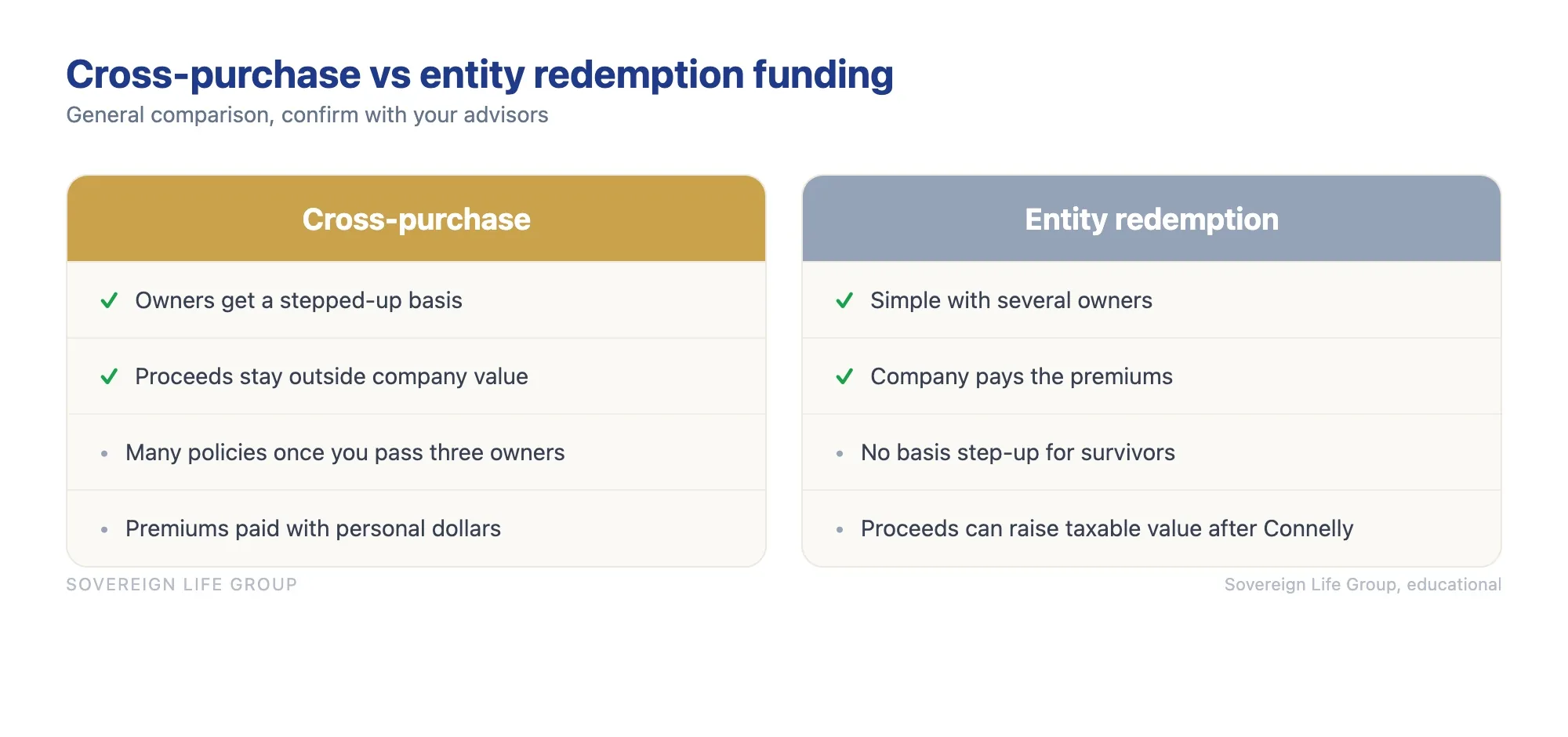
Each owner personally buys a policy on every other owner, pays the premiums, and is the beneficiary. When one dies, the survivors use the proceeds to buy the shares directly from the estate. The big advantage is basis. The survivors get a stepped-up cost basis in the shares they buy, which can save real money if they later sell. The headache is arithmetic. With two owners you need two policies. With five owners you need twenty, because everyone insures everyone. It gets unwieldy fast.
Entity or stock redemption
The business itself owns the policies, pays the premiums, and receives the death benefit, then uses it to redeem the departing owner's shares. This is clean and simple with many owners because the company holds one policy per person, not a web of them. The trade-offs are that surviving owners generally do not get a basis step-up, and, after the 2024 Connelly ruling, the proceeds can inflate the taxable value of the company. More on that below, because it matters.
Wait-and-see
A hybrid that keeps the decision open. The agreement gives the company the first option to redeem the shares, and if it declines, the individual owners step in to buy. This lets your advisors pick the most favorable route at the actual time of death rather than locking it in years earlier. It adds flexibility and a little complexity, and it needs careful drafting to work.
One-way
Built for a single owner with no co-owner to trade with, but with a key employee or outside buyer who has agreed to purchase the business. That buyer owns a policy on the owner and uses the proceeds to buy the company from the estate. Common in a founder-to-successor handoff where the successor cannot yet afford the business outright.
How life insurance funds a partner buyout
Life insurance is the most common way to fund a partner buyout because it delivers a large sum of cash at the exact moment it is needed, tax free in most cases, for pennies on the dollar compared to the payout. The alternatives, cash reserves, a bank loan, or paying the estate in installments, are slower, costlier, and often not there when the death actually happens.
Run the math on the alternatives and you see why insurance wins. Say a share is worth one million dollars. Funding that buyout from retained earnings means parking a million in low-yield cash for years, money that could have grown the business. Borrowing it means a bank has to say yes right after a key owner just died, which is precisely when they get nervous. Paying the estate over ten years means the grieving family becomes an unwilling lender to the business, and everyone resents the arrangement. A life insurance policy sidesteps all of it. The premium is a known, budgetable cost, and the benefit shows up in full the moment it is needed.
The structural choice, who owns the policies, is where good planning earns its keep. Cross-purchase gives survivors a basis step-up and keeps the proceeds out of the company's value, but the number of policies balloons with more owners. Entity redemption is administratively simple, especially past three or four owners, but gives up the step-up and, since 2024, can enlarge the estate tax bill. A specialist sometimes solves the many-owners problem with an insurance LLC or a partnership that holds the policies, capturing the simplicity of one policy per owner while keeping the cross-purchase tax treatment. This is drafting territory for your attorney and CPA, and it is worth their fee.
Get a fast, free estimate tailored to your age and health.
What the 2024 Connelly ruling changed
In June 2024 the Supreme Court decided Connelly v. United States, and it reshaped how company-owned buy-sell agreements should be built. The Court held that life insurance a company receives to buy back a dead owner's shares counts toward the company's value for estate tax, and the obligation to pay for those shares does not offset it. That can quietly raise the tax bill on a family business.
Here is the story in plain terms, because it is a real cautionary tale, not a hypothetical. Two brothers owned a building supply company. According to the opinion published by the Supreme Court, the company held about 3.5 million dollars in life insurance on each of them so it could redeem the shares if one died. One brother died. The company collected the insurance and bought his shares. The family assumed the payout and the buyout obligation canceled out, leaving the company's value unchanged. The IRS disagreed. The Court sided with the IRS, unanimously.
Why it stings: the roughly 3 million in insurance the company received got added to the company's date-of-death value, but the company's duty to spend that same money buying the shares was not treated as an offsetting liability. So the deceased brother's stock was valued as if the company were richer by the full insurance amount, and the estate owed more tax than anyone expected. A plan meant to protect the family created a surprise bill instead.
What owners are doing about it. Many are revisiting entity redemption structures and looking hard at cross-purchase instead, where the owners rather than the company hold the policies, keeping the proceeds out of the company's taxable value. Justice Thomas even pointed to cross-purchase arrangements as a workaround in the opinion. If your buy-sell is company-funded and your business is worth enough to bump into estate tax, this is a real reason to have your agreement reviewed. I am not your attorney or your CPA, and you should not treat this article as the review. But most owners with a company-owned buy-sell have not looked at it since before 2024, and that is a mistake worth fixing.
A worked example: two partners, one buyout
Numbers make this real, so here is a simple illustration. It is a sample, not a quote, and not a promise of any specific rate or result. Picture a company worth two million dollars owned fifty-fifty by two partners. Each partner's share is worth one million. The question a buy-sell answers is: when one dies, where does the surviving partner find a million dollars?
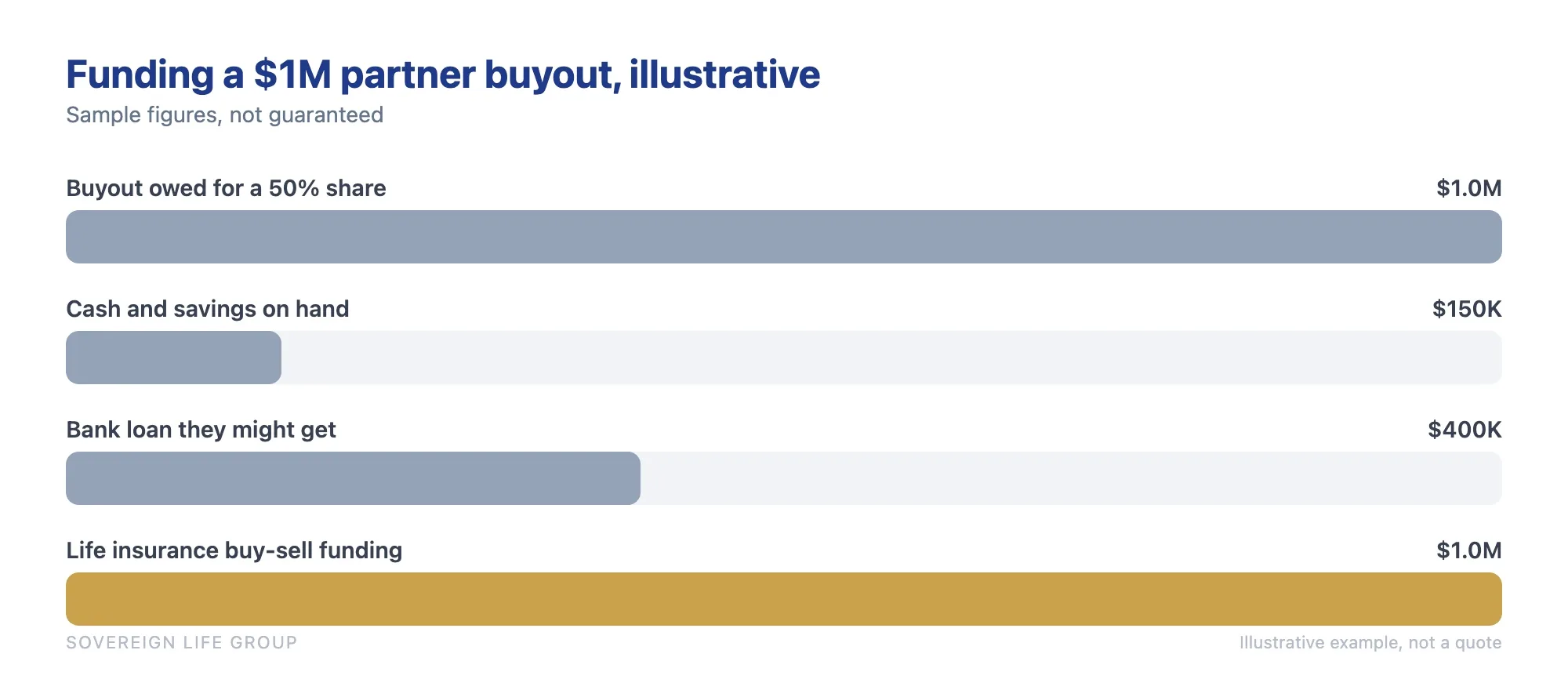
Without a funded agreement, the surviving partner has bad options. She can drain 150 thousand in company cash and still be more than 800 thousand short. She can beg a bank for a loan right after losing her co-owner, and maybe get 400 thousand at a rough rate. Or she can pay the deceased partner's spouse in installments over a decade, turning a grieving widow into a reluctant creditor who now has a say in the business. Every path is slow, expensive, and strained.
Now add the buy-sell funded with life insurance. In a cross-purchase, each partner owns a one million dollar policy on the other. When one dies, the survivor receives one million tax free, hands it to the estate, and receives the shares in return. The spouse gets fair value in cash and moves on. The survivor now owns the whole company with a stepped-up basis in the purchased half. The transaction that could have taken a year and a lawsuit takes a few weeks and a signature. That is the entire point of doing this before you need it.
Layer a key man policy on top and the picture gets stronger. Say the company also holds a 500 thousand dollar key man policy on each partner. When one dies, that money goes to the business to cover the revenue dip while the survivor rebuilds. Ownership is settled by the buy-sell, and operations are cushioned by the key man coverage. Two buckets, two jobs, no robbing one to pay the other.
What business coverage costs
Business coverage usually costs less than owners expect, because most of it is term life insurance priced on the health and age of the insured person. For a healthy owner in their forties, a sizable term policy can run a manageable monthly premium. Permanent coverage costs more but builds cash value the company can use. Your real number depends on age, health, coverage amount, and structure.
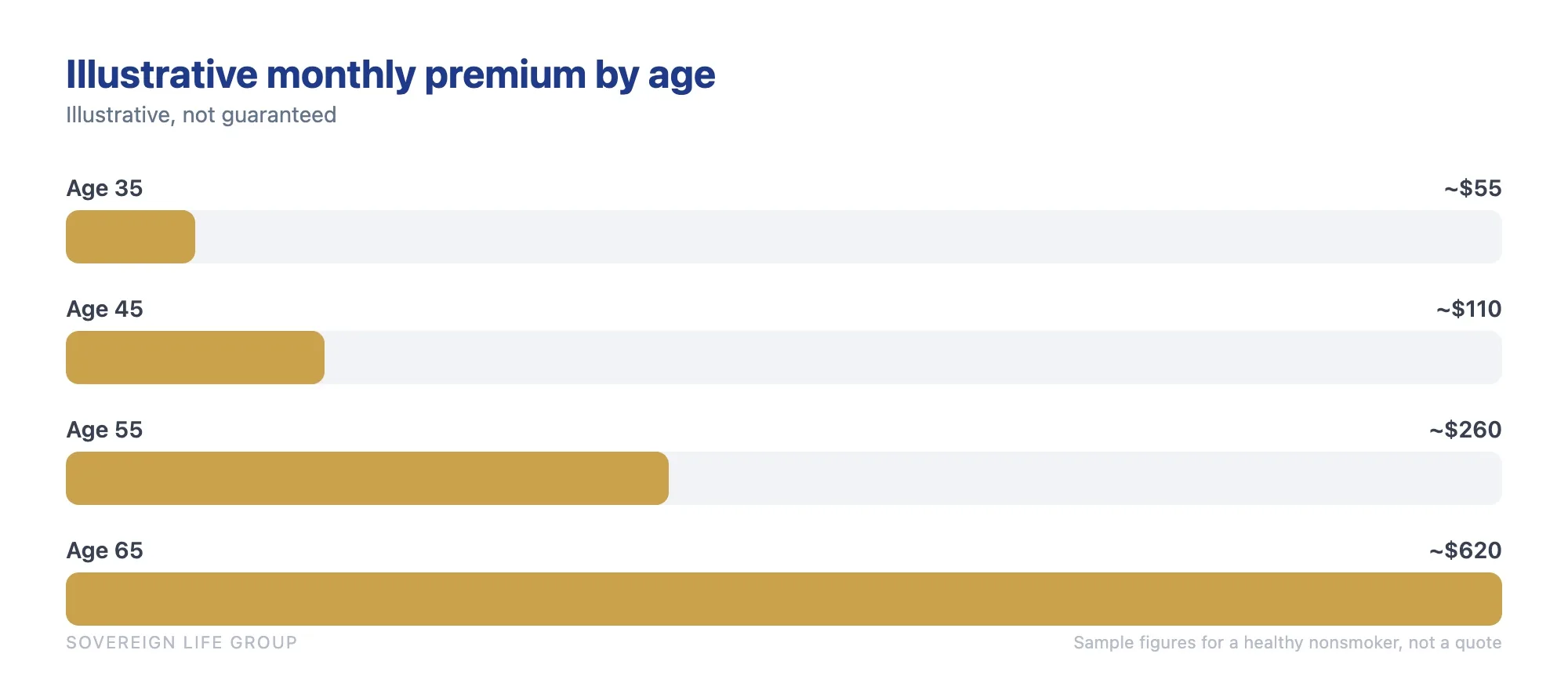
A few honest things drive the price, and none of them are a mystery. Age is the big one, and it only moves in the wrong direction, which is why the cheapest day to buy is almost always the soonest one you reasonably can. Health matters, since the policy is underwritten on the insured person, so a partner with a clean bill of health locks in a better rate than one with a diagnosis in the file. Coverage amount and term length scale the cost in the obvious way. And term versus permanent is a real fork: term is cheaper and covers a defined window, while permanent costs more and builds value the business controls.
What I will not do is quote you a flat rate from an article, and you should be skeptical of anyone who does. The same million-dollar policy can carry very different premiums for two owners the same age, purely on health and carrier appetite. The only way to a real number is a short application and a look at your actual profile. What I can tell you is that the cost of the coverage is almost always a rounding error next to the cost of not having it when the day comes.
How much coverage and valuing the business
Sizing the coverage starts with an honest business valuation, not a gut number. For a buy-sell, the benefit should match the value of the ownership share being bought. For key man, it should reflect what the business would lose without that person: lost profit, the cost to recruit and train a replacement, and any debt tied to them. Guessing low here defeats the purpose.
Valuation is the step owners most want to skip, and the one that causes the most damage when they do. According to research from LIMRA, a large majority of small businesses have never had their value formally assessed, and many have no continuation plan at all. That is a problem, because a buy-sell priced on a stale or made-up number invites exactly the fight it was supposed to prevent. The estate thinks the share is worth more, the survivor thinks it is worth less, and the agreement that was supposed to settle it becomes the thing they argue about.
You have a few ways to set the price. A fixed value stated in the agreement and updated on a schedule is simple but goes stale if you forget to revisit it. A formula, such as a multiple of earnings, updates itself but can misfire in an odd year. A professional appraisal at the time of death is the most accurate and the most expensive. Many well-drafted agreements combine them, naming a formula as the default and an independent appraisal as the tiebreaker. Whatever you choose, revisit the number as the business grows, because a valuation from three years and one good contract ago can be badly out of date.
For key man specifically, resist the urge to insure the person for their salary and stop there. The loss is bigger than a paycheck. If a rainmaker who drives a million dollars in annual profit dies, the company is not out one salary, it is out the profit, the client relationships, and the months of scramble to replace them. Size the coverage to the hole, not to the payroll line. Our overview of key person and business coverage options goes deeper on matching the benefit to the real exposure.
How to set it up without overpaying
Setting this up well is a team sport, and the order matters. You want an attorney to draft the agreement, a CPA to check the tax and valuation, and a licensed agent to structure and place the coverage. Do it in that order, get the structure right before you buy, and you avoid the expensive mistake of owning the wrong policies for your chosen structure.
Here is the path I walk business owners through, roughly in sequence.
- Decide what you are protecting. Operations, ownership, or both. That single answer tells you whether you need key man, a buy-sell, or the pair. It also frames every decision that follows.
- Value the business honestly. Before anyone buys a policy, agree on how the company is valued and roughly what it is worth. The coverage amount falls out of that number, not the other way around.
- Pick the buy-sell structure with your advisors. Cross-purchase or entity redemption is not a coin flip. It changes who owns the policies, the tax result, and, after Connelly, the estate exposure. Choose it deliberately.
- Match the policies to the structure. This is where the wrong move gets baked in. In a cross-purchase, the owners own the policies. In a redemption, the company does. Buying the right amount in the wrong name creates a mess to unwind later.
- Underwrite while everyone is healthy. The application captures today's health, and today is, on average, the healthiest your owners will be going forward. Waiting only raises the price or narrows the options.
- Review it on a schedule. The business grows, owners change, tax law shifts. An agreement and a coverage amount set once and forgotten is how a plan quietly stops fitting the company it was built for.
The overpaying almost never comes from the premium itself. It comes from buying the wrong structure, over-insuring in a panic, or bolting on riders nobody needed, then paying a lawyer to untangle it. Get the sequence right and the coverage is the cheap, easy part. If you would rather talk it through before you commit to anything, you can reach a licensed agent and lay out your situation with no obligation.
The mistakes I see most
Most of the damage I see with business coverage is not from buying the wrong policy. It is from meaning to buy and never finishing, or from setting it up once and never touching it again. A few patterns come up over and over, and every one of them is avoidable with a little attention.
The most common by far is simply not having it. According to a 2024 Gallup survey, a large share of small-business owners have no succession plan at all, and separate industry data has long shown only about one in five small firms carry business life insurance. That gap is not because owners do not care. It is because the business is busy, the topic is uncomfortable, and there is always next quarter. The problem is that death does not check your calendar.
The second is the unfunded agreement. I have seen buy-sell contracts that beautifully describe a mandatory buyout with no money behind it. When the owner dies, the surviving partner is legally obligated to buy a share he cannot afford, and now everyone lawyers up. A buy-sell without funding is a lawsuit waiting for a trigger.
Third is the stale valuation. An agreement priced at what the company was worth five years ago, before it doubled, hands the surviving owner a windfall and shortchanges the deceased owner's family, or the reverse. That is how a document meant to keep the peace ends up in court. Revisit the number.
Fourth is the mismatched structure, and it is the one Connelly made urgent. Owning company-funded policies without understanding the estate tax effect, or running an entity redemption when a cross-purchase would have served the family better, is a quiet error that only shows up at the worst possible time. If your agreement predates 2024, treat that as your cue to have it looked at. And if you want to understand the broader trade-offs between term and permanent coverage for the business, our breakdown of term versus whole life insurance is a useful companion, as is our look at the best age to buy life insurance, since age drives the premium on every one of these policies.
None of these mistakes require a genius to avoid. They require doing the thing, then checking on it every couple of years. That is the whole discipline. The owners who do it sleep better, and their families and partners inherit a plan instead of a problem.
Protect the business you built
Fifteen minutes to map out whether your company needs key man coverage, a funded buy-sell, or both, and how to structure it after the 2024 rules. No pressure, no jargon, just a clear plan.
Book a 15-Min Review Prefer to start with a quote? Save my card and get a quick quote and I will follow up with options.Frequently asked questions
Do I need both key man insurance and a buy-sell agreement?
Often yes, because they solve different problems. Key man insurance replaces the income and stability the business loses when a vital person dies. A buy-sell agreement funds the purchase of that person's ownership share so control stays where you want it. A company with partners and real value usually needs both working together.
What is the difference between key man insurance and a buy-sell agreement?
Key man insurance is a policy the business owns on a person whose loss would hurt revenue, and the death benefit goes to the company to keep it stable. A buy-sell agreement is a legal contract that decides how an owner's share is bought out, usually funded with life insurance so the money is there to complete the purchase.
Who owns and pays for the life insurance in a buy-sell agreement?
It depends on the structure. In a cross-purchase, each owner personally owns and pays for a policy on the other owners and is the beneficiary. In an entity or stock redemption, the company owns the policies, pays the premiums, and receives the proceeds to buy back the shares. Each approach has different tax and basis results.
How much key person or buy-sell coverage do I need?
For key person coverage, size the benefit to the cost of losing that person, which can include lost profit, recruiting, and debt tied to them. For a buy-sell, size it to the value of the ownership share being bought. Both start with an honest valuation of the business, not a guess.
Is key man insurance tax deductible?
Generally the premiums a business pays for key man insurance are not tax deductible when the business is the beneficiary, and the death benefit is usually received income tax free if the notice and consent rules under IRC 101(j) were followed at issue. Tax treatment varies, so confirm your situation with a licensed tax professional.
Does the 2024 Connelly ruling affect my buy-sell agreement?
It can if your buy-sell is funded through the company. In Connelly v. United States the Supreme Court held that life insurance proceeds a company receives to redeem a deceased owner's shares are counted in the company's value for estate tax, without an offset for the buyout obligation. Many owners are revisiting cross-purchase structures as a result.
The choice between key man insurance vs buy sell agreement is really a choice about which risk keeps you up at night: the business losing the person who drives it, or the ownership landing in the wrong hands. For most companies with partners, the answer is that both risks are real, and a smart plan covers each one deliberately. If you are still weighing which business policy fits, a short conversation with a real person beats another article, and you can start one with Sovereign Life Group, your independent life insurance strategist.
Joseph McDermott is a licensed life insurance agent (NPN 22121673), licensed in 27 states. Brokered through Family First Life, in partnership with Catalyst Life. This article is educational and is not financial, tax, or legal advice. Buy-sell agreements and their tax treatment are complex and state-specific, so please work with a licensed attorney and tax professional on your agreement and your situation. Product availability, features, riders, and rates vary by state, age, health, and carrier, and any coverage is subject to underwriting approval. Guarantees are subject to the claims-paying ability of the issuing insurance company.