IUL for Business Owners: Smart Uses and Costly Pitfalls


The Short Version
An indexed universal life policy can do real work for a business owner: protect the company if a key person dies, fund a partner buyout, reward top people through an executive bonus plan, and build tax-advantaged cash value you can reach later. It also carries fees, funding demands, and a few traps that quietly wreck policies. Fund it well and review it, or leave it alone.
Most owners I talk to already have a mental list of things that would break if they got hit by a bus tomorrow. The loan they personally guaranteed. The partner who could not run the shop alone. The two employees who are the actual reason clients stay. What almost none of them have is a funded plan for any of it. That gap is exactly where IUL for business owners comes in, and it is also where people get sold something they do not understand. My goal here is to give you the straight version: the smart uses, the honest costs, and the pitfalls that turn a good idea into a lapsed policy and a wasted decade.
I write as a licensed agent, not a pitchman. IUL is a powerful tool for the right owner and a genuinely bad fit for others. By the end of this you should be able to tell which one you are.
What this guide covers
- What IUL for business owners actually means
- How indexed universal life really works
- The smart ways owners put IUL to work
- Executive bonus IUL and the Section 162 play
- A worked example with the numbers
- What an IUL really costs
- The pitfalls that sink these policies
- IUL compared to the alternatives
- Is an IUL right for your business?
- Frequently asked questions
What IUL for business owners actually means
IUL for business owners is indexed universal life insurance used as a business tool, not just a personal death benefit. It is permanent life insurance that pairs a death benefit with a cash value account tied to a market index like the S&P 500. Owners use it to protect the company, fund succession, reward key people, and build tax-advantaged reserves.
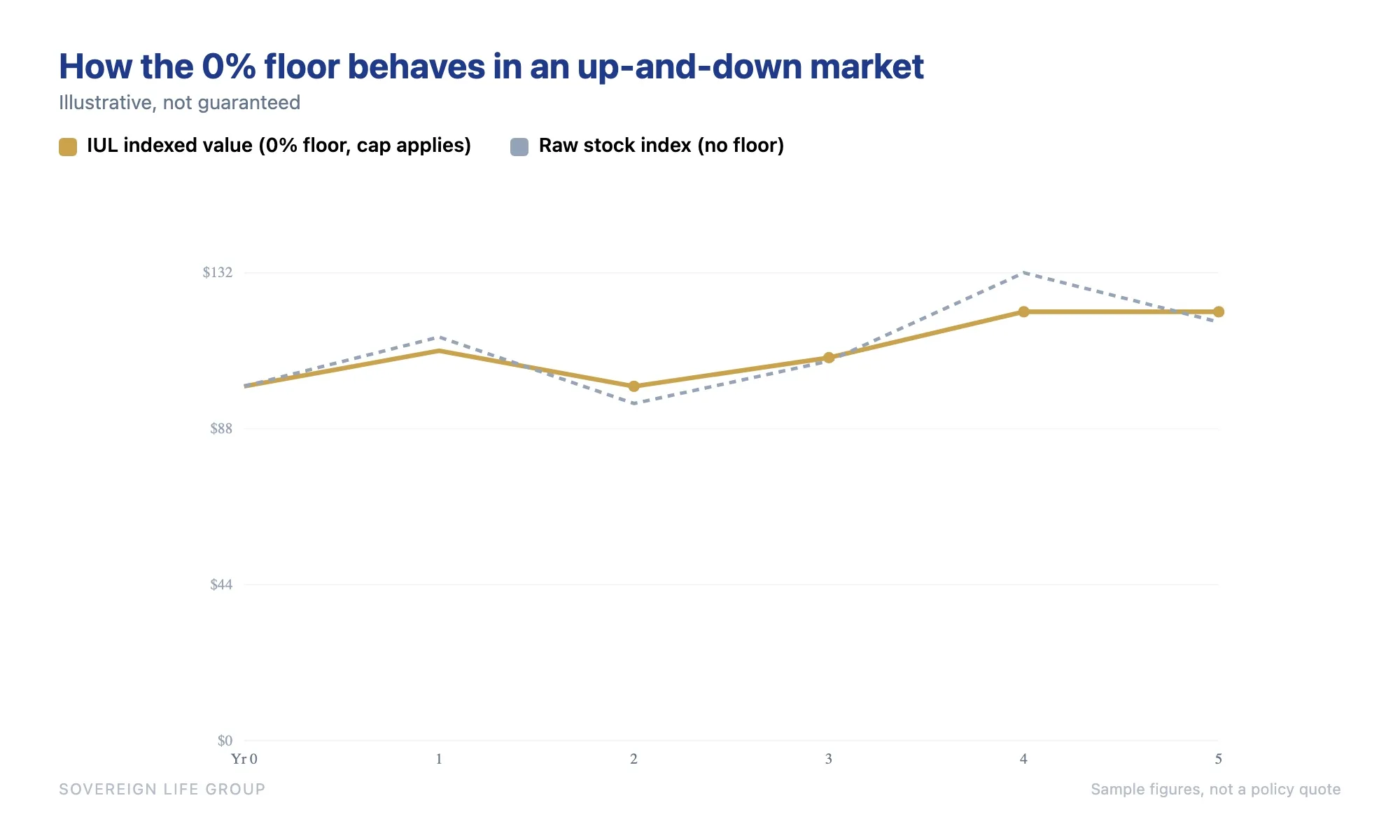
Here is the part that trips people up. The word "indexed" does not mean your money is invested in the stock market. It means the insurer credits interest to your cash value based on how a chosen index performs, inside limits the insurer sets. In most designs there is a floor, often 0%, so a bad market year does not shrink your credited value. In exchange there is a cap or a participation rate that trims your gain in a strong year. You trade some upside for a hard bottom. For a business, that trade often matters more than it does for an individual, because business reserves are money you may need at a bad moment, and a bad moment in your business often lines up with a bad moment in the market.
The reason this product keeps showing up in owner conversations is that it stacks three jobs into one contract. It pays a death benefit if you die, which is the protection piece. It accumulates cash value you can borrow against while you are alive, which is the liquidity piece. And it does both with tax treatment that, structured correctly, is friendlier than a taxable brokerage account. No single feature is magic. The combination is what makes it worth understanding.
No medical exam for a ballpark. Free, and no pressure.
How indexed universal life really works
An IUL works by splitting your premium three ways. Part covers the cost of insurance, part covers policy fees, and the rest goes into cash value that earns index-linked interest with a floor and a cap. You can adjust premiums within limits, borrow against the cash value, and the death benefit passes to your beneficiary generally income-tax-free.
Where each dollar of premium goes
When you pay a premium, the insurer does not drop the whole amount into your cash value. It first takes the cost of insurance, which is the actual price of the death benefit and rises as you age, plus administrative and policy charges. What is left is credited to your account value. In the early years that cost drag is heaviest, which is why a policy funded thinly at the start can look disappointing for a while before it turns. Owners who expect a cash machine in year two are always the ones who get frustrated. This is a long game by design.
The floor, the cap, and the index
Your cash value earns interest linked to an index over each segment, usually a year. If the index rises, you get credited up to the cap or by the participation rate. If the index falls, the floor protects you, often at 0%, so you do not lose credited value to the market itself. You still pay the internal costs, so a long string of flat years can erode a thin policy even though the market did not directly take your money. That distinction is subtle and it matters, and it is one that too many sales conversations skip.
The living access piece
Cash value inside an IUL grows tax-deferred, and you can reach it through policy loans or withdrawals. Loans do not trigger income tax the way pulling from a 401(k) early would, which is a big reason owners like the flexibility. The catch is that an unpaid loan reduces the death benefit, and if loans and costs outrun the cash value, the policy can lapse, which can create a tax bill on gains. Access is a real advantage. It is not free, and it is not automatic.
For the deeper mechanics of turning that cash value into an income stream in retirement, our breakdown of using an IUL for retirement income walks through the loan-based distribution approach and where it helps or hurts.
The smart ways owners put IUL to work
Business owners use IUL in a handful of proven ways: insuring a key person so the company survives a death, funding a buy-sell agreement so partners can buy out an estate, rewarding executives through a bonus plan, and building tax-advantaged cash value for retirement or opportunity capital. Each solves a specific business risk, not a vague one.
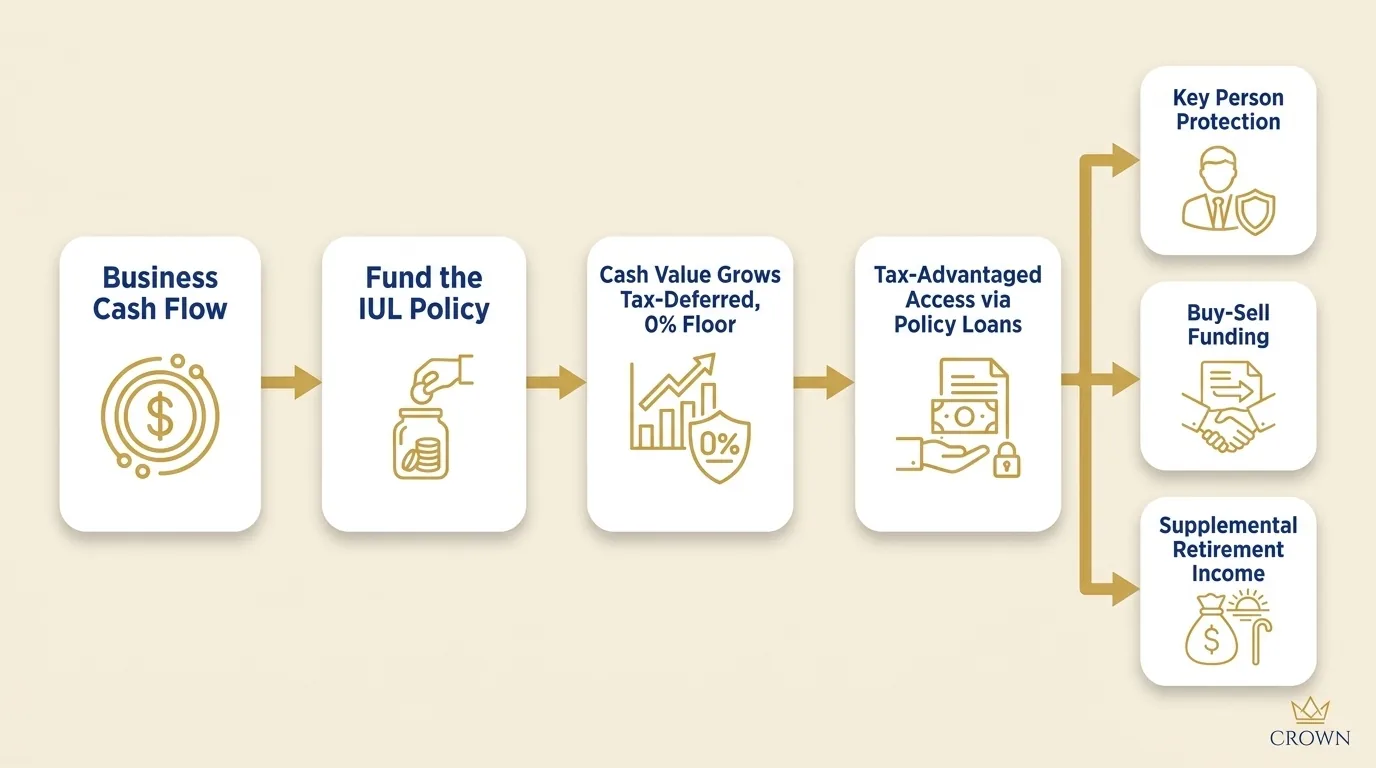
Protecting a key person
Think about the one person whose sudden absence would cost you real revenue. Sometimes it is a co-founder. Sometimes it is the salesperson who owns half your client relationships, or the operator who keeps the whole thing running while you are out front. Key person coverage puts a policy on that individual, owned by and payable to the business, so a death does not turn into a cash crisis on top of a loss. The money buys you time to recruit, to reassure clients and lenders, and to keep payroll moving. IUL adds a cash value component that a plain term policy would not, though I will be honest that for pure key person protection, many owners are better served by term. Our full explainer on key person and business life insurance lays out when the permanent version earns its keep and when it does not.
Funding a buy-sell agreement
If you have partners, a buy-sell agreement is the document that decides what happens to an owner's share when they die, leave, or become disabled. A great agreement with no money behind it is just a wish. Life insurance is how you fund it: each owner is insured so that when one dies, there is cash to buy out the estate at the agreed price. The family gets liquidity, the surviving owners keep control, and nobody ends up in business with a deceased partner's heirs who never wanted to run the place. IUL can fund a buy-sell while also building cash value the business or owners can use for other purposes, which appeals to people who dislike paying premiums that build nothing.
Rewarding and keeping key people
Good people leave for better offers. One of the quieter ways owners hold onto them is a benefit the employee cannot easily get on their own and does not want to walk away from. An executive bonus plan built around a personally owned IUL is the common version of this, often called golden handcuffs, and it gets its own section below because the tax structure deserves real explanation. The short version: you help fund a policy your key person owns, they get a growing asset and coverage, and they have a strong reason to stay.
Building tax-advantaged cash and opportunity capital
This is the use owners either love or roll their eyes at, and both reactions are fair. Because IUL cash value grows tax-deferred and can be accessed through loans, some owners treat a well-funded policy as a supplemental retirement bucket that sits outside the market's direct swings and outside the contribution caps of a 401(k). Others use the accessible cash as a private line of capital, borrowing against the policy to cover a slow season or grab an opportunity without going to a bank. The idea has real merit and real limits. It only works if the policy is funded properly for years, and if you understand that a policy loan is still a loan against your own death benefit. Done casually, it disappoints. Done deliberately, it is a legitimate piece of a plan. If tax-advantaged retirement cash flow is your main goal, weigh IUL against the trade-offs in our guide to how an IUL builds tax-advantaged cash value.
Executive bonus IUL and the Section 162 play
An executive bonus IUL is a plan where the business pays a bonus that a key employee uses to fund a personally owned IUL policy. Under Internal Revenue Code Section 162, that bonus is generally deductible to the business as reasonable compensation and taxable income to the employee, who owns the policy, its cash value, and the death benefit.
People love this structure because it is simple compared to formal deferred compensation plans, and it avoids a lot of the complexity that comes with plans the business owns. Here is the flow in plain terms. The business decides to reward a key person, or the owner rewards themselves in an owner-employee setup. Instead of a cash bonus that gets spent, the bonus funds a life insurance policy the employee owns. The employee reports the bonus as income, the same as any other pay, and the business generally deducts it as compensation. Some plans add a "double bonus," where the business pays extra to cover the employee's tax on the bonus, so the benefit is not diluted.
What makes it a retention tool is the ownership and the vesting. Because the employee owns the policy, they build a personal asset that grows over time and provides coverage for their own family. Some employers add a vesting schedule or a restrictive endorsement so the employee cannot access the cash value freely for a set number of years, which is the golden handcuff. Stay, and the asset keeps growing in your hands. Walk early, and you leave some of it on the table.
The honest limits matter too. The bonus is taxable to the employee now, so it is not a tax dodge, it is a way to fund a tax-advantaged asset with deductible dollars on the business side. And because the employee owns the policy, the business gives up control once the bonus is paid. That is a feature for retention and a bug if you wanted the company to keep the asset. For that, owners look at business-owned arrangements or deferred compensation, which our overview of key person and business coverage options gets into. As always, the IRS notes that life insurance proceeds paid at death are generally not counted as taxable income, but the deductibility and reporting details of a bonus plan depend entirely on how it is written, so this is a conversation to have with a licensed tax professional before you fund anything.
| Question | Executive bonus IUL (Section 162) | Plain cash bonus |
|---|---|---|
| Business deduction | Generally deductible as compensation | Generally deductible as compensation |
| Taxable to employee? | Yes, in the year paid | Yes, in the year paid |
| Builds a lasting asset? | Yes, cash value plus a death benefit | Only if the employee saves it |
| Retention leverage | Strong, especially with vesting | Weak, spent and forgotten |
| Who controls the money | The employee owns the policy | The employee, immediately |
A worked example with the numbers
Consider an owner, age 45, healthy, who commits to funding an IUL with roughly 20,000 dollars a year for 20 years, then stops. The example below is illustrative, not a quote, and no return is guaranteed. It shows the shape of how premiums, cost drag, and index-linked growth interact over time, which is far more useful than any single projected number.
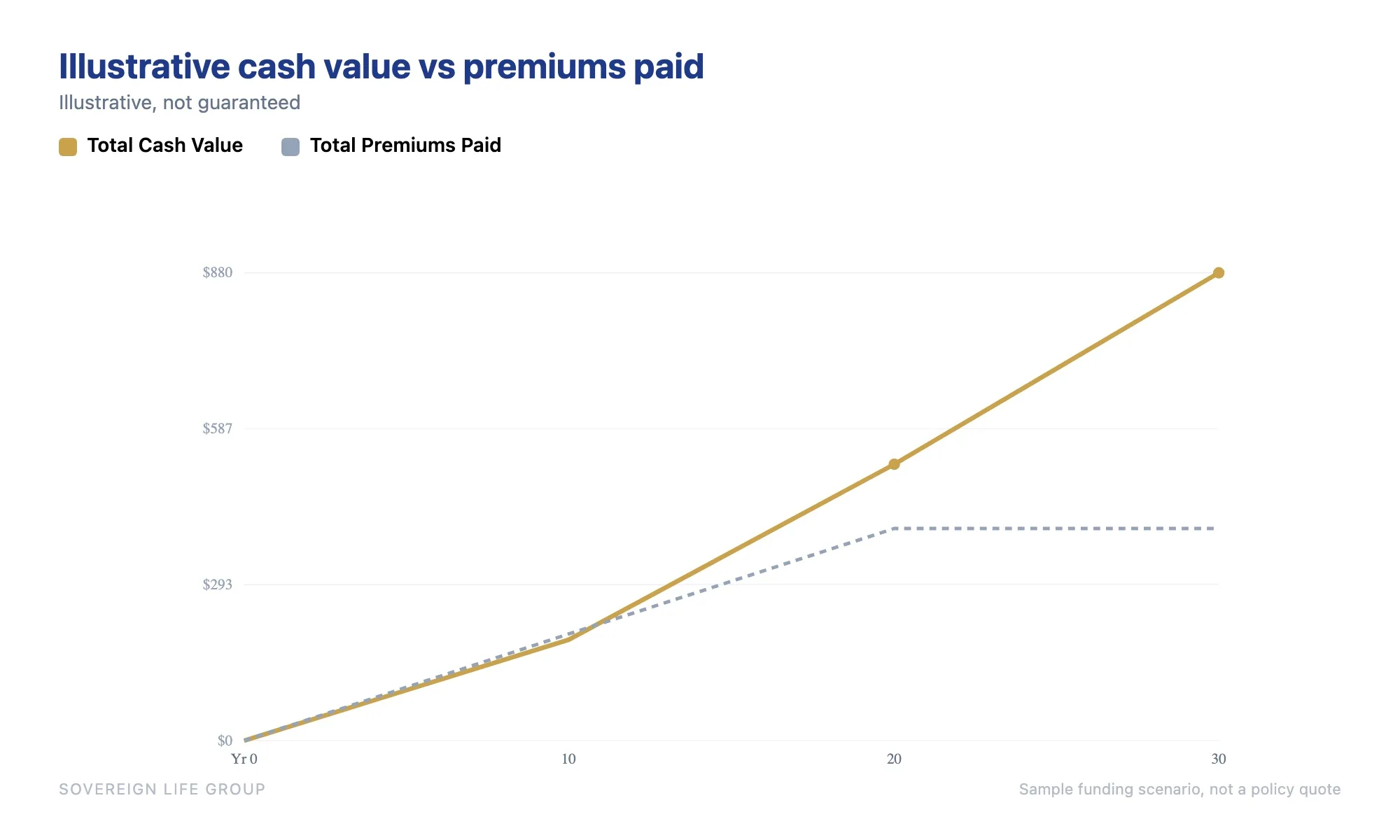
Read the chart honestly. Around year 10, the illustrative cash value sits just below total premiums paid. That is not a flaw, it is the cost of insurance and early charges doing their work, and it is exactly why IUL punishes people who bail early or fund it thinly. By year 20, when premiums stop at 400,000 dollars total, the account has pulled ahead. By year 30, with no new premiums going in, the tax-deferred growth and the floor have done the compounding. The crossover is the whole story. IUL rewards patience and consistent funding, and it does very little for someone who treats it like a savings account they might raid in year three.
Now put that same policy to work for the business. Along the way, that growing cash value is a reserve the owner could borrow against to fund a buy-sell buyout, cover a payroll gap in a bad quarter, or bridge to a bank loan on their own terms. The death benefit the whole time protects the family and any personally guaranteed debt. That is the argument for permanent coverage over term for owners who can fund it: the policy is doing protection and reserve duty at once. The argument against is equally real, and it is the cost, which is where we go next.
Get a fast, free estimate tailored to your age and health.
What an IUL really costs
An IUL carries several internal costs: the cost of insurance that rises with age, premium load charges, monthly policy and administrative fees, and charges for any riders. Surrender charges also apply if you cancel in the early years. These costs are heaviest early and are the main reason a thinly funded or abandoned policy underperforms badly.
Let me name the charges plainly, because vague talk about "fees" is how people get surprised. The cost of insurance is the real price of the death benefit, and it climbs every year as you age, which is normal for permanent coverage but becomes a serious drag in later years if the policy is underfunded. There is usually a premium load, a percentage taken off each premium before anything reaches your cash value. There are flat monthly administrative and policy charges. If you add riders, chronic illness access, a disability waiver, extra coverage, each has its own cost. And if you cancel in the first several years, a surrender charge can claw back a chunk of your cash value. None of these are hidden if you read the illustration and the policy, but they are easy to gloss over when someone is showing you a hopeful growth curve.
The single most important cost habit for an owner is to fund the policy well enough that the growing cash value comfortably outpaces the rising cost of insurance over time. A well-funded IUL uses its own growth to absorb those internal costs. An underfunded one slowly bleeds, and in a stretch of flat index years the cost of insurance can eat into a thin account until the owner is forced to pour in money late or watch it lapse. That failure mode is common, and it is almost always a funding-and-review problem, not a product problem. For a cleaner sense of where IUL sits against simpler permanent coverage on cost, our comparison of term versus whole life insurance is a useful companion, since the same cost-versus-flexibility trade-offs apply.
The pitfalls that sink these policies
The biggest pitfalls with IUL for business owners are underfunding the policy until it lapses, buying based on an aggressive illustration, accidentally creating a modified endowment contract by overfunding, and ignoring rising internal costs in later years. IUL rewards a funded and reviewed plan and quietly punishes a set-and-forget one.
I put this section where competitors usually stop, because the trade-offs are the part that actually protects you. Here are the traps I watch owners walk into.
- Underfunding. This is the number one killer. Someone commits to a premium during a good year, cash flow tightens, they trim payments, and years later the rising cost of insurance overwhelms a thin account. The policy lapses, and a lapse with an outstanding loan can trigger a tax bill on gains you never actually pocketed. Fund conservatively so you can keep going in a bad year, not aggressively based on a great one.
- The illustration game. An IUL illustration can be run at different crediting rates, and a higher assumed rate makes the whole thing look wonderful. Regulators have tightened the rules on this for a reason. Always look at the policy under a modest rate and stress a few flat years. If the plan only survives on optimism, walk.
- Triggering a MEC. Pour in too much premium too fast relative to the death benefit and the policy becomes a modified endowment contract, which changes the tax treatment of loans and withdrawals and can undo the tax advantage you bought it for. There are IRS limits for this, and a competent agent designs the funding to stay on the right side of them. Overfunding is not automatically good.
- Confusing the policy with an investment. IUL is insurance with a linked crediting mechanism. It is not an S&P 500 index fund, and the cap means you will not capture a full bull market. Owners who buy it expecting market-level returns end up disappointed, and disappointment leads to abandoning the policy, which is the worst outcome of all.
- Set and forget. A business changes. Partners come and go, debt gets paid down, a key employee leaves, revenue doubles. A policy sized for the business you had five years ago may be wrong for the business you have now. Review it every year or two with someone who will tell you the truth, even when the truth is that you are overinsured.
None of these means IUL is a scam. They mean it is a real financial instrument that rewards discipline and punishes neglect. Most of the horror stories I hear trace back to one of the five above, usually underfunding, and usually a policy nobody looked at again after the sale.
IUL compared to the alternatives
IUL is not the only way to solve a business owner's protection and planning needs. Term life covers pure risk cheaply, whole life offers guarantees with less upside, and a qualified plan like a 401(k) handles retirement saving with its own tax rules. IUL competes when you want permanent coverage plus flexible, tax-advantaged cash value in one contract.
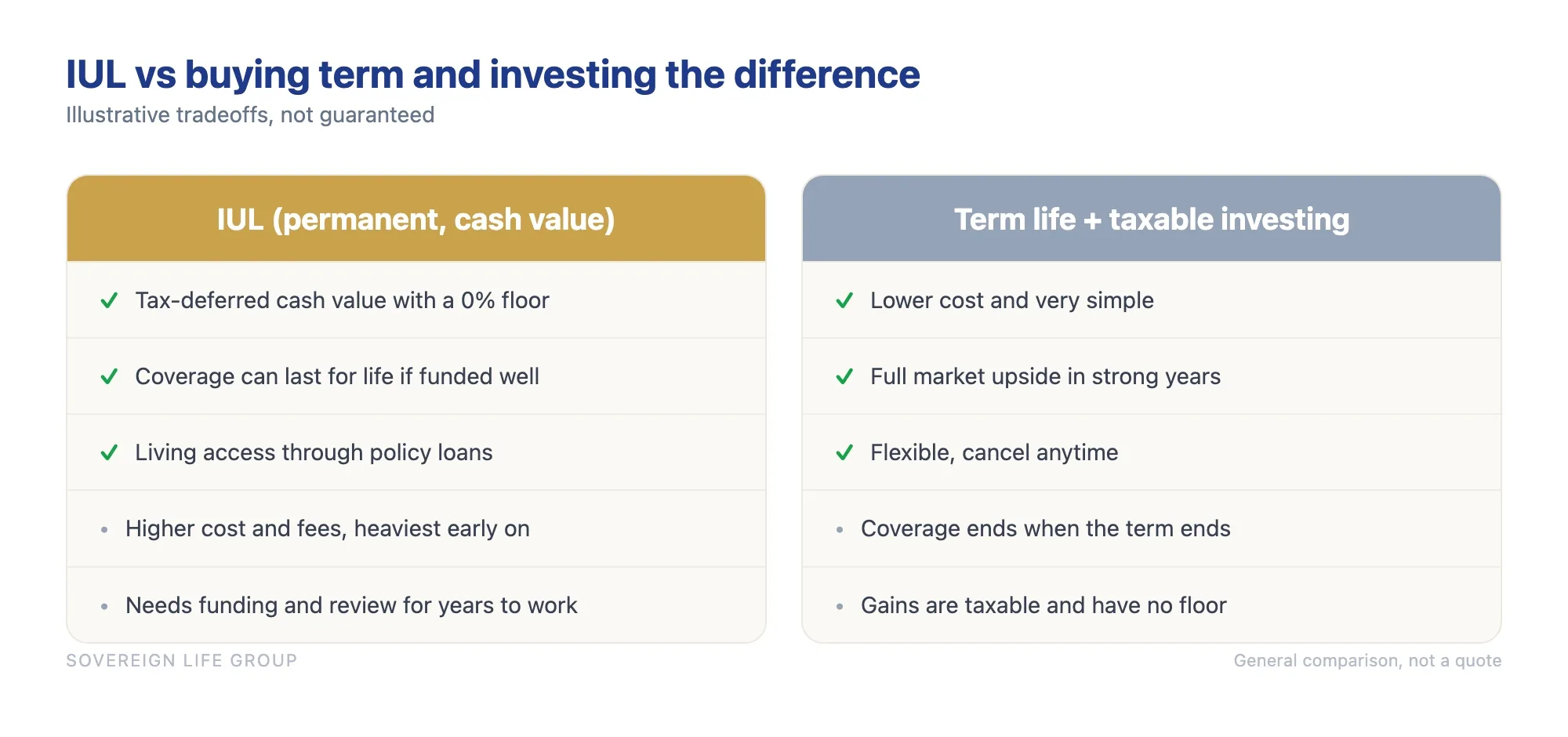
The comparison most owners actually wrestle with is IUL against buying cheaper term life and investing the difference in a brokerage account or a qualified plan. Both are defensible. Term plus investing wins on cost and simplicity and gives you the market's full upside, but the coverage ends when the term does, and your investment gains are taxable with no floor under them. IUL costs more and demands commitment, but it can provide lifelong coverage, a downside floor, and tax-advantaged access, all in one place. If you are disciplined, healthy, and only need coverage for 20 years, term plus investing is often the smarter, cheaper call, and I will tell a client that directly. If you want permanent protection and value the tax and floor features enough to fund it for the long haul, IUL earns its spot.
| Tool | Best at | Main trade-off |
|---|---|---|
| Term life | Cheap, simple protection for a set number of years | No cash value; coverage ends when the term does |
| Whole life | Guaranteed cash value and predictable premiums | Lower growth potential; less flexible funding |
| IUL | Permanent coverage plus index-linked, tax-advantaged cash value | Fees and funding discipline; caps limit upside |
| 401(k) or SEP | Tax-advantaged retirement saving with possible match | Contribution caps; early-access penalties; no death benefit |
Notice that IUL and a qualified plan are not really rivals. Plenty of owners max a 401(k) or SEP for the tax deduction and the simplicity, then use an IUL for coverage plus additional tax-advantaged cash beyond the contribution caps. The tools solve different problems. The wrong question is "IUL or my 401(k)." The right one is "what job am I hiring each dollar to do."
Is an IUL right for your business?
An IUL is likely a fit if you own a business, have a genuine need for permanent coverage, and have steady cash flow to fund the policy for a decade or more. It is a poor fit if your need is short-term, your cash flow is unpredictable, or you would not review and manage the policy. Match the tool to a real need, not to a pitch.
Rather than a yes or no, run yourself through the questions I would ask across a real conversation.
- Is there a permanent need? A personally guaranteed loan you will carry for years, a partner buyout, a family that depends on the business, a key person you cannot afford to lose. Permanent needs justify permanent coverage. A 15-year need usually does not.
- Can you fund it consistently? Not just this year, but through a slow year. IUL rewards the owner who keeps funding and punishes the one who cannot. If your income swings hard, be conservative or look at term first.
- Do you have the protection basics covered? Enough coverage on yourself for your family and your business debt, before you chase the cash-value story. Get the floor of protection right, then build.
- Will you actually review it? A policy nobody looks at is a policy waiting to lapse. If you know yourself well enough to admit you will forget it, either commit to an annual review with your agent or choose a simpler tool.
- Have you compared it honestly? Against term plus investing, against whole life, against just funding your retirement plan. If IUL still makes sense after an apples-to-apples look, it is probably a real fit and not a sale.
The demand for this kind of planning is not small. LIMRA's 2024 Insurance Barometer Study found that roughly 42% of U.S. adults say they have no life insurance or not enough, and business owners are overrepresented in that gap because they are busy and assume they will get to it later. Add that the U.S. Small Business Administration counts more than 33 million small businesses in the country, most without any funded plan for a partner's death or a key employee's exit, and you get a lot of exposure sitting uncovered. If you want to talk it through with a person instead of a brochure, that is what Sovereign Life Group, your life insurance strategist, is for.
Want a straight answer for your business?
Fifteen minutes. We will look at your protection needs, your cash flow, and whether an IUL, term, or something simpler is the honest fit. Conservative illustrations, real trade-offs, no pressure.
Book a 15-Min Call Prefer to start on your own time? Save my card and get a quick IUL quote.Frequently asked questions
Is an IUL a good idea for business owners?
It can be, when a real need for permanent coverage is there and the business has steady cash flow to fund it for years. Owners use IUL for key person protection, buy-sell funding, executive bonus plans, and tax-advantaged supplemental retirement income. It is a poor fit if you cannot commit to funding it or you only need short-term coverage, where term life is usually cheaper and simpler.
What is an executive bonus IUL, or Section 162 plan?
An executive bonus IUL is an arrangement where the business pays a bonus that a key employee or owner uses to fund a personally owned IUL policy. Under Internal Revenue Code Section 162, that bonus is generally deductible to the business as reasonable compensation, and it is taxable income to the employee. The employee owns the policy, controls the cash value, and names the beneficiary.
Can a business deduct IUL premiums?
Usually not when the business owns the policy and is the beneficiary. Under IRC Section 264, premiums on that kind of policy are generally not deductible. The common workaround is a Section 162 executive bonus, where the deductible item is the bonus paid as compensation, not the premium itself. Tax treatment depends on how the plan is structured, so confirm the details with a licensed tax professional.
How do business owners use the cash value in an IUL?
Cash value in an IUL grows tax-deferred and can be reached through policy loans or withdrawals. Owners tap it for supplemental retirement income, to fund a buy-sell buyout, to bridge a slow season, or to seize an opportunity without a bank. Loans reduce the death benefit if unpaid and can lapse the policy if it is not managed, so access is a tool, not free money.
What are the biggest pitfalls of IUL for business owners?
The main pitfalls are underfunding the policy so it lapses, being sold an illustration built on an aggressive rate, triggering a modified endowment contract by overfunding, and ignoring rising internal costs that can drain a thin policy in later years. IUL rewards a funded, reviewed plan and punishes a set-and-forget one. Model it conservatively and review it every year or two.
Joseph McDermott is a licensed life insurance agent (NPN 22121673), licensed in 27 states. Brokered through Family First Life, in partnership with Catalyst Life. This article is educational and is not financial, tax, or legal advice. Please talk with a licensed professional about your specific situation. Indexed universal life values are not guaranteed and depend on index performance, policy costs, and how the policy is funded. Product availability, features, riders, and rates vary by state, age, health, and carrier, and any coverage is subject to underwriting approval. Guarantees are subject to the claims-paying ability of the issuing insurance company. Tax outcomes depend on how a plan is structured; consult a licensed tax professional.