How to Calculate Key Man Insurance for Your Business


The Short Version
To calculate key man insurance, value what the business would lose if the person were gone, then run two or three methods and compare them: a multiple of their total pay, the real cost to replace them, and the profit or revenue they drive. Most businesses land near five to ten times compensation. Add any debt the person guarantees, and pick a number inside the range the methods point to.
If your business would take a real hit tomorrow because one person did not walk in the door, you already understand why key man insurance exists. The hard part is the number. Learning how to calculate key man insurance is not about a magic formula, it is about honestly measuring what that person is worth to the company and how long it would take to recover without them. In this guide I will walk through the five methods agents and carriers actually use, show you a full worked example with real math, cover what the coverage costs, and flag the tax rule that quietly trips people up.
I write this as a licensed agent who sizes these policies for business owners, not as someone selling you the biggest number I can. Some of what follows will point you toward less coverage than a sales pitch would. That is fine. The right amount is the goal.
What this guide covers
- What key man insurance is, and who counts
- How to calculate key man insurance: the five methods
- A worked example, step by step
- How much keyman coverage to actually buy
- Who owns the policy and how to set it up
- Term vs permanent for key person coverage
- What key man insurance costs
- Taxes, deductibility, and the consent rule
- The mistakes I see most
- Frequently asked questions
What key man insurance is, and who counts as a key person
Key man insurance, also called key person insurance, is a life insurance policy a business owns on someone whose loss would hurt the company financially. The business pays the premiums, is the beneficiary, and receives the death benefit if that person passes away. The money buys the company time to recover, hire, and steady the ship.
Notice who is protected. This is not personal coverage for the employee's family. The check goes to the business, and the business uses it to survive the gap. That single fact shapes everything about how you size the policy, how you own it, and how it is taxed, so hold onto it as we go.
Who actually qualifies as a "key person"
A key person is anyone whose absence would cost the company real money, not just anyone with an important title. In my experience it usually comes down to a few honest questions. If this person were gone Monday, would revenue drop? Would a lender get nervous? Would a handful of big clients follow them out the door? Would projects stall because the knowledge lives in their head? If yes, they are probably a key person. Common examples:
- The owner or founder. In most small companies this is the obvious one. Small businesses make up 99.9 percent of U.S. firms, and in a lot of them the owner is the engine, per the U.S. Small Business Administration's 2023 small business profile.
- A top producer or rainmaker. The salesperson who personally carries a big slice of revenue and the client relationships behind it.
- A partner or co-owner. Especially when their death would trigger a buy-sell agreement the surviving owners have to fund.
- A specialized expert. The lead engineer, the master technician, the person who holds a license or a process nobody else can run.
- A person who personally guarantees the debt. Banks often tie a loan to a specific individual. If that person dies, the loan does not.
The mistake I see most here is businesses insuring by org chart instead of by impact. A vice president with a nice title but replaceable duties may not need coverage, while a quiet operations lead who holds the whole thing together absolutely does. Insure the impact, not the title. If you want the fuller picture of how this fits a company's overall protection, our overview of key person and business life insurance is a good companion read.
No medical exam for a ballpark. Free, and no pressure.
How to calculate key man insurance: the five methods
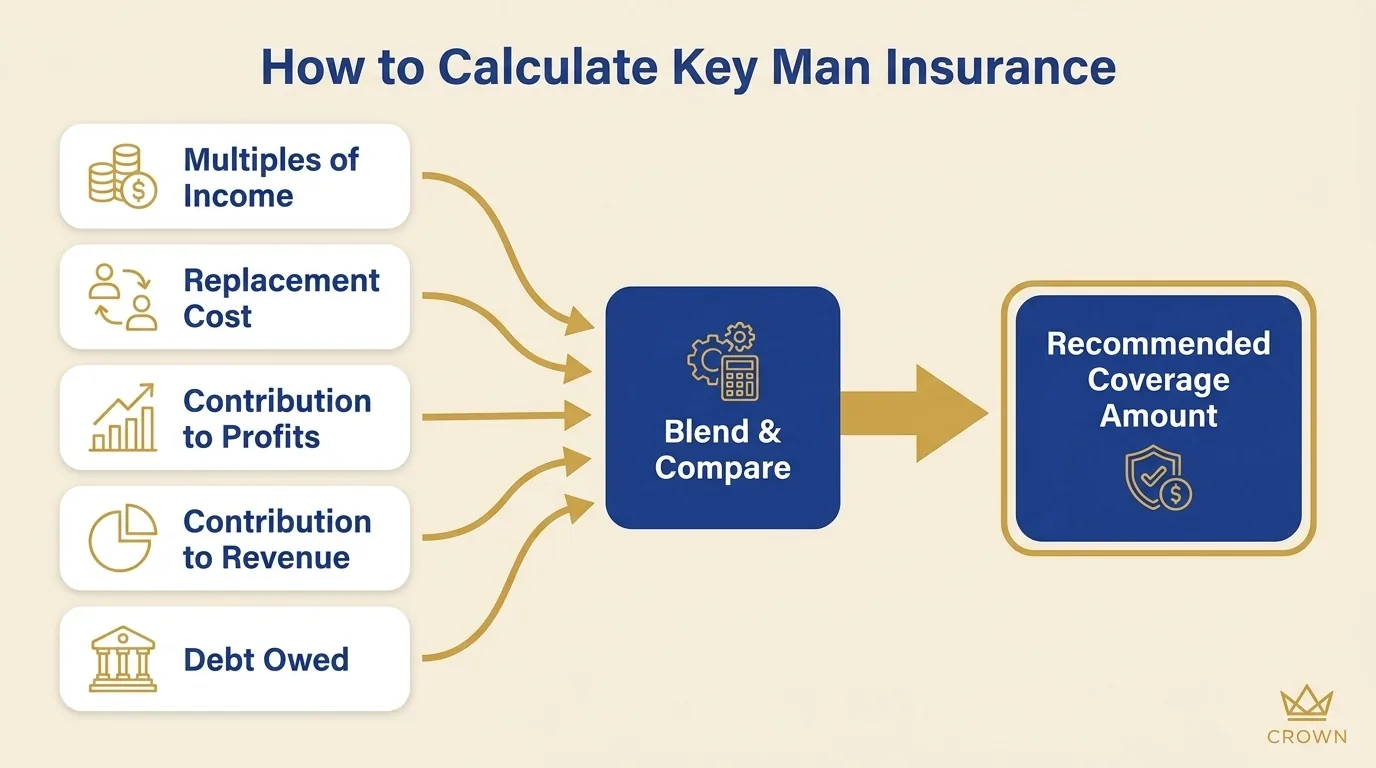
There are five common ways to calculate key man insurance: a multiple of the person's income, the cost to replace them, their contribution to profits, their contribution to revenue, and the debt they cover. Each one measures a different kind of loss. The strongest coverage number comes from running two or three and comparing, not from trusting any single method.
1. Multiples of income
This is the simplest and the one carriers lean on first. You take the key person's total annual compensation, salary plus bonus, benefits, and other pay, and multiply it by a set number of years. Most carriers work in a range of five to ten times income for life coverage. For a truly irreplaceable person, a role that took a decade to build, that multiple can stretch higher. The logic is that you are replacing several years of the value that walked out the door.
So a key person earning 150,000 dollars in total compensation lands somewhere between 750,000 dollars at five times and 1.5 million dollars at ten times. Clean, fast, and good enough to start the conversation. The weakness is that it ignores whether the person drives far more value than their paycheck, which top producers usually do.
2. Replacement cost
This method asks a concrete question: what would it actually cost to replace this person? Recruiting fees, signing bonus, training and ramp-up time, lost productivity while the seat is empty or half-full, and any temporary help you would hire to bridge the gap. Add it up. For a specialized role, replacement is rarely quick or cheap, and the number surprises owners who have never sat down and counted it.
Replacement cost tends to produce a lower figure than the income multiple, because it captures the transition rather than the long-term earnings the person generated. It is most useful for roles where the value is the skill and the seat, not the client book.
3. Contribution to profits
Here you estimate the share of company profit the key person is directly responsible for, then multiply it by the number of years it would take to rebuild that profit stream. If your total profit is 800,000 dollars and this person drives roughly 30 percent of it, that is 240,000 dollars a year. Multiply by a recovery period of three years and you are at 720,000 dollars.
This is my favorite method for a rainmaker, because it ties the coverage to what the person genuinely produces rather than what you pay them. The honest challenge is the estimate. Attributing profit to one person is part math, part judgment, so be conservative and be ready to defend the percentage.
4. Contribution to revenue
Similar idea, aimed at the top line. You calculate the portion of total revenue tied to the key person and cover a slice of it for the time it would take to replace that flow. If a salesperson is responsible for 25 percent of 4 million dollars in revenue, that is 1 million dollars a year running through their hands. Cover one to two years of it and you are looking at 1 to 2 million dollars.
Revenue-based numbers run large, so use them with care. Revenue is not profit, and you do not want to insure a dollar of sales as if it were a dollar of value. I usually treat this method as an upper bound, a sanity check on the others, not the final answer by itself.
5. Debt owed and obligations
The last method is the most overlooked and often the most important. If the key person personally guarantees a loan, a line of credit, or a lease, that obligation does not vanish when they do. Total the debt the person backs and make sure the coverage can retire it. A bank that financed your growth on the strength of one founder will want to be made whole, and coverage that clears the debt keeps the company breathing while it regroups.
Add this on top of the other methods rather than averaging it in. The debt is a hard number the business truly owes, so it belongs in the coverage as its own layer.
A worked example: putting a number on a key employee
The fastest way to make this concrete is to run one business through all five methods. The numbers below are illustrative, not a real client, but they mirror how I would work through a mid-sized company on the back of an envelope before we ever talk to a carrier.
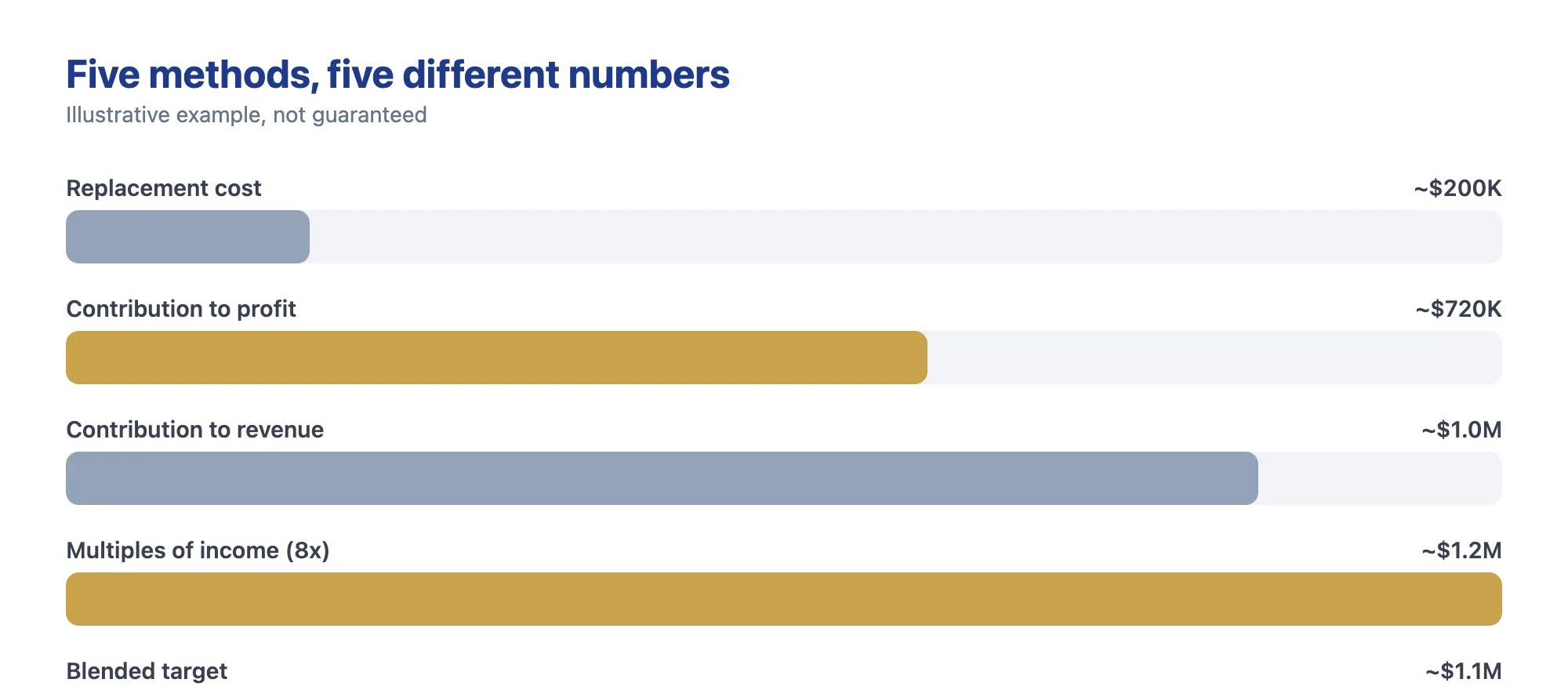
Meet a hypothetical regional service company. It runs about 4 million dollars in annual revenue and roughly 800,000 dollars in profit. The key person is the operations lead who also closes the largest accounts. Her total compensation, salary plus bonus and benefits, is 150,000 dollars. She personally guarantees a 500,000 dollar equipment loan. Here is each method:
- Multiples of income. At eight times her 150,000 dollar compensation, that is 1.2 million dollars. The five to ten range spans 750,000 dollars to 1.5 million dollars.
- Replacement cost. A recruiter at roughly 25 percent of salary is about 37,500 dollars. Add a year of reduced output while a new hire ramps, call it 120,000 dollars, plus temporary help around 40,000 dollars. Total near 200,000 dollars.
- Contribution to profits. She drives about 30 percent of the 800,000 dollar profit, or 240,000 dollars a year. Over a three year recovery, 720,000 dollars.
- Contribution to revenue. She touches about 25 percent of 4 million dollars in revenue, or 1 million dollars a year. Covering one year gives 1 million dollars, the upper bound.
- Debt owed. The 500,000 dollar loan she guarantees is a separate layer that sits on top.
Look at the spread. The core three methods, income multiple, replacement, and profit, come in at 1.2 million, 200,000, and 720,000 dollars. Average those and you get about 707,000 dollars. The revenue method says the ceiling is around 1 million dollars. Then you add the 500,000 dollar debt because it is real and owed. A reasonable coverage target here lands around 1.1 to 1.25 million dollars, enough to cover the operating loss and clear the loan without loading the company with premium it does not need.
That is the whole exercise. Not a formula handed down from on high, but a handful of honest estimates that triangulate a sensible number. When I do this with an owner, we usually spend more time debating the profit percentage than anything else, and that debate is the point. It forces you to actually value the person.
How much keyman coverage to actually buy
How much keyman coverage you buy is a judgment call inside the range your methods produce, tempered by what the business can comfortably pay in premium. Aim for enough to cover the operating loss and any guaranteed debt, then round to a coverage amount the company will keep paying for years without strain.
The two forces to balance are protection and premium. Buy too little and the death benefit will not carry the company through the gap. Buy too much and the premium becomes a line item someone eventually questions, and a policy that gets cancelled protects nobody. I would rather see a business own a right-sized policy it keeps than an oversized one it drops in a tight quarter.
A simple way to land on the figure
Here is the sequence I actually use with owners:
- Start with the loss. Use the profit-contribution method as your anchor, since it ties coverage to what the person produces.
- Sanity-check with the multiple. If your anchor number falls inside the five to ten times compensation range, you are in defensible territory. If it is way outside, revisit your assumptions.
- Add the debt layer. Stack any personally guaranteed loans on top as a separate amount.
- Round to a clean coverage band. Carriers price in bands, so 1 million or 1.25 million is often as efficient as an oddly specific figure.
- Check the premium against the budget. If it strains cash flow, right-size down or split the need between term and a smaller permanent policy.
One more thing worth saying plainly. Coverage on a key person is not a trophy. More is not automatically better. The number that protects the business without becoming a burden is the number, and it is usually smaller than the scariest method suggests and larger than the cheapest one. If you carry several key people, size each one on their own impact and prioritize the biggest exposures first rather than buying identical policies across the board.
Who owns the policy and how to set it up
The business owns a key man insurance policy, pays the premiums, and names itself as the beneficiary. The key employee is the insured, signs a consent form, and takes a health exam or answers medical questions, but they do not own the coverage and their family does not receive the death benefit. Setup is straightforward once you know the roles.
The roles, kept simple
- Owner: the business entity. It applies, holds the contract, and controls the policy.
- Payer: the business, using company funds.
- Insured: the key person, whose life the policy is measured on.
- Beneficiary: the business, which receives and uses the proceeds.
The key person does have to consent in writing before the policy is issued. That is partly courtesy and partly a hard legal requirement we will get to in the tax section. Most people are fine with it once they understand it protects the company they work for, not a windfall for someone else.
Where key person coverage overlaps with buy-sell and estate needs
If the insured is a co-owner, key person coverage often sits next to a buy-sell agreement, which is a separate arrangement that lets surviving owners buy out a deceased partner's share. They are not the same tool, and I have watched businesses assume one policy does both jobs when it does not. Keep the purposes distinct even if the same person is insured. For the broader business context and how these pieces work together, our key person insurance coverage page lays out the common structures, and a good advisor will loop in your attorney and CPA before anything is signed.
Get a fast, free estimate tailored to your age and health.
Term vs permanent for key person coverage
Most businesses use term life for key man insurance because it is affordable and can match a defined recovery window, like ten or twenty years. Permanent coverage such as indexed universal life costs more but builds cash value the business can access and can stay in force for the person's entire career. The right choice depends on budget, time horizon, and whether the company wants an asset on its books.
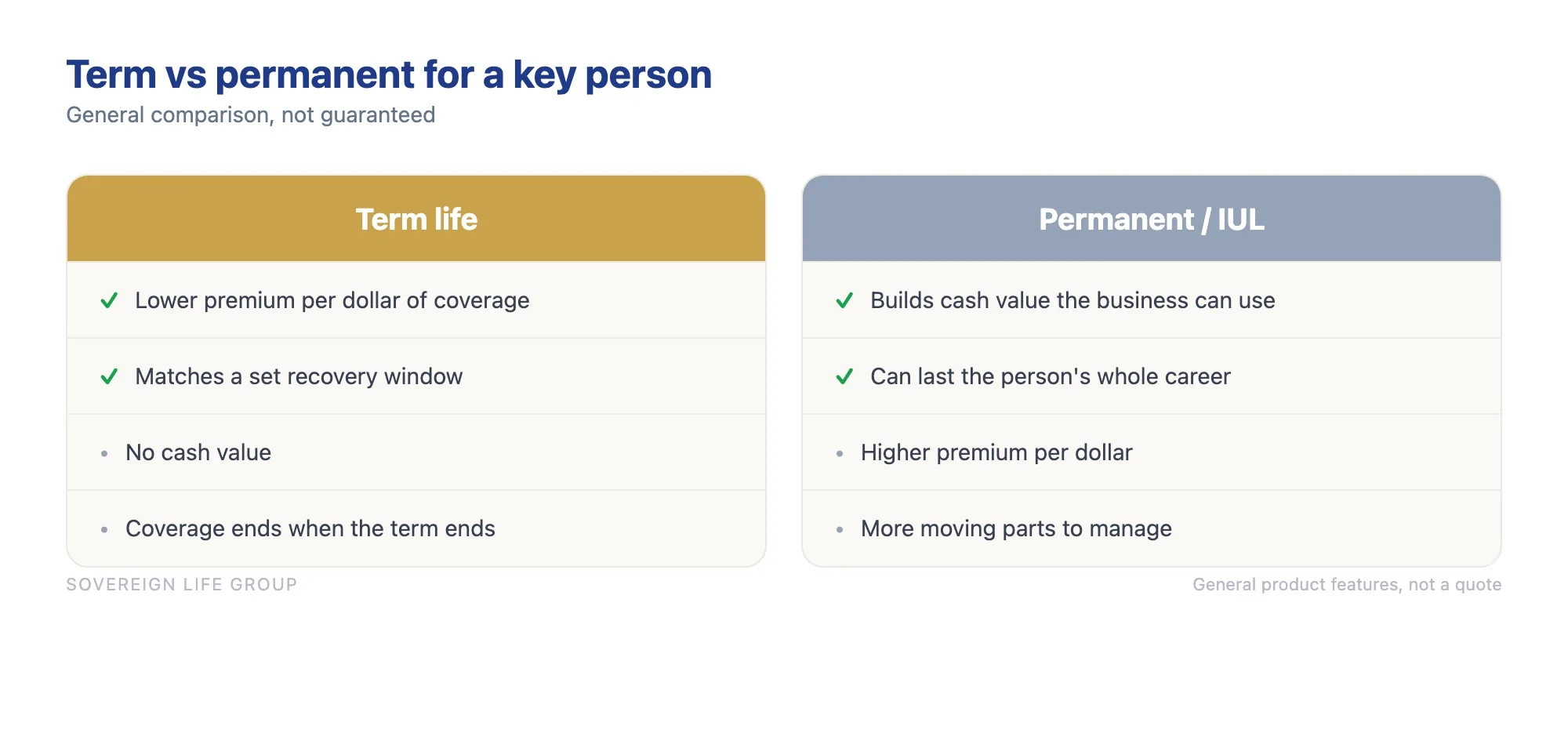
Term life is where I start for most key person needs. If the exposure is really about surviving a recovery period, a level term policy covers it cleanly and cheaply, and you can size the term to the years you expect the person to be central to the business. When that season ends, the coverage ends, and you have paid only for what you needed.
Permanent coverage earns its keep in specific situations. If the key person is likely to stay for decades, if the business wants cash value it can borrow against or count as an asset, or if the coverage doubles as part of a long-term succession or executive-benefit plan, an indexed universal life policy can make sense. The trade-off is honest: higher premiums and more complexity, and the cash value growth is tied to a market index with caps and is not guaranteed. If you are weighing the two structures more broadly, our breakdown of term versus whole life insurance covers the mechanics in plain English.
| Factor | Term life | Permanent (IUL / whole life) |
|---|---|---|
| Cost per dollar of coverage | Lower | Higher |
| How long it lasts | A set term, then ends | Can last the whole career |
| Cash value | None | Builds over time, not guaranteed |
| Best fit | Defined recovery window on a budget | Long horizon or an asset on the books |
| Complexity | Simple | More to manage and monitor |
What key man insurance costs
Key man insurance usually costs less than owners expect, especially with term life. Price depends on the coverage amount, the insured person's age and health, whether it is term or permanent, and the term length. A healthy person in their thirties or forties can often be covered for a monthly premium in the range of a couple of business software subscriptions, though the number climbs steadily with age.

No honest agent can quote you a firm rate from an article, and you should be wary of anyone who tries. What I can tell you is the direction each factor pushes the price:
- Coverage amount. More death benefit means more premium. This is why right-sizing matters, every extra 100,000 dollars of coverage you did not need is premium you keep paying.
- Age. The single biggest lever after health. The illustrative figures above roughly double each decade, which is typical.
- Health and tobacco. Underwriting is built on the insured's health at application, and nicotine use raises the price significantly.
- Term versus permanent. Term is far cheaper for the same face amount, permanent costs more because part of it funds cash value.
- Term length. A longer term locks the rate for more years and costs more than a shorter one.
The reason cost matters for this topic is simple. Many businesses are underinsured not because coverage is expensive, but because they assume it is. According to the 2024 research from LIMRA, more than 100 million U.S. adults say they need life insurance or more of it than they carry, and that same gap shows up in the businesses those people run. The cheapest day to put coverage in place is almost always the soonest one, because the insured is not getting younger or healthier while you wait.
Taxes, deductibility, and the consent rule you cannot skip
Key man insurance premiums are generally not tax deductible, because the business is the beneficiary. In return, the death benefit is usually received income tax free. But that tax-free treatment depends on meeting the IRS notice and consent rules for employer-owned life insurance before the policy is issued, and skipping them can make the benefit taxable.
Why premiums are not deductible
The tax code does not let a business deduct premiums when it stands to collect the death benefit. Think of it as the trade for receiving the proceeds tax free later. So the company pays premiums with after-tax dollars. That is normal for key person coverage, and it is worth budgeting for rather than being surprised by.
The 101(j) rule that quietly voids the tax break
Here is the part competitors tend to gloss over, and it is the one that actually bites. Under the employer-owned life insurance rules, the business generally must give the insured written notice, get their written consent, and file the right form with its tax return, all before the policy is issued. Do this correctly and the death benefit stays income tax free. Miss it, and the proceeds above what the company paid in premiums can become taxable income. You can read the framework straight from the source in the IRS instructions for employer-owned life insurance reporting.
The mistake I see is a business rushing to bind coverage and handling consent as an afterthought, or worse, backdating it. Get the paperwork done up front. It takes minutes and it protects six or seven figures. This is also exactly why you want a CPA and, if there is a buy-sell involved, an attorney at the table. I am a licensed insurance professional, not your tax advisor, and this is one area where a quick call to a professional pays for itself.
The mistakes I see most when businesses size this coverage
After sizing these policies for owners, the same avoidable errors keep showing up. None of them are complicated, and all of them cost either money or protection. Here are the ones worth guarding against before you commit to a number.
- Insuring the title, not the impact. The person with the biggest business card is not always the person the business cannot lose. Size by what disappears financially, not by rank.
- Using one method and calling it done. A single income multiple is a fine starting point and a poor finish. Run two or three and look at the spread.
- Forgetting the debt. Personally guaranteed loans do not die with the guarantor. If you leave the debt layer out, the coverage can fall short exactly when the bank comes calling.
- Confusing revenue with value. Insuring a full year of revenue as if it were profit produces a scary, oversized, overpriced policy. Treat revenue as a ceiling, not the target.
- Skipping the consent paperwork. The fastest way to turn a tax-free benefit into a taxable one is to ignore the employer-owned life insurance notice and consent step.
- Buying so much the policy gets cancelled. An oversized premium is the enemy of coverage that actually lasts. Right-size it so the business keeps paying for years.
If you avoid those six, you are ahead of most companies that buy this coverage. The goal is not the biggest policy or the cheapest one, it is a number you can defend, funded in a way the business will keep. When you are ready to run your own figures, you can get a clear, no-pressure look with Sovereign Life Group, your life insurance strategist.
Ready to size your key man coverage?
Fifteen minutes. We will run the methods on your actual numbers, factor in your debt and budget, and lay out term and permanent options plainly so you can choose with clear eyes.
Get a Quote Book a 15-Min Review Want the bigger picture first? See our key person insurance coverage overview.Frequently asked questions
How much key man insurance do I need?
Most businesses land somewhere between five and ten times the key person's total compensation, adjusted for how much profit or revenue that person drives and how long it would take to recover. Run two or three methods, compare the numbers, and pick a figure inside the range they suggest. Add any business debt the person personally guarantees.
What is the formula for key man insurance?
There is no single formula. The most common is the multiples of income method: annual salary and benefits multiplied by five to ten. A fuller estimate blends that with replacement cost and the person's contribution to profits or revenue, then adds any debt they guarantee. Averaging the methods usually gives a defensible coverage amount.
Is key man insurance tax deductible?
No. Premiums for key man insurance are generally not tax deductible because the business is the beneficiary. In exchange, the death benefit is usually received income tax free, but only if the employer met the IRS notice and consent rules for employer-owned life insurance before the policy was issued. Confirm the details with a tax professional.
Who owns a key man insurance policy?
The business owns the policy, pays the premiums, and is named as the beneficiary. The key employee is the insured but does not own the coverage and does not receive the benefit. They do have to consent in writing before the policy is issued, which is both an IRS requirement and simple courtesy.
Can a small business get key man insurance on the owner?
Yes. In many small companies the owner is the key person, so the business can insure the owner the same way it would insure a top producer. The coverage protects the company from the loss of the owner's revenue, relationships, and personal guarantees, and it can also help fund a smooth transition or buy-sell agreement.
Should key man insurance be term or permanent?
Term life is the common choice because it is affordable and can match a set recovery window, such as ten or twenty years. Permanent coverage like an indexed universal life policy costs more but builds cash value the business can use later and can stay in force for the person's whole career. The right answer depends on budget and goals.
Joseph McDermott is a licensed life insurance agent (NPN 22121673), licensed in 27 states. Brokered through Family First Life, in partnership with Catalyst Life. This article is educational and is not financial, tax, or legal advice. Please talk with a licensed professional, including a CPA or attorney, about your specific situation. Product availability, features, riders, and rates vary by state, age, health, and carrier, and any coverage is subject to underwriting approval. Guarantees are subject to the claims-paying ability of the issuing insurance company.