How to Borrow Against Your Life Insurance Policy


The Short Version
You can borrow against life insurance if you own a permanent policy that has built cash value. You request a policy loan from your insurer, no credit check, and the cash value stays put as collateral. The loan is usually tax free while the policy stays in force, but interest accrues and any unpaid balance is subtracted from what your family receives. Used with care it is a genuinely useful tool. Ignored, it can quietly lapse the policy.
Clients ask me how to borrow against life insurance more than almost any other question about permanent coverage, and most of them have heard only half the story. Yes, you can pull cash out of your own policy without a bank, without a credit check, and usually without a tax bill. That part is real. What the glossy pitches leave out is the interest that keeps ticking, the way an ignored loan can eat a policy alive, and the handful of rules that decide whether the money stays tax free. So this guide covers both sides. I will walk you through who can do it, exactly how a life insurance policy loan works, what it costs, the tax rules, a real worked example with numbers, and the honest cases where borrowing from your policy is a smart move versus a warning sign.
I write this as a licensed agent, not someone selling you a loan. Nobody makes a commission when you borrow your own cash value. My only goal here is that you understand the tool well enough to use it without hurting the coverage you paid years to build.
What this guide covers
- What it means to borrow against life insurance
- How a life insurance policy loan works
- Which policies let you borrow, and which do not
- How much you can borrow from cash value
- How to borrow against life insurance, step by step
- Policy loan interest and what it really costs
- A real worked example with numbers
- Repaying a policy loan without lapsing it
- The tax rules you cannot ignore
- Policy loan versus withdrawal versus surrender
- Alternatives worth comparing first
- When it is smart, and when it is a red flag
- Frequently asked questions
What it means to borrow against life insurance
Borrowing against life insurance means taking a loan from your insurance company using your policy's cash value as collateral. You are not withdrawing your money, and you are not borrowing from a bank. The insurer lends you its money, holds your cash value as security, and charges interest. Only permanent policies with cash value allow it, never term.
Here is the piece that trips people up. When you take a policy loan, your cash value does not actually leave the policy. It stays right where it is, often still earning interest or dividends, while the insurer advances you a separate pool of its own money and uses your cash value as the guarantee it will be repaid. That is why there is no credit check and no approval drama. The lender is fully secured from day one. If you want the fuller picture of how that inside balance builds in the first place, our explainer on how cash value life insurance actually works is a good companion to this piece.
People also call this a life insurance policy loan or borrowing from cash value. Same idea. The "loan" language is accurate: it is debt you owe back to the policy, with interest, not a free withdrawal of savings.
No medical exam for a ballpark. Free, and no pressure.
How a life insurance policy loan works
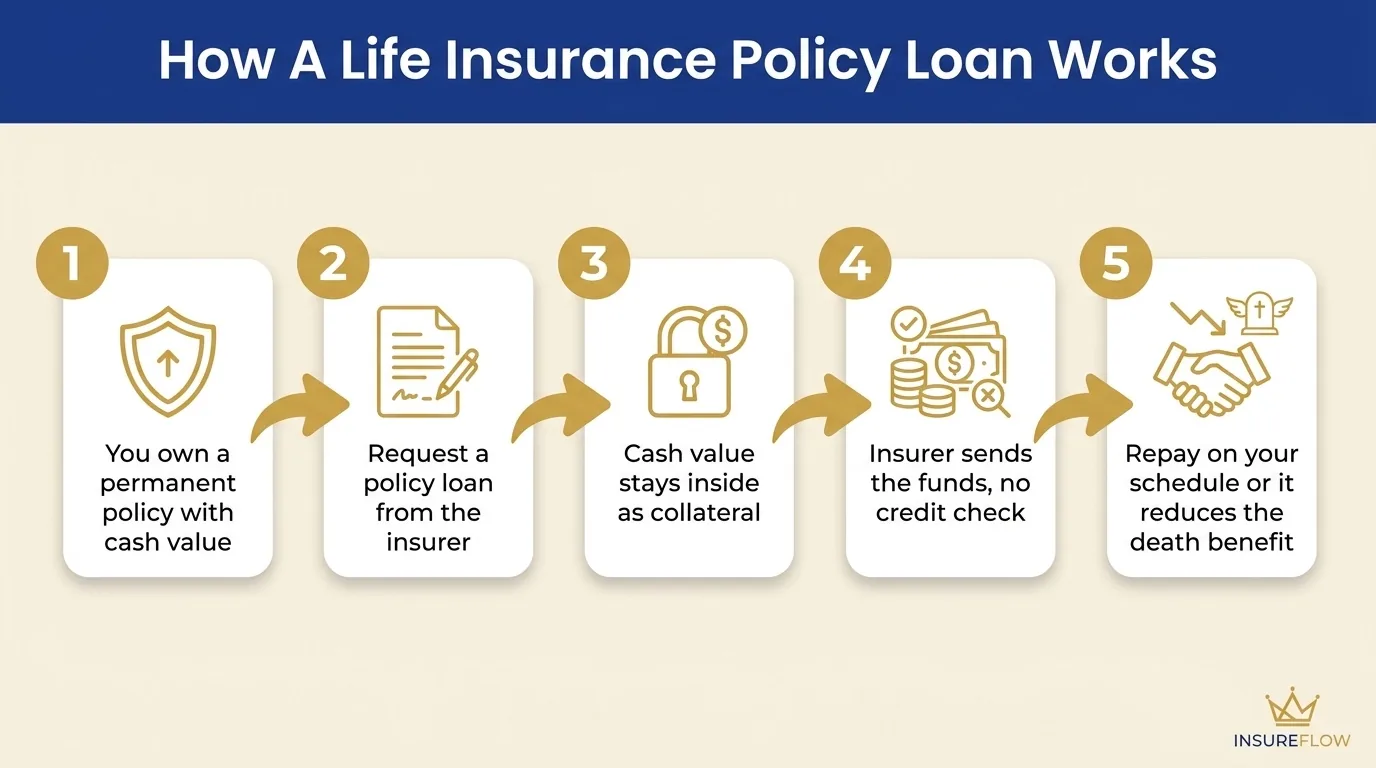
Mechanically, a policy loan is simple. You request the loan from your insurer, the cash value stays in the policy as collateral, the company sends you the money, and interest starts accruing. You repay on your own timeline, or you do not, in which case the balance plus interest is deducted from the death benefit later.
What makes it feel different from any bank loan is the absence of the usual friction. There is no application to be approved or denied, because the loan is already fully secured by your own money. There is no minimum monthly payment in most cases. And the cash value backing the loan often keeps growing while you have the money in hand, which is the feature that made this whole concept popular in the first place.
Direct recognition versus non-direct recognition
This is the detail almost every article skips, and it changes the math. Carriers handle your borrowed cash value one of two ways. Under non-direct recognition, your full cash value keeps earning the same dividend or interest rate whether or not you have a loan against it, so your money can be working in two places at once. Under direct recognition, the carrier credits a different rate on the portion you have borrowed against. Neither is automatically better, and the difference is often smaller than the marketing suggests, but if you plan to use policy loans regularly, ask which model your carrier uses before you count on the numbers. I have seen people build an entire strategy on the assumption of non-direct recognition and never confirm it.
The loan sits against the policy, not on your credit
Because your cash value is the collateral, a policy loan does not show up on your credit report and does not affect your credit score. There is no lender deciding whether you are worthy. That cuts both ways. The freedom is real, but so is the lack of a built-in guardrail. A bank would cut you off. Your policy will keep letting you borrow and letting interest compound right up until the day the whole thing is at risk of collapsing, which is exactly why you have to be your own guardrail here.
Which policies let you borrow, and which do not
Only permanent life insurance that builds cash value lets you borrow: whole life, universal life, and indexed universal life. Term life insurance has no cash value, so there is nothing to borrow against. If you own term and want this feature someday, you would need to add or convert to a permanent policy.
The reason is structural. Term insurance is pure protection for a set number of years, priced low precisely because it builds no savings component. Permanent policies cost more because part of every premium goes into a cash value account that grows over time, and that account is what a loan draws against. Our side-by-side on term versus whole life insurance breaks down that trade-off if you are still deciding which you own or want.
- Whole life. Builds guaranteed cash value on a set schedule, and many policies pay dividends on top. The most predictable base for policy loans.
- Universal life. Builds cash value tied to a crediting rate, with flexible premiums. Loan access is standard, but a thinner cash value cushion can raise lapse risk if you are not watching it.
- Indexed universal life (IUL). Cash value growth is linked to a market index with a floor and a cap. Loans are a core feature, and for many owners the loan strategy is the whole point of the policy. If that is your interest, our overview of indexed universal life coverage gets into how those loans are designed to work in retirement.
- Term life. No cash value, no loan. Full stop.
One honest caveat on newer permanent policies: cash value takes years to become meaningful. In the early years, most of your premium is covering the cost of insurance and policy expenses, so do not expect to borrow much in years one through five. This is a long game by design.
How much you can borrow from cash value
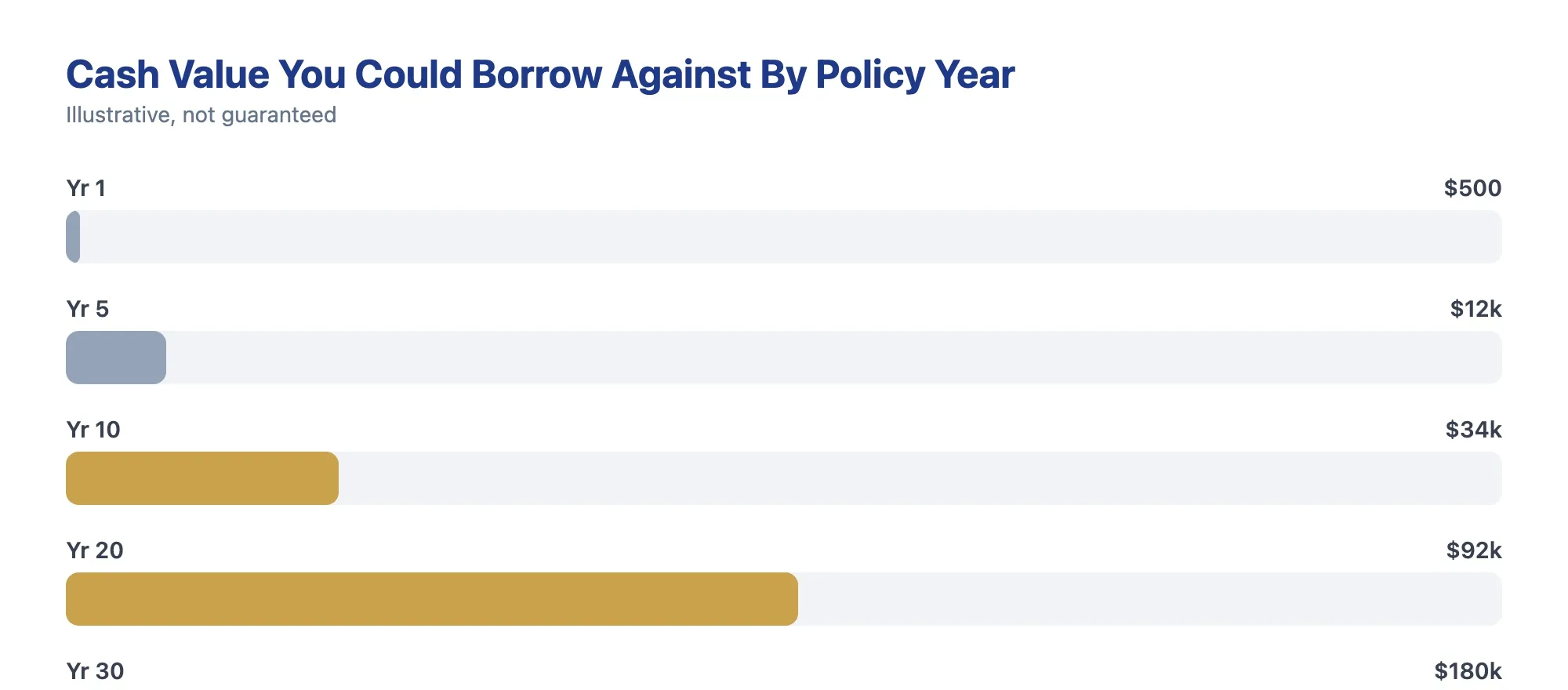
Most insurers let you borrow a large share of your cash value, commonly around 90 to 95 percent, though the exact ceiling depends on the carrier and policy type. The limit is based only on the cash value you have accumulated, not your death benefit and not your income. Your annual statement lists the available loan value, and a quick call to the carrier confirms it.
Why not 100 percent? The carrier leaves a margin so that accruing interest does not immediately push the loan past the collateral backing it. That buffer protects you as much as the insurer. Borrow every last dollar available and the first year of interest can already start the slide toward a lapse.
The number that matters is not what you can borrow, it is what you should. Just because a policy shows sixty thousand dollars of available loan value does not mean draining it is wise. The bigger the loan relative to the cash value, the less cushion you have if interest outruns growth. The mistake I see most is treating the full loan value like a checking account balance. It is not. It is the ceiling, and living near the ceiling is where policies get into trouble.
How to borrow against life insurance, step by step
To borrow against life insurance, you contact your insurer, request a policy loan, choose an amount up to your available loan value, and receive the funds by deposit or check. There is no credit application. Most carriers process the request in a few days to a couple of weeks, and you can often start it online.
Here is the practical order I walk clients through so nothing gets missed.
- Confirm your available loan value. Pull your latest annual statement or log into the carrier portal. That number is your real ceiling, not a rough guess.
- Ask about the interest rate and how it is set. Is it fixed or variable? Is the policy direct or non-direct recognition? Get this in plain terms before you decide.
- Request the loan. Complete the policy loan form, online or on paper. No credit check, no explanation of what the money is for.
- Choose your amount and delivery. Borrow what you actually need, not the maximum. Pick direct deposit for speed or a mailed check.
- Set your own repayment plan. There is no bill in the mail, so decide now how you will pay it back, even a modest monthly amount, and put a reminder on the calendar.
- Watch the annual statement. Each year, check the loan balance against the cash value so you catch trouble early instead of getting a lapse warning.
That last step is the one people skip, and it is the one that saves policies. A loan you check on once a year almost never surprises you. A loan you forget about for a decade is how a thirty thousand dollar borrow turns into a lapsed policy and a tax bill.
Policy loan interest and what it really costs
Policy loan interest is the cost of borrowing against your cash value, and it typically runs in the range of about 5 to 8 percent, well below most credit cards. The rate is set by the carrier and may be fixed or variable. Interest accrues on the outstanding balance and, if you do not pay it, gets added to the loan, so it compounds.
That compounding is the whole ballgame, so let me be blunt about it. A policy loan feels cheap because there is no monthly bill, but "no bill" does not mean "no cost." Every year you leave interest unpaid, that interest becomes part of the loan, and next year you pay interest on the interest. Left alone long enough, a comfortable loan becomes an uncomfortable one, and eventually a dangerous one.
Fixed versus variable loan rates
A fixed loan rate stays put for the life of the loan, which makes planning easy. A variable rate moves with an index the carrier ties it to, so it can rise or fall over time. Neither is a trap on its own, but if your whole plan depends on borrowing cheaply for decades, a variable rate is a variable you do not fully control. Ask which one you have.
The "net cost" that marketing loves
You will hear that a policy loan can have a low "net cost" because your cash value keeps earning while you borrow. On a non-direct recognition policy, if your cash value credits, say, 5 percent and your loan charges 6 percent, the real drag is closer to that 1 percent gap than the full 6. That can be true. It is also a best case that assumes crediting rates hold and you actually manage the loan. I like the concept, I just do not like when it is sold as a guarantee. Crediting rates are not promised, and a forgotten loan does not care about your spreadsheet.
Get a fast, free estimate tailored to your age and health.
A real worked example with numbers
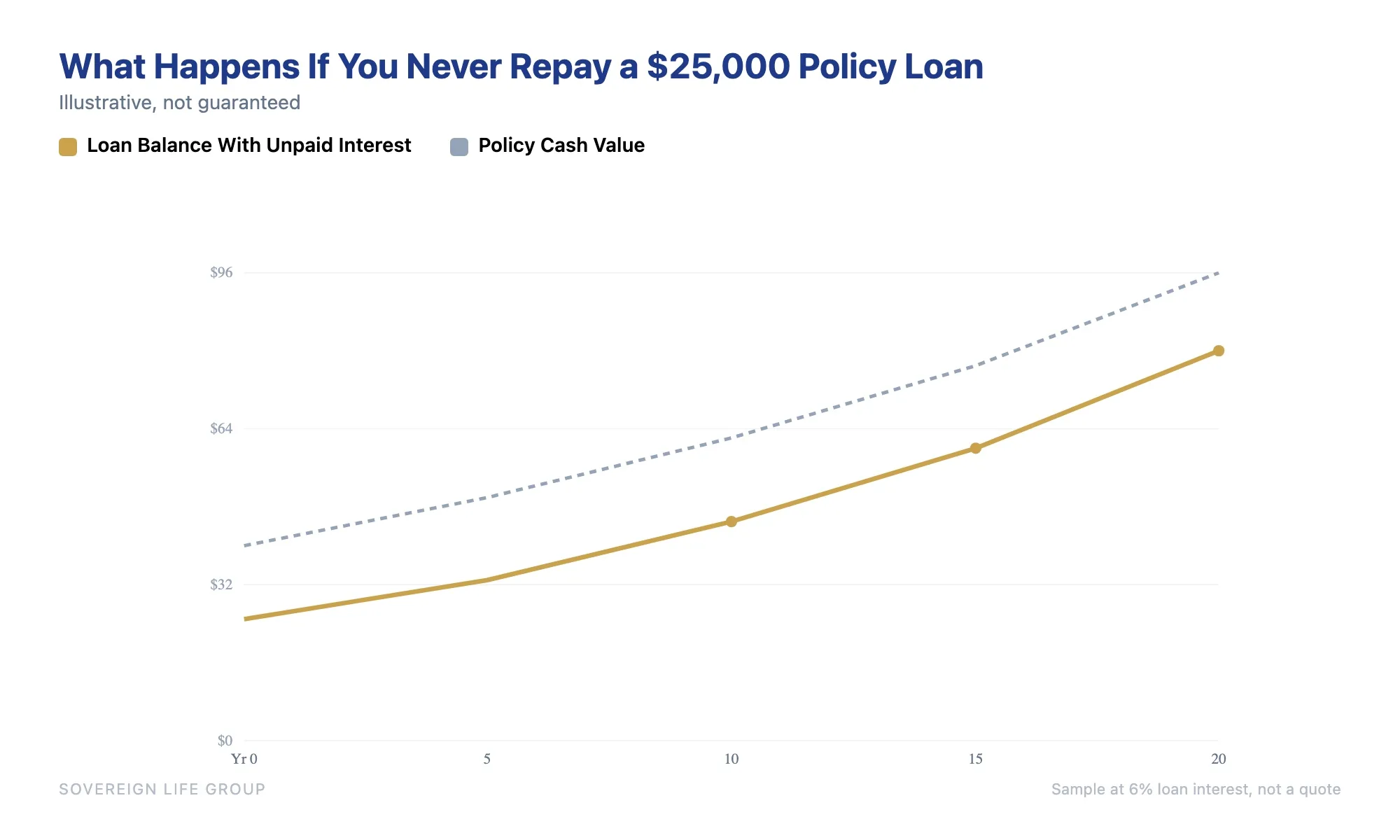
Numbers make this concrete, so let me build a clean, illustrative example. It is a sample, not a quote, and every real policy differs. Picture a whole life policy with 40,000 dollars of cash value. You borrow 25,000 at a 6 percent fixed loan rate to cover a business need, and you decide to pay the loan back in full over five years.
On that plan, you would repay roughly 483 dollars a month for sixty months, paying about 4,000 dollars of total interest over the five years. When you finish, the loan is gone, your death benefit is whole again, and your cash value kept growing the entire time. That is the tool working exactly as intended. A useful chunk of cash, no bank, no credit hit, a manageable cost.
Now run the other version, the one the chart above shows. You borrow the same 25,000 and pay nothing back, letting interest compound at 6 percent. After 5 years the balance is near 33,000. After 10 years it is around 45,000. After 20 years, close to 80,000. Meanwhile your 40,000 of cash value is growing too, but if it grows slower than 6 percent, the loan is steadily eating a larger and larger share of it. The day the loan balance catches the cash value, the carrier sends a notice: pay in, or the policy lapses. And a lapse with a big loan is the one scenario that can turn your tax-free loan into a taxable event, which we get into below.
Same starting loan. Two completely different endings. The only variable that changed was whether anyone paid attention. That is the honest heart of this entire subject.
Repaying a policy loan without lapsing it
You are not required to repay a policy loan on a set schedule, but you should treat it like you are. Paying at least the annual interest keeps the balance from compounding, and paying down principal restores your death benefit and rebuilds your available loan value. The goal is to never let the loan plus interest approach your cash value.
The flexibility here is a genuine benefit and a genuine hazard, wrapped in the same feature. Because no bill arrives, disciplined people love it: they pay when cash flow is strong, pause when it is tight, and never miss a payment because there is no payment to miss. Undisciplined use is where policies die. Without the external pressure of a due date, it is easy to let a loan drift for years.
A few habits keep you safe:
- Cover the interest every year at minimum. This alone stops the compounding that lapses policies. Think of it as the floor, not the goal.
- Set your own repayment schedule and automate it. A recurring transfer turns the flexibility into structure without giving up the flexibility.
- Rebuild before you re-borrow. If you use policy loans as a recurring tool, pay the last one down meaningfully before taking the next. Stacking loans is how the balance sneaks up on you.
- Read the annual lapse notice seriously. If a carrier ever warns that the loan is nearing the cash value, that is not junk mail. Act that week.
If you are drawn to using policy loans as an ongoing personal finance strategy rather than a one-time need, that is essentially the idea behind the be-your-own-bank and infinite banking concept, which has real merits and real caveats worth understanding before you build a plan around it.
The tax rules you cannot ignore
A life insurance policy loan is generally not taxable while the policy stays in force, because you are borrowing against your own asset rather than receiving income. The two big exceptions are a policy that lapses or is surrendered with a loan outstanding, and a modified endowment contract (MEC), where loans can be taxed as income. When in doubt, confirm with a tax professional.
This is the part where I get formal on purpose, because the tax treatment is exactly what makes policy loans attractive and exactly where people get burned.
Why a loan is normally tax free
The government does not treat borrowed money as income. According to the IRS guidance on life insurance proceeds, amounts you access from a policy are handled under specific rules, and a loan against an in-force policy generally is not counted as taxable income. That is why cash value life insurance gets talked about as a source of tax-advantaged access to money in retirement.
The lapse trap
Here is the scenario that catches people. If your policy lapses or you surrender it while a loan is outstanding, the IRS can treat the forgiven loan amount above what you paid in as taxable income. Picture years of untaxed gain suddenly counted in a single year, on a policy that is now gone, with a tax bill and no death benefit to show for it. That is the worst possible ending, and it comes almost entirely from ignoring the loan. Keeping the policy in force is what keeps the loan tax free.
Modified endowment contracts (MECs)
If you pour money into a policy too quickly, past a federal limit sometimes called the seven-pay test, the IRS reclassifies it as a modified endowment contract. Loans from a MEC are taxed differently, generally as income first, and may carry a penalty before age 59 and a half. A well-designed cash value policy is deliberately structured to avoid MEC status. This is one more reason to build these policies with someone who knows the guardrails, not to over-fund one on your own and stumble into a tax category you did not intend.
Policy loan versus withdrawal versus surrender
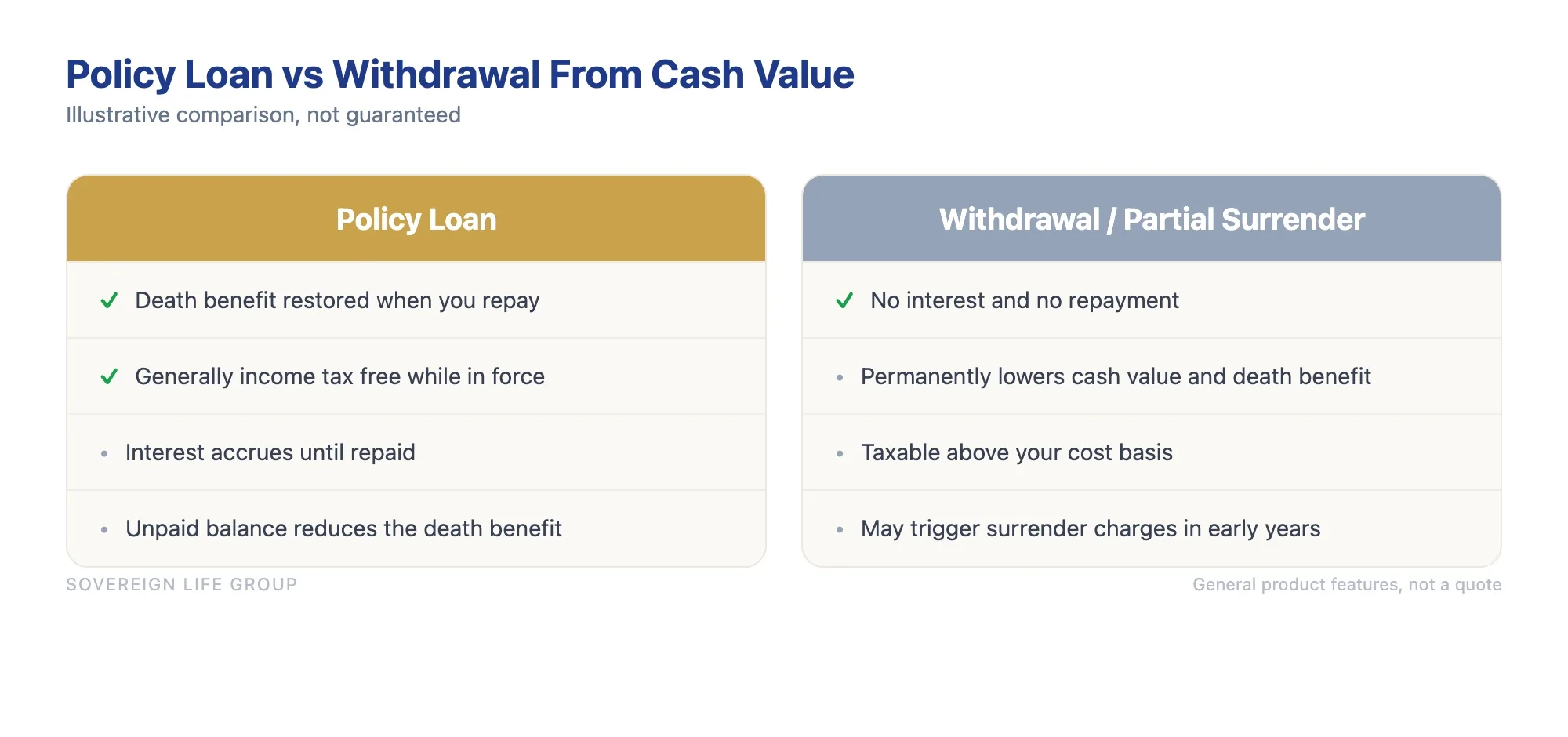
Borrowing is not your only way to reach the cash value, and the alternatives matter. A loan leaves the policy intact and is usually tax free, but it accrues interest and must be managed. A withdrawal, also called a partial surrender, permanently reduces both your cash value and your death benefit and can be taxable above what you paid in. A full surrender ends the policy entirely.
The right choice depends on whether you want the coverage to survive. If keeping the death benefit whole matters, a loan is almost always the better tool, because a repaid loan restores everything. A withdrawal is simpler and carries no interest, but you are permanently spending down the very protection you bought, and once that death benefit is reduced, you cannot loan your way back to it. Early on, a withdrawal can also run into surrender charges, which quietly take a bite you did not plan for.
Surrendering the whole policy should be the last resort, and rarely a good one if you still need coverage. You give up the protection, you may owe tax on the gain, and replacing that coverage later costs far more because you are older and possibly less healthy. If you are thinking about surrendering because of cost or a changed situation, talk to an agent first. There is often a better move, from reducing the death benefit to using a small loan to bridge a tight stretch.
Alternatives worth comparing first
A policy loan is one option among several, and the honest thing to do is compare it before you borrow. Depending on your situation, a home equity line, a 401(k) loan, or even a plain personal loan might fit better. Each has trade-offs a policy loan does not, and a policy loan has advantages they do not.
| Option | Main advantage | Main trade-off |
|---|---|---|
| Life insurance policy loan | No credit check, flexible repayment, usually tax free | Reduces death benefit if unpaid, can lapse the policy |
| Home equity line (HELOC) | Large limits, often low rates | Your home is the collateral, credit check and closing steps |
| 401(k) loan | Borrow from your own retirement, no credit check | Repayment tied to your job, missed pay can trigger tax and penalty |
| Personal loan | Fast, keeps other assets untouched | Credit-based rate, fixed monthly payment required |
| Credit card | Instant and convenient | Highest rates by far, easy to spiral |
The place a policy loan genuinely shines is flexibility and speed with no credit consequence. The place it can hurt you is the same place all the freedom lives: no one is forcing repayment. A HELOC or personal loan comes with a payment schedule that keeps you honest. A policy loan trusts you to keep yourself honest. Know which kind of borrower you are before you choose.
When it is smart, and when it is a red flag
Borrowing against life insurance is smart when you have a real, time-limited need, a plan to repay, and enough cash value that the loan is a small share of it. It is a red flag when you are reaching for it because money is chronically tight, when you plan to never pay it back, or when you would be borrowing near your full loan value. The tool is neutral. Your plan is what makes it good or bad.
After years of these conversations, here is the pattern I trust. The people who use policy loans well share a few traits, and the people who get hurt share the opposite ones.
Good reasons to consider it
- A defined need with an end date: a business opportunity, a bridge between jobs, a large planned expense you will repay from a known source.
- Supplementing retirement income from a policy built for it, on a schedule you and your agent modeled.
- Avoiding a worse form of debt, like carrying a balance on a high-rate card, when you have the discipline to repay the policy.
- Access to cash during a market downturn without selling investments at a loss.
Signs to stop and rethink
- You are borrowing because every month is a struggle and this is the only cash left. That is a budget problem a loan will deepen, not solve.
- You have no repayment plan and are quietly hoping to leave it against the death benefit forever. Sometimes that is a deliberate strategy, but it must be a decision, not a drift.
- You would be tapping most of your available loan value, leaving no cushion for interest.
- You do not actually know your loan rate, your recognition type, or your current cash value. If you cannot answer those, you are not ready to borrow yet.
If you are somewhere in the middle and not sure which side you are on, that is exactly the moment to talk it through with a licensed agent before you sign anything. A ten minute conversation about your actual numbers beats a decade of guessing.
As one more piece of context on why this matters at all, in its 2024 Insurance Barometer Study, research published by LIMRA found that only about half of American adults, roughly 51 percent, owned any life insurance, and that more than 100 million adults said they either had no coverage or knew they needed more. The living benefits of a cash value policy, borrowing included, are among the most misunderstood features in the whole product, which is a big part of why so many people leave money and options on the table. The Insurance Information Institute is a solid neutral place to read up on how cash value works before anyone tries to sell you on it. And when you want a plain, no-pressure look at your own situation, that is what we do at Sovereign Life Group, your life insurance strategist.
Not sure if a policy loan is the right move?
Fifteen minutes. We will look at your policy, your cash value, your loan rate, and whether borrowing, waiting, or another option fits your situation best. No pressure, no jargon.
Get a Quick Quote Book a 15-Min Call Want the bigger picture first? See how coverage fits a household on the families coverage page.Frequently asked questions
How soon can you borrow against a life insurance policy?
You can borrow once your policy has built enough cash value, which usually takes a few years. Most permanent policies accumulate little in the first two to five years because early premiums cover insurance costs and fees. Check your annual statement for the current loan value, or ask your carrier what is available today.
Do you have to pay back a life insurance policy loan?
You are not on a fixed repayment schedule, but you should still repay it. Interest keeps accruing on any unpaid balance and is added to the loan. If the loan plus interest ever grows larger than the cash value, the policy can lapse. Any unpaid balance at your death is subtracted from the death benefit your family receives.
Is a life insurance policy loan taxable?
Generally no. While the policy stays in force, a loan is not treated as taxable income because you are borrowing your own money using the policy as collateral. The main exceptions are a policy that lapses or is surrendered with a loan outstanding, and a modified endowment contract, where loans can be taxed. Confirm your situation with a tax professional.
How much can you borrow against life insurance?
Most insurers let you borrow a large share of your cash value, often around 90 to 95 percent, though the exact limit depends on the carrier and policy. The available loan value is listed on your statement. It is not based on your death benefit or your credit, only on the cash value you have built.
Can you borrow against term life insurance?
No. Term life insurance has no cash value, so there is nothing to borrow against. Only permanent policies that build cash value, such as whole life, universal life, and indexed universal life, offer policy loans. If you have term and want this feature, you would need to add or convert to a permanent policy.
What happens to a policy loan when you die?
The insurer subtracts any unpaid loan balance plus accrued interest from the death benefit before paying your beneficiary. So a fifty thousand dollar loan left unpaid reduces a five hundred thousand dollar payout to roughly four hundred fifty thousand. Repaying the loan, or at least the interest, keeps the full benefit intact for your family.
Joseph McDermott is a licensed life insurance agent (NPN 22121673), licensed in 27 states. Brokered through Family First Life, in partnership with Catalyst Life. This article is educational and is not financial, tax, or legal advice. Please talk with a licensed professional about your specific situation. Product availability, features, riders, loan provisions, and rates vary by state, age, health, and carrier, and any coverage is subject to underwriting approval. Policy loans accrue interest and reduce the death benefit and cash value; unpaid loans may cause a policy to lapse and can create a taxable event. Guarantees are subject to the claims-paying ability of the issuing insurance company.