Chris Naugle and Infinite Banking: What He Teaches


The Short Version
Chris Naugle teaches infinite banking, a strategy that overfunds a dividend paying whole life policy so you can borrow against your own cash value and become your own bank. The tool is real and the discipline is sound, but it is slow to start, front loaded with cost, and often pitched with returns nobody can promise. It fits a specific kind of saver, and this piece is written to help you tell whether that is you.
If you have spent ten minutes on financial YouTube, you have probably run into Chris Naugle talking about infinite banking. He is loud, confident, and very good at making a hundred year old insurance product sound like a secret the wealthy have been hiding from you. Clients ask me about him constantly. So let me do something the hype videos rarely do and give you a plain, licensed look at what Chris Naugle actually teaches about infinite banking, what is true, what is oversold, and who it genuinely fits.
I sell these policies. I also talk people out of them when they are wrong for the situation. Both of those things can be true, and if you only take one thing from this article, let it be that the strategy is a tool, not a miracle. Tools work when they match the job.
What this article covers
- Who is Chris Naugle
- What Chris Naugle teaches about infinite banking
- How the infinite banking concept works
- The Money Multiplier and Money School
- A worked example, start to finish
- Infinite banking vs a traditional bank loan
- The honest trade-offs and costs
- Is infinite banking a scam
- Who infinite banking actually fits
- How to start the right way
- Frequently asked questions
Who is Chris Naugle
Chris Naugle is a former professional snowboarder who became a real estate investor and financial educator, and he is now one of the most visible teachers of infinite banking in the country. He runs The Money School, speaks at live events, and has built a large audience explaining how to be your own bank with whole life insurance.
His story is part of the appeal, and honestly it is a good one. He rode competitively, got into money management and financial services, moved through real estate with a couple hundred transactions, and picked up the kind of brand recognition that gets you a Forbes mention and even an HGTV pilot. Somewhere in there he found the infinite banking concept, went all in, and rebuilt his teaching around it. He is also listed as an Authorized Infinite Banking Concept Practitioner through the Nelson Nash Institute, which is the group that carries the torch for the man who coined the idea.
Here is my honest read as someone in the industry. Chris Naugle is a genuine believer and a skilled communicator. That is a compliment and a caution at the same time. A skilled communicator can make a nuanced financial product feel simple and urgent, and simple and urgent is exactly the mood in which people buy things that do not fit them. So take his energy as a starting point for learning, not as a reason to sign anything fast.
No medical exam for a ballpark. Free, and no pressure.
What Chris Naugle teaches about infinite banking
Chris Naugle teaches that you can recapture the interest you normally lose to banks by running your money through a dividend paying whole life insurance policy instead. You fund the policy, build cash value, borrow against it for cars, real estate, or business, then pay yourself back. The core promise of Chris Naugle infinite banking is control, so your dollars keep working even while you spend them.
Strip away the showmanship and his teaching rests on a few claims. The first is that most people finance everything they buy, either by borrowing and paying interest or by paying cash and giving up the interest that money could have earned. He calls this the biggest wealth leak in a normal household budget, and he is not wrong that it is real. The second claim is that a properly structured whole life policy lets you be the lender instead of the borrower, so you capture that interest yourself. The third is that the cash value keeps growing even while you have a loan out against it, which is the piece that makes people lean forward in their chairs.
What he teaches well is the mindset. Most families never think about the cost of how they finance their lives, and getting someone to notice that leak is genuinely valuable. Where I get more careful is the leap from "this is a real concept" to "this is the best home for your next dollar." Those are different statements. The concept can be sound and still be the wrong fit for your budget, your timeline, or your goals.
One more thing he emphasizes, and this part I fully agree with. The policy has to be structured correctly. A standard, agent sold whole life policy built for maximum commission is close to the opposite of what infinite banking needs. The strategy calls for a policy engineered for high early cash value, usually with paid up additions riders, and that is a specific build that not every agent knows how to do. If you take this route, structure is everything.
How the infinite banking concept works
The infinite banking concept works by turning a whole life policy into a personal lending pool. You overfund the policy so cash value builds quickly, borrow against that value when you need money, and repay yourself over time. Because the insurer loans against your policy rather than withdrawing from it, the full cash value can keep earning while you use the borrowed funds.
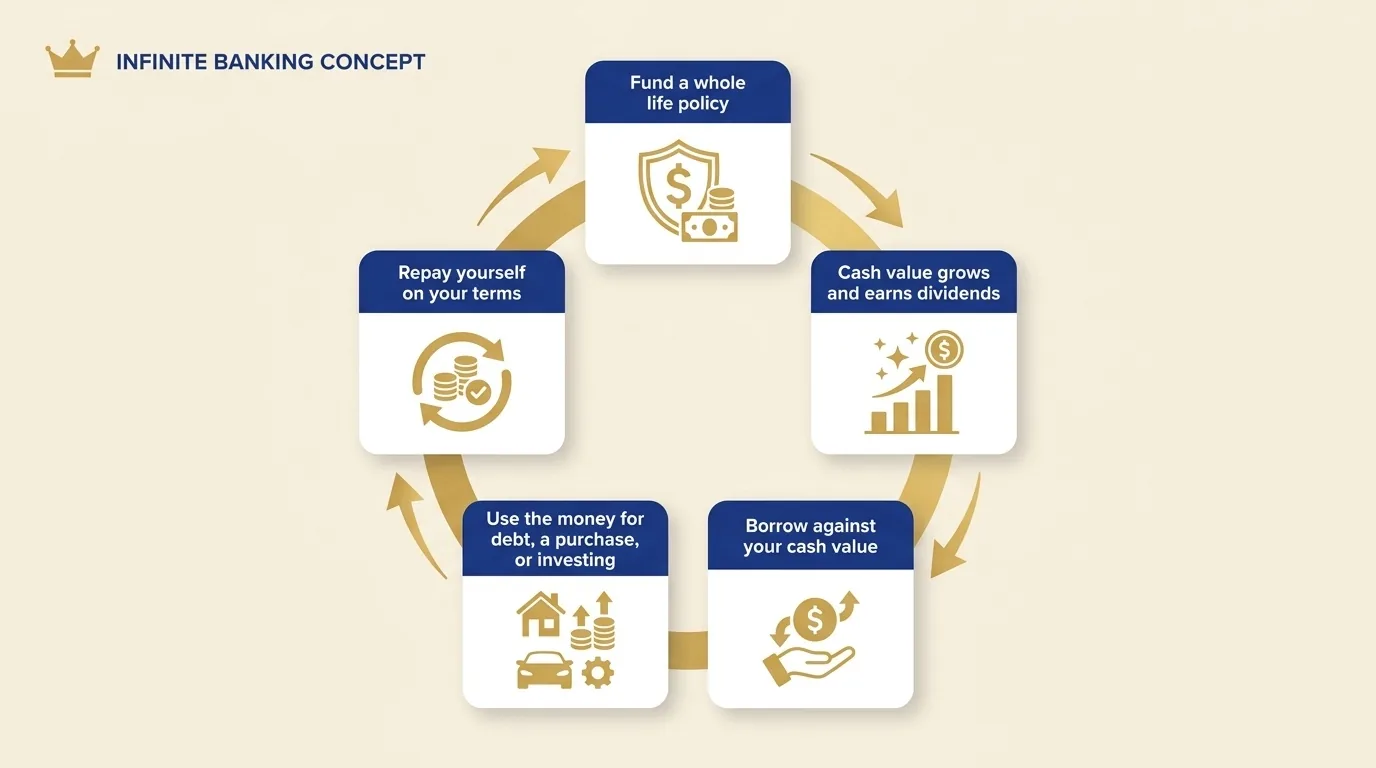
Let me walk the steps the way I would at my kitchen counter with a legal pad, minus the counter.
Step one, you fund a properly structured policy
You buy a dividend paying whole life policy and, critically, you overfund it using a paid up additions rider. That rider pushes extra money into cash value instead of into pure insurance, which is what lets the cash value grow fast in the early years instead of crawling. This is the structural piece Chris Naugle hammers on, and rightly so. Skip it and the strategy barely functions.
Step two, cash value accumulates
As you pay premiums, cash value builds inside the policy. It grows at a contractual guaranteed rate, and on top of that the carrier may pay a dividend if the company performs well. Dividends are not guaranteed, and I will keep saying that because it is the single most glossed over line in these presentations. To understand the engine underneath all of this, it helps to read up on how cash value life insurance actually builds over time before you commit a dollar.
Step three, you borrow against the policy
When you need money, you request a policy loan. The insurance company lends you money and uses your cash value as collateral. Here is the part that sounds like magic and is actually just contract mechanics. Because it is a loan against the policy and not a withdrawal from it, your full cash value generally keeps earning interest and dividends as if you had never touched it. You are borrowing the insurer's money with your value as security.
Step four, you repay yourself
You pay the loan back on a schedule you set, with interest going back toward the policy system rather than to an outside bank. Miss the discipline here and the whole thing weakens, because an unpaid loan plus its interest quietly eats into the death benefit and can, in a bad case, put the policy at risk. The strategy assumes you actually pay yourself back like you would a real bank. That assumption is doing a lot of work.
That loop, fund, build, borrow, repay, repeat, is the entire concept. Everything else is packaging.
The Money Multiplier and Money School
The Money Multiplier is a coaching brand that teaches the infinite banking concept and routes people to agents who set up the policies, and Chris Naugle has been one of its best known educators. His Money School is his own platform for the same mission, teaching people to be your own bank. Both sell education and a framework, then the actual whole life policies are placed by licensed agents.
It helps to separate the layers, because they get blended in the marketing. There is the concept, which is public and older than most of the people teaching it. There is the education business, the courses, events, and coaching that people like Chris Naugle sell around the concept. And there is the product, the whole life insurance policy itself, which a licensed agent has to actually write. When you buy into a program like the Money Multiplier, you are paying for the second layer, the training and the introduction, then you still buy the third layer, the policy, through an agent.
None of that is inherently a problem. Education has value, and a good coach can shorten your learning curve. What I want you to see clearly is the money flow, because it explains the intensity of the marketing. The education layer earns from your enrollment. The product layer earns a commission when the policy is placed. That is not a scandal, it is just how the ecosystem is paid, and knowing it helps you stay level headed when the pitch gets warm. Ask what you are paying for at each layer, and ask whether you could learn the same concept for free and simply buy a well structured policy from an agent you trust.
A worked example, start to finish
A simple example makes infinite banking concrete: you fund a whole life policy, let cash value build for a few years, borrow against it to buy a truck, then repay the policy instead of a lender. Over time your cash value can grow past what you paid in, while you still used the money along the way. The numbers below are illustrative and are not guaranteed.
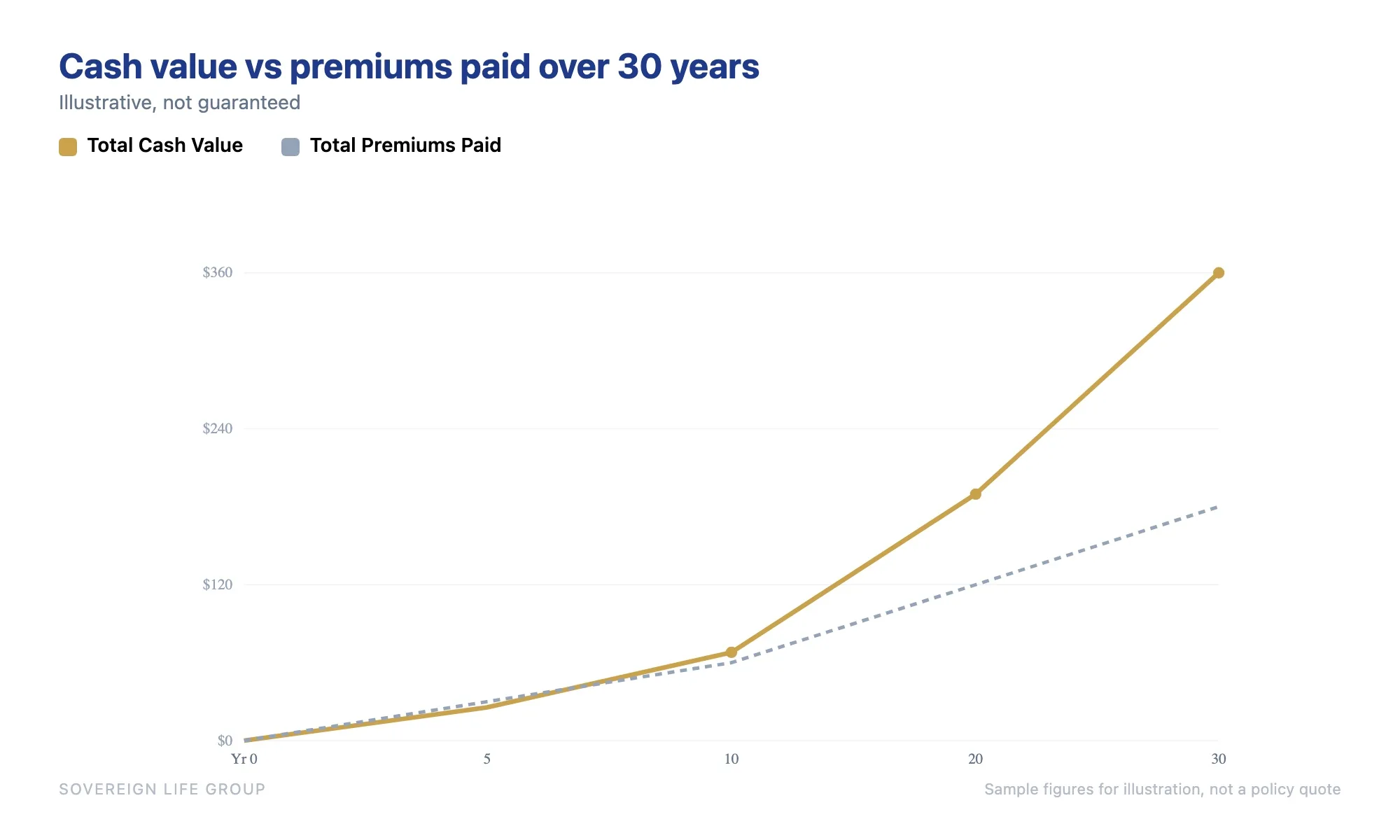
Picture a small business owner who can comfortably put a set premium into a properly structured policy every year. In the first few years, and this is important, the cash value is less than the premiums paid. That gap is the cost of insurance and the early expenses, and it is exactly why this is a long game. Anyone who tells you the numbers look great in year one is not showing you the real illustration.
By year five or so, the cash value has caught up to a healthy chunk of what went in. Now the owner needs a work truck. Instead of financing it through a dealer at whatever rate the finance office offers, he takes a policy loan against his cash value and buys the truck. His cash value, in most designs, keeps earning as if the loan were not there, because he borrowed against it rather than pulling it out. He then pays the loan back over the next few years on his own schedule.
Fast forward and two things have happened. He drove the truck, so the money did its real world job. And his policy kept compounding the whole time, so the long term cash value line pulls away from the premiums line, as the chart above sketches. That crossover, where accumulated value passes total premiums paid, is the payoff people are chasing. It is real. It is also slow, and it depends on him actually repaying those loans and on dividends that are not promised.
Now the honest footnote. If that same business owner had a rough year, skipped the loan repayment, and let interest stack up, the picture dims fast. The death benefit shrinks, the policy needs more attention, and the elegant loop starts to wobble. The example works because the person in it is disciplined and has steady surplus cash. Change those inputs and you change the ending.
Get a fast, free estimate tailored to your age and health.
Infinite banking vs a traditional bank loan
Compared with a traditional bank loan, infinite banking keeps you in control: you set the repayment terms, there is no credit approval on a policy loan, and your underlying cash value can keep growing. The trade is that you give up simplicity and liquidity in the early years, and you take on the responsibility of being disciplined enough to repay a loan that no bank will chase you for.
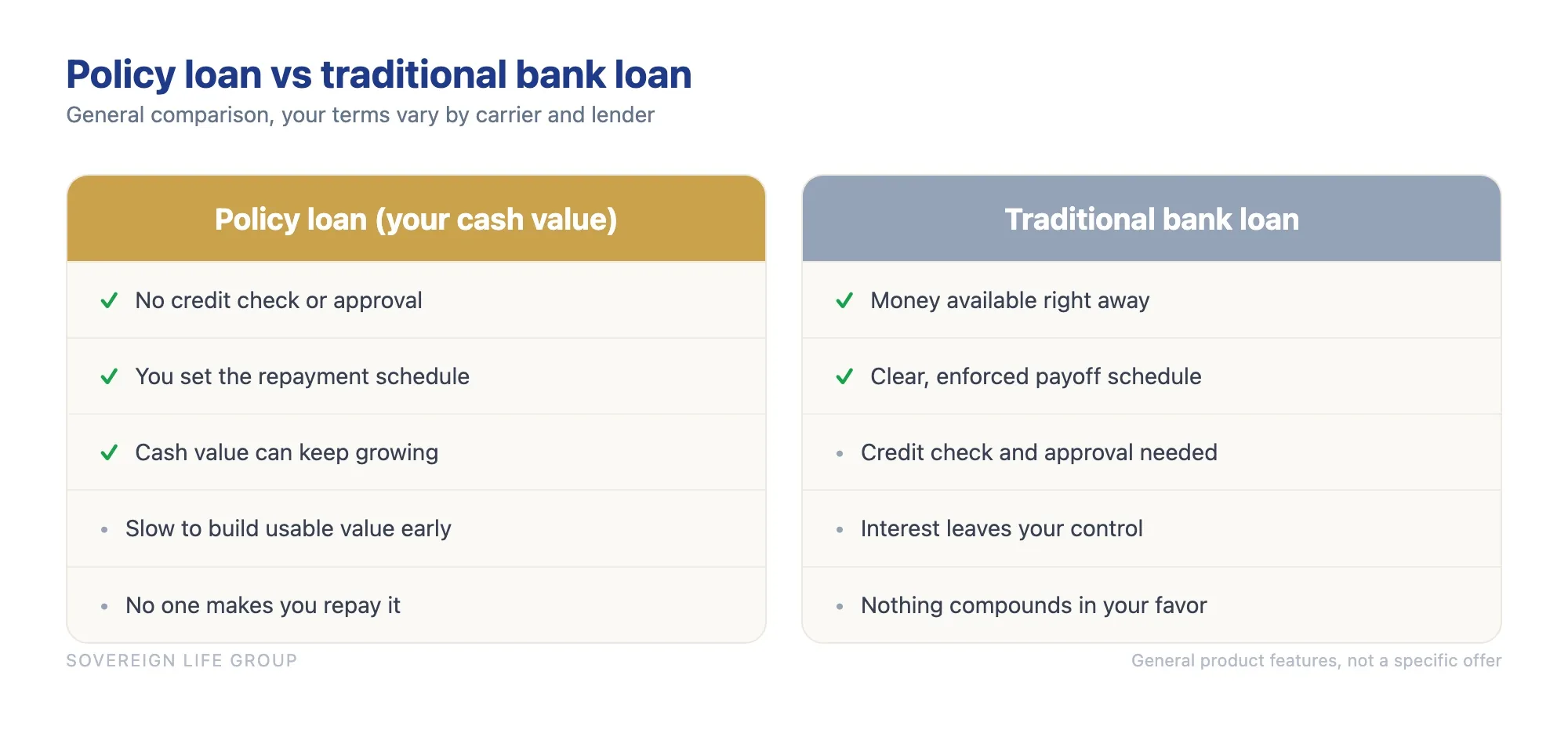
The appeal of the policy loan is control and privacy. There is no loan application, no credit pull, and no bank deciding whether you qualify. You call, you request the loan against your own value, and the money shows up. You decide the repayment pace. For a business owner who values flexibility and hates asking permission, that is genuinely attractive.
The catch is the flip side of that same freedom. A bank loan has a payoff schedule that gets enforced, and that structure protects you from yourself. A policy loan has no one making you pay it back, which sounds like a benefit until you meet the version of yourself that keeps deferring the repayment. I have watched disciplined people use this beautifully and watched others let a loan drift for years until it quietly hollowed out the policy. The tool amplifies whoever you already are with money.
| Factor | Policy loan (infinite banking) | Traditional bank loan |
|---|---|---|
| Approval | No credit check on the loan | Application and credit approval |
| Repayment | You set the schedule, self enforced | Fixed schedule, enforced by the lender |
| What your money does | Cash value can keep compounding | Interest leaves your control |
| Early access | Limited until cash value builds | Available immediately if approved |
| Best fit | Disciplined saver with surplus cash flow | Anyone needing money now |
The honest trade-offs and costs
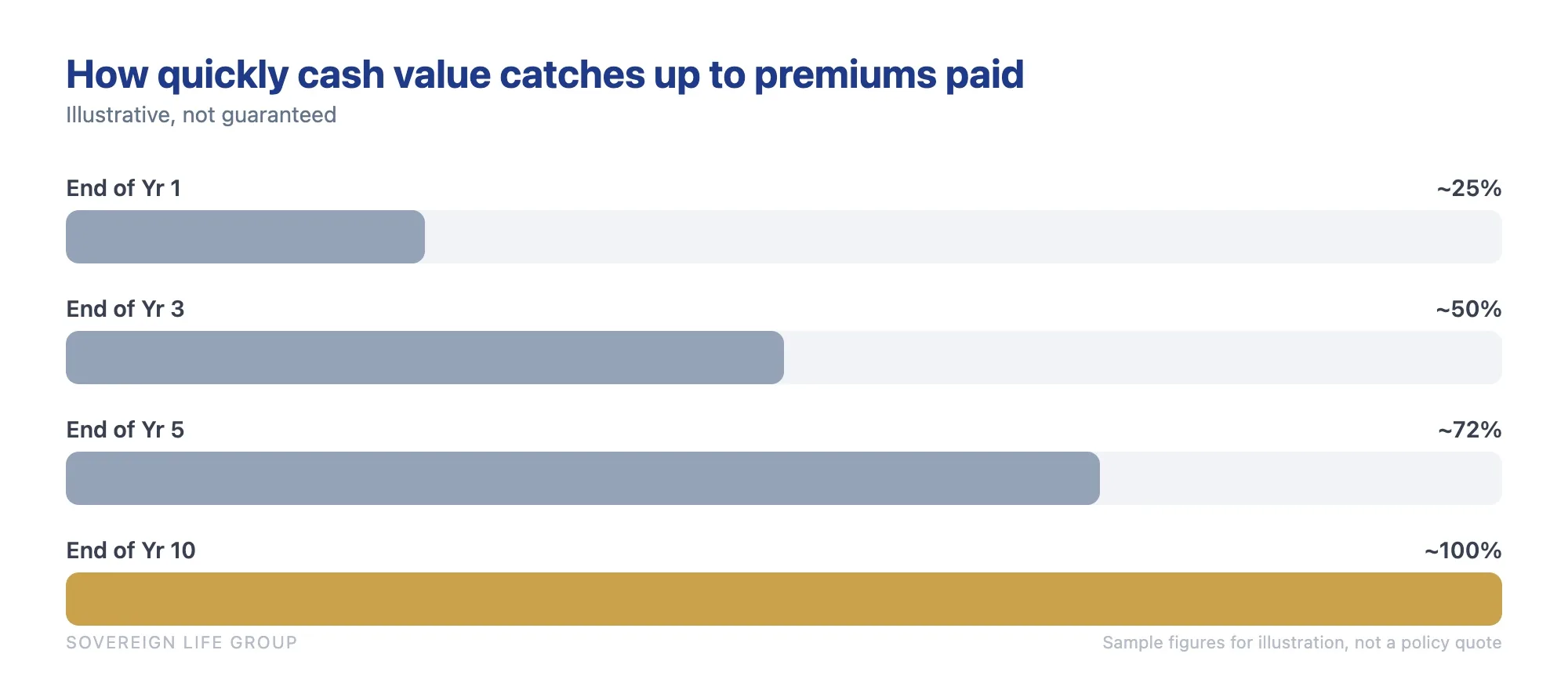
The honest trade-offs of infinite banking are a slow start, real costs, and required discipline. Cash value lags premiums in the early years, whole life is more expensive than term for the same death benefit, dividends are not guaranteed, and the strategy only works if you keep paying premiums and repaying loans. These are not deal breakers, but they are the parts the hype skips.
Let me lay out the costs the way I wish every video did.
It starts slow. Even a well structured policy usually shows cash value below premiums paid for the first several years. That early gap, sketched in the chart above, is the cost of the insurance and the setup. If your plan needs the money to be there and working in year two, this is the wrong vehicle. This rewards patience.
Whole life costs more than term. For the same death benefit, whole life premiums are far higher than term, because part of every dollar funds the cash value engine. That is the point, but it is also a real budget commitment. If cash flow is tight, a big whole life premium is hard to sustain, and this strategy punishes a lapse. It is worth understanding the plain difference between term and whole life insurance before you decide whole life is your tool.
Dividends are not guaranteed. Most attractive infinite banking illustrations lean on a projected dividend. Dividends depend on the insurer's actual results and can be lower than projected. The contractually guaranteed values are the floor you can count on, so read the guaranteed column, not just the sunny one. Any presentation that only shows you the best case is doing you a quiet disservice.
Loan interest is real. Policy loans charge interest. In many designs your cash value keeps earning, which can offset it, but the loan is not free money. If you never repay it, the interest compounds against the policy and can reduce the death benefit or, in a worst case, threaten the coverage.
Watch the MEC line. Overfund a policy too aggressively and the IRS reclassifies it as a Modified Endowment Contract, which strips away some of the tax friendly loan treatment that makes this strategy attractive in the first place. Per the IRS guidance on the taxability of income, the tax treatment of life insurance and its loans follows specific rules, and a MEC classification changes them. A competent agent structures the policy to stay just under that line on purpose. This is not a place for guesswork.
I am not listing these to scare you off. I am listing them because a strategy you understand is one you can actually stick with, and sticking with it is the whole game.
Is infinite banking a scam
Infinite banking is not a scam, but it is frequently oversold. The underlying product, dividend paying whole life insurance, is real, regulated, and has existed for over a century. The valid criticism, voiced loudly by Dave Ramsey and others, is that it is complex, expensive up front, and often marketed with returns and simplicity it cannot honestly promise. The concept is legitimate. Some of the selling is not.
This is the question I get most, so let me be direct. When a strategy gets sold with this much intensity, skepticism is healthy. Dave Ramsey has flatly called infinite banking a scam, and while I think that word is too broad, the instinct behind it is fair. A lot of the marketing does what good marketing does. It flattens a nuanced product into a slogan and adds urgency. That is where people get hurt, not by the insurance itself but by buying it for the wrong reasons and abandoning it when the early years feel slow.
Here is where the critics are right. Whole life is more expensive and more complicated than term. Most families are underinsured on pure protection first, and loading up on a cash value strategy before you have adequate coverage and an emergency fund is backwards. And the "your money grows while you spend it" line, taken literally by a beginner, sets up expectations the guaranteed numbers will not meet.
Here is where the critics overreach. Saying the entire concept is a scam ignores the millions of these policies that pay dividends and death benefits exactly as contracted every year. According to industry research published by LIMRA, a large and persistent share of Americans, more than one hundred million adults in its 2024 findings, say they either have no life insurance or not enough of it. That is a coverage gap, not evidence that permanent insurance is fraudulent. The tool is legitimate. Whether it is right for you is a separate and more personal question, and it is the one worth spending your energy on.
Who infinite banking actually fits
Infinite banking fits disciplined savers with strong, reliable cash flow, a long time horizon, and a genuine need for permanent life insurance anyway. It suits business owners and high savers who already have protection and an emergency fund in place. It does not fit people stretched on budget, carrying high interest debt, or hoping for fast growth, because the early years are slow and demanding.
After years of these conversations, I can usually tell within twenty minutes whether this is a fit. The people it serves well tend to share a profile.
- You have surplus cash flow and can fund a meaningful premium for years without strain.
- You already carry enough life insurance to protect your family, so this is a next step, not your only coverage.
- You have an emergency fund and are not juggling high interest credit card debt.
- You are patient and think in decades, not quarters.
- You genuinely value control and would use the policy loans deliberately, then repay them.
And the profile it does not fit, which matters just as much.
- Money is tight and a large premium would be a stretch to sustain.
- You have high interest debt that should be knocked out before anything fancy.
- You need liquidity and growth in the next year or two.
- You would struggle to repay a loan that no one forces you to repay.
- You mainly need affordable protection, in which case term does that job for far less.
The mistake I see most is people reaching for infinite banking before the basics are handled. If you do not yet have solid protection in place, start there. A well built permanent policy can absolutely be part of a long term plan, and if that is the direction you are exploring, our overview of indexed universal life and tax advantaged cash value strategies is a useful companion read alongside whole life. There is more than one way to build cash value, and the right one depends on you, not on whoever has the best YouTube thumbnail.
How to start the right way
To start infinite banking the right way, get your protection and emergency fund in place first, then work with an independent agent who can structure a dividend paying whole life policy with paid up additions for high early cash value. Compare guaranteed numbers, understand the loan mechanics and the MEC rules, and only commit to a premium you can sustain for the long haul.
If you have read this far and it still feels like a fit, here is the order I would follow.
Cover the fundamentals first
Make sure your family is actually protected and you have an emergency cushion. Infinite banking is a wealth strategy layered on top of a stable base, not a substitute for one. If the base is not there, build it before anything else.
Work with someone who structures these on purpose
This is not a policy you want from an agent who writes one whole life case a year. The structure, especially the paid up additions rider and the balance that keeps you under the MEC line, is technical. An independent agent who shops multiple carriers can build it for cash value efficiency rather than maximum commission. If you want to compare the fundamentals yourself first, our deeper explainer on how the be your own bank strategy really works is a good next stop.
Read the guaranteed column
When you get an illustration, look at the guaranteed values, not just the projected ones. Ask what happens if dividends come in lower. Ask how the policy performs if you are late on a loan repayment. A good agent welcomes those questions. Anyone who dodges them is telling you something.
Commit only to what you can sustain
Pick a premium you can fund through a bad year, not just a good one. The strategy rewards consistency and punishes lapses, so a smaller policy you keep beats a bigger one you abandon. You can often grow the plan later.
The whole point of learning about people like Chris Naugle is to make an informed decision, not an impulsive one. If you want a straight, licensed opinion on whether this fits your situation, you can always reach out and talk it through with a licensed agent before you sign anything. That conversation costs you nothing and can save you from a policy that was never built for you. You can also start by getting to know Sovereign Life Group, your life insurance strategist, and how we shop carriers on your behalf.
Want a straight answer about infinite banking?
Fifteen minutes. We will look at your budget, your existing coverage, and whether a properly structured policy makes sense for you, or whether something simpler does the job. No hype, no pressure.
Get a Quote Book a 15-Min Review Prefer to start with the basics? See how coverage fits a household on the families page.Frequently asked questions
Who is Chris Naugle?
Chris Naugle is a former professional snowboarder turned real estate investor and financial educator. He is the founder of The Money School and a well known teacher of the infinite banking concept, which uses properly structured dividend paying whole life insurance as a personal banking system. He teaches through videos, live events, and his coaching brands.
What is infinite banking in simple terms?
Infinite banking is a strategy where you overfund a dividend paying whole life insurance policy, build cash value inside it, then borrow against that cash value to fund purchases, debt payoff, or investments. You repay the loan on your own schedule, so your money keeps compounding while you use it. Chris Naugle calls this being your own bank.
What is The Money Multiplier that Chris Naugle promotes?
The Money Multiplier is a coaching program that teaches the infinite banking concept and connects people with agents who set up the whole life policies used for it. Chris Naugle has been one of its most visible educators. It sells the training and the framework, then policies are placed through licensed life insurance agents.
Is infinite banking a scam?
Infinite banking is not a scam, but it is oversold. The underlying tool, dividend paying whole life insurance, is real and regulated. The strategy can work for disciplined savers with strong cash flow. The valid criticism, including from Dave Ramsey, is that it is complex, front loaded with cost, and often pitched with returns it cannot promise.
How much money do you need to start infinite banking?
There is no single minimum, but the strategy is built for consistent premiums, often a few hundred dollars a month or more, sustained for years. It rewards people with reliable surplus cash flow. If a monthly premium would strain your budget, a properly structured policy is hard to keep in force, and a lapse can be costly.
Is the cash value in a whole life policy guaranteed?
The guaranteed portion of a whole life policy's cash value is contractually guaranteed by the insurer. Dividends, which many infinite banking illustrations rely on, are not guaranteed and depend on the carrier's performance. Any projection that assumes a steady dividend is an estimate, not a promise, which is why you read the guaranteed column too.
Joseph McDermott is a licensed life insurance agent (NPN 22121673), licensed in 27 states. Brokered through Family First Life, in partnership with Catalyst Life. This article is educational and is not financial, tax, or legal advice. Please talk with a licensed professional about your specific situation. Infinite banking involves whole life insurance, which carries costs and long term commitments. Policy values, dividends, and loan terms vary by carrier and are subject to underwriting approval. Dividends and non guaranteed values are not guaranteed. Guarantees are subject to the claims-paying ability of the issuing insurance company.