Who Is Caleb Guilliams? The AND Asset and Infinite Banking


The Short Version
Caleb Guilliams is the founder of BetterWealth and author of The AND Asset. He teaches a whole life insurance strategy, often called infinite banking, where a properly built policy can grow your money and stay available to use at the same time. The idea is real. It is also oversold. Here is what it actually is, how the math works, and who it does and does not fit.
If you have spent any time watching money content on YouTube, you have probably run into Caleb Guilliams. He is young, he is confident, and he talks about using life insurance in a way that sounds nothing like what most people were taught. Clients ask me about him almost every week now, usually some version of the same question: is this legit, or is it just a slick way to sell whole life insurance? Fair question. I am a licensed agent who sells this stuff for a living, and I am going to give you the honest version, the parts the highlight reels leave out included.
This is not a takedown and it is not a fan page. It is a plain walk through who Caleb Guilliams is, what the AND Asset book actually says, what BetterWealth does, and how the strategy holds up when you run the real numbers.
What this article covers
- Who is Caleb Guilliams
- What the AND Asset book is about
- What BetterWealth is
- Caleb Guilliams and infinite banking explained
- How the AND Asset works: a worked example
- The AND Asset vs saving and investing the normal way
- The honest criticisms and trade-offs
- Who it fits, and who it does not
- My take as an agent
- Frequently asked questions
Who is Caleb Guilliams
Caleb Guilliams is the founder and CEO of BetterWealth and the author of the book The AND Asset. He got his start young. He was a bank teller as a teenager, and by his late teens he was running the investment division of a community bank, which is where he says he first saw how many ordinary people were quietly losing the money game despite following standard advice. In 2017 he left to start BetterWealth, wrote his book, and began building the podcast and YouTube presence he is known for today.
The origin story matters because it is part of the pitch. The short version he tells is that he was inside the traditional financial system, watched it fail regular families, went and studied under a range of financial mentors, and came out convinced there was a better way to think about money. Whether or not you buy every piece of that, the biographical facts are straightforward, and he has built a real company and a large audience around them.
What he is actually known for is one specific idea. He teaches people to use a certain kind of life insurance as a financial tool, not just a death benefit. That idea is old. Caleb's contribution is repackaging it in cleaner language for a younger, online audience, and giving it a memorable name.
The name behind the concept
Here is something worth being clear about up front. Caleb Guilliams did not invent this strategy. The underlying concept, using whole life insurance cash value like your own personal bank, traces back to Nelson Nash and his book Becoming Your Own Banker, which is where the term infinite banking comes from. Plenty of advisors teach versions of it. What Caleb did well was branding. He took a dry, jargon-heavy concept and gave it a hook that a 28-year-old scrolling on their phone can actually follow.
No medical exam for a ballpark. Free, and no pressure.
What the AND Asset book is about
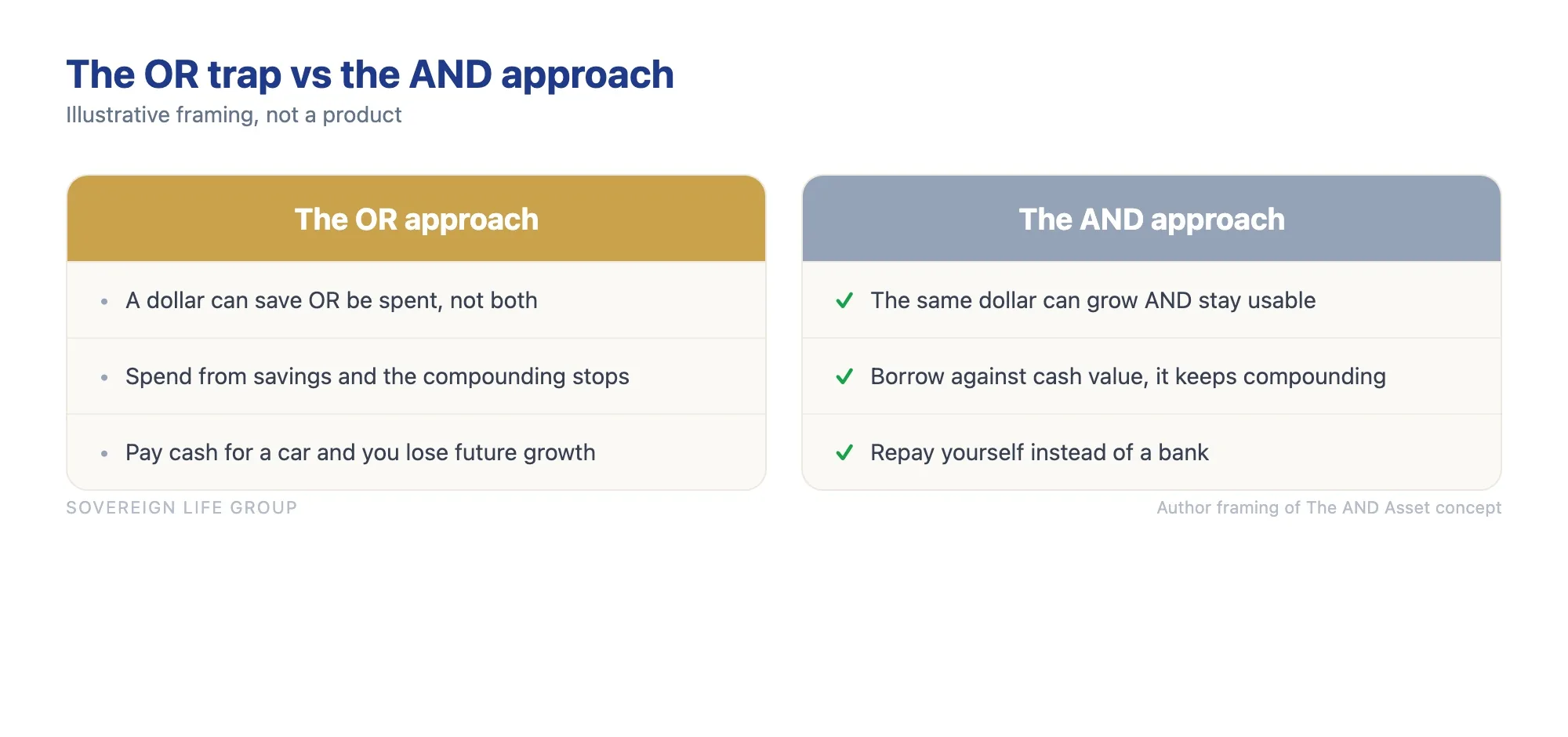
The AND Asset argues that most people are stuck making either or decisions with money, and that the right tool lets you do two things at once. The full title is The AND Asset: The Secret Way to Save AND Use Your Money at the Same Time. The whole book builds toward one claim: a properly structured whole life policy can grow your money and keep it available to spend.
Think about how normal saving works. You put a dollar in an account. If you spend that dollar, it is gone, and it stops growing. That is an "or" decision. You can save it or use it. Guilliams' pitch is that a well-built cash value life insurance policy breaks that trade-off. Your cash value keeps growing based on the full balance, and you borrow against it when you need money, so in his framing the dollar is doing two jobs at once. That is the "and" in the AND Asset.
The book leans hard on the idea of control. A recurring theme is that you should worry less about chasing the highest projected investment return and more about keeping access, certainty, and control over your capital. It is a mindset argument as much as a product argument, and honestly that part is where the book is strongest. Most people have never once thought about where their money lives between the moment they earn it and the moment they spend it.
Now, the fair-minded caveat. The AND Asset is also a marketing engine. The book is genuinely a lead tool for BetterWealth, and there is nothing shady about that as long as you know it going in. A book that exists partly to sell you a policy is going to spend more pages on the upside than the downside. So read it for the concept, then get the trade-offs from someone who is not paid when you buy. That is a big reason I wrote this piece.
What BetterWealth is
BetterWealth is the company Caleb Guilliams founded in 2017 to teach and sell this strategy. It runs a large content operation, a podcast, and an advisory arm that designs and places the whole life insurance policies at the center of the AND Asset approach. In plain terms, it is a financial services firm built around cash value life insurance and the planning that surrounds it.
The BetterWealth audience skews toward business owners and higher earners, people with real surplus cash flow who are looking for somewhere to park capital that is not the stock market or a savings account. That is not an accident. This strategy works best when you have money you can commit for years and a reason to want a pool of accessible capital. A lot of the content is aimed squarely at that person.
Where I would slow you down is here. BetterWealth makes money when you buy a policy. That does not make the advice wrong, but it does mean the incentive runs one direction. Any firm whose revenue depends on placing whole life is going to present whole life as the answer more often than a neutral party would. I hold the same skepticism about my own industry, which is exactly why I show clients term life and plain investing side by side with permanent insurance instead of pretending one always wins. If you want the deeper permanent-versus-temporary breakdown, our guide to term versus whole life insurance lays out both without the sales gloss.
Caleb Guilliams and infinite banking explained
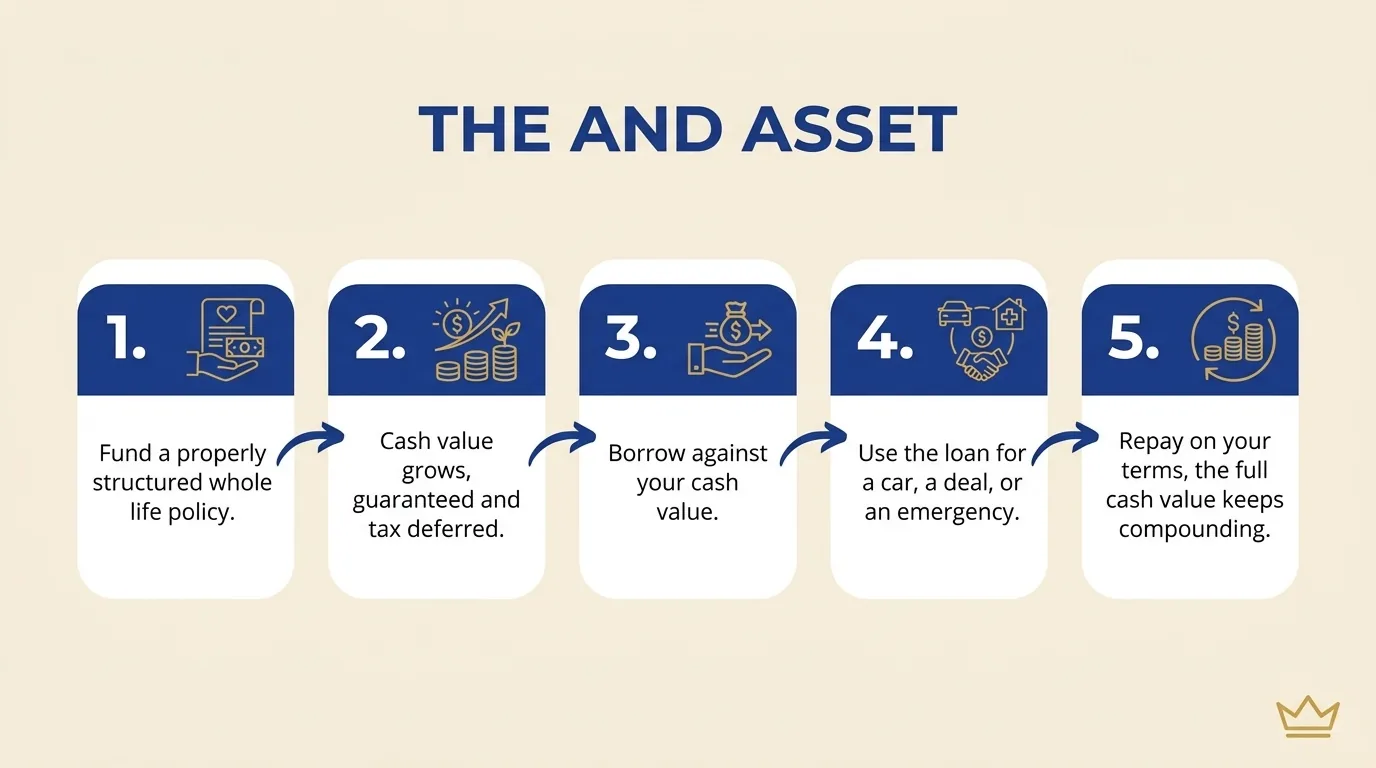
Caleb Guilliams infinite banking is the same idea Nelson Nash popularized decades ago, taught with newer language. You overfund a dividend-paying whole life policy so it builds cash value quickly, then you borrow against that cash value to pay for things, and you repay the loans over time so the money is available again. The policy keeps compounding the whole way through.
Let me break the mechanics down without the jargon, because this is where most explanations lose people.
- You fund a special kind of policy. Not any whole life policy. It is structured with extra paid-up additions so that a large share of your money becomes usable cash value early, instead of most of it going to the insurance cost.
- The cash value grows. It earns a guaranteed rate plus potential dividends, and that growth is tax-deferred inside the policy. The death benefit sits behind it as the actual insurance.
- You borrow against it, not from it. This is the piece people miss. When you take a policy loan, you are not withdrawing your cash value. You are borrowing from the insurer using your cash value as collateral. Your full balance keeps earning, which is the "and" in the whole pitch.
- You repay on your own schedule. There is no fixed payment the way a bank loan works, though unpaid interest and loans reduce the death benefit and can, in a worst case, collapse the policy if you ignore them completely.
The tax treatment is a real part of the appeal, and it is worth stating accurately rather than breathlessly. Cash value grows tax-deferred, policy loans are generally not treated as taxable income while the policy stays in force, and according to guidance from the IRS, life insurance death benefits are generally not counted as taxable income to your beneficiaries. Those are genuine advantages. They are also the reason the product is complex and tightly regulated, so the details matter enormously.
If this whole concept is new to you, I would start with our plainer explainer on be your own bank and how infinite banking works before you go deeper. It walks the same ground more slowly, without a brand attached to it.
Whole life or IUL?
One point of confusion I should clear up. Caleb Guilliams teaches this with dividend-paying whole life insurance, and he has been openly critical of using indexed universal life for the same job. Both are permanent policies with cash value, but they behave differently. Whole life offers more certainty and slower, steadier growth. IUL ties its crediting to a market index with caps and floors, which can mean more upside potential and more moving parts. Neither is automatically better. If you want to understand the other side of that debate, our look at how IUL can build tax-free retirement income covers where indexed policies fit and where they get oversold.
How the AND Asset works: a worked example
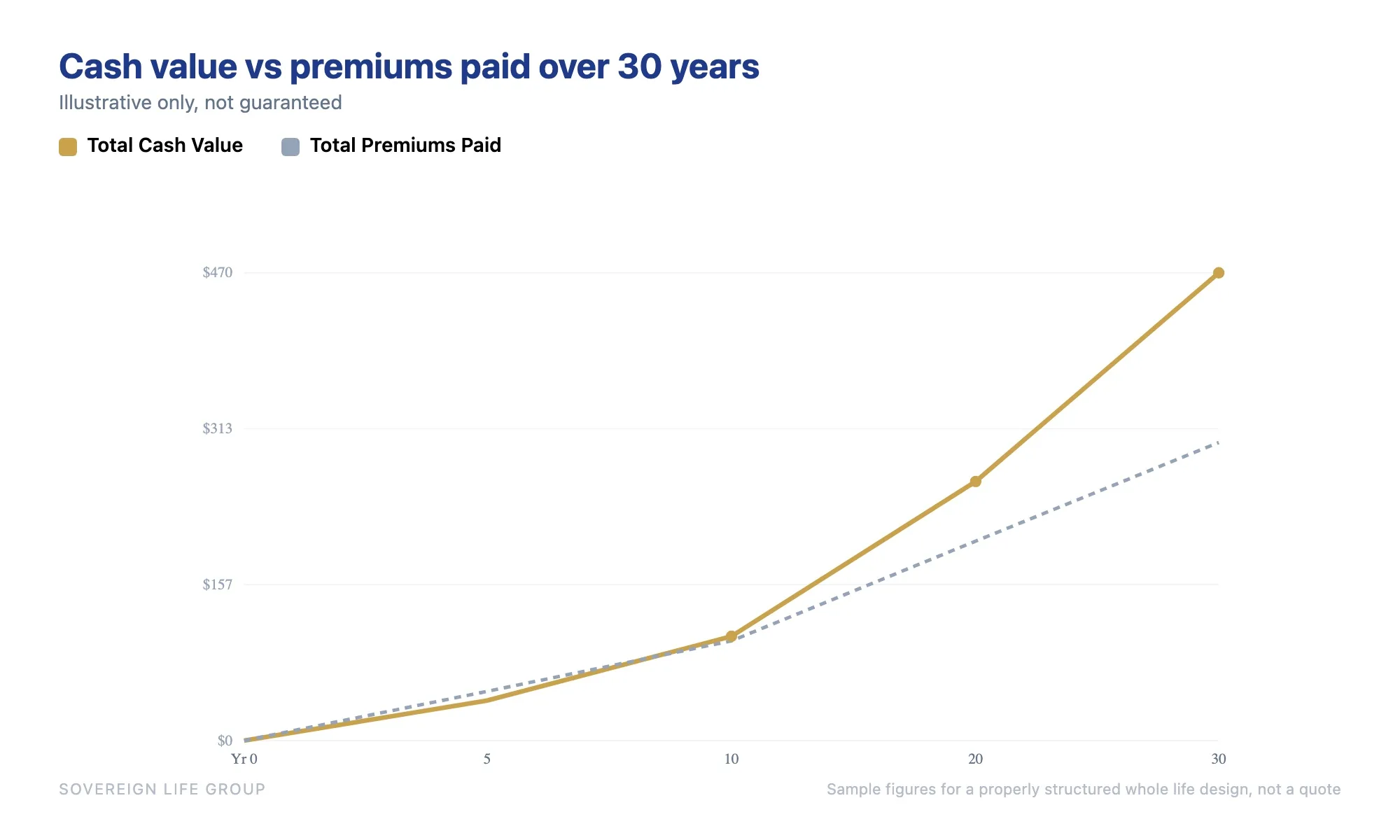
Numbers make this concrete, so let me build a simple, illustrative example. These are round sample figures to show the shape of how it works, not a quote and not a guarantee. Every real policy depends on your age, health, the carrier, and how the policy is designed.
Say a healthy 35-year-old commits 10,000 dollars a year into a whole life policy structured for high early cash value, and plans to keep it for the long haul. Here is roughly how the two numbers that matter behave.
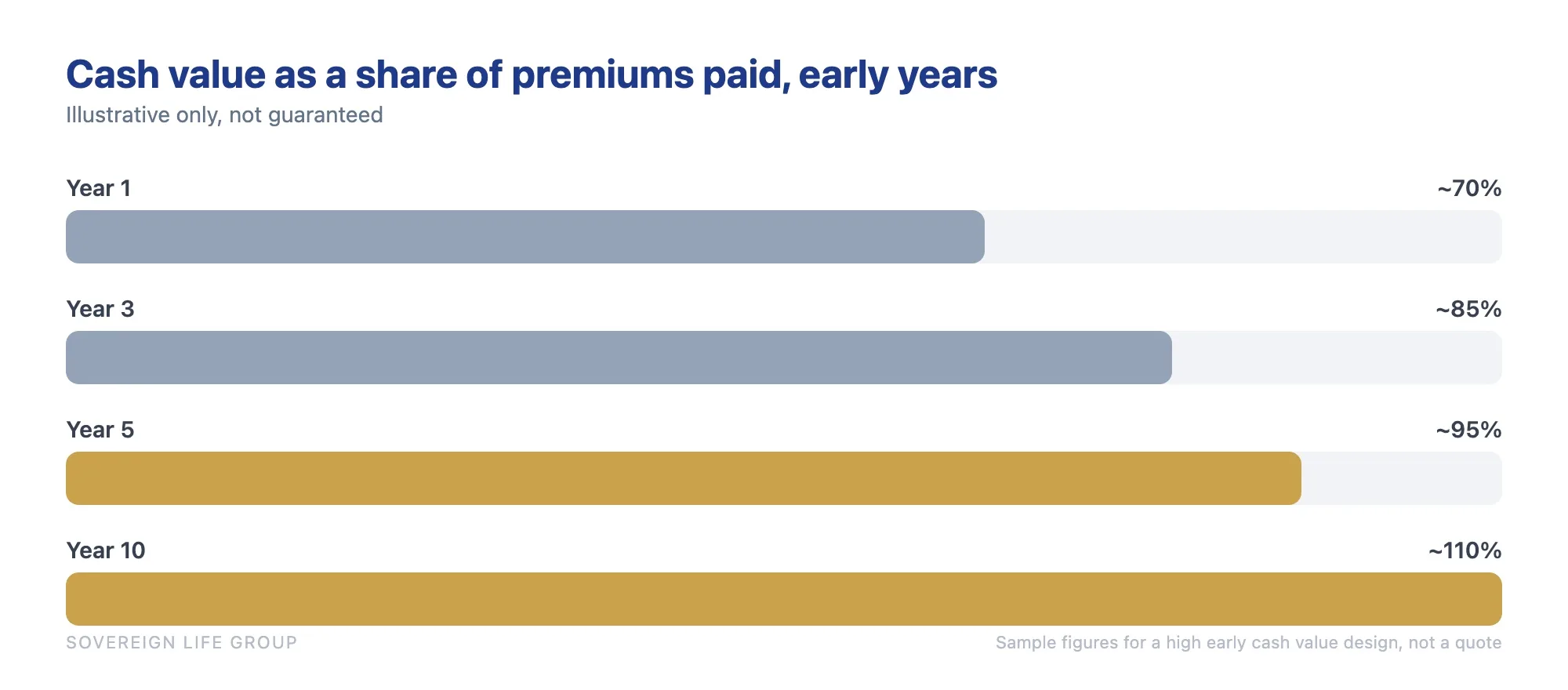
In the early years, the cash value is less than what you have paid in. That is the part the hype videos skip. In year one you might see something like 70 cents of cash value for every dollar of premium, because part of your money went to the actual cost of insurance and the agent's commission. By somewhere around year eight to ten, in a well-built design, the cash value catches up to and passes the total premiums you have paid. From there it keeps compounding, and the gap widens in your favor over the decades.
Now the "and" part in action. Suppose in year twelve you want to buy a 30,000 dollar truck. Instead of draining a savings account or taking a dealer loan, you take a policy loan against your cash value. Your full cash value keeps earning as if you never touched it, and you repay the loan over the next few years on your own schedule, with the interest going to keep the arrangement in force. When it is paid back, that capital is available again for the next thing. That recycling of the same pool of money is the entire point of the strategy.
Run that pattern across a lifetime and the appeal starts to make sense. You are trying to become the source of your own financing, so that the interest and fees you would have paid to banks and lenders stay closer to your own balance sheet. That is a genuinely different way to think about cash flow. Whether it beats simply investing the difference is the real debate, and it depends heavily on discipline, rates, and how long you hold the policy.
Get a fast, free estimate tailored to your age and health.
The AND Asset vs saving and investing the normal way
The AND Asset is not automatically better or worse than a savings account plus an index fund. It trades higher long-term growth potential for certainty, tax advantages, and access to capital. For a disciplined investor with a long horizon, ordinary investing may build more wealth. For someone who values guarantees and a usable pool of cash, the policy can be worth the trade-off.
Here is the comparison the sales material tends to blur. A whole life AND Asset policy and a plain "buy term and invest the difference" plan are solving overlapping problems in very different ways. Let me lay them side by side honestly.
| Factor | AND Asset (whole life) | Term life + investing |
|---|---|---|
| Growth potential | Lower and steadier, with guarantees | Higher potential, with market risk |
| Certainty | Guaranteed floor plus possible dividends | No guarantees, values can fall |
| Access to money | Loans against cash value, flexible | Sell investments or use savings |
| Early years | Cash value lags premiums at first | Money is fully invested from day one |
| Cost and fees | Higher, built into the policy | Term is cheap, fund fees are low |
| Discipline required | Structured, forces the habit | You must invest the difference yourself |
| Tax treatment | Tax-deferred growth, tax-advantaged access | Taxable unless in a retirement account |
Notice that last row on discipline, because it is underrated. The classic argument against whole life is "buy term and invest the difference." It is a good argument on paper. The problem is that most people never actually invest the difference. They spend it. A whole life policy is a forced savings habit with a bill that shows up whether you feel like saving that month or not. For a natural saver, that structure is unnecessary. For someone who has never managed to build real assets despite a good income, it can be the thing that finally works. I have seen both kinds of people, and I try to steer each toward the tool that matches who they actually are, not who they wish they were.
This gap between what people say they will do and what they do is not a small thing. It is worth pointing out that, according to 2024 ownership research from LIMRA, about 59 percent of American adults own life insurance at all, and a record 42 percent of adults, roughly 102 million people, say they need it or need more than they have. Most families are underinsured and under-saved to begin with. Against that backdrop, a strategy that forces both coverage and saving has a real argument in its favor, even if it is not the perfect fit for everyone.
The honest criticisms and trade-offs
The fair criticism of the AND Asset is not that it is a scam. It is that it gets oversold. The strategy is slow to start, the fees and commissions are real, it demands a long commitment, and it is a poor fit for anyone whose finances are not already stable. Presented as a miracle, it sets people up for disappointment. Presented honestly, it is a legitimate tool for the right person.
Let me go through the specific objections, because you deserve the real ones, not a strawman.
The early years lag
This is the big one. In the first several years, your cash value is usually less than what you have paid in. If you fund a policy and then need to walk away in year two or three, you can lose money. This is a long-game product. Guilliams himself will tell you it is not built for a two-year time horizon, but a lot of the excited people who find him online miss that part.
The cost is real
Whole life insurance is more expensive than term for the same death benefit, and part of your early premium covers insurance cost and commission. That cost buys you the guarantees and the tax treatment, so it is not wasted, but pretending it is not there does you no favors. You are paying for certainty and structure. Decide if that is worth it to you.
Design is everything, and bad designs exist
A policy sold as an AND Asset but structured like an ordinary whole life policy, with little paid-up additions and a fat commission, can perform badly for this purpose. The whole strategy depends on the policy being built for high early cash value. Not every agent knows how or wants to build it that way, because the commission is often lower on a well-structured design. That is a real conflict, and it is why the person selling it matters as much as the concept.
Opportunity cost is a fair complaint
Critics point out that money locked into a slow-growing policy could have been in the market compounding faster. Over long stretches, historically, diversified stock investing has produced higher returns than whole life cash value. That is a legitimate point. The counter is that the two are not really the same asset class, and the policy is meant to replace the cash and bond part of your plan, not your growth investments. Both sides have a point, and anyone who pretends it is settled is not being straight with you.
It is not for everyone, full stop
If you do not have an emergency fund, if you carry high-interest debt, if your income is unstable, or if you might need to stop funding it within a few years, this is not your move yet. The most common mistake I see is someone with a shaky financial foundation getting excited by a video and trying to jump straight to the advanced strategy. Get the basics solid first. The policy will still be there.
Who it fits, and who it does not
The AND Asset fits people with stable income, surplus cash flow they can commit for a decade or more, and a reason to want accessible, guaranteed capital. It does not fit people who are still building an emergency fund, carrying high-interest debt, or unsure they can keep funding it. Matching the tool to your actual situation matters more than the strategy itself.
Here is my quick gut check, the same one I would run on the phone with you.
It may fit you if
- You have a fully funded emergency fund and no high-interest debt.
- You have consistent surplus cash flow you are confident you can commit for 10 or more years.
- You are a business owner or high earner who wants a pool of accessible capital outside the market.
- You already max out the obvious tax-advantaged accounts and want another bucket.
- You value certainty and forced discipline more than chasing the highest possible return.
It probably does not fit you if
- Your budget is tight or your income is unpredictable month to month.
- You have credit card balances or other high-interest debt to clear first.
- You mainly need a large, cheap death benefit to protect young kids, where term wins on cost.
- You are a disciplined investor who will genuinely invest the difference on your own.
- You might need to stop paying within a few years, when the early-year lag would bite.
For a lot of younger families I talk to, the honest first move is not the AND Asset at all. It is a big, affordable term policy to cover the income years, plus steady investing, and then a permanent cash value strategy layered in later once the foundation is rock solid. There is no prize for skipping steps. If your priority right now is simply protecting your family for the lowest cost, start there, and our broader guide to cash value and tax-advantaged life insurance can show you how the permanent piece fits once you are ready.
My take as an agent
My honest read on Caleb Guilliams is that he does more good than harm. He gets people who never thought about money to start thinking about it, and the AND Asset is a legitimate strategy when it is built right and matched to the right person. The danger is not the man or the concept. It is people copying an advanced move without the foundation underneath it.
I will give him real credit. Guilliams is a good teacher, and he has pulled a lot of people out of financial autopilot. The concept of control, of caring about where your money lives and not just what it might return, is worth internalizing whether or not you ever buy a policy. And to his credit, in his more careful content he does warn against the exact unrealistic expectations that his more excitable followers run with.
Where I part ways with the loudest version of this online is the certainty. Whole life is a tool. It is not the only tool, it is not free money, and it is not right for every person who stumbles onto a compelling video at 11pm. The people who get burned are almost always the ones who skipped the boring foundation and jumped straight to the advanced play. I have had to gently talk more than one person off that ledge, not because the strategy is bad, but because it was the wrong strategy for where they were standing at that moment.
So take the good idea. Sit with the concept of control. Then, before you commit real money for real years, get a look at your own numbers from someone who wins when you make the right call, not just when you buy a policy. That is the whole reason a licensed strategist is worth talking to before you act on a book.
Want a straight answer for your situation?
Fifteen minutes. We will look at your income, your goals, and whether a cash value strategy or plain term life fits you better. No jargon, no hype, just the options laid out honestly.
Get a Free Look Book a 15-Min Review Prefer to ask a question first? You can reach out to a licensed human and start there.Frequently asked questions
Who is Caleb Guilliams?
Caleb Guilliams is the founder of BetterWealth and the author of The AND Asset. He started as a bank teller, took over a community bank's investment division in his late teens, and launched BetterWealth in 2017. He is known for teaching a whole life insurance strategy often called infinite banking.
What is the AND Asset book about?
The AND Asset argues that money should not force you into either or choices. Guilliams uses a properly structured whole life insurance policy as an asset that can grow and stay available at the same time, so you can build cash value while still using that money for other opportunities. It is his version of the infinite banking idea.
Is the AND Asset the same as infinite banking?
They are closely related. Infinite banking is the older term from Nelson Nash for using whole life cash value like a personal bank. The AND Asset is Caleb Guilliams' branding and teaching of the same core mechanics, with his own language and framework. The underlying product and the trade-offs are the same.
Is Caleb Guilliams' AND Asset strategy a scam?
No. Whole life insurance is a real, regulated product and the concept is legitimate when the policy is designed well. The fair criticism is that it is oversold, the early years lag, and the fees and commitment are real. It fits some people and is a poor fit for others. Treat it as one tool, not a miracle.
Do you have to buy whole life insurance to use the AND Asset?
Yes. The AND Asset is built on a permanent life insurance policy, usually a dividend-paying whole life policy structured for high early cash value. Without that policy there is no cash value to borrow against, so the strategy does not exist in any other form. That is why the design of the policy matters so much.
How much money do you need to start the AND Asset strategy?
There is no single number, but it works best for people with steady surplus cash flow they can commit for years, often a few hundred dollars a month or more. If your budget is tight or your emergency fund is thin, term life plus ordinary investing is usually the smarter first step.
Joseph McDermott is a licensed life insurance agent (NPN 22121673), licensed in 27 states. Brokered through Family First Life, in partnership with Catalyst Life. This article is educational and is not financial, tax, or legal advice, and it is not affiliated with or endorsed by Caleb Guilliams or BetterWealth. Please talk with a licensed professional about your specific situation. Product availability, features, riders, and rates vary by state, age, health, and carrier, and any coverage is subject to underwriting approval. Policy loans and withdrawals reduce cash value and the death benefit and may have tax consequences. Guarantees are subject to the claims-paying ability of the issuing insurance company.