Buying Life Insurance Online vs an Agent: How to Choose

The Short Version
Buying life insurance online is fast and works fine for a healthy person who wants simple term coverage and already knows the amount. An independent agent earns their keep when your health is complicated, the benefit is large, or you want more than one carrier competing for you. For most families the smartest path is a hybrid: research online, then let an agent shop the market and place the policy.
If you have started shopping at all, you have already run into the central question: is buying life insurance online vs an agent the smarter move, or are you leaving money and coverage on the table by skipping a human? A slick website promises a quote in minutes and no phone call. An agent promises to do the heavy lifting for you. Both are telling the truth about their own strengths, and both leave out the part that would help you decide. This guide fills that gap.
I write as a licensed independent agent, so treat me as biased and read accordingly. That is exactly why the sections below spell out when you should skip me and buy online, and when a human genuinely saves you money and heartache. The goal is not to talk you into a call. It is to help you buy the right coverage the right way, whichever way that turns out to be.
What this guide covers
- What the online vs agent choice really is
- How buying life insurance online works
- What a life insurance agent actually does
- Broker vs agent vs direct: the real differences
- Is it cheaper to buy online?
- Why the online quote and your real rate differ
- A worked example: same person, two paths
- When health history changes everything
- Term is simple, permanent is not
- Pros and cons at a glance
- The hybrid path most families want
- How to choose an agent you can trust
- Frequently asked questions
What buying life insurance online vs an agent really means
Buying life insurance online vs an agent is not really a fight between a website and a person. It is a choice about who does the shopping. Online, you are usually matched to one carrier's underwriting on your own. With an independent agent, one person compares many carriers and steers your file to the one likely to price you best.
Once you frame it that way, most of the noise falls away. The website is a channel. The agent is a channel. What actually changes your outcome is how many companies get to compete for you, and how well your particular situation gets matched to the company that treats it kindly. A perfectly healthy 30 year old and a 55 year old who had a heart stent last year are asking very different questions, even though the headline choice looks the same.
There is also a naming tangle worth clearing up early. You will see "direct," "online," "captive agent," "independent agent," and "broker" used loosely and sometimes interchangeably. They are not the same, and the differences decide how much of the market is working for you. We untangle those terms in detail below, but hold onto the one idea that matters most: your result depends on how many carriers are in the race, not on whether a form or a human hits submit.
No medical exam for a ballpark. Free, and no pressure.
How buying life insurance online works
Buying life insurance online means you complete a quote and application through a website instead of talking to a person first. You enter your age, sex, height, weight, tobacco use, and a coverage amount, the platform returns an estimated rate, and you finish a health questionnaire. Approval can be instant for healthy applicants, or it routes to underwriting.
Under the hood there are two very different things people both call "online," and telling them apart matters.
Direct to consumer platforms
Some carriers and tech-forward companies sell straight to you with no agent in the loop. You answer questions, an automated engine called an accelerated underwriting model scores your file against data it can pull quickly, and many healthy applicants get an instant decision. It is genuinely fast and genuinely convenient. The limit is simple: you are being evaluated by one company's rules, and if that one company does not like a detail in your history, the process does not go find you a friendlier one.
Online agencies and marketplaces
Other sites look like direct platforms but are actually licensed agencies. You start online, and behind the scenes a licensed agent or a comparison engine can place your application with one of several carriers. This is closer to what an independent agent does, though how many carriers they truly shop, and how much a human reviews your file, varies a lot from one site to the next. The clean question to ask any online seller is this: how many companies can you actually submit my application to, and who looks at it if the computer says no?
In its 2024 Insurance Barometer, research published by LIMRA found that roughly 3 in 10 consumers say they would prefer to buy life insurance online, and carriers have responded by making the front end faster and smoother. That is a real win for convenience. Just keep the accelerated part in perspective: fast is about the process, not about whether you got the best home for your specific health and budget.
What a life insurance agent actually does
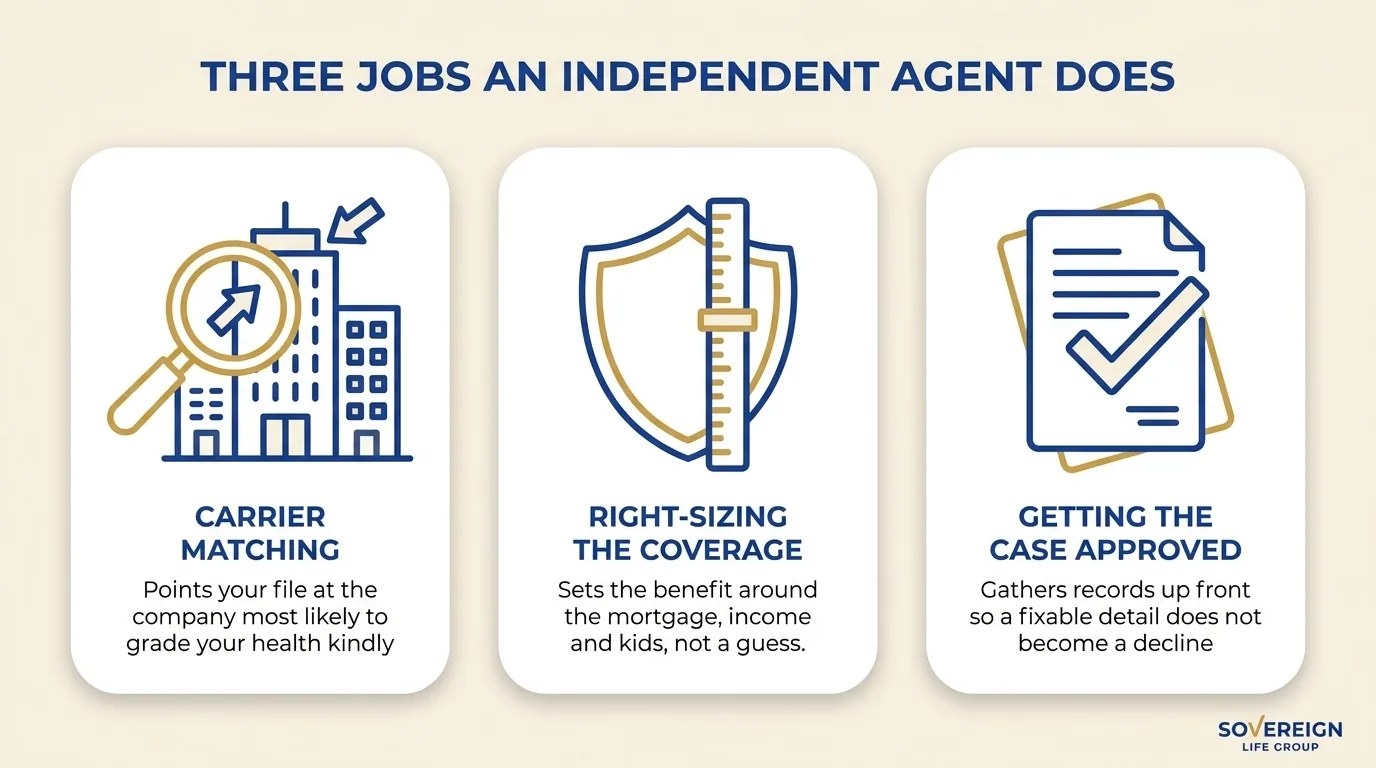
A good independent agent does the shopping, the translating, and the placing. They gather your health and financial picture, know which carriers grade conditions like yours the most favorably, run your file across many companies, explain the trade-offs in plain language, and manage the application so a fixable detail does not turn into a decline. The independent agent value is in the matching, not the paperwork.
Break that down and it is less mysterious than it sounds. Three jobs are doing the real work.
- Carrier matching. Every company underwrites differently. One is easy on well-managed diabetes, another is generous with a past DUI that is now years back, a third loves runners and is tough on higher body weight. An agent who places policies every week carries a working map of who forgives what, and points your file at the kind spots.
- Right-sizing the coverage. A form asks how much you want. A person asks what you are protecting: the mortgage, the income, the kids getting through college, a business loan you personally guaranteed. That conversation is how people avoid being underinsured, which is the far more common mistake than overpaying. Our guide to how much life insurance you need walks through the math an agent would.
- Getting the case approved. Applications get delayed or declined over missing records, an unexplained note in a chart, or the wrong carrier for the risk. An agent anticipates those, gathers what the underwriter will ask for, and knows when to move a case rather than accept a bad offer.
The honest caveat: not every agent operates this way. A captive agent tied to one company can only offer that company, and some agents lean toward the product that pays them most rather than the one that fits you best. So "use an agent" is not automatically good advice. "Use an independent agent who shows you options and explains trade-offs" is.
Broker vs agent vs direct: the real differences
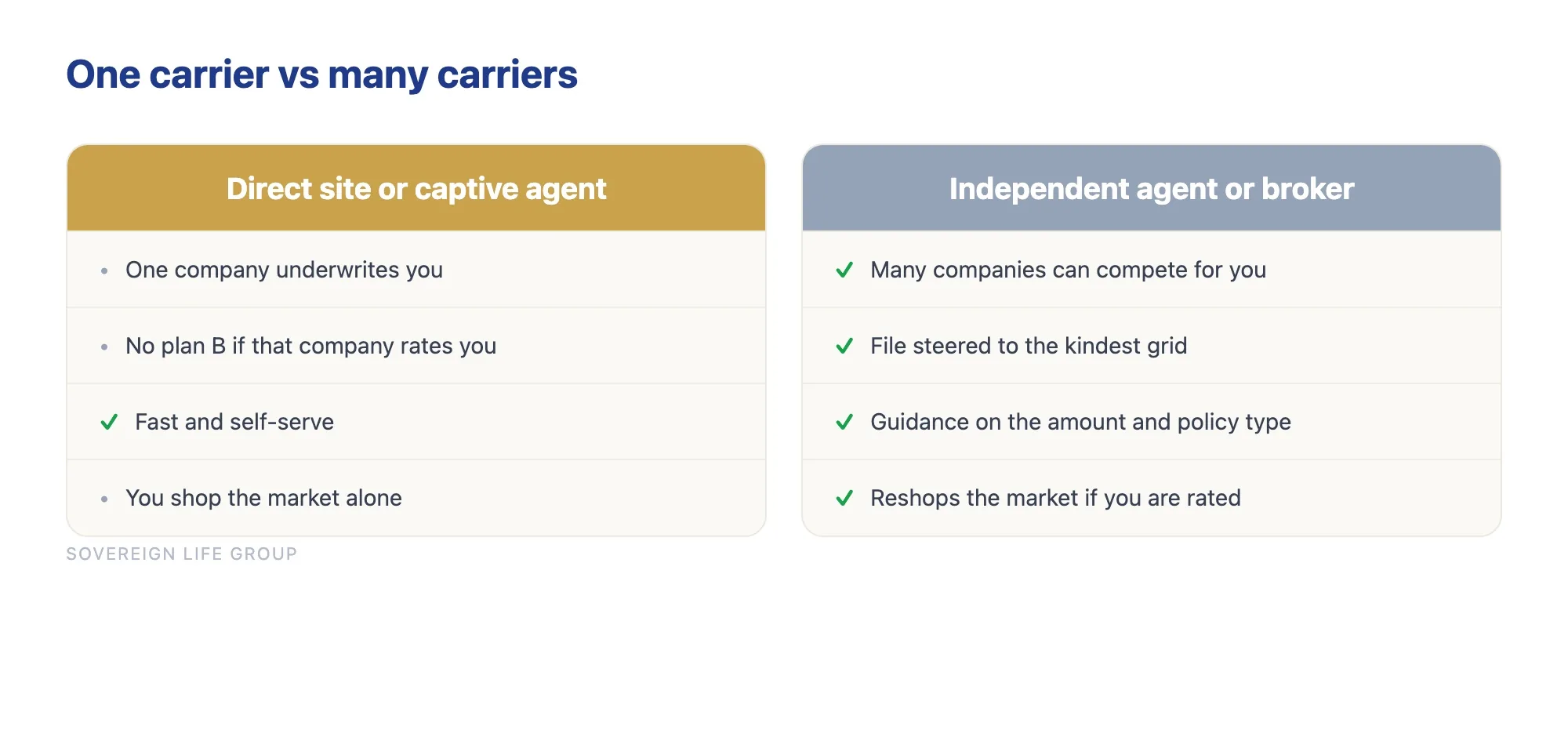
The difference between a life insurance broker vs direct buying, and between a broker and an agent, comes down to one thing: how many carriers can compete for you. Direct and captive both mean one company. An independent agent or broker is appointed with many companies and shops them. The titles blur in daily use, so judge by carrier count, not the label.
Here is the plain-English version of each term you will run into:
- Direct to consumer. You buy straight from one carrier, usually online. One company, no shopping.
- Captive agent. A licensed person who represents a single company and sells only its products. One company, with a human attached.
- Independent agent. A licensed person appointed with many carriers who can compare them for you. Many companies, human guidance.
- Broker. In life insurance, this word is used almost interchangeably with independent agent. Both shop multiple carriers on your behalf. Do not get hung up on the label, ask how many companies they can actually place you with.
Notice what the meaningful line is. It is not broker versus agent. It is one carrier versus many carriers. A captive agent and a direct website share the same core limitation even though one is a person and one is a form. An independent agent and a good online agency share the same core strength. When you compare life insurance broker vs direct options, you are really asking whether one company or the whole shelf gets to bid for your business.
| Path | Carriers shopped | Human guidance | Best fit |
|---|---|---|---|
| Direct to consumer site | One | Little to none | Healthy, simple term, knows the amount |
| Captive agent | One | Yes, one company | Loyal to a brand, simple needs |
| Online agency | A few to many | Varies by site | Wants speed plus some choice |
| Independent agent or broker | Many | Yes, full | Health history, larger benefit, wants options |
Is it cheaper to buy online?
Buying online is not automatically cheaper. The same policy from the same carrier costs the same whether a website or an agent submits it, because the agent commission is already baked into the rate that state regulators approved. You do not save the commission by cutting out the agent. What actually lowers your price is shopping more carriers, and that favors an independent agent.
This surprises people, so it is worth sitting with. Life insurance rates are filed with and approved by state insurance departments. A carrier cannot legally quote you one price online and a secretly higher price through an agent for the identical policy. The commission is part of the pricing either way. So the common instinct, "I will buy direct and pocket the middleman's cut," is usually chasing savings that do not exist.
Where real dollars are won or lost is the health class you land in. Two carriers can look at the same person and put them in different rate tiers, and the gap between a preferred and a standard class on a large policy can add up to thousands of dollars over the life of the coverage. An independent agent whose whole job is matching your history to the carrier that grades it best is far more likely to capture that difference than a single website matching you to its own grid.
Why the online quote and your real rate differ
The number on an online quote and the price on your final policy often differ because the quote assumes a health class before anyone reviews your file. Instant tools typically ask only age, sex, height, weight, and tobacco, then show the best-case rate. Underwriting can move you to a different class once it sees your full history, and the premium moves with it.
This is one of the most common frustrations in the whole process, and it is not usually a bait and switch. It is the difference between an estimate and an underwritten offer. A few reasons the two drift apart:
- The quote used the top tier. Many quote engines default to preferred plus, the best and least common class. Most people do not land there, so the real rate is higher, sometimes noticeably.
- Records added detail the form missed. Underwriters pull prescription histories, motor vehicle records, and sometimes medical records. A medication or a note you forgot to mention can nudge the class.
- Build, family history, or lab results. Height and weight together, a family history of early heart disease, or lab values from an exam can all shift the offer from the estimate.
Here is where the buying path quietly matters. When a direct site comes back with a higher-than-quoted offer, your realistic choices are take it or start over somewhere else. When an independent agent gets that same news, they can shop the adjusted profile to other carriers and often find one that grades the exact same detail more gently. Same you, same history, better home. That is the difference between one grid and the whole market.
Get a fast, free estimate tailored to your age and health.
A worked example: same person, two paths
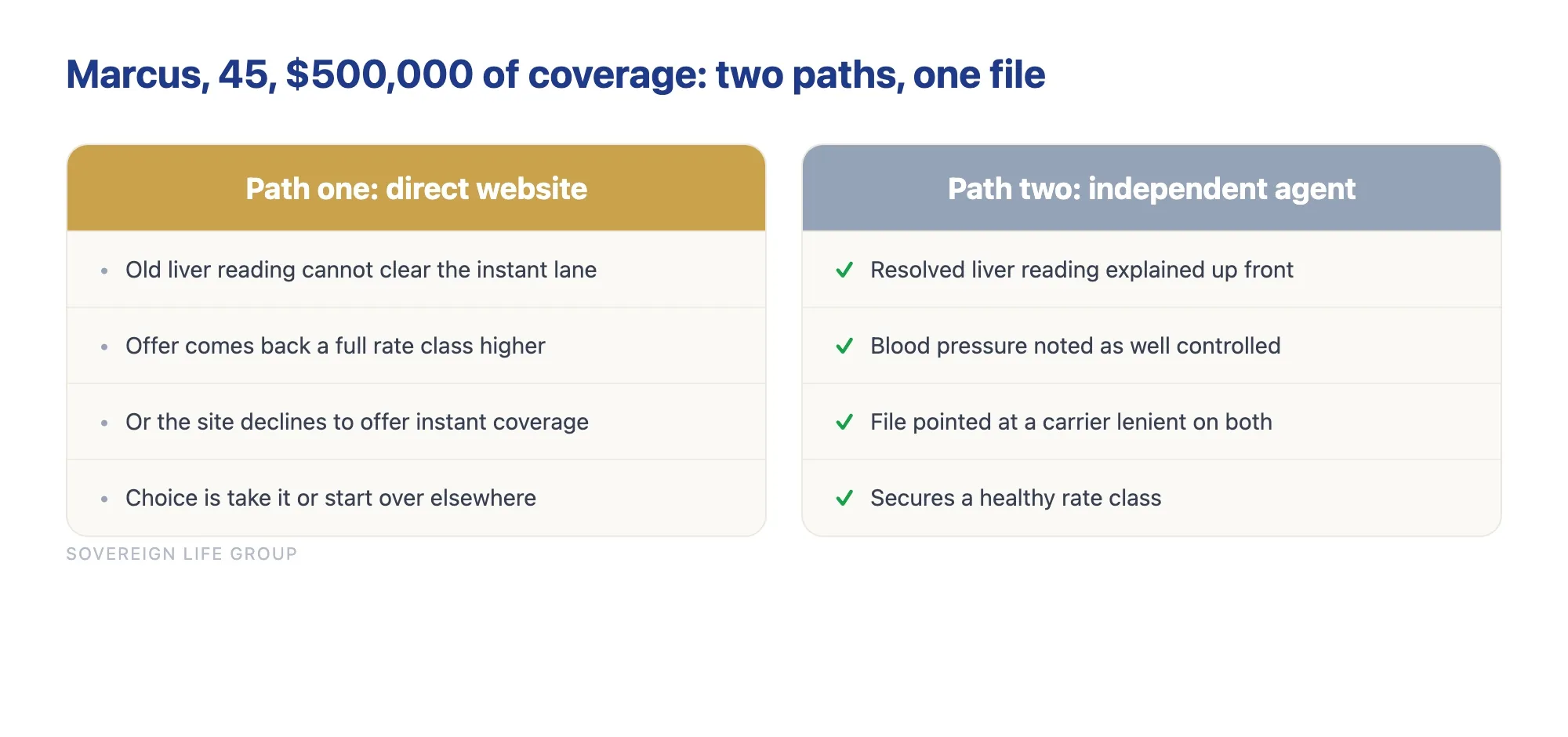
Consider one applicant walking both paths. This is an illustration, not a quote, but it shows exactly where buying life insurance online vs an agent produces a different result for the identical person on the identical day.
Meet a fictional shopper, Marcus, age 45. He wants roughly $500,000 of coverage to protect his family and a chunk of mortgage. He is a healthy weight, does not smoke, exercises, and takes one blood pressure medication that his doctor considers well controlled. He also had one elevated liver enzyme reading on a routine physical two years ago that resolved on a follow-up test.
Path one: the direct website
Marcus uses a fast direct-to-consumer platform on a Sunday night. The instant quote, built on the best health class, looked very attractive. He answers the health questions honestly, including the old liver reading. The automated engine cannot cleanly resolve that flag on its own, so it kicks the file out of the instant lane, asks for more information, and eventually returns an offer a full rate class higher than the quote, or in some versions simply declines to offer instant coverage and invites him to try later. Marcus is now discouraged, half-convinced he is uninsurable, and tempted to give up. Nothing about that outcome was dishonest. It was one company applying one set of rules.
Path two: the independent agent
Marcus instead sends the same details to an independent agent. The agent recognizes that the single, resolved liver reading is a detail some carriers wave through with a brief explanation and a normal follow-up result, while others treat it cautiously. Knowing the blood pressure is well controlled and the follow-up lab was clean, the agent points the file at a carrier known to be reasonable on both, includes the doctor's note up front, and secures a healthy rate class. Same person, same medication, same old lab, materially better result, because someone shopped the market instead of accepting the first grid's verdict.
The lesson is not that websites are bad or that agents are magic. It is that a single carrier's automated decision is a single opinion. When your file has even one wrinkle, having many carriers compete, and a human who knows their tendencies, is where the value shows up. For a healthier, simpler file, both paths might have landed in the same place, which is exactly why the right choice depends on you, not on a slogan.
When health history changes everything
Health history is the single biggest reason to use an independent agent instead of buying online. Automated engines are built for clean, simple files. The moment your history includes a managed condition, a past diagnosis, certain medications, or a family pattern, carrier selection starts to swing your rate class and even your approval, and shopping many companies becomes the whole game.
Carriers are not uniform, and their differences are specific and knowable. A few real-world patterns an experienced agent works with:
- Well-managed diabetes. Some carriers offer surprisingly competitive classes for controlled type 2 diabetes with good numbers, while others rate it harder. The spread between them can be large.
- Past cardiac events. A stent or a heart procedure years ago, now stable, is viewed very differently across companies. The right carrier can mean an approval where another sends a decline.
- Mental health and prescriptions. Treatment for anxiety or depression is common and is not the barrier people fear, but the carrier you pick still affects the class.
- Build and lifestyle. Height and weight tables, a past DUI, or a dangerous hobby each land differently from one insurer to the next.
If any of that describes you, a direct site is a coin flip. It might match you to a friendly carrier by luck, or to a harsh one, with no plan B. This is the entire reason a specialist in coverage with health conditions exists: not to promise approval, which no honest agent can, but to steer your file toward the companies most likely to say yes at the best available class. If a direct platform has already declined or rated you, that is not the end of the story, it is often the signal to have an agent reshop the market.
Term is simple, permanent is not
The type of policy you want should steer the buying path. Level term life insurance is straightforward, a set benefit for a set number of years, so a healthy person can reasonably buy it online. Permanent coverage like whole life or indexed universal life carries cash value, riders, and long-term mechanics, so it rewards a real conversation before you commit.
Term is the more commoditized product, and that is a feature, not an insult. You are buying a clear promise: if you pass away during the term, your beneficiary gets the benefit. There is little to customize beyond the amount and the length, which is why a healthy buyer who knows those two numbers can move quickly online with little downside. Even then, an agent can be worth a call simply to confirm the amount and length actually fit the job.
Permanent coverage is a different animal. Whole life and indexed universal life build cash value, involve fees and crediting mechanics, and can be structured well or poorly in ways that take years to reveal. Many carriers will not even sell these products through a pure self-service flow, and for good reason: the details matter, and a bad structure is expensive to unwind. If you are weighing lifelong coverage or a cash-value strategy, read our breakdown of term versus whole life insurance first, then have a real conversation before you sign. This is one place where clicking "buy" without guidance can genuinely cost you.
Pros and cons at a glance
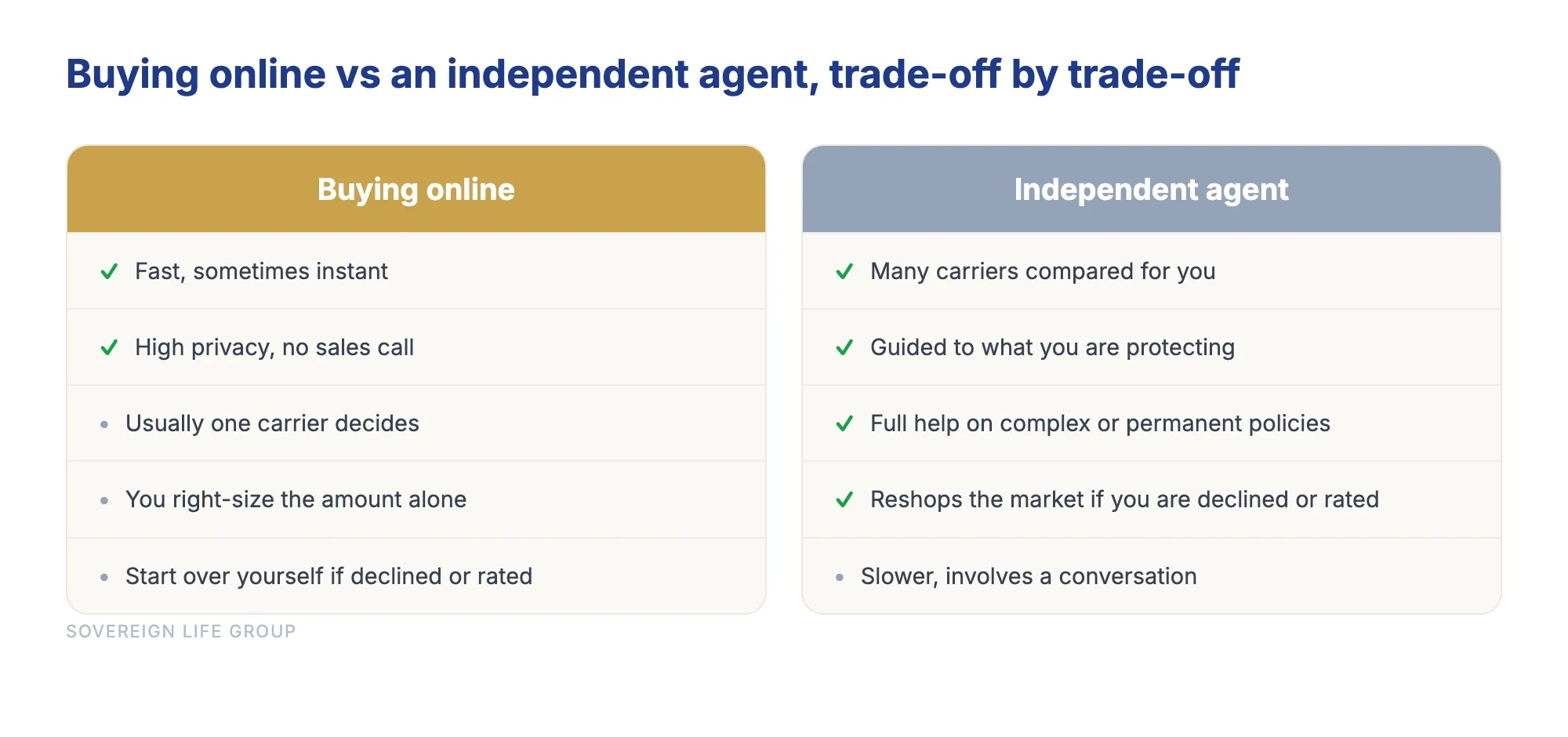
Neither path is the winner for everyone. Buying online wins on speed, privacy, and simplicity for clean, straightforward cases. An independent agent wins on carrier choice, health matching, right-sizing, and having an advocate when something goes sideways. The table below lays the trade-offs side by side so you can weigh them against your own situation.
| What you care about | Buying online | Independent agent |
|---|---|---|
| Speed | Fast, sometimes instant | Slower, involves a conversation |
| Carriers compared | Usually one | Many |
| Handling health issues | Weak, one grid decides | Strong, shops for the right fit |
| Right-sizing the amount | You decide alone | Guided to what you protect |
| Complex or permanent policies | Limited or unavailable | Full guidance |
| Privacy and self-pace | High, no sales call | Requires talking to someone |
| Help if declined or rated | Start over yourself | Reshops the market for you |
| Price on the same policy | Same, commission is built in | Same, plus a shot at a better class |
Read the table honestly and a pattern jumps out. If your file is clean and your need is simple, the online column is full of green lights and the trade-offs barely cost you anything. The more complexity you add, in health, in coverage size, in policy type, the more the agent column pulls ahead. That is the whole decision in one grid.
The hybrid path most families want
Most people do not actually have to choose one lane. The path that serves the majority of families is a hybrid: use the internet to educate yourself and estimate coverage, then bring that homework to an independent agent who shops the market and places the policy. You keep the control and speed of online research and gain the carrier matching of a human.
In practice the hybrid path looks like this:
- Do your homework online first. Read up, run a coverage estimate, and get comfortable with the vocabulary so you are not negotiating from zero. An informed buyer makes better choices and is harder to upsell.
- Decide what you are protecting. Income for how many years, the mortgage balance, future education, final expenses, a business obligation. This is the number that actually drives everything, and you can rough it out before any call.
- Bring it to an independent agent. Let someone who places policies every week check your amount, compare carriers, and match your health to the company most likely to reward it. This is where the online-only shopper leaves value behind.
- Compare the real offers, then decide. Look at the actual underwritten quotes side by side, including any direct option that beats them, and choose on the facts. If direct wins, take it. If the agent's shopping wins, take that.
This is the approach I would tell a family member to use, and it is close to how our own process runs at Sovereign Life Group, your life insurance strategist. You are never asked to trade convenience for good coverage. You get the research you did on your own, plus a market shopped on your behalf, and you make the final call with every option in front of you. When you are ready to see what fits a household budget, the coverage that fits your family's budget is a good place to start.
How to choose an agent you can trust
If you decide a human belongs in the process, the person matters as much as the path. The agent you want is licensed in your state, appointed with many carriers rather than one, transparent about how they are paid, willing to show you more than a single product, and comfortable telling you when buying direct is actually the better move for you.
A short checklist you can use on the first call:
- Confirm the license. A legitimate agent is licensed in your state, and you can verify it. State insurance departments keep public lookup tools, and the NAIC publishes neutral guidance on checking an agent before you buy.
- Ask how many carriers they shop. "Just one" tells you a lot. "Many, and here is who tends to be best for your situation" tells you more.
- Ask how they are paid. An honest agent will tell you plainly that the carrier pays a commission built into the premium, and that it does not add a separate fee on top for you.
- Watch for options, not a pitch. If you only ever hear about one product, that is a flag. You want trade-offs and choices, not a single script.
- Notice the pressure. Real urgency in life insurance comes from your age and health, not from a deadline someone invented on the call. A trustworthy agent lets you think.
You can vet me by exactly these standards, which is the point. You can read more about how I work as an independent agent before we ever talk. As a bit of neutral context on why guidance matters at all, industry data from LIMRA reported in 2024 that about half of American adults have life insurance, and that many overestimate the cost of a simple term policy by roughly three times. Both problems get smaller when someone honest walks you through the real numbers instead of leaving you to guess.
Want the market shopped for you?
Fifteen minutes. Bring your homework and your health, and I will compare carriers, right-size the amount, and lay the options out plainly, including any direct route that beats them. No pressure, no jargon.
Get a Quote Book a 15-Min Call Prefer to move fast? You can save my card and get a quick quote in a couple of taps.Frequently asked questions
Is it cheaper to buy life insurance online or through an agent?
Neither path is automatically cheaper. The same policy from the same carrier is priced by that carrier, not by whether a website or an agent submits it, because the agent commission is already built into the rate. An independent agent can often find a lower total price by shopping several carriers and matching your health to the one that grades it best.
What is the difference between a life insurance broker and an agent?
In everyday use the words overlap. A captive agent represents one company and sells only its products. An independent agent or broker is appointed with many carriers and shops them on your behalf. The distinction that matters is not the title, it is whether the person can compare multiple companies or only one.
Can I buy life insurance without an agent?
Yes. Several carriers and online platforms let you apply directly, and for a healthy person who wants straightforward term coverage that can work well. The trade-off is that you are matched to one company's underwriting, so if that company rates you harshly for a health detail, there is no one shopping the rest of the market for a better home.
Do life insurance agents charge a fee?
An independent life insurance agent does not usually charge you a separate fee. The agent is paid a commission by the insurance company, and that cost is already inside the premium whether you use an agent or not. Because the price is the same either way, buying direct rarely saves you the commission.
Is buying life insurance online safe?
Buying from a licensed carrier or a licensed online agency is generally safe, and the policy is a real contract backed by the issuing company. Confirm the seller is licensed in your state, read what you are actually buying, and be cautious of instant approvals that quietly reduce the benefit or add a waiting period.
When should I use an independent agent instead of buying online?
Use an independent agent when your health history is complicated, you want a large benefit, you are comparing term against permanent coverage, or a direct site has already declined or rated you. In those cases the value of shopping many carriers and matching you to the right one usually outweighs the speed of a self-service form.
Joseph McDermott is a licensed life insurance agent (NPN 22121673), licensed in 27 states. Brokered through Family First Life, in partnership with Catalyst Life. This article is educational and is not financial, tax, or legal advice. Please talk with a licensed professional about your specific situation. Product availability, features, riders, and rates vary by state, age, health, and carrier, and any coverage is subject to underwriting approval. Guarantees are subject to the claims-paying ability of the issuing insurance company.