Bank on Yourself Review: How Pamela Yellen's Method Works


The Short Version
Bank on Yourself is Pamela Yellen's trademarked name for using a dividend-paying whole life insurance policy as your own personal financing system. It is a real product, not a scam, but the marketing oversells it and the early years grow slowly. Done right, it can be a stable place to store and borrow money. Done wrong, or bought from savings you actually need soon, it can disappoint. This review walks through the honest version.
Clients ask me about Bank on Yourself more than almost any other strategy, usually after a late-night YouTube rabbit hole or a book someone handed them. So let me give you the straight version in this Bank on Yourself review, the one an agent gives a friend, not a prospect. Bank on Yourself is Pamela Yellen's brand name for a specially designed whole life insurance policy you can borrow against, and the pitch is that you can "become your own banker." Some of that is true. Some of it is oversold. And whether it fits you depends on details that most sales presentations skip right over.
I write this as a licensed agent who actually sells these policies, which cuts both ways. I have seen them do exactly what families hoped. I have also talked people out of one because it was the wrong tool for their money. My goal here is to hand you enough of the mechanics, the math, and the trade-offs that you can decide for yourself instead of taking a pitch on faith.
What this review covers
- What Bank on Yourself actually is
- Who Pamela Yellen is
- How the Bank on Yourself method really works
- Is Bank on Yourself a scam?
- Bank on Yourself vs infinite banking
- A worked example, year by year
- What it really costs and where the money goes
- The honest pros and cons
- Who it fits well
- Who should probably skip it
- How to do it right if you try it
- Frequently asked questions
What Bank on Yourself actually is
Bank on Yourself is a trademarked strategy that uses a dividend-paying whole life insurance policy as a place to store cash and borrow against it, so you can finance your own purchases instead of relying on banks. It is not a special account or a new product. It is a specific way of designing and using permanent life insurance that already exists.
Strip away the branding and here is what you are buying: a participating whole life policy from a mutual insurance company. "Participating" means the company can pay you dividends when it does well, though those dividends are never guaranteed. The policy has two moving parts that matter for this strategy. There is the death benefit your family receives when you pass, and there is the cash value, a pool of money inside the policy that grows over time and that you can access while you are alive.
The Bank on Yourself twist is in how the policy is structured. A standard whole life policy is built to maximize the death benefit. A policy designed for this strategy is deliberately built to pour more of your money into cash value early, often by adding what is called a paid-up additions rider. That gives you more usable money sooner, at the cost of a smaller death benefit per dollar of premium. If you want the deeper mechanics of using cash value this way, I break them down in my longer guide on how to be your own bank with infinite banking.
No medical exam for a ballpark. Free, and no pressure.
Who Pamela Yellen is
Pamela Yellen is the financial researcher and author who trademarked the Bank on Yourself name. She wrote two New York Times bestsellers, Bank on Yourself and The Bank on Yourself Revolution, and she runs a network of advisors trained to design and sell these policies. Her core message is that you can grow wealth safely without stock market risk.
Yellen's story, as she tells it, is that she spent years investigating hundreds of wealth-building strategies looking for something safe and predictable after getting burned by riskier approaches. She landed on dividend-paying whole life insurance, a product she argues was common financial wisdom before the 1970s pushed everyone toward market risk. Her books are readable and packed with case examples, and they have sold well. Reader reactions run the full range. According to the search of published reviews, close to 80 percent of raters give her work four or five stars, while critics say the books read like one long advertisement for her advisor network.
Here is my honest take on the author question, because it matters. Yellen is a marketer as much as an educator, and the Bank on Yourself brand is a business that generates advisor referrals. That does not make the underlying strategy fake. It does mean you should separate the idea from the sales funnel around it. A good concept can still be wrapped in hype, and this one often is.
How the Bank on Yourself method really works
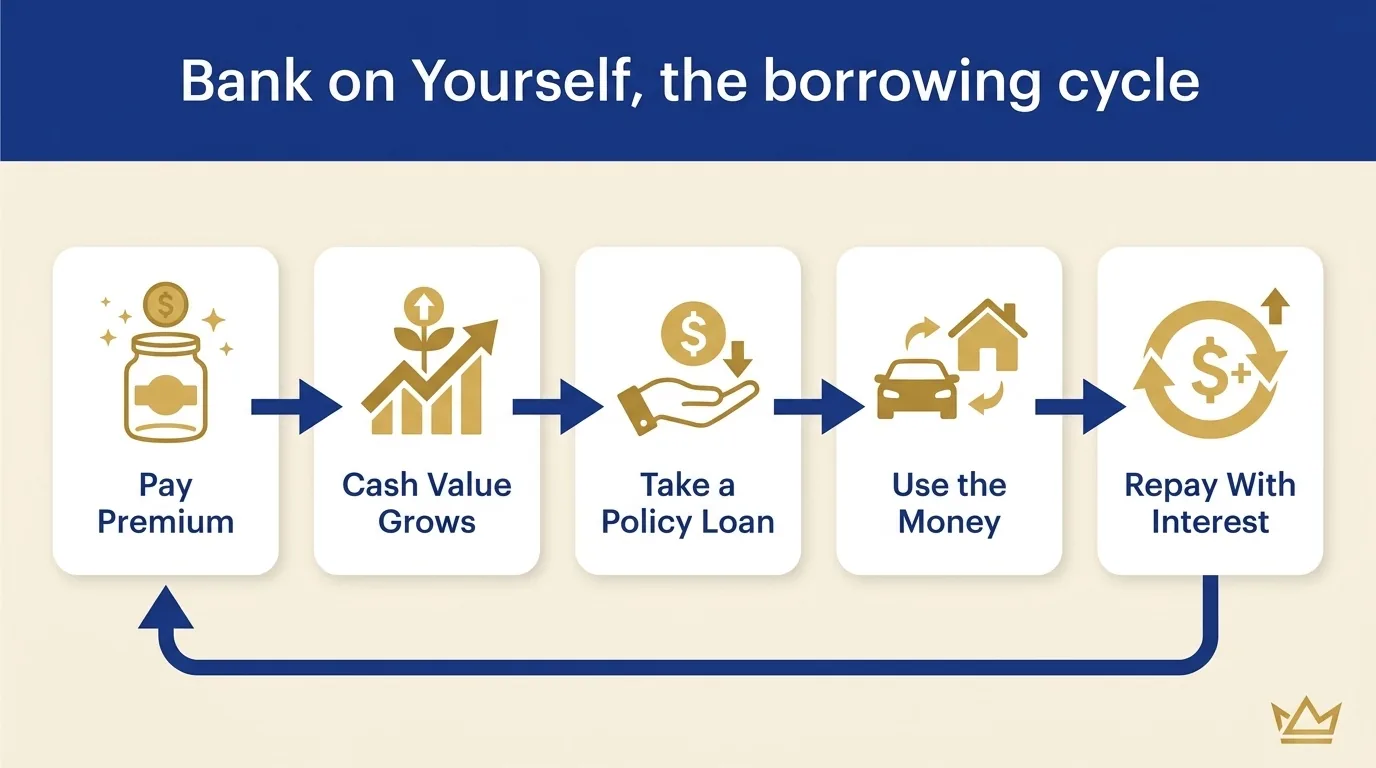
The method works by turning your whole life policy into a revolving pool of money. You pay premiums, cash value builds, and once there is enough, you can take a policy loan against it for a car, a business expense, or an emergency, then pay yourself back over time. The full cash value can keep earning while the loan is out, which is the heart of the pitch.
Step one, you fund the policy
You commit to a premium, usually monthly or annually, and you keep paying it. A Bank on Yourself style policy is designed so a meaningful chunk of that premium builds cash value quickly rather than disappearing into insurance costs. Even so, the first couple of years are front-loaded with costs, so early cash value is low. This is the part sales pitches gloss over and the part I make sure clients understand before they sign anything.
Step two, the cash value grows
Your cash value grows two ways. There is a guaranteed interest rate the insurer credits, and there are potential dividends the mutual company may pay when it performs well. Dividends are not guaranteed, and any honest illustration will show you both a guaranteed column and a non-guaranteed column. The growth is steady and slow, not explosive. Think of it as a stable savings engine, not a growth stock.
Step three, you borrow against it
Once you have real cash value, you can request a policy loan. The insurer lends you money and uses your policy as collateral, so there is no credit check and no rigid repayment schedule. Crucially, in most designs your full cash value stays in the policy and keeps earning while the loan is outstanding, because the company is lending you its money against your collateral, not pulling your money out. The insurer charges loan interest, and you decide the pace of repayment.
Step four, you repay yourself and repeat
You pay the loan back on your own schedule. If you never repay it, the outstanding balance plus interest is simply subtracted from the death benefit when you pass. The idea is that by routinely borrowing for big purchases and paying yourself back with interest, you recapture money that would otherwise go to a bank or a car lender. That is the "become your own banker" line in one sentence.
The mistake I see most is people treating the loan feature like a magic money printer. It is not. A policy loan is still a loan with real interest, and if you borrow and never repay, you quietly shrink the very death benefit you bought the policy for. The strategy rewards discipline. It punishes people who thought they were getting something for nothing.
Is Bank on Yourself a scam?
No, Bank on Yourself is not a scam. It uses dividend-paying whole life insurance, a regulated product that mutual insurers have sold for more than a century and that pays claims reliably. The legitimate criticism is aimed at how it gets marketed, the inflated numbers some advisors quote, and the slow early growth, not at the product being fake.
I want to be fair to both sides here, because the internet is not. Skeptics, including some well-known voices in personal finance, raise real points. According to a widely read breakdown from the White Coat Investor, the strategy is often sold with returns that quietly assume you borrow and repay in ways most people never actually do, and the whole life fees drag on results compared with simpler investing. That is a fair warning. The counterpoint is also fair: a properly designed policy from a strong mutual carrier really does give you a stable, liquid, tax-advantaged pool of money you control, and that has genuine value for the right person.
So where does the "scam" feeling come from? A few honest sources:
- Overselling. Some promoters imply returns that only work on paper, or make it sound like you get market-style growth with zero risk. You do not. Whole life growth is modest and steady.
- Slow start. Because of front-loaded costs, your cash value in year one or two is often less than what you paid in. Someone who was promised "your money is always working" feels misled when they see that first statement.
- Conflicts of interest. These policies pay the agent a commission, and a poorly designed policy pays the agent more while serving you less. That conflict is real, which is why design matters so much.
None of that makes it a scam. It makes it a product that has to be sold honestly and designed correctly, and too often it is not. My rule is simple. If an illustration only shows you the rosy non-guaranteed numbers and nobody walks you through the guaranteed column and the early-year dip, walk away from that agent, not necessarily from the concept.
Bank on Yourself vs infinite banking
Bank on Yourself and infinite banking are two brand names for essentially the same strategy: using the cash value of a dividend-paying whole life policy as a personal financing system. Infinite banking, coined by Nelson Nash, is the older term and the broader movement. Bank on Yourself is Pamela Yellen's trademarked, more consumer-packaged version with its own advisor network.
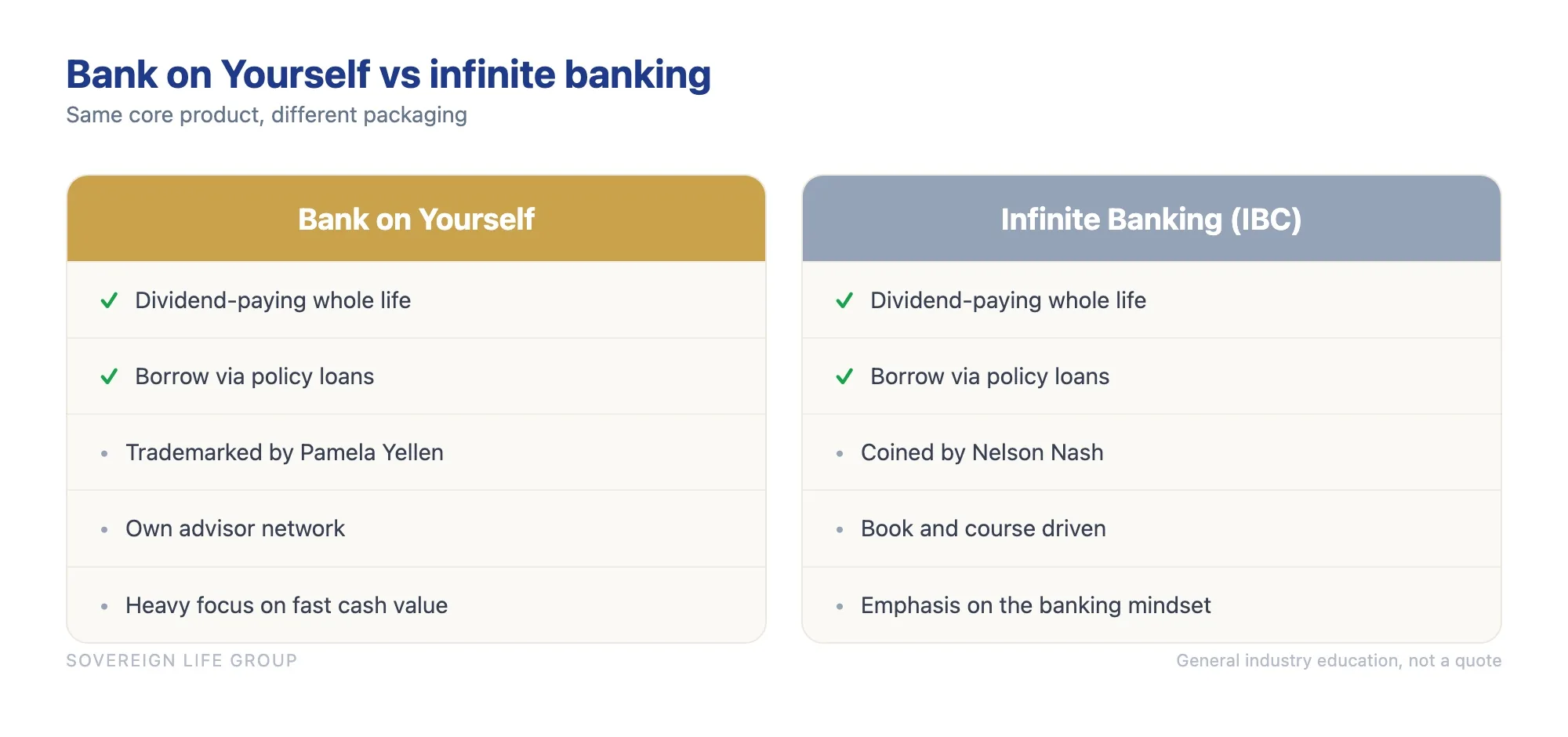
When clients ask me which one is "better," my answer is that the question is a little off. You are not choosing between two products. You are choosing between two marketing systems built on top of the same product, dividend-paying whole life. The differences that actually matter are the ones on your specific illustration: the carrier's strength, how the policy is designed, the guaranteed values, and the fees. A great agent using either label can build you a solid policy. A weak one using either label can build you a bad one.
People also confuse both of these with indexed universal life, which is a different animal. Whole life gives you steadier, more conservative growth with stronger guarantees. Indexed universal life ties growth to a market index with caps and floors and different flexibility. If you want that comparison, our overview of how indexed universal life insurance works lays it out, and it is worth reading before you assume all cash value strategies are the same.
| Feature | Bank on Yourself / infinite banking | Indexed universal life (IUL) |
|---|---|---|
| Underlying product | Dividend-paying whole life | Universal life tied to an index |
| Growth style | Steady, guaranteed floor plus possible dividends | Index-linked with caps and a floor |
| Predictability | Higher, more conservative | More variable year to year |
| Loan access | Policy loans against cash value | Policy loans against cash value |
| Premium flexibility | Usually fixed | Often flexible |
| Best for | People who want stability and to self-finance | People who want index upside with a floor |
A worked example, year by year
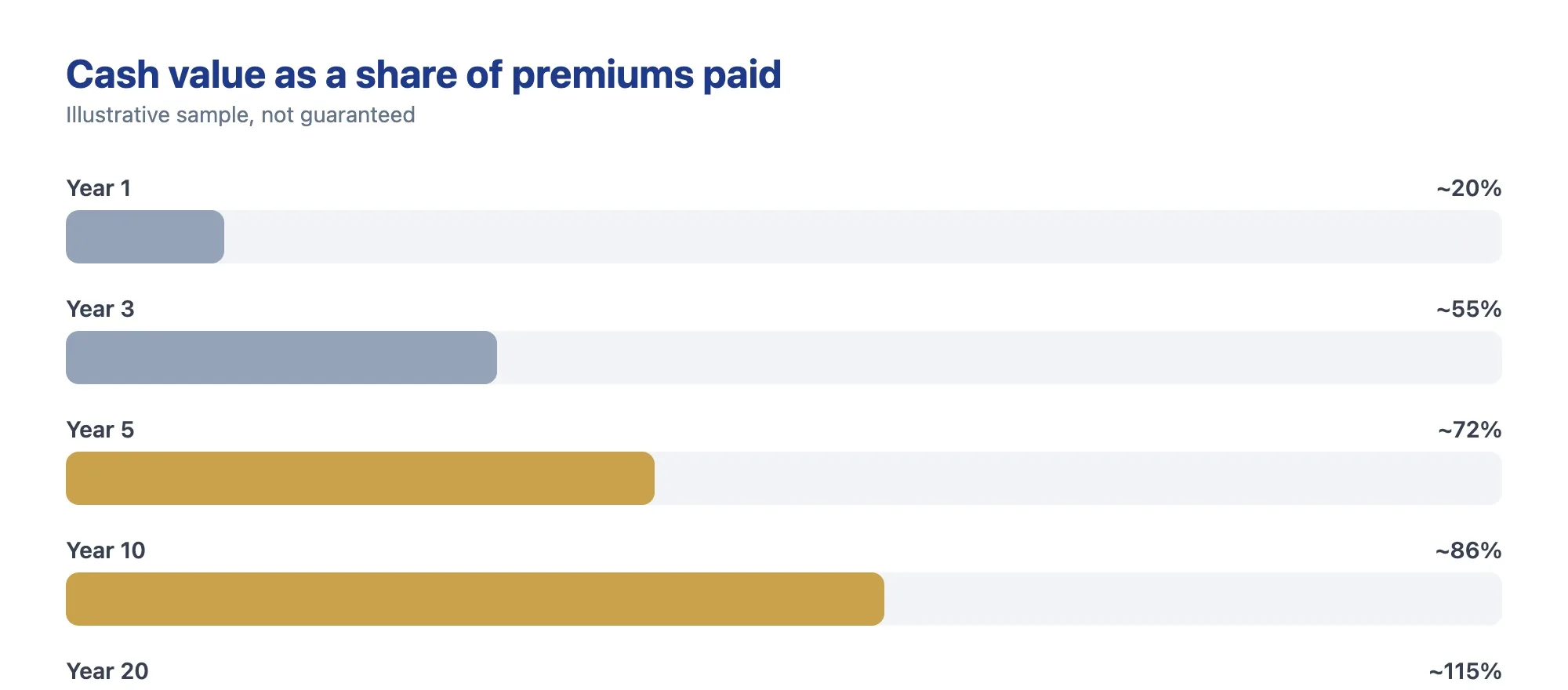
Here is a simplified, illustrative example so the numbers feel real instead of abstract. These are round sample figures to show the shape of how cash value builds and where it crosses your total premiums paid. They are not a quote and not guaranteed. Your real policy depends on your age, health, carrier, and design.
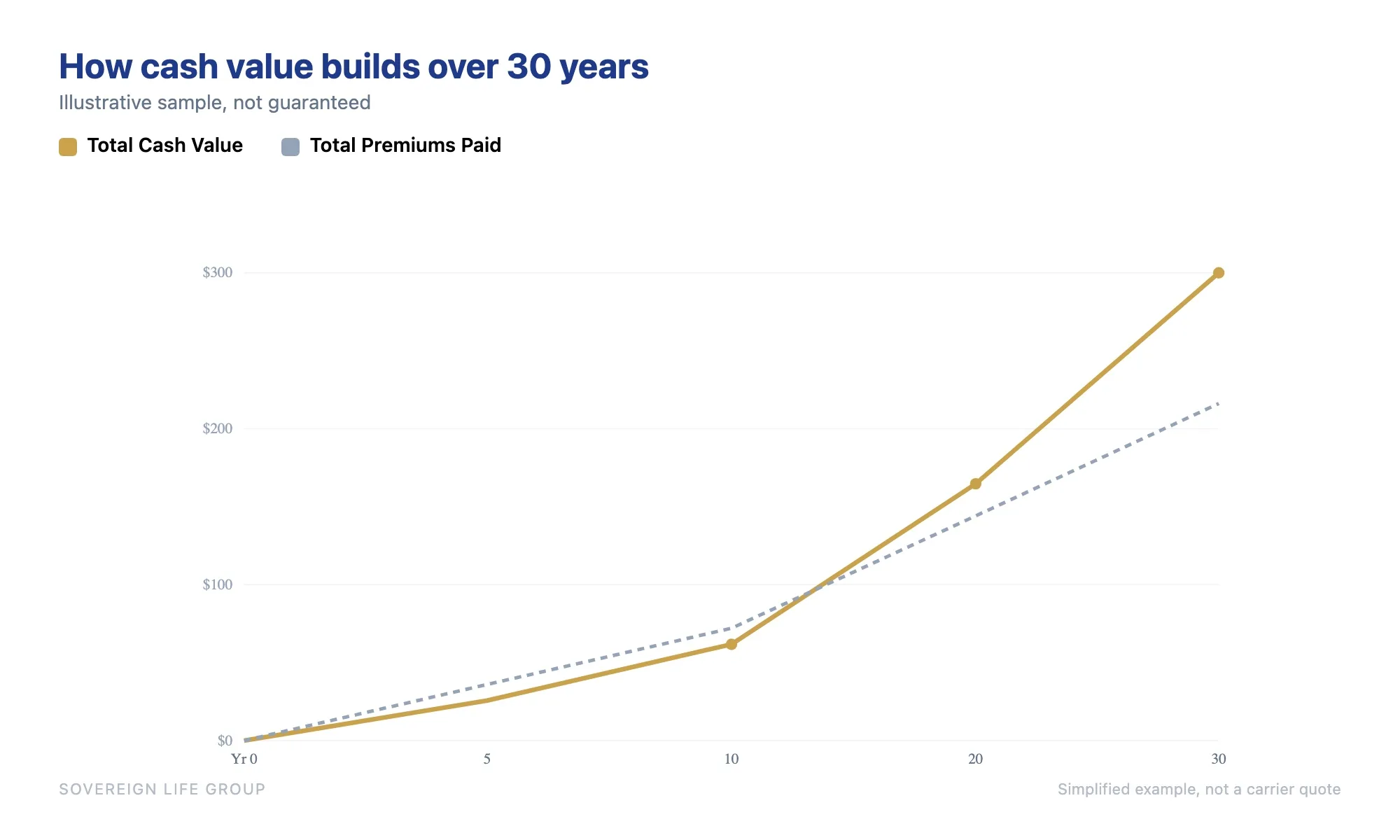
Picture a healthy 40-year-old who commits 600 dollars a month, or 7,200 dollars a year, to a well-designed policy. Watch the pattern, not the exact numbers.
- Years 1 to 2. Cash value is low, often less than what you paid in, because early costs are front-loaded. This is the dip that surprises people. If you cannot ride through it, this is not your strategy.
- Years 3 to 5. Cash value starts catching up as more premium flows to savings and costs level off. You may be able to take a small first loan.
- Around year 10. In many designs, total cash value crosses above total premiums paid. Now the "your money working" story starts to hold water.
- Years 15 to 30. Compounding and dividends do the heavy lifting. The gap between what you put in and what you can access widens, and the death benefit rides alongside it the whole time.
Now the borrowing piece. Say in year 12 you need 20,000 dollars for a used truck. Instead of a dealer loan, you take a policy loan. In many policy designs, your cash value keeps earning while the loan is out, and you repay the insurer at its loan interest rate on your own timeline. If you repay it, you have quietly recaptured the interest a lender would have collected. If you do not repay it, that 20,000 plus interest comes out of your death benefit later. Both are allowed. Only one keeps the strategy working the way it was pitched.
Get a fast, free estimate tailored to your age and health.
What it really costs and where the money goes
The real cost of Bank on Yourself is twofold: the front-loaded fees and commissions in the early years, and the opportunity cost of slower growth than you might get investing directly. In exchange you get guarantees, stability, tax advantages, and liquidity you control. Whether that trade is worth it depends entirely on what job you need the money to do.
Let me name the costs plainly, because vague reassurance is how people get burned.
- Front-loaded costs and commissions. A chunk of your first year or two goes to policy charges and the agent's commission. That is why early cash value lags. A well-designed policy with a paid-up additions rider reduces this drag, but it never eliminates it.
- Ongoing insurance costs. You are paying for a death benefit the whole time. That is part of the value, but it is also part of why raw growth trails a pure investment.
- Loan interest. Borrowing against your policy is not free. The insurer charges interest, and if you do not manage it, an unpaid loan can erode the policy over decades.
- Opportunity cost. Over a long horizon, low-cost index investing has historically produced higher average returns than whole life cash value. You are trading some of that upside for stability, guarantees, and access.
Now the other side of the ledger, because it is real too. Life insurance gets favorable tax treatment. According to the IRS, life insurance proceeds paid to a beneficiary because of the insured's death are generally not counted as taxable income. Cash value can grow tax-deferred, and properly structured policy loans are generally not treated as taxable income while the policy stays in force. That tax profile is a genuine part of why the strategy appeals to higher earners who have already maxed out other tax-advantaged accounts. It is not a loophole, and it is not magic, but it is a real feature.
One data point worth sitting with on the demand side. According to industry research from LIMRA, permanent life insurance, which includes whole life, remains a large and steady share of the U.S. life insurance market year after year, which tells you this is mainstream, not fringe. Millions of ordinary families own the exact product underneath the Bank on Yourself label, most without ever hearing the brand name.
The honest pros and cons
Bank on Yourself has genuine strengths and genuine weaknesses, and any review that only lists one side is selling you something. The strengths are stability, guarantees, tax treatment, and control over your money. The weaknesses are slow early growth, real fees, long-term commitment, and lower raw returns than direct investing over long horizons.
The real advantages
- Stability and guarantees. Your guaranteed cash value does not drop when the market does. For money you cannot afford to gamble, that peace of mind has value.
- Access and control. Policy loans give you liquidity without a credit check or a bank's approval, on your own schedule.
- Tax advantages. Tax-deferred growth, generally tax-free death benefit, and generally non-taxable loans when structured correctly.
- Forced discipline. The premium commitment nudges savers who struggle to save on their own. That behavioral push is underrated.
- A death benefit that never expires. Unlike term, a whole life policy is built to pay out whenever you pass, as long as it stays in force.
The real drawbacks
- Slow early growth. The first few years lag, sometimes below what you paid in. This is the number one reason people quit and lose money.
- Lower long-run returns than investing. For pure growth over decades, low-cost index funds have historically won. You are trading return for safety and access.
- Cost and complexity. Fees, commissions, and design details matter enormously, and a badly built policy can quietly underperform for years.
- Long-term commitment. This is a marathon. Cancel early and you can lose real money to surrender charges and lost costs.
- Marketing hype. The concept attracts overpromising promoters, which means you have to work harder to find an honest design.
If you want to see how this permanent, cash value approach stacks up against the simpler, cheaper alternative most families should consider first, my breakdown of term versus whole life insurance walks through exactly when each one wins. A lot of people who think they need Bank on Yourself actually need a big term policy plus a boring index fund, and I will tell them so.
Who Bank on Yourself fits well
Bank on Yourself tends to fit disciplined, long-term savers who already have their financial basics covered and want a stable, tax-advantaged pool of money they can borrow against. It works best for people with steady income, a long time horizon, and money they will not need to touch for years, not for someone reaching for a quick win.
In my experience, the people who are genuinely happy with these policies five and ten years in share a few traits:
- They already have an emergency fund and are capturing any employer retirement match. This is not their first or only savings.
- They are high earners who have maxed out other tax-advantaged accounts and want another tax-favored place to build.
- They value guarantees and stability over chasing the highest possible return, often because they got burned by risk before.
- They finance things regularly, like vehicles or business equipment, and like the idea of recapturing that interest.
- They can comfortably commit to the premium for the long haul and ride through the slow early years without flinching.
- They want to leave a legacy and like that the death benefit rides alongside the savings the entire time.
Business owners are often a strong fit too, because they finance purchases constantly and value liquidity they control. If you fall in this group and want to understand the mechanics before you ever talk price, start with the education, not a sales call. You can always reach out and ask a licensed human the specific questions your situation raises.
Who should probably skip it
You should probably skip Bank on Yourself if your budget is tight, your basics are not covered, or you need pure growth on a short timeline. The strategy demands a long-term premium commitment and rewards patience, so it is a poor fit for anyone who might need to cancel in the first few years or who is choosing it instead of cheaper term coverage.
Here are the honest cases where I steer people away, even though it means no sale:
- You do not yet have enough life insurance. If your family needs protection and your budget is limited, a large term policy covers far more for far less. Get protected first, then talk cash value.
- You are not maxing basic retirement accounts. Capture the employer match and use tax-advantaged accounts before adding a whole life policy on top. The match is free money you cannot replicate.
- Your budget is fragile. If there is real risk you cancel within a few years, the front-loaded costs mean you can lose money. Do not start a marathon you cannot finish.
- You want maximum growth and can tolerate risk. If your goal is the highest long-run return and volatility does not scare you, low-cost investing usually wins on the numbers.
- You are being rushed. Any pitch built on urgency, secrecy, or "the banks do not want you to know this" deserves a slow, skeptical read.
There is no shame in any of these. The right financial move is the one that fits your actual life, not the one with the most compelling story. Sometimes the smartest answer to "should I do Bank on Yourself" is "not yet," and a good agent will say so.
How to do it right if you try it
If you decide the strategy fits, doing it right comes down to policy design, carrier strength, and honest expectations. A properly built policy pours money into cash value early, uses a strong mutual carrier, and is sized to a premium you can sustain for decades. Getting those details right is the difference between a policy you love and one you regret.
Here is the checklist I actually use with clients, in plain terms:
- Insist on a policy designed for cash value. Ask whether it uses a paid-up additions rider and how the premium splits between base coverage and cash value. A design tuned for this strategy behaves very differently from an off-the-shelf whole life policy.
- Look at the guaranteed column first. Any illustration has a guaranteed side and a non-guaranteed side. Read the guaranteed numbers and make sure you are comfortable even if dividends underdeliver. If they only show you the optimistic column, that is a red flag.
- Check the carrier's strength. You want a financially strong mutual company with a long, steady dividend history. You can look up an insurer's ratings through neutral sources and the National Association of Insurance Commissioners before you commit.
- Size the premium to what you can truly sustain. Better to fund a smaller policy for thirty years than a big one you cancel in three. You can often add to cash value later through the rider.
- Understand the loan rules in writing. Ask exactly how a loan affects your dividends and crediting, what the loan interest rate is, and what happens if a loan goes unpaid for years.
- Work with an agent who shows you the alternatives. If nobody ever mentions term plus investing, or an IUL, or simply says "you might not need this," you are getting a pitch, not advice.
That last point is the whole game. The strategy is only as good as the design and the honesty behind it. I have rebuilt policies for people who were sold a poorly structured version by someone chasing the commission, and the difference in usable cash value over ten years can be significant. When you are ready to compare your options with someone who will show you the boring guaranteed numbers alongside the hopeful ones, that is exactly the kind of straight conversation Sovereign Life Group, your life insurance strategist, is built for.
Want a straight answer for your situation?
Fifteen minutes. We will look at your goals, your budget, and whether a cash value policy actually earns its place in your plan, or whether something simpler wins. No pressure, no hype, just the numbers laid out plainly.
Book a 15-Min Review Prefer to start on your own? Save my card and get a quick quote.Frequently asked questions
Is Bank on Yourself a scam?
No. Bank on Yourself is a trademarked way to use a dividend-paying whole life insurance policy, which is a real, regulated product that has existed for well over a century. It is not a scam. The fair criticism is about how it is sold, not what it is. The high-pressure marketing, the inflated return claims from some advisors, and the slow early growth are real concerns, so read the illustration carefully before you fund anything.
Who is Pamela Yellen?
Pamela Yellen is the author of the New York Times bestsellers Bank on Yourself and The Bank on Yourself Revolution, and she trademarked the Bank on Yourself name. She spent years studying wealth-building strategies before promoting specially designed dividend-paying whole life insurance as a safe place to store and access money. She runs a network of trained advisors who sell the concept.
What is the difference between Bank on Yourself and infinite banking?
They are two brand names for nearly the same strategy: using the cash value of a dividend-paying whole life policy as a personal financing system. Infinite banking is the older term coined by Nelson Nash. Bank on Yourself is Pamela Yellen's trademarked version with her own advisor network and policy-design emphasis. The underlying product and mechanics are basically identical.
How much money do you need to start Bank on Yourself?
There is no single minimum, but a properly designed policy usually works best when you can commit a few hundred dollars a month or more for the long term. Many people fund policies with anywhere from a couple hundred to a few thousand dollars a month. The strategy rewards consistency and time, so it fits money you will not need to touch for years, not an emergency fund you may need next month.
Can you really borrow from your own policy?
Yes. Once your whole life policy builds cash value, you can request a policy loan against it, usually without a credit check or a fixed repayment schedule. The insurer charges interest, and the loan reduces the death benefit until repaid. The appeal is that the full cash value can keep earning while you borrow, but the loan is still a loan with real interest, so it is not free money.
Is Bank on Yourself better than a 401(k)?
It is not better or worse, it is different, and for most people it should not replace a 401(k) match. A 401(k) match is an immediate return you cannot get anywhere else, so capture that first. Whole life can complement retirement savings by adding a stable, accessible pool of money, but the fees and slow early growth mean it rarely beats low-cost index investing on raw returns over decades.
Joseph McDermott is a licensed life insurance agent (NPN 22121673), licensed in 27 states. Brokered through Family First Life, in partnership with Catalyst Life. This article is educational and is not financial, tax, or legal advice. Please talk with a licensed professional about your specific situation. Product availability, features, riders, dividends, and cash value vary by state, age, health, and carrier, and any coverage is subject to underwriting approval. Dividends and non-guaranteed values are not guaranteed. Guarantees are subject to the claims-paying ability of the issuing insurance company.