12 Money Lessons Wealthy Parents Teach Their Kids


The Short Version
Most of the money lessons wealthy parents teach their kids cost nothing to pass on. They talk about money openly, separate assets from liabilities, make kids earn and invest early, give on purpose, and think in generations instead of paychecks. You do not need to be rich to raise a child who is good with money. You need to start young and stay consistent.
Most of us were handed money as a mystery. You got a job, you got a paycheck, and you figured out the rest by making expensive mistakes in your twenties. I did. Wealthy families tend to skip that hard tuition, not because their kids are smarter, but because the money lessons wealthy parents teach their kids start in childhood and never really stop. Families ask me about this all the time, usually some version of the same question: what are rich people actually doing differently at home?
I am a licensed life insurance strategist, and I sit with families every week talking through how to protect and grow what they are building. The patterns are real, and here is the part that surprised me early in this work: almost none of them require a big bank account to teach. They require repetition and a parent willing to model the behavior. Below are twelve of them, in plain English, with an honest look at where the insurance and investing pieces fit and where they do not.
What this guide covers
- Why these lessons start so young
- 1. Money is a tool, not a scoreboard
- 2. Talk about money out loud
- 3. Know assets from liabilities
- 4. Make them earn it
- 5. Pay yourself first
- 6. Let compound growth do the work
- 7. Give every dollar a job
- 8. Invest early, do not just save
- 9. Be generous on purpose
- 10. Relationships are assets too
- 11. Respect debt, use credit as a tool
- 12. Think in generations, not paychecks
- A worked example: the head start
- What to teach at each age
- Frequently asked questions
Why the money lessons wealthy parents teach their kids start so young
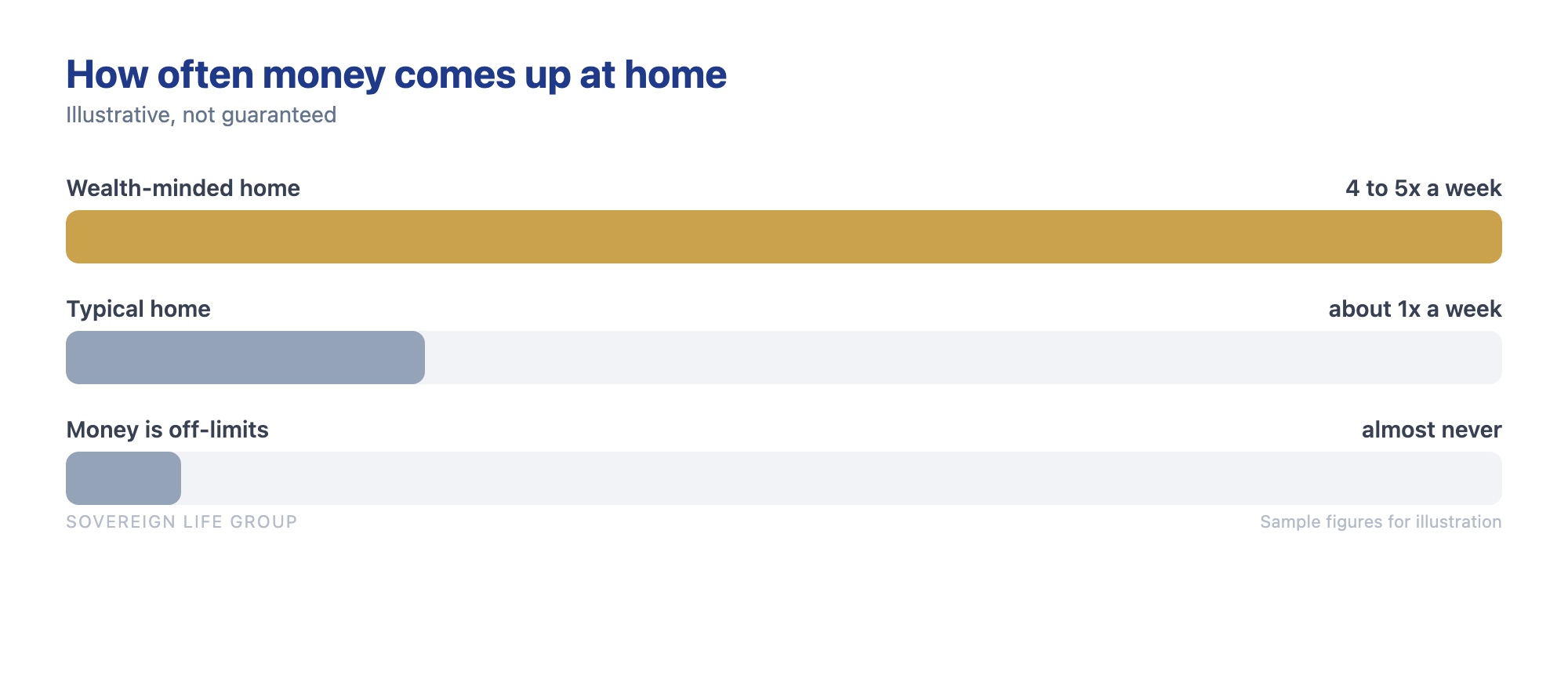
Wealthy families start early because money attitudes harden early. Research on childhood behavior suggests that by around age seven, a lot of a child's basic financial habits are already forming. Waiting until eighteen to explain money is like waiting until the driving test to mention the brakes. The lessons still land, they just land late.
Here is what I notice most. In families that build and keep wealth, money is a normal, ongoing conversation. Nobody whispers about it. Kids hear their parents weigh a purchase out loud, talk through why they are investing instead of spending, and explain a decision they got wrong. In a lot of other homes, and I grew up in one of them, money was either a source of stress or a topic you did not raise at dinner. That silence teaches something too. It teaches that money is scary and out of your control.
The good news is that this is a habit gap, not an income gap. A family earning an ordinary living can absolutely raise a financially confident kid. According to a widely cited T. Rowe Price Parents, Kids and Money survey (2023), a large share of parents say they are reluctant to talk with their kids about money at all, even though the parents who do tend to raise more financially prepared children. The lesson underneath all twelve below is simple: start the conversation, and keep it going.
| The moment | Common default | What wealthy families tend to do |
|---|---|---|
| A kid wants something | Buy it or just say no | Turn it into a saving goal with a deadline |
| Talking about money | Avoid it, it is private | Explain the decision out loud |
| The first dollars earned | Spend it all | Save some, give some, then spend |
| Long-term money | A basic savings account | An invested account that compounds |
| The goal | Afford this month | Build something that outlasts them |
No medical exam for a ballpark. Free, and no pressure.
1. Money is a tool, not a scoreboard
Wealthy parents teach that money is a tool that buys options, not a scoreboard that measures worth. The point of a dollar is the freedom and choices it creates, the ability to say yes to the right things and no to the wrong ones. A child who sees money this way chases usefulness and independence, not the appearance of being rich.
This one shapes everything downstream. If a kid believes money is a scoreboard, they will spend to look like they are winning, and looking rich and being rich are very different games. The families who actually keep their money almost never look the flashiest. They drive the paid-off car. I have watched people with real assets get outspent by neighbors who are quietly drowning, and the difference always traces back to this belief.
How do you teach it without giving a lecture a nine-year-old will tune out? You connect money to freedom in language they feel. Money means we can take the summer trip. Money means Dad could leave a job he hated. Money means we can help Grandma. When the reward attached to money is options and security rather than stuff, kids stop asking "how do I look rich" and start asking "how do I become free." That second question builds wealth. The first one spends it.
2. Talk about money out loud
Affluent families treat money like an ordinary topic, discussed as casually as the weather. Kids hear real prices, real trade-offs, and real mistakes. That steady exposure removes the fear and mystery, so by the time the child controls real money, the concepts already feel familiar instead of frightening.
Silence is the default in most homes, and I understand why. A lot of us grew up in houses where money meant tension, so we protect our kids from it by not mentioning it. The trouble is that kids fill silence with anxiety. They know something is stressful, they just do not know what or why, and they carry that fog into adulthood.
You do not have to hand your ten-year-old a spreadsheet of your finances. Age-appropriate honesty is the goal. Let them see you compare two prices at the store and say why you picked the cheaper one, or the more expensive one. Talk through a bill. Explain that you are putting money into an account you will not touch for thirty years, and why. When you get something wrong, and you will, say so. "I bought this thing and it was a waste, here is what I learned" might be the single most valuable money sentence your kid ever hears from you. It teaches that mistakes are survivable and that money is a skill, not a personality trait you either have or you do not.
3. Know assets from liabilities
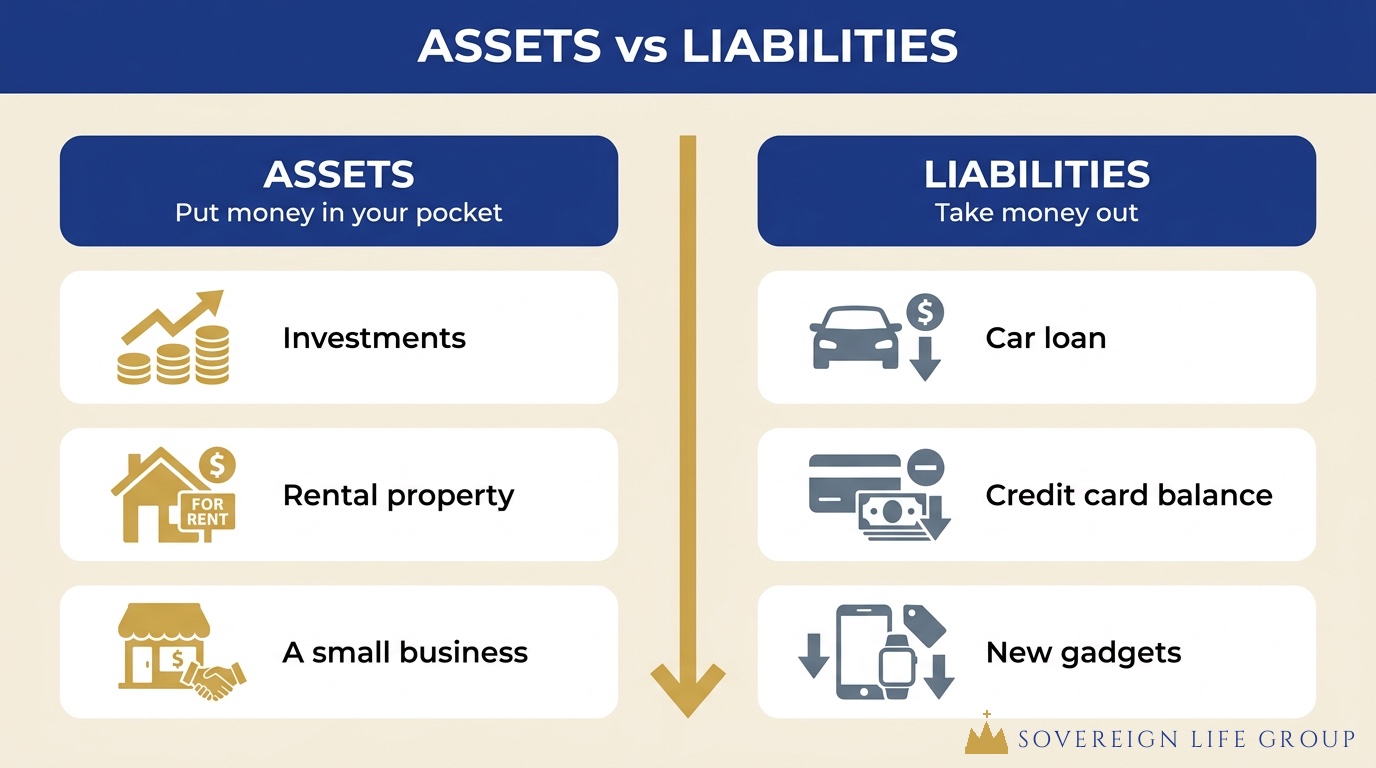
An asset puts money in your pocket over time. A liability takes money out. That single distinction is, if I had to choose, the most important money idea a parent can hand a child. Almost every financial decision a person will ever make comes back to it, and a kid who truly gets it has an edge for life.
Most people never learn to separate the two, so they buy liabilities that feel like assets. A financed truck feels like wealth in the driveway, but it drains money every month and loses value the whole time. A stock index fund does nothing exciting in the driveway and quietly grows for decades. Wealthy families teach their kids to want the boring thing that pays them, and to be suspicious of the exciting thing that charges them.
You can teach this shockingly young. Point at things and ask one question: does this make money or cost money? The lemonade stand makes money, it is an asset. The video game costs money, it is a liability, which is fine, just know which is which. As kids get older you layer in the real versions: shares of a company, a rental property, a small business on one side, and car payments, credit card balances, and gadgets on the other. The habit you are building is a filter they will run every purchase through for the rest of their lives.
4. Make them earn it
Wealthy families connect money to value created, not to time passed or to being owed. Kids earn through work, small ventures, or solving a real problem, so they learn that income comes from being useful. That mindset turns a child from someone waiting for a paycheck into someone who can create one.
There is a real debate about allowance, and I land somewhere in the middle. Handing a kid money for existing can accidentally teach entitlement. But some chores should just be part of being in a family, done because we all pitch in, not because a payment is attached. Where I have seen the best results is when parents keep those two things separate: family responsibilities are unpaid, and then there is extra paid work or a small enterprise on top, where the money clearly follows the value.
The enterprise piece is where it gets fun and where the wealthy really lean in. Lemonade stand, mowing lawns, reselling, a little craft business, dog walking. The dollars are small. The lesson is enormous, because the kid discovers they can make money appear by solving someone's problem, and that discovery changes how they see the whole world. Suddenly a paycheck is not the only door. My honest take is that one summer of running a tiny business teaches more about money than a year of allowance ever could, because the kid feels the whole loop: effort, value, risk, reward.
5. Pay yourself first
Pay yourself first means the moment money comes in, a set portion goes to saving and investing before anything gets spent. Wealthy families teach kids to take that slice off the top automatically, so wealth is not what happens to be left over at the end. It is the first bill they pay, to themselves.
Most people do it backwards. They spend on life, and whatever survives to the end of the month gets saved, which usually means almost nothing survives. Flip the order and everything changes. When saving comes first and you learn to live on the rest, you build wealth on any income, and I mean any income. I have seen modest earners retire comfortable and high earners retire broke, and this habit is often the whole story.
With kids you make it visible and automatic. Every dollar that comes in, a portion goes straight into the save or invest bucket before they are allowed to spend a cent of the rest. Ten percent, twenty, whatever fits your family, the exact number matters less than the reflex. You are wiring a lifelong instinct: money arrives, a piece of it immediately goes to future you. Do that for a decade of a childhood and your kid will feel physically weird spending every dollar they get, which is exactly the discomfort you want them to carry into adulthood.
6. Let compound growth do the work
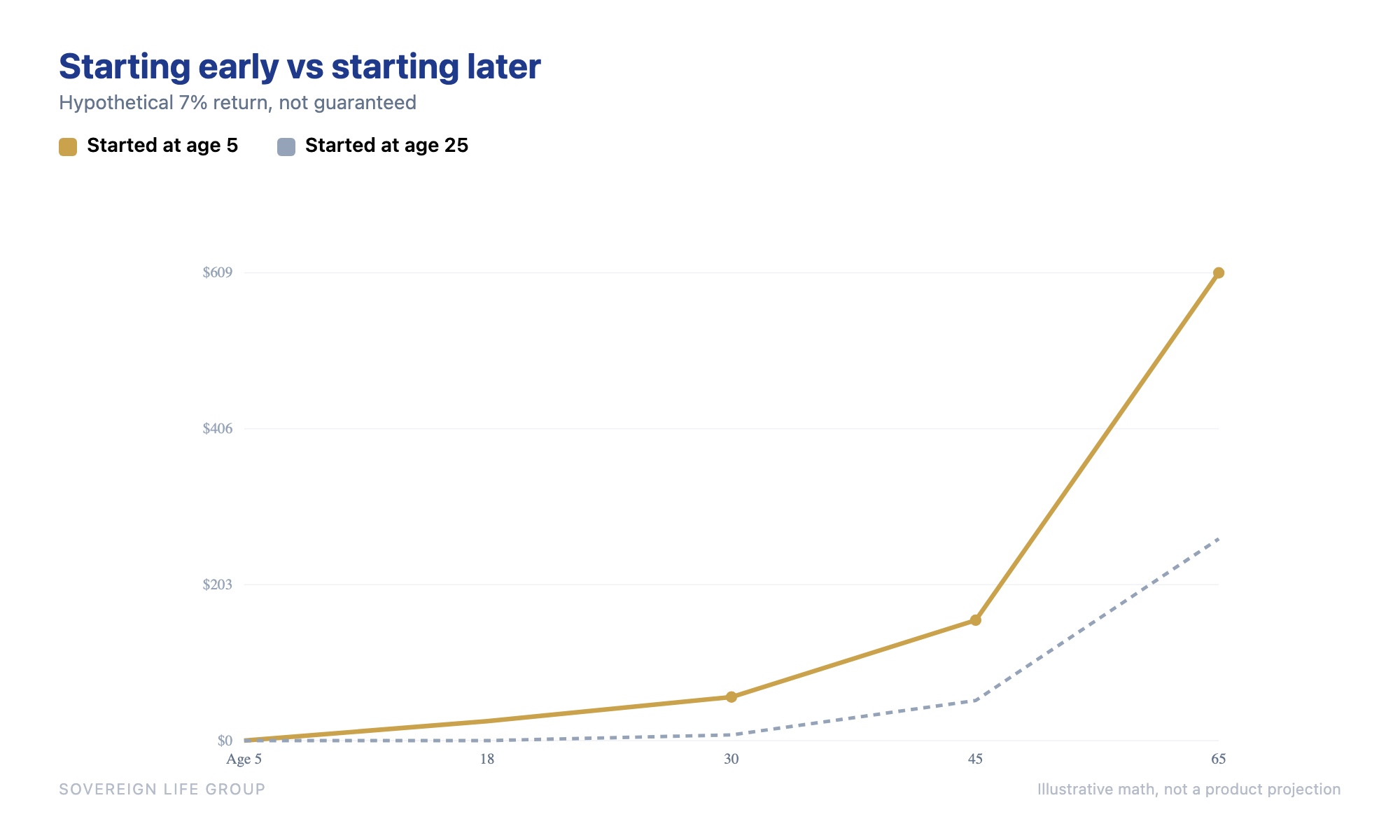
Compound growth is money earning money, and then that new money earning money too, on and on. Wealthy parents teach it early because time is the one ingredient a child has more of than any adult ever will. Starting at seven instead of twenty-seven can matter more than the size of the contributions, and kids can feel that in their own account.
The math is close to unfair, and that is the point. A modest amount invested for a child, left alone for decades, can outrun a much larger amount invested later, because the early dollars have more years to multiply. Einstein supposedly called compound interest the most powerful force in the world. Whether he actually said it, the idea holds, and rich families organize a child's money around it.
Here is the trap, though, and I want to be honest about it. Compounding only works if you leave it alone, and leaving money alone is emotionally hard, especially for a kid staring at a balance they could spend today. That is really what wealthy families are teaching under the surface: patience. Delayed gratification. The willingness to let something grow quietly while your friends buy the shiny thing now. The account is just the classroom. The actual lesson is the discipline to not touch it, and that discipline is worth more than any single investment. For a fuller walk through the timing math, our piece on the best age to lock in coverage and start early covers the same principle from the protection side.
7. Give every dollar a job
Budgeting in wealthy homes is not about restriction, it is about direction. Every dollar gets assigned a job before it is spent: some to save, some to invest, some to give, some to spend freely. Kids who grow up sorting money into buckets learn that they are the ones in control of their money, rather than the other way around.
The classic tool here is the simplest one, and it works because a kid can see it. Divide money into buckets the moment it arrives. A common split is save, spend, and give, and some families add a fourth for invest. Physical jars for little kids, then real accounts as they grow. When a child watches the save jar fill toward a goal they chose, patience stops being a lecture and becomes something they can literally see happening.
What I like about the bucket system is that it kills the two worst money habits before they start. It kills mindless spending, because the spend bucket has a floor and when it is empty, it is empty. And it kills guilt, because the spend bucket is allowed to be spent, guilt free, once the other jobs are covered. That balance is the whole game. Wealthy families are not raising kids who never spend. They are raising kids who spend on purpose, after the important dollars already have somewhere to be.
Get a fast, free estimate tailored to your age and health.
8. Invest early, do not just save
Saving protects money, investing grows it. Wealthy families teach kids that a savings account is for the money you need soon, and that money you will not touch for years belongs in investments that can compound. The distinction sounds small. Over a lifetime, it is the difference between keeping up with prices and actually getting ahead.
Plenty of careful families teach saving and stop there, and their kids grow up cautious but stuck, because cash sitting in a basic account slowly loses ground to rising prices. Rich families take the next step and make investing normal. They open a custodial account, a simple diversified fund, sometimes a simulated portfolio to practice with, and they let the kid watch small regular contributions grow across years. The goal is not turning a ten-year-old into a stock picker. It is letting them feel ownership and patience in an account with their name on it.
There are real tools built for exactly this. A custodial brokerage account lets a parent invest on a minor's behalf. Some families also use permanent life insurance on a child as a long-horizon vehicle that builds cash value the child can access later, which I will come back to at lesson twelve because it deserves an honest look at the trade-offs, not a sales pitch. If you are weighing whether a policy makes sense for a young child at all, our explainer on how child life insurance actually works lays out where it fits and where a plain investment account is the better call.
9. Be generous on purpose
Wealthy families teach giving as a deliberate habit, not a leftover afterthought. Kids set aside a portion to give from the very first dollars they earn, and they choose where it goes. Generosity practiced young builds a healthier relationship with money, because the child learns early that money is meant to move and to do good, not just to pile up.
This one surprises people who assume the wealthy are simply hoarders. The families I respect most are deliberate about giving, and they involve their kids in it. Not writing an anonymous check, but choosing a cause together, and sometimes handing the money over in person so the child sees where it lands. That experience does something a lecture cannot. It teaches that you have enough, that you are a person who helps, and that money is a resource you direct rather than a security blanket you clutch.
There is a quieter benefit too, and I think it is underrated. Giving is the cleanest antidote to the scoreboard mindset from lesson one. A kid who regularly gives money away, on purpose, from their own earnings, does not tie their worth to their balance. They learn that they are not their net worth, which frees them to take smart risks, to be generous without fear, and to keep their head straight if they ever do get wealthy. Money makes a good servant and a terrible master, and giving is how you stay the master.
10. Relationships are assets too
Wealthy parents teach that your network and your reputation are assets that compound like money does. They coach kids to add value to others, to keep their word, and to build real relationships, because opportunities, mentors, and partnerships tend to flow through people. A strong reputation opens doors that no amount of cash can force.
This is the lesson that almost never shows up in a budgeting book, and it might be the highest leverage one on the list. Deals, jobs, introductions, and second chances travel through relationships. Rich families understand this in their bones, so they teach kids how to treat people, how to follow through on a commitment, and how to be someone others want to help. That is not manipulation. It is the plain truth that being reliable and generous with people pays off in ways a paycheck never captures.
How do you teach a kid this? You model it, and you name it when they do it. Point out that keeping your word is why people trust you with bigger things. Show them what it looks like to help someone with nothing expected back, and let them feel how that comes around. Encourage mentors, because kids who learn to seek out and listen to people ahead of them get a shortcut the rest of us pay for in mistakes. Reputation is the one asset you build slowly and can lose in a day, and the earlier a child understands that, the more careful and the more generous they tend to be.
11. Respect debt, use credit as a tool
Wealthy families do not teach that debt is evil, they teach the difference between debt that builds and debt that drains. Borrowing to buy an appreciating asset can be smart. Borrowing to fund a lifestyle is usually a trap. The goal is a kid who respects credit, understands interest, and uses debt on purpose, if at all.
Blanket rules fail kids here. "All debt is bad" is not how the wealthy think, and it leaves a young adult unprepared for a world that runs on credit. The real lesson is more useful and more honest. There is debt that can put money in your pocket, like a loan on a cash-flowing rental or a business that earns more than it costs to borrow. And there is debt that only ever takes money out, like a credit card balance carried on things that lost their value the day you bought them. One is a tool. The other is quicksand.
Credit cards are where this gets real fast, and it is where I watch young adults get hurt most. Rich families teach that a credit card is fine as a convenience you pay off in full every month, and dangerous the moment you carry a balance, because that interest rate quietly runs compound growth in reverse, against you. Teach a teenager how interest actually works, that a balance can grow while they sleep, and you inoculate them against one of the most common wealth killers there is. Respect for debt, not blanket fear of it, is what keeps them free.
12. Think in generations, not paychecks
The deepest difference is time horizon. Most families plan to the next paycheck. Wealthy families plan across generations, building assets and structures meant to outlast them and to give their children and grandchildren a head start. That long view changes every decision, from how they invest to how they protect what they have built.
This is the mindset that ties the other eleven lessons together, and it is where my work sits, so I will be direct about it. Families who keep wealth think about transfer, not just accumulation. They ask how money moves to the next generation cleanly, with as little lost to taxes, delays, and disputes as possible. They use ordinary tools most people never open: custodial accounts, 529 plans for education, basic estate documents, and often permanent life insurance as a way to pass money to heirs with certainty and to build cash value along the way. Some of it is as simple as steady gifting. The IRS annual gift tax exclusion (2025) lets a person give up to 19,000 dollars per recipient in a year without touching lifetime limits, and wealthy families quietly use that room to move money down a generation year after year.
Let me be honest about the insurance piece, because you deserve trade-offs, not a pitch. Permanent life insurance, including the indexed policies people use to build tax-advantaged cash value, is a real tool, but it is not a magic account. It carries costs and fees, the cash value takes years to build, and the illustrations are not guarantees. For many families a term policy plus a simple invested account does the job for less. For others, especially those focused on guaranteed transfer and long-horizon cash value, a permanent policy earns its place. The right answer depends on your situation, which is the whole reason to compare rather than assume. If you want the structural version of that comparison, start with term versus whole life insurance, then look at how families use an indexed universal life policy to build tax-advantaged cash value. New parents thinking about this for the first time will find our guide to life insurance for new parents a gentler on-ramp, and the broader child life insurance coverage page lays out the options for locking in a child's insurability early.
The teaching part matters as much as the tools. When a child grows up hearing the family plan in decades, they inherit the horizon, not just the assets. That is the real inheritance. You can hand a kid money and watch it evaporate, or you can hand them the way of thinking that made the money, and watch them build more. Wealthy families bet on the second one every time.
A worked example: what the head start really does
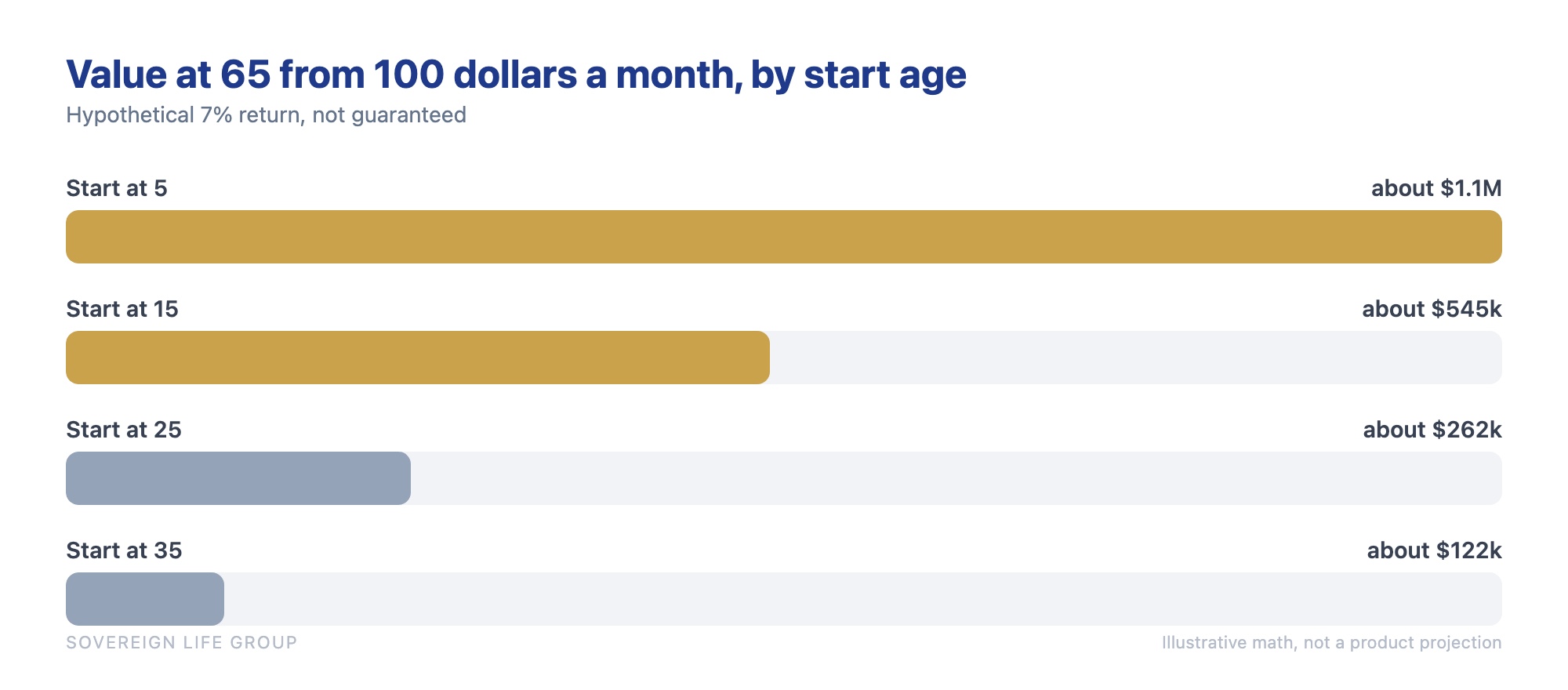
Numbers make the head start real, so here is a clean one. These figures are illustrative, at a hypothetical 7 percent annual return, and they are not guaranteed. Real markets go up and down, and no product promises this. I am using round math only to show the shape of the thing.
Picture two kids and the same 100 dollars a month. The first family starts investing for their child at age five and keeps it up through age eighteen, thirteen years, then stops adding a dime and just lets it sit. The second person starts at twenty-five and invests that same 100 dollars a month all the way to sixty-five, forty straight years. Who ends up with more?
The early starter. It is not close. The child's family put in about 15,600 dollars total between ages five and eighteen, then never added again, and by sixty-five that account has grown to roughly 600,000 dollars in this illustration. The person who started at twenty-five put in about 48,000 dollars over forty years, more than three times the contributions, and lands near 262,000 dollars. Same monthly amount. The early start wins by hundreds of thousands, purely because those first dollars had sixty years to compound instead of forty.
That gap is the entire argument for teaching this young. The bars above push it further: the earlier the start age, the smaller the contributions need to be to reach the same place, because time is doing the heavy lifting instead of your wallet. This is why wealthy families are almost fanatical about starting early. They are not smarter investors. They just refuse to waste the one resource a child has in abundance and an adult can never get back, which is time. If your kid is young, the most valuable thing you can hand them is not a big balance. It is an early start and the patience to leave it alone.
What to teach at each age
You do not teach a five-year-old about index funds, and you do not wait until a teenager to mention saving. The money lessons wealthy parents teach their kids are layered on with age, each one building on the last. Here is a rough map of what tends to land when, so you can meet your kid where they actually are.
| Age | What clicks at this age | One simple move |
|---|---|---|
| 3 to 5 | Money is used to get things, and you can wait for something better | A clear jar for coins so saving is visible |
| 6 to 10 | Earning, saving, spending, and giving as separate jobs | Split every dollar into save, spend, and give buckets |
| 11 to 13 | Goals, patience, and the idea that money can grow | Open a custodial account and add a little together |
| 14 to 17 | Compounding, assets versus liabilities, how credit works | Let them run a small venture and manage the money |
| 18 and up | Investing for real, debt strategy, long-horizon and legacy thinking | Hand over more control and coach, do not command |
The through line is repetition. One money talk does nothing. The same handful of ideas, revisited a hundred times across a childhood in slightly more grown-up language each year, builds an adult who is genuinely comfortable with money. That comfort is the real gift, more than any account balance, because it is the thing that lets them build for themselves. When you are ready to think through how your own coverage and long-term plan fit into what you are teaching, you can get a clear, no-pressure look at the numbers with Sovereign Life Group, your family's life insurance strategist.
One more piece of context on why the legacy lesson matters so much. According to research published by LIMRA (2024), only about half of American adults own life insurance, and a large share of those who have it say they still do not have enough. A lot of families intend to leave something behind and simply never put the structure in place. Teaching a child to think in generations is partly about making sure the plan actually exists, not just the good intentions.
Want to build the plan behind the lessons?
Fifteen minutes. We will look at your family, your goals, and the simplest way to protect what you are building and pass it on. No pressure, no jargon, just options laid out plainly.
Get a Quote Book a 15-Min Call Prefer to start small? Visit the families coverage page to see how a plan fits a household budget.Frequently asked questions
At what age should you start teaching kids about money?
Earlier than most people think. Research on childhood habit formation suggests basic money attitudes are largely set by around age seven, so wealthy families start with simple, hands-on ideas in early childhood, like a clear jar for saving, and add complexity as the child grows. You do not wait for a perfect moment. You start small and keep going.
What is the single most important money lesson to teach a child?
If I had to pick one, it is the difference between an asset and a liability. An asset puts money in your pocket over time, a liability takes it out. A child who genuinely understands that one idea will make better decisions for decades, because almost every money choice comes back to it.
Should kids get an allowance, and should it be tied to chores?
Both approaches can work. Many wealthy families split the two on purpose: some chores are simply part of being in the family, and separate paid work teaches that money follows value created. What matters more than the structure is that the child has real dollars to save, spend, and give, so the lessons are practiced, not just heard.
How do wealthy families teach kids about investing?
They make it concrete and boring in the best way. Many open a custodial investment account or a simulated portfolio and let the child watch small, regular contributions grow over years. The goal is not stock picking. It is feeling compound growth and patience in your own account so the habit sticks into adulthood.
How does life insurance fit into teaching kids about generational wealth?
Permanent life insurance is one tool wealthy families use to move money to the next generation with certainty and to build cash value a child can borrow against later. It is not a magic account and it has real costs and trade-offs, so it should be compared against simpler options. Used well, it teaches a child to think in decades, not paychecks.
Do you have to be rich to teach your kids these lessons?
No, and that is the point. Almost none of these lessons require money to teach. They require conversation, consistency, and a parent willing to model the behavior. A family earning an ordinary income can raise a financially confident child, and often the habits matter more than the starting balance.
Joseph McDermott is a licensed life insurance agent (NPN 22121673), licensed in 27 states. Brokered through Family First Life, in partnership with Catalyst Life. This article is educational and is not financial, tax, or legal advice. The investment figures shown are hypothetical illustrations, not guarantees, and actual results vary. Please talk with a licensed professional about your specific situation. Product availability, features, riders, and rates vary by state, age, health, and carrier, and any coverage is subject to underwriting approval. Guarantees are subject to the claims-paying ability of the issuing insurance company.