Is Key Man Insurance Tax Deductible? A Clear Answer


The Short Version
Is key man insurance tax deductible? For most businesses, no. When your company owns the policy and collects the benefit, the IRS blocks the premium deduction. In exchange, the death benefit usually comes to the business income tax free, as long as you handle the consent paperwork before the policy is issued. That trade, no write-off now for a tax-free payout later, is the whole story.
This is one of the first questions a business owner asks me, and it usually comes with a hopeful tone: "I'm paying for this coverage on my top salesperson, so is key man insurance tax deductible for the company?" I understand the instinct. It's a real business expense, it protects the company, and most real business expenses are deductible. But this one is not, and the reason actually makes sense once you see the trade the tax code is offering you. Below I'll walk through the rule, the single exception people misread, the consent form that quietly decides whether your payout stays tax free, whether the proceeds are taxable, a worked example with numbers, and how this compares to the other coverage a business carries. Straight answers, no pitch.
I write this as a licensed agent who places this coverage, not as an accountant, so treat everything here as education and run the specifics past your CPA. The mechanics, though, are more consistent than most owners expect.
What this guide covers
- What key man insurance actually is
- Is key man insurance tax deductible?
- Why the IRS treats the premiums this way
- The one exception where premiums can be deducted
- Section 101(j): the consent rule that protects the payout
- Are the death benefit proceeds taxable?
- A worked example: how the numbers play out
- Key man insurance vs other business coverage
- How much key man coverage a business needs
- C-corp, S-corp, and LLC treatment
- Mistakes I see business owners make
- Frequently asked questions
What key man insurance actually is
Key man insurance, also called key person insurance, is a life insurance policy a business buys on an employee or owner whose skills, relationships, or knowledge drive real revenue. The company applies for it, the company pays the premiums, the company is the beneficiary, and the person being insured is the key employee. If that person dies, the business collects the benefit to stay afloat.
Think about who in your shop, if they were gone next Monday, would take a chunk of the revenue with them. The founder who holds every client relationship. The engineer who is the only one who understands the product. The rainmaker who books most of the sales. That person is your key man or key woman, and the policy exists to buy the company time: time to find loans, recruit a replacement, reassure customers and lenders, and keep the doors open while it absorbs the hit. I dig into how to identify that person and size the risk in my longer piece on how key person and business life insurance protects a company.
None of that changes the tax answer, but it frames it. Because the business owns the policy and stands to collect, the whole tax treatment flows from those two facts. Keep them in mind, because they are exactly what the IRS looks at.
No medical exam for a ballpark. Free, and no pressure.
Is key man insurance tax deductible?
No, in almost every real case key man insurance is not tax deductible. When your business owns the policy and is the beneficiary, the IRS does not let you deduct the premiums. This sits in Internal Revenue Code Section 264(a)(1), which denies a deduction for premiums on any life insurance policy where the taxpayer is directly or indirectly a beneficiary. Owner and beneficiary equals no write-off.
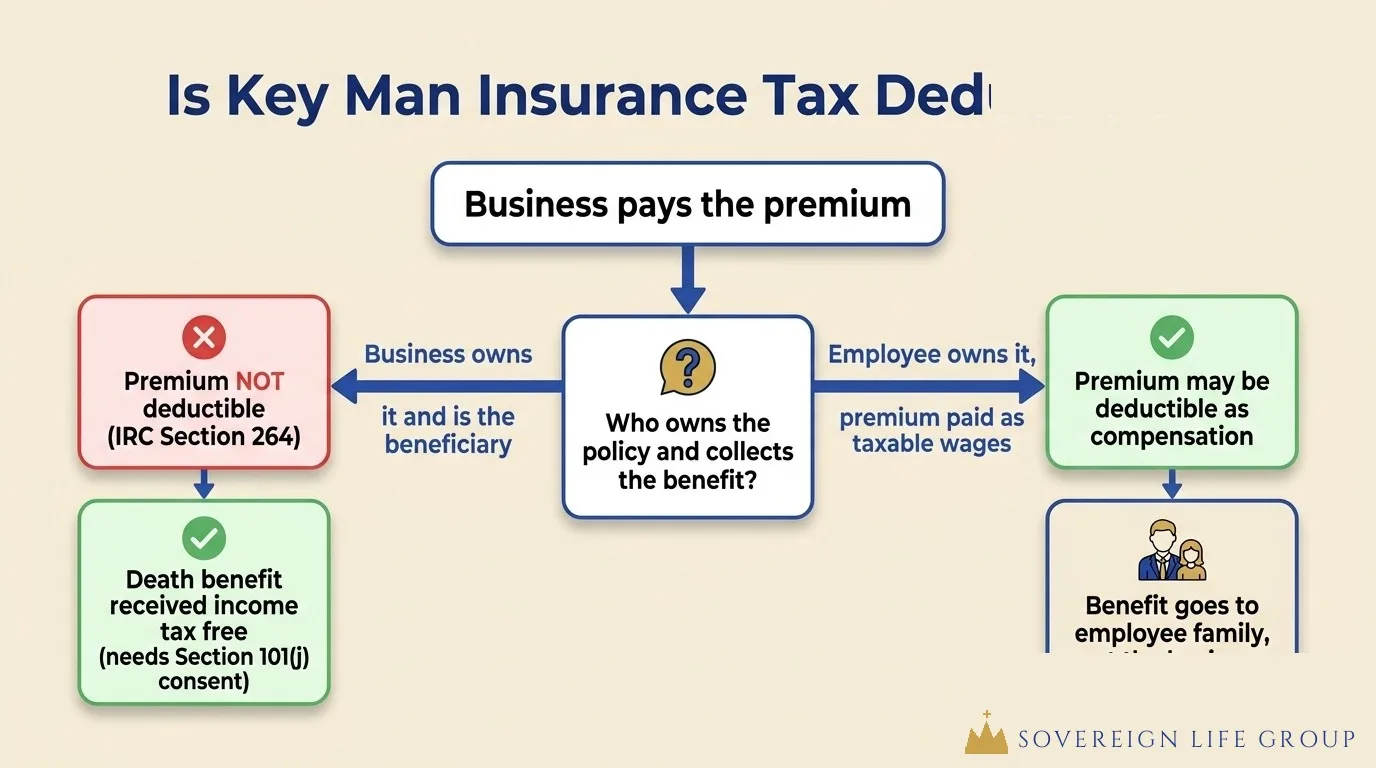
Here is the part that trips people up. The rule is not the IRS being difficult. It is the flip side of a benefit you actually want. Because the government does not tax the death benefit when it comes in, it does not let you deduct the premiums on the way out. You get one or the other, never both. If premiums were deductible and the payout were tax free, life insurance would become a giant tax shelter, and Congress closed that door a long time ago.
So when someone tells you their accountant "writes off the key man premiums," one of a few things is true. They are quietly deducting something they should not, which is an audit waiting to happen. Or they are using the narrow exception I cover below, in which case it is not really key man protection anymore. Or they are confusing it with a different, deductible benefit like group term life. I've seen all three. The clean answer for standard key man coverage is: the premium is paid with after-tax dollars, full stop.
Why the IRS treats the premiums this way
The logic behind keyman insurance taxes is a matching principle. The tax code tries to avoid letting the same dollars catch a break twice. A death benefit that arrives income tax free is already a large advantage, so the code refuses to stack a premium deduction on top of it. That single idea explains most of what confuses owners about a business life insurance deduction.
It helps to compare key man coverage to two things a business genuinely can deduct, so the line is clear.
- Group term life insurance on employees is generally deductible for the employer, because the coverage benefits the workers and the first $50,000 per employee is a tax-free fringe under IRC Section 79. The company is not the beneficiary there. The employees' families are.
- Ordinary operating costs like rent, payroll, and equipment are deductible because they are simply the cost of doing business, and nothing tax-advantaged is waiting on the other end.
- Key man insurance fails the test on both counts. The business is the beneficiary, and a tax-free payout is the reward. So no deduction.
Once owners see it as a trade rather than a penalty, the frustration usually fades. You are not losing a deduction you deserved. You are choosing a tax-free payout instead, which for most companies is the far better deal. A denied deduction on a modest annual premium is small. A tax-free six or seven figure benefit at the exact moment the business is reeling is not.
The one exception where premiums can be deducted
There is exactly one common way to make the premium deductible, and it works by giving up the thing that made it key man insurance in the first place. If the business pays the premium as additional taxable compensation to the employee, and the employee owns the policy and names their own family as beneficiary, then that premium is deductible to the business as wages. Deductible, yes. Still key man protection, no.
Walk through what actually changed. In that setup the company no longer owns the coverage and no longer collects when the person dies. The money goes to the employee's spouse and kids, exactly like a raise the employee spent on personal life insurance. That can be a lovely executive perk, sometimes called an executive bonus or Section 162 bonus arrangement, and it can help you keep a star employee. But it does nothing to reimburse the business for losing them. The company gets the small deduction and none of the protection.
The mistake I see most is an owner hearing "you can deduct it if you bonus it out" and thinking they can have it both ways. You cannot. Either the business owns the policy for its own protection and forgoes the deduction, or the employee owns it as compensation and the business gets the deduction but no payout. Decide which problem you are actually solving before you sign anything.
Section 101(j): the consent rule that protects the payout
This is the part almost every short article skips, and it matters more than the deduction question. Under IRC Section 101(j), added by the Pension Protection Act of 2006, the death benefit on an employer-owned life insurance policy is only income tax free if the business follows specific notice and consent steps before the policy is issued, and reports it every year on Form 8925. Miss those steps and the payout above what you paid in premiums can become taxable income.
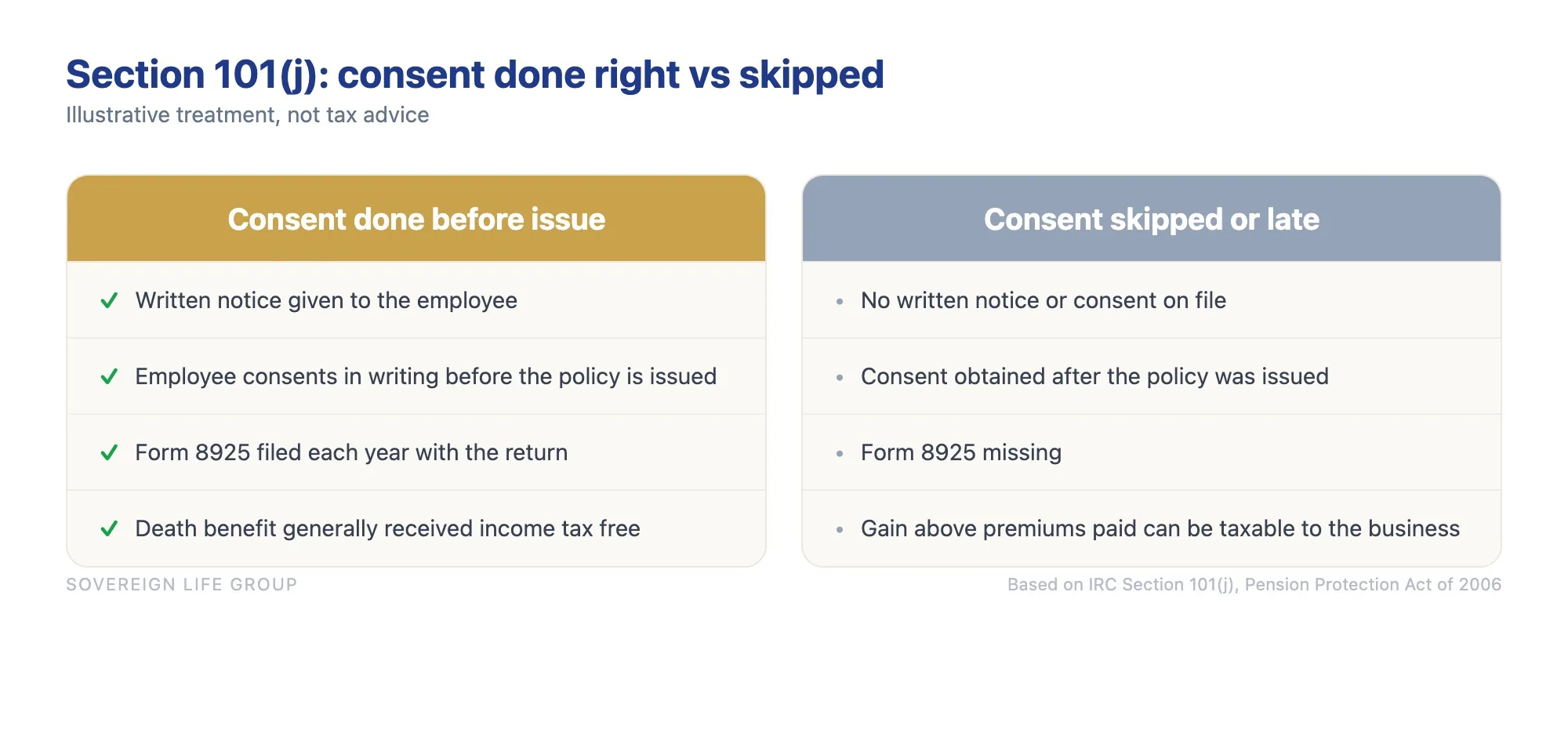
The steps are not complicated, but the timing is unforgiving. Before the policy is issued, the business must:
- Notify the employee in writing that the company intends to insure their life and that it will be the beneficiary.
- Tell them the maximum face amount the person could be insured for.
- Get the employee's written consent to be insured, including consent for the coverage to continue after they leave the company.
- File Form 8925 with the business tax return each year the policy is in force, reporting the number of employees, the number covered, and the total amount in force. You can read the requirements straight from the source in the IRS materials on Form 8925.
Here is why I hammer on this. The consent has to happen before the policy is issued. You cannot paper it after the fact. If a business insures its top earner, skips the notice, and that person dies years later, the company can find that a large slice of the benefit it was counting on is suddenly taxable. That is the worst possible moment to learn about a form. Policies issued on or before August 17, 2006 are grandfathered out of these rules, but anything newer is squarely inside them.
I always tell owners to treat the consent form as part of buying the coverage, not an afterthought. A good agent and your CPA should build it into the application step so it is never missed.
Are the death benefit proceeds taxable?
Generally no, the death benefit on company-owned key man insurance is received income tax free, which is the payoff for not deducting the premiums. The Insurance Information Institute notes that life insurance proceeds paid because of the insured's death are generally not counted as taxable income. But that clean result depends on the Section 101(j) consent being handled correctly, so the two topics are joined at the hip.
A few honest caveats belong here, because "tax free" gets oversold.
- Section 101(j) is the gatekeeper. Do the consent and Form 8925 right and the benefit is generally income tax free. Skip them and the gain, meaning the benefit minus premiums paid, can be taxable to the business.
- C corporations should ask about the corporate AMT. Large tax-free life insurance proceeds can factor into the corporate alternative minimum tax picture for some C corps. It rarely bites small businesses, but it is worth a question to your CPA if the numbers are big.
- Transfer-for-value can spoil it. If a policy is sold or transferred to another party for something of value, part of the death benefit can lose its tax-free status. This comes up when policies move around during ownership changes, so never transfer a business policy without tax advice.
- The proceeds are income tax free, not necessarily free of everything. How the money then moves through the business, or eventually to owners, is a separate question with its own rules.
For a straightforward company-owned policy with clean consent, though, the headline holds: the business pays premiums with after-tax dollars and, when it needs the money most, collects the benefit income tax free.
Get a fast, free estimate tailored to your age and health.
A worked example: how the numbers play out
Let me put real numbers on it, because the trade only clicks when you see it. These figures are illustrative, not a quote, and not guaranteed. They just show the shape of the deal so keyman insurance taxes stop feeling abstract.
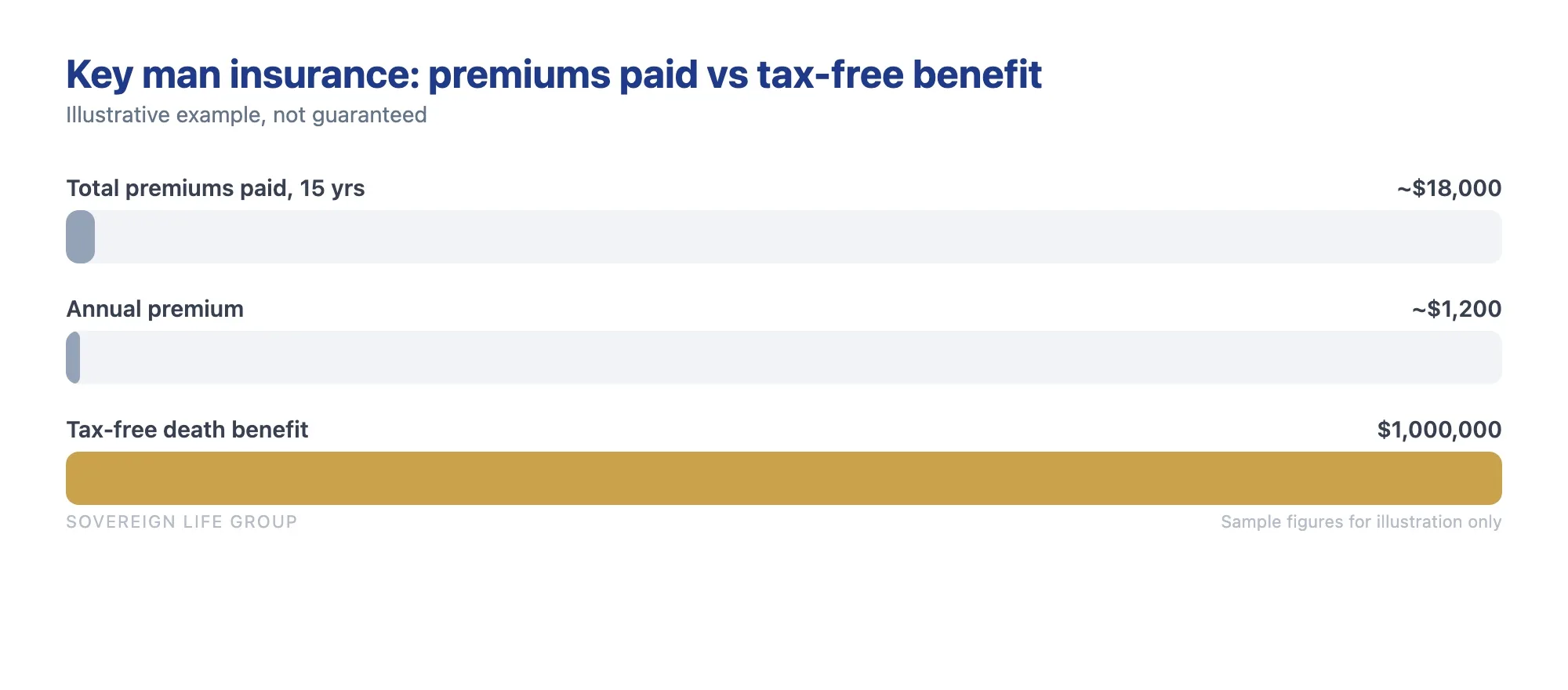
Say a company insures its founder, age 45 and healthy, with a $1,000,000 term key man policy, and the premium runs about $1,200 a year. Because the business owns the policy and is the beneficiary, that $1,200 is not deductible. Over 15 years the company pays roughly $18,000 in after-tax premiums.
Now suppose the founder dies in year 15. The business files the claim and, with the Section 101(j) consent handled up front, collects the full $1,000,000 income tax free. It uses that money to service its bank loan, cover a rough revenue year, and recruit and pay a replacement while customers stay calm.
Run the "what if it were deductible instead" comparison and you see why nobody should want that version. Deducting $1,200 a year at, say, a 21% rate saves about $252 annually, roughly $3,780 over 15 years. To get that small savings, the business would have to make the $1,000,000 payout taxable. At a 21% corporate rate that is a $210,000 tax bill on the benefit. Nobody trades a $210,000 tax hit for a $3,780 deduction. That is the trade the tax code is quietly offering, and once owners see it in dollars, the deduction question answers itself.
Key man insurance vs other business coverage
Key man insurance often gets confused with two other business tools that use life insurance, and the tax treatment is where owners mix them up. Here is how they line up. The short version: buy-sell funding and key man coverage are both generally non-deductible, while group term life for employees generally is deductible, and the reason each time is who benefits.
| Coverage | What it does | Premiums deductible? |
|---|---|---|
| Key man insurance | Reimburses the business for losing a vital employee or owner | Generally no, business is the beneficiary |
| Buy-sell funding | Lets surviving owners buy a deceased owner's share | Generally no, the owners or entity benefit |
| Group term life (Section 79) | Employee benefit, families are the beneficiaries | Generally yes, up to limits, employer is not the beneficiary |
| Executive bonus (162 plan) | Employer-funded personal policy the employee owns | Yes, as taxable compensation to the employee |
A lot of small companies actually need more than one of these at once. The founder is a key person, so the company wants key man coverage on her. She also co-owns the business, so the partners want a buy-sell arrangement funded separately. Those are two different jobs with two different policies, even though both premiums land in the non-deductible column. Buy-sell planning also overlaps heavily with personal estate work, which I cover in my guide to how life insurance fits into estate planning.
One more practical note. The structure of the policy, term versus permanent, does not change the deduction answer, but it changes cost and flexibility. Many businesses use level term for pure key man protection because it is affordable and matches a set need, like the years left on a loan. If you want the deeper structural comparison, my breakdown of term versus whole life insurance lays out the trade-offs. To see how key person coverage is built and quoted, the key person insurance page is the place to start.
How much key man coverage a business needs
Sizing the policy is a separate question from taxes, and it deserves its own thought. There is no single formula, but three approaches cover most situations, and many small businesses land somewhere between five and ten times the key person's annual compensation. The right number depends on your revenue, your debt, and how hard the role would be to replace.
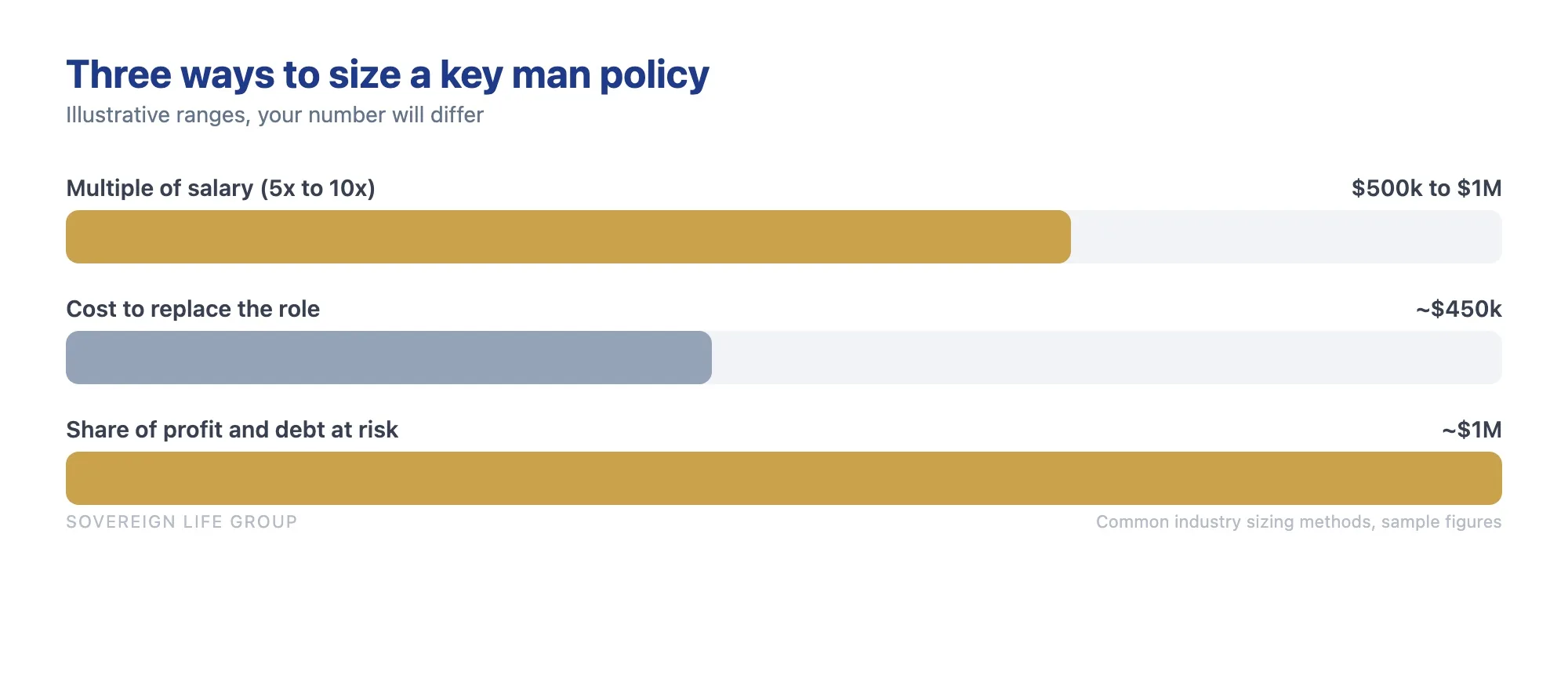
The three lenses, in plain terms:
- Multiple of compensation. The simplest method. Take the key person's salary and multiply by five to ten. Fast, rough, and usually the starting point for a smaller company.
- Cost to replace. Add up recruiting fees, signing bonuses, training time, and the productivity you'd lose while a new hire ramps up. This tends to fit specialized roles where the person's knowledge is hard to hand off.
- Contribution to profit and debt. The most tailored method. Estimate the revenue or profit the person directly drives, then add any business loans a lender could call or that would be hard to service without them. This is the number bankers and serious owners care about.
In practice I walk owners through all three and we settle on a benefit that would genuinely carry the business through 12 to 24 months of disruption. Too little coverage and the policy is a gesture. Too much and you are paying for protection past the point of the real risk. The goal is a number that matches what the company would actually have to spend and cover to survive the loss.
For the record, undercoverage is the far more common problem. According to LIMRA's 2024 Insurance Barometer Study, 42% of U.S. adults say they need more life insurance than they carry, and the same instinct to underinsure shows up in how owners protect their companies. Most know the business leans on one or two people. Far fewer have put real coverage behind that fact.
C-corp, S-corp, and LLC treatment
Owners often ask whether their business structure changes the answer, hoping an S-corp or LLC unlocks a deduction. It generally does not. The Section 264 rule that denies the premium deduction applies whether you are a C corporation, an S corporation, a partnership, or an LLC. If the business owns the policy and is the beneficiary, the premium is non-deductible across the board.
The structure does affect a few second-order details, and this is exactly where your CPA earns their fee:
- C corporations should be aware that large tax-free life insurance proceeds can interact with the corporate alternative minimum tax in some cases. It is usually a non-issue for small companies, but ask if the benefit is substantial.
- S corporations and partnerships are pass-through entities, so items flow to the owners' returns. The non-deductible premium generally does not reduce the owners' taxable income, and the tax-free benefit generally passes through without creating income, though basis and distribution rules can get technical.
- Single-member LLCs taxed as sole proprietorships face the same core rule. The premium is a personal, non-deductible cost when you are effectively the owner and beneficiary.
The takeaway is simple. Do not choose or change your entity to try to deduct key man premiums, because the deduction is not there in any of them. Choose your entity for the reasons that actually matter, liability and overall tax posture, and treat the key man premium as a non-deductible cost of protecting the business no matter which box you are in.
Mistakes I see business owners make
After placing this coverage for a while, the same avoidable errors keep showing up. None of them are about the coverage itself. They are about the paperwork and the assumptions around it.
- Assuming it is deductible and building it into the budget as a write-off. It is not. Plan for the premium as an after-tax cost so there are no surprises when your accountant reviews the return.
- Skipping the Section 101(j) consent. This is the expensive one. No written notice and consent before the policy is issued can turn a tax-free payout into a taxable one years later, and there is no way to fix it after the fact.
- Forgetting Form 8925 every year. The consent up front is step one. Reporting it annually with the return is step two, and it is easy to drop after year one.
- Confusing key man coverage with a buy-sell plan. They solve different problems. A company can need both, and stacking one on top of the other by accident wastes money or leaves a gap.
- Transferring a policy without tax advice. Moving a business policy around during an ownership change can trip the transfer-for-value rule and cost the tax-free treatment. Loop in your CPA before any transfer.
- Letting the coverage lapse when the loan or the role changes. Review it when the business changes. The number that was right at founding is rarely the right number five years later.
If you are setting up key man coverage, the cleanest path is to line up the agent and the CPA at the same time, get the consent signed before the policy is issued, and calendar the Form 8925 filing. Do those three things and the tax side takes care of itself. If you want a second set of eyes on your setup, you can always reach out and talk it through with a licensed human before you commit.
Want a straight answer for your business?
Fifteen minutes. We will look at who really drives your revenue, how much coverage the business needs, and how to structure it so the death benefit stays tax free. No jargon, no pressure.
Book a 15-Min Review Prefer to start on your own? You can save my card and get a quick quote whenever you're ready.Frequently asked questions
Is key man insurance tax deductible?
Usually no. When your business owns the policy and is the beneficiary, the IRS does not allow you to deduct the premiums under Internal Revenue Code Section 264(a)(1). The trade-off is that the death benefit is generally received income tax free. You cannot write off the premium and also collect the payout tax free.
Are key man insurance proceeds taxable to the business?
Death benefits from an employer-owned policy are generally received income tax free, but only if the business met the Section 101(j) notice and consent rules before the policy was issued and files Form 8925 each year. Miss that step and the payout above the premiums paid can become taxable income to the business.
Can you ever deduct key man insurance premiums?
There is one narrow path. If the business does not own or benefit from the policy and instead pays the premium as taxable compensation to the employee, who owns the coverage, that premium can be deductible as wages. But then the death benefit goes to the employee's family, not the business, so it no longer functions as key man protection.
What is IRS Form 8925 and do I need it?
Form 8925 is the annual report a business files with its tax return for employer-owned life insurance contracts issued after August 17, 2006. It confirms the number of employees covered, the amount in force, and that valid consent was obtained. Filing it is part of keeping the death benefit tax free under Section 101(j).
Is key person insurance the same as a buy-sell agreement?
No. Key person insurance reimburses the business for losing an employee whose skills drive revenue. A buy-sell agreement, often funded with separate life insurance, lets surviving owners buy a deceased owner's share. A company can need both, and the tax treatment of the premiums is generally the same, meaning not deductible.
How much key man insurance does a business need?
Common methods size the benefit at a multiple of the person's salary, the cost to replace them, or their measurable impact on profit and debt. Many small businesses land somewhere between five and ten times the key person's compensation, but the right number depends on your revenue, loans, and how hard the role is to fill.
Joseph McDermott is a licensed life insurance agent (NPN 22121673), licensed in 27 states. Brokered through Family First Life, in partnership with Catalyst Life. This article is educational and is not financial, tax, or legal advice. Tax rules for business-owned life insurance are complex and change, so please confirm your situation with a licensed tax professional and your CPA before you act. Product availability, features, riders, and rates vary by state, age, health, and carrier, and any coverage is subject to underwriting approval. Guarantees are subject to the claims-paying ability of the issuing insurance company.